sustainability
Oysters, Abattoir, perennial food crops and Eco-Fair
 All blissfully quiet at my end of the Gorge these days, now that Craigflower Bridge has been closed for rebuilding and traffic re-routed. I was gratified to learn that not only were there viable
  oyster beds in the Gorge, but the planners had taken steps to relocate and preserve them so that the construction does not do away with this rare species (for the next eight months or so). These are our native Olympia oysters, not the Pacific upstarts introduced from Japan that now dominate the West Coast’s shoreline and oyster farming operations. I happened to pass what I assume to be the relocation action as it was unfolding and snapped them at it.
Meanwhile, I’ve been spreading myself thin in recent weeks, trying to keep up with different social media (Twitter, Facebook and most recently Pinterest), working on some of my own writing, and going nose to grindstone with my holistic nutrition studies. We’re deep into preventive nutrition this month, studying up on nutritional approaches to digestive, blood sugar, cardiovascular and arthritic conditions. Quite a ride.
 On Friday I returned from Nanaimo via Salt Spring Island where the community abattoir was officially launched with an open house in the drizzly rain. I’d visited earlier this year but was interested to have a look at the finished structure. There is more work to be done if larger animals (cattle) are to be slaughtered here, but it’s up and running for poultry, rabbit, goat and lamb. It’s going very well so far: an arrangement with a local farmer has meant all the offal and skins are being composted, which has taken one of the main economic headaches for an abattoir out of the picture, and has solid community support – no small achievement for this kind of business.
 Saturday I took in a workshop on perennial fruit crops at ALM Farm in Sooke, in which farmer Jordan took us for a tour of the farm’s apple, pear, fig and plum trees, kiwi vines, strawberries, raspberries, rhubarb, Jerusalem artichokes, hazelnuts, gooseberries, herbs and asparagus before I had to whistle off to take my place behind my books, alongside the Haliburton farmers at the Reynolds School Eco-Fair
 . It was a lively and well-attended event with speakers including Green Party leader Elizabeth May and Brandy Gallagher from O.U.R. Ecovillage, and lots of well-chosen information tables, including Pedal to Petal, LifeCycles, Growing Young Farmers, Organic Gardeners Pantry, BC Sustainable Energy Association and more. The Hali stand was peddling organic food boxes (CSA subscriptions), seeds, plants and good advice.
Laughing oysters, food forests and a trip to Bellingham
 Last weekend I happened upon this rather lovely book display in the window of the Laughing Oyster book store in Courtenay. I’m keeping good company!
This afternoon I go head-to-head with the Superbowl, whatever that might be, giving a book talk at 4pm at the beautiful Village Books in Fairhaven, Bellingham. I took the marvelously efficient and comfortable Amtrak train from Vancouver, which gave me a little time to wrap my head around a new laptop, purchased reluctantly after my previous faithful companion died a lingering death of old age (obsolete after 5 whole years: why is this legal??).
The trip also gave me time to reflect on last night’s thoughtful and inspiring talk by  Seattle’s food forest designer, Jenny Pell. She spoke about community-driven food security initiatives in Washington and Oregon, including the Beacon Hill Food Forest in Seattle, a 7-acre parcel that is being developed as the largest public food forest in all of North America. It’s had lots of media coverage.
Pell, like many permaculturalists I’ve met, was a broad thinker who has passed the stage of thinking about change: the time for change is already here, and she wants to see movement into a more sustainable and positive way of life. Why, she asked, do we behave like zoo visitors, simply marveling over model achievements (like the Bullock Brothers’ permaculture homestead, or the solitary Sea Street in Seattle) and never creating multiples of them? We know what’s coming and that change is needed, but somehow we keep our heads down and live on as if we had nothing to do with making a sustainable world possible.
She admitted she was unusual, having never had a credit card nor made a mortgage payment, so was free of the economic traps that have wrapped so many in knots. Do what you need to do, was her message, and you too can live in a world where a salad costs less than a heavily subsidized hamburger, or you don’t have to call in the media in order to be allowed to keep your front yard food garden; where municipal planners can encourage home owners and builders to incorporate features like greywater harvesting and composting toilets; and where it’s not illegal to sell produce grown in your own garden.
Flavour of September, with a pinch of October


How busy can one month be? Very very in September’s case. Here it is October and I’m still rushing. A quick review will show why I’ve been too crazed to post, though it’s been delightful and stimulating.
 Friday Sept. 21 was the long-anticipated (by me, certainly) panel discussion featuring visiting baker Andrew Whitley, community-supported fisherman Guy Johnston and urban farmer Angela Moran, with her chicken wrangler Trevor van Hemert. Whitley kicked off with a description of the organic baking career that led him to his current life as a baking instructor and organic activist. He is helping to launch a local community supported baking enterprise, and through the Real Bread Campaign which he co-founded, to raise awareness about different ways to promote bread in communities. Johnston described his two-year old community supported fishery, which helps him keep his boat in the water and his family in the sustainable fishing business. He urged us to join in the October 22 protest against the Northern Gateway Pipeline, which will endanger the livelihood of all those who fish in west coast waters. Moran and van Hemert have arranged with eight neighbours to share both chicken-shaped responsibilities and egg-shaped outcomes so that Moran’s urban farm is able to keep its flock of laying hens. They’ve come up with a model agreement they want to share with others to spread the joy of shared chicken ownership.
Saturday we put Andrew back in the kitchen to lead a breadmaking workshop for a lucky baker’s dozen who were spared the cost of airfare to Scotland to take the class at Bread Matters. In the beautifully equipped domestic science lab at Royal Oak Middle School, Andrew and the participants faced some challenges with the limitations of domestic ovens and unfamiliar flours while he shared some of his knowledge about bread, flour and the state of grain in the world today.


Sunday Sept. 23 marked the first offering of the Flavour Gourmet Picnic, held at Coastal Winery in Black Creek, just north of the Comox Valley. I’d been to Feast of Fields and the Island Chefs Collaborative festivals, and thought it would be interesting to experience a north Island event. Andrew & Veronica joined us to sample the many, many wares on offer at a gentle, sun-warmed and well-organized afternoon of sipping and tasting. One of those who’d attended Andrew’s talk to the VIU Professional Baking program in Nanaimo the week before was there with her Church Street Bakery breads, and he make an appearance in the rather lovely video made to commemorate the day (accepting one of the most delicious items on offer: a piece of chocolate pave from Kingfisher Lodge).


On Monday, after a relaxing morning gathering oysters for supper, we headed back to Victoria where I attended a meeting of the Victoria Horticultural Society‘s Veggie group – one of the members was explaining her planting calendar and use of cover crops, which is something I’d like to do better even in my tiny garden.
By Wednesday 26th Andrew & Veronica were packed and ready to leave, but not until we’d  stopped in to see Cliff Leir’s operation at Fol Epi. He’d described his grain soaking and flour milling operations at the Kneading Conference, but seeing the tiny space in which the magic happens made it the more special. Good things, small packages etc. (and the pumpkin pie and sausage roll we sampled, among other treats, were formidably good).
Wednesday evening arrived promptly and after a small misspelling on the poster had been  swiftly corrected (yes, I pine still for England where there is never a D in my name) the maiden voyage of Digging the City took place in a room in my local library filled with interesting and interested people, many from GTUF.
Thursday saw me back on the farmstand at Haliburton and then back on the road to Nanaimo where we were discussing vitamins and minerals in the CSNN introductory holistic nutrition course. Fascinating but mind-blowing.
Friday 28th I went to a permaculture potluck to hear Brandon Bauer, one of the instructors in the permaculture design course I took earlier this year, talk about his work replenishing the soil on his property on Salt Spring Island. He’s currently teaching a permaculture and site planning workshop and as ever had some pithy things to say about his own experiences in those areas. Saturday was a workshop on tenancy management (better late than never) that was fascinating and offered by one of the very knowledgeable souls at ROMS. That evening we went for supper at the Moon Under Water brewpub which I hadn’t had a chance to try out, and enjoyed my Fanny Bay Oyster Burger for auld lang syne.
Sunday was my weekly family dinner, plus some lying-in, sitting-down and catching-up, which meant I missed the Saanich Sustainable Food Festival and the 5th Annual Chef Survival Challenge and Feast at Madrona Farm… I’ll get to one of those one of these days… AND the Slow Food Terra Madre fundraiser Last Hurrah At Orange Hall.
Monday it was suddenly October, and I joined some other GTUFers to talk about food security at Gorge-ous Coffee, our newly opened local hangout. While we did not quite set the world to rights, we had an interesting chat about foraging in the neighbourhood, rooftop gardens, preserving skills, grafting tours and nut trees, among others.


After a quasi-restful Tuesday in which I attempted to catch up on a few more things, like a bit of light tomato canning, and a chat with my neighbour who’d attracted a frog to his garden, and a bit of acorn gathering, it was suddenly Wednesday and time for the debut screening of Symphony of the Soil, Deborah Koons Garcia’s (The Future of Food) second feature film and an excellent one it is. It explains very beautifully what soil is, how it produces food (not just for humans) and how it can be preserved and nourished. Recommended viewing for all living things. We too were nourished with birthday cake as the occasion marked Open Cinema’s tenth anniversary and afterwards there was a panel discussion with Robin Tunnicliffe, Heide Hermary and the filmmaker.


Ecovillage tour & Canada Day
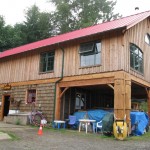 Another place I’d long wanted to see was O.U.R. Ecovillage, near Shawnigan Lake on Vancouver Island. A haven for green builders, permaculture designers, and people in search of collaborative and sustainable lifestyles, it’s a half-finished dream with a population that ebbs and flows through the seasons.
The root cellar was the subject of a green building workshop last year, and progress was documented on this Youtube video. Like many of the other buildings it uses recycled materials in its construction: car tires and styrofoam blocks are part of its structure. Like everything that happens at the Ecovillage, the decision to use these materials was taken after lengthy thought and discussion, and the feeling is that it’s better to put them into a structure where they have a purpose and are contained than into a landfill (at best). The styrofoam blocks they use are discarded tree plug trays – available by their millions, an otherwise useless and unsustainable byproduct of reforestation by the lumber industry. The community is also working its way through some 15 truckloads of reclaimed lumber – windfall timber that would otherwise have been sold as firewood or burned as slash.
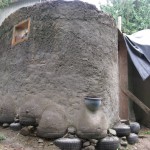
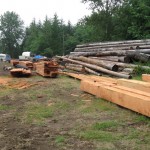
Permaculture has always been part of the ideals of the Ecovillage; the Permaculture Design courses that are offered here result in projects of many kinds – garden, water reclamation and food forestry among others.
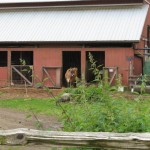
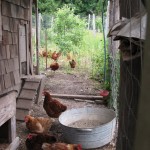
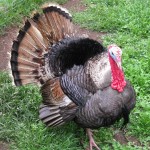
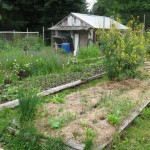
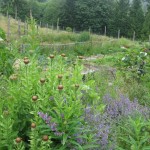
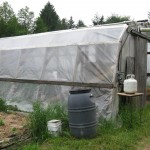
Food is a major preoccupation – it grows in various ways and places: in a deer-fenced garden and a new food forest that’s under development around the property; pigs, chickens, cows and a rather majestic turkey are part of the scene, producing food and fertilizer. This greenhouse recirculates water, heating it for a shower stall that’s in the greenhouse itself.

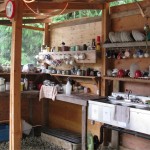
The kitchen has been recently expanded so that it could accommodate the large and small mealtimes. During our visit a Zimbabwean music camp – Nhemamusasa North – was on, and there were 130 people for meals… all of them washing their own dishes in the wash station. Grey water gets filtered and reused, of course.
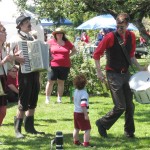
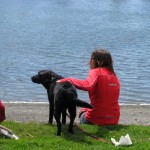
After that it was time for Canada Day celebrations. Here on the Gorge we have a street party that this year was graced by the queen, who also deigned to have her picture taken with neighbourhood dogs, and was then whisked away by canoe. There was of course food, music and a little dancing.


Wendell Berry: “It All Turns on Affection”
By now all thoughtful people have begun to feel our eligibility to be instructed by ecological disaster and mortal need. But we endangered ourselves first of all by dismissing affection as an honourable and necessary motive.
Our decision in the middle of the last century to reduce the farm population, eliminating the allegedly inefficient small farmers was enabled by the discounting of affection. As a result, we now have barely enough farmers to keep the land in production with the help of increasingly expensive industrial technology and at an increasingly ecological and social cost.
Wendell Berry is known to many of us in many ways, whether as farmer, poet, novelist, essayist or land activist. I recommend taking the time to listen to his no-holds-barred Jefferson Lecture, in which he urges us to restore affection – for our land, neighbours and community – in order to attend to matters crucial for human survival.
The lecture is a powerful and compassionate analysis of our times. Such words as these struck me:
Now the two great aims of the industrialism, the replacement of people with technology and concentration of wealth into the hands of a small plutocracy, seem close to fulfillment. At the same time, the failures of industrialism have become too great and too dangerous to deny.
Corporate industrialism itself has exposed the falsehood that it ever was inevitable or that it ever has given precedence to the common good. It has failed to sustain the health and stability of human society. Among its characteristic signs are destroyed communities, neighbourhoods, families, small businesses and small farms. It has failed just as conspicuously and more dangerously to sustain the health and wealth of nature.
And these:
The losses and damages characteristic of our present economy certainly cannot be stopped, let alone restored, by liberal or conservative tweakings of corporate industrialism, against which the ancient imperatives of good care, home-making and frugality can have no standing.
The possibility of authentic correction comes I think from two already evident causes.The first is scarcity, and other serious problems arising from industrial abuses of the land community.
A positive cause still little noticed by high officials and the media is the by now well-established effort to build or rebuild local economies, starting with economies of food. This effort to connect cities with their surrounding rural landscapes rests exactly upon the recognition of human limits and the necessity of human scale. Its purpose to the extent possible is to bring producers and consumers, causes and effects, back within the bounds of neighbourhood, which is to say the effective reach of imagination, sympathy, affection and all else, including enough food, that neighbourhood implies.