Skip to content
Home » Michael Pollan

Michael Pollan

Scared of our food

Listening to the periodic updates on the salmonella in your fast food tomato (or is it the peppers or is it the salsa or what the heck is it anyway) made me run back to Michael Pollan for comforting words. His 2006 article (remember the spinach E. coli scare?), the Vegetable-Industrial Complex, has a lot to say to today’s issues and is worth revisiting, or just plain visiting if you missed it the first time.

If you don’t want to read the whole article, I like this bit in particular:

Wendell Berry once wrote that when we took animals off farms and put them onto feedlots, we had, in effect, taken an old solution–the one where crops feed animals and animals’ waste feeds crops–and neatly divided it into two new problems: a fertility problem on the farm, and a pollution problem on the feedlot.

Timely thoughts, now that we’re in the season of growing and farmers marketing. The trust that Pollan talks about with respect to produce he buys from stallholders he’s known and patronised for years is missing from what you pick up off a supermarket shelf, or from a fast food counter. And he makes another important point, one that small BC meat producers will recognise, about governments punishing small farmers in their efforts to impose safety measures on industrial-scale farming.

On that very topic, I happened upon a recent podcast of the always interesting Kootenay Coop Radio program, Deconstructing Dinner, which was about The Culture of Meat and features an interview with Susan Bourette, the author of Carnivore Chic: From Pasture to Plate, A Search for the Perfect Meat.

Televisualess, with eggplant

I have been living for a couple of years now without television, which has been freeing; it has, as I’d hoped, freed up more time for reading, cooking and walking. I still watch stuff on tv-like screens, but now I rent movies and watch videos online. I suppose that has narrowed the field from which my media heroes are drawn, but if it has there’s one person I’m glad I’ve been able to see in a number of documentaries. She speaks clearly, simply and – although the message is terrifying – with hope and vision.

Here’s an interview with the awesome Vandana Shiva, who has put the plight of Indian farmers into the public spotlight, can explain beautifully the perils of seed patents (covered by Vanity Fair in the May/08 issue!) and biodiesels, has put her money where her mouth is through her foundation, Navdanya, and among her many other activities, now sits on the board of Slow Food International:

And now, if you have a couple of hours to spare, here’s Fast Food World: Perils and Promises of the Global Food Chain, a fascinating panel discussion from way back in 2003, featuring just about everyone I admire together on one stage: Vandana Shiva together with Carlo Petrini, poet Wendell Barry, Michael Pollan, Eric Schlosser and a charming introduction from Alice Waters.

If you’re still hungry after that, I wandered into a wonderful website that is all about aubergines, or eggplants, or melanzane. It includes a recipe for Tumbet, which we had in Spain; I tried Rose Elliot’s version the other day, which was very good, but I think this is closer to the one I fell in love with.

Vancouver’s Italian food trail

The day after the BC government announced funding for improvements for the province’s transportation, I travelled from Victoria to Vancouver using only public transportation. For those not familiar with the art of getting off this island, my options were:

1. Fly: from the Inner Harbour, round-trip fares run about $275 (tax included) on a seaplane; airport to airport it’s about $300, plus local travel costs. I guess it would take 2-3 hours door to door. Each direction.

2. Drive: the ferry fare would have been $47.80 in each direction, a round-trip cost of $95.60, plus gas and parking in Vancouver. To make the ferry I wanted (without incurring an extra $35 round-trip reservation fee) I would have had to allow about 4-5 hours travel time door to door, in each direction.

3.
Private bus line (this company has a monopoly on direct non-stop service to and from ferry terminals on both sides): the round-trip cost would be $83.00 plus about $10 in local bus fares, and it would have taken (door to door) about 5 hours in each direction.

4. Public bus service
: the round trip cost was $39.60 and it took me about 6 hours, door to door each way. Curiosities of public bus travel include: the Vancouver bus fare was a nice round $5 from Tsawwassen terminal, but they will only take coins! The Victoria bus that runs from Swartz Bay terminal to downtown costs $3 (and will take bills) but the route’s publicity shouts out that they have no room for luggage: We do our best to accommodate all customers, they tell us, but oversize luggage and backpacks can be difficult to accommodate on any transit system.

So whatever you do, you lose. Though I was happy with the economies of my route – and I managed to read all of Michael Pollan‘s terrific new book, In Defense of Food, during the trip, which put the ferry’s dismal food offerings into perspective. I was pleased to have brought my own: which was indeed food; not too much; mostly plants.

Once I arrived, I had just time to forage for a quick supper, and found some truly awful sushi on the food floor of an underground mall at Granville Station, then went on to an STC meeting to learn something about authoring documents with DITA.

The next day, to keep me from drifting too fully into the dark world of technical writing, I was whisked away to spend a delightful day touring some Italian groceries. Our first stop was the wonderful Cioffi’s, which has an awesome meat counter, generous offerings of salumi, olives and cheeses. I bought some taralli! and a few pieces of their excellent pancetta for our risotto of the evening; the staff were extremely kind and charming.

Then on to Ugo & Joe’s, which was very big and had lots and lots of meats and cheeses on offer, although I paused at seeing some cheese labelled as “Grana Parmigiano”… hmm; something not quite kosher there; because they were also selling cheese labelled Parmigiano-Reggiano, I wonder if the mystery cheese may have been my old friend Grana Padano, the labelling blurring some boundaries between two quite different products. Because both these cheeses are technically referred to as “Grana” cheeses, meaning they are similar styles of cheese – hard and granular – produced in much the same way (though the rules over milk quality and length of aging are the chief differences) it is technically correct to call the artisanal product Grana Parmigiano-Reggiano; what this particular shop meant by “Grana Parmigiano” will have to remain a mystery until my next visit.

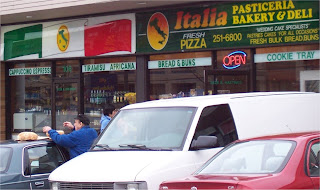
After that, we were a little peckish, so we stopped at Pasticceria Italia where the pizza had been recommended to us. It looks like their bread can’t get any fresher as there was a customer outside cooling his loaves on the roof of his car when we got there. We bought a giant slab of tomato & cheese pizza, which was fabulous. The lovely woman behind the counter said to us, “See you tomorrow!” and we sure understood what she meant.
Then another treasure – Renzullo Food Market was compact but well-provisioned, and the owners were delightful, knowledgeable and friendly.

We then did a swift little tour of offerings on one corner of Commercial Drive.
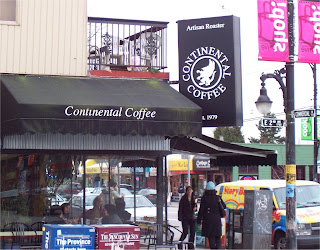
We stopped first at Fratelli bakery, then to the La Grotta del Formaggio (lots of cheese, yes, and a great selection of olive oils which we had to fight the crowd thronging the sandwich bar to get to). Most excitingly, I saw a familiar package on the pasta shelf: it was our old pal Spinosi from Le Marche! Very thrilling to know that his products have made it to this far outpost of the pasta eating world.
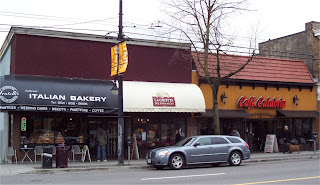


We then nipped down the block to the doors of
JN & Z Deli which sadly for us were closed (winter holiday), and so we finally subsided with a giant, strong and beautiful cappuccino at Continental.



A final stop at Bosa‘s spacious big store, where I came away with a giant bag of beautiful fresh walnuts.

Journalism, food geography and a mighty fine picnic

We had the entertaining guidance of the Guardian‘s very own Matthew Fort to speak to us last week. I have been to many a talk on how to write and on selling your writing, but it never hurts to have a few stern reminders from a guy at the top, like: you can’t call yourself a writer if you don’t write every day. His chief tip is to try to elicit three reactions from the reader: ‘I never thought of that’; ‘that’s really useful’; and ‘I really enjoyed that’.

One side-comment he made stayed with me: British food shops are shooting themselves in the foot by keeping bankers’ hours; the only food shops open at times when their customers are able to shop are the supermarkets, and so they win the business. A remark that goes for other places as well; but he praised Italian food shops for staying open in the evening so that working shoppers could patronise them on their way home. Here in Parma most shops open between 8.30 and 9.30 and close for a very long lunch (12.30 till as late as 4.30) but then reopen for evening trade, until about 7 or 7.30 – which is indeed convenient, seen in that light. Not the first thought in my mind when I finally emerge to do my shopping on Saturdays around noon, but I guess that’s my choice.

We finished our week with Colin Sage, an environmental geographer and crusader for raw milk Irish cheeses. He talked to us about food geography, and specifically about some of the regulatory issues around raw milk cheeses that are helping to draw a scientific noose ever more tightly round the food we are able to buy. He referred us to Marion Nestle, a name that’s been coming up in various places and readings, and mentioned a useful article by our hero Michael Pollan about the rise of a whole new evil that goes by the handle of nutritionism. And he left us with the suggestion that maybe it’s time to grow our own food.

He called on us to shift away from thinking of ourselves as simply consumers having our choices limited and being passive recipients of what might be less and less a ‘whole food’ and more and more a nutrition product. We need, he says, to become food citizens with an active role in asserting values and creating an environment for our own sustenance. Increasing transportation costs mean there will be a higher and higher cost for our food: the current system is unsustainable. We need to be responsible and involved in how and where food is sourced, and grow some of our own food if we can. He advocates alternative food networks: perhaps develop small scale cooperatives for sharing food resources. Fair trade needs to go further than chocolate or coffee, and develop in such areas as fruit that we’ll never be able to grow in northern climates.

Oddly enough I had been listening to a Food Programme piece from last February on much the same theme, where the speaker, Colin Tudge, advocated a “world-wide food club” – a cooperative relationship between good farmers who really want to produce good stuff, artisans, bakers and brewers who are prepared to produce good food from it, and people who are willing to pay for good food properly produced.

Colin Sage has also spent time looking at the structures around our food governance, and is uneasy with his findings. The bodies that research and govern our food supply are suspect: there are well publicised funding relationships between business and research (academics and scientists) and government which is problematic for impartiality: when funding determines what is being studied and how the results may be released, that limits what we can truly investigate and report in all that we need to know about our food. The ‘cosy relationship’ that exists between business and regulatory bodies in terms of who heads them (but where do you find the expertise to head regulators if not in the industries they come in to regulate?) can be causing problems again in impartiality. And food sovereignty means that countries that need to feed themselves are using their own resources to grow export crops, which are more lucrative, but create a world in which food is being grown as animal feed or fuel while their own populations suffer hunger and malnourishment. Sobering stuff; the more so when so much of it is literally echoing down this year, repeated with variations by our speakers and in our readings.

With all that on our minds it could have been hard to gather the strength for a Labour Day picnic in the park but we managed. We spread our blankets on a sunny day in a quiet, walled garden overhung by chestnuts in full flower with a few bouncing dogs in the background – and later in the afternoon some curious soundtracks (Frank Sinatra?) coming from the puppet show in the courtyard of the Castello dei Burattini. One by one we set down our wares, explaining why they were not adequate, which ingredients we’d been unable to find or adapt, why the recipes had not worked as we had hoped, why they didn’t look the way they were supposed to; and one by one we ate the offerings with delight and mutual encouragement. Even halfway through our year it can be a scary thing to share humble food among our ever-more gastronomically enlightened selves. But we all agreed we must do it more often.

Some food reading, viewing, listening

An interesting interview with Whole Foods co-president Walter Robb. The CEO of Whole Foods, John MacKay, posts a blog on the company’s website. Of interest to me and my recent reading is the exchange of public letters between MacKay and Michael Pollan, discussing Pollan’s somewhat skeptical take on the Whole Foods phenomenon in The Omnivore’s Dilemma. and the expansion of organic food production and retailing into something that rather too closely resembles the system that organics grew up to counteract.

David Szanto, who completed our course at UniSG in November, joined us for some merrymaking at the Quebec cheese tasting evening last week, and he pointed me to a recent article in The Guardian, The Organic Church Splits, about the Soil Association which I suppose you could say turns some of the same ground from a British perspective; and there was an earlier article and podcast on US organics in Business Week last October. An op-ed piece in the New York Times called The Amber Fields of Bland explains the US farm bill, and the terrifying span of its coverage, and just what it has done to food production in that country.

I’ve been watching a dvd called The Future of Food which MJ brought back from Canada. About farmers, farming, gmo crops and seed/pesticide monopolies, it’s an excellent introduction to the realities of farming today and the issues we should all be attending to in our food. I liked the dvd extras, which included a clip from Michael Pollen responding to the question about ‘will food cost more in future’ – yes, he said, but it’s artificially cheap right now because of heavy crop and farming subsidies in the US and Europe, and people need to perhaps look at their relative priorities: which do you want to spend your money on more each month: safe/nutritious food or $40+ on cable tv? He also made the excellent point that prepared food is always more expensive than food you cook: so people need to learn to cook. But they also need sources for raw ingredients: in some poor neighbourhoods it’s simply impossible even to buy fresh fruit or vegetables.

Doris pointed us to a well respected Austrian documentary on themes of food and hunger, We feed the world – global food which I’d like to have a look at someday.

There’s a Belgian-made short documentary you can view online at EUX-TV called Chicken Madness, about dumping of chicken surpluses in Africa by western countries such as Belgium, Germany, Holland and Brazil. It seems we’ve got very picky in the western world and we just don’t want to eat all of the chicken, so we sell the icky bits to someone hungrier than us. But the lack of effective licensing (=political corruption) and the dearth of functioning cold storage facilities at the receiving end results in an economic double-whammy: food spoilage and the trashing of African poultry farming which can’t compete with the prices — or the convenience of a ready-to-cook product, however tainted. But the industrialised world is committed to free trade at (literally) all costs. As one African farmer bitterly noted, would the US and Europe be ok with the destruction of their local economies in the name of globalisation? Something to think about next time you pick up a packet of chicken breasts…

And I recently listened to a podcast about nutritional food labelling. An education in how little consumers understand of what they read on the label: consumer food education has a long way to go. One telling example from the American representative who said that the majority of American consumers surveyed could not say what a typical daily calorie intake ought to be, despite the calorie information printed on the food labels since 1994 which stated that it was based on a 2000 calorie per day allowance; and that they often disregarded serving size recommendations and simply ate the whole packet. Which says something about labelling, obesity and education.

Corn and turkeys

I was confused when I first moved to England about use of the term “corn” – which to North Americans means the yellow kernels that brighten every summer picnic. In England it’s used in its traditional and more wide-ranging sense, meaning any grain, and generally the kind that feeds livestock. According to Michael Pollan, it used to mean literally any grain at all – including grains of salt, hence the expression “corned beef”. And hence the qualifier “sweet” which is added to the kind of corn that people eat, as in sweetcorn.

While passing through London in November, on my way to Italy, I happened on a copy of his recently published and much-praised book, The Omnivore’s Dilemma, right there in the Bloomsbury Oxfam Bookshop. Delighted I was, but long in the opening of this fascinating story. I have started reading it this week, after coming upon an interview with him recorded a few months before the book hit the shelves. The interview is more about Pollan and his research and writing methods than the content of the book, but he does preface the interview with a reading from it and answers some interesting questions about it at the end.

(Corn Maiden, in the sculpture garden of The Museum of Indian Arts & Culture, Santa Fe)

And so I’ve been reading the first section, which is a depressing story about the appropriation of corn – one of the traditional foods of American Indians – by agribusiness, and about the enslavement of American farmers to corn subsidies which in turn has created such a surplus of corn that its products form a shocking part of the fabric of American life, from sweeteners to manufacturing materials.

And if we thought it was cruel to feed cow by-products to cows, it turns out it’s actually not much better to feed them corn, which they aren’t designed to digest either (they are grass not grain-eaters). Luckily Pollan is a talented, humane and funny writer, so it’s possible to survive the facts he’s presenting to his fellow humans. I thought I’d take a break and look at some of his other writings today.

His 2003 article about Slow Food (from Mother Jones magazine) is interesting reading, particularly following turkey season. I hadn’t realised, when I wrote my poem, Lamenting the Turkey, that I was writing about Broad Breasted Whites, but seeing them described in Pollan’s article as “mindless eating and shitting machines” that are so deformed by breeding they cannot reproduce without artificial insemination, I’d say that’s exactly what they were; lumpy and awkward like the poem. Here it is, (from Cartography) – let’s dedicate this iteration to Pollan and to omnivores everywhere (oh, and by the way I do -really!- like eating turkey but will of course be more diligent about buying traditional breeds in future..).

Lamenting the Turkey

Stub-winged idiot, a food whose life
is a brief hymn to gluttony: crescendo of feathers
and flesh fills our tables, bloodlessly knifed
as the red leaves of Christmas bloom in the background,
remorselessly bright.

In a time we’re kneeling to stars and shepherds
this is our chosen meal: a feathered blunder
so dumb it drowns in rain, gaping at skies
as they seal its throat with liquid wonder.

We adopt all the symbols of peace
but consume the corpse of a baleful thing:
it riots at the scent of blood, will slay
wounded brothers with its bladed chin.

We fill the season with music, and stop
this wobbling voice with a plug of bread;
it ends its time as it always lived:
stuffed with food, yet never fed.

So this is our festive platter:
a death of stupidity and fatted fear,
naked and shining beneath the candles,
a meal we gobble in the gullet of the year.