Skip to content
Home » olive oil tasting

olive oil tasting

Puglia Wednesday: wine and white cities

Wednesday’s schedule included a trip to la Riserva di Torre Guaceto where olive trees and other growing things are being protected. The olive trees we saw were at least 500 years old, and were part of a scheme to involve farmers in organic production methods by creating a co-op to produce and market organic extra-virgin olive oil.

There is also a marine park which includes the beach below, which we were told accommodates as many as 5000 visitors a day in the summer.

Although Italian marine parks like this one are off-limits to commercial fishermen, it seems that, through its conservation efforts, the reserve has enabled a 400% increase in fish stocks, and now a small local fishing enterprise is permitted, under strict scrutiny by the University of Lecce which monitors the size and type of fish that are caught.


We travelled next to a restored olive mill, Frantoio Locopagliaro, in the midst of a large olive grove. Underground mills were once the norm in this area, because they were practical to build – aboveground constructions required specialised labour – and their rock ceilings could withstand the pressure exerted by manual presses. The underground setting also maintained the oil and processing at optimal temperatures.

The press itself: after the olives and their stones were ground to a paste beneath horse-powered millstones, the paste was put in round woven baskets that were stacked and placed beneath the wooden screw which was turned by human effort. The oil was then separated from the rest of the liquid, and the paste was transferred for further pressing.

This olive crusher was used for the second crushing, to reduce the olive paste residue further for processing into lamp oil or other industrial use.

After a tasting of Puglian extra-virgin olive oils, we sat in intermittent sunshine to enjoy a terrific lunch which included such local novelties as chicory (a kind of spinach-like green) with pureed fava beans and roasted green peppers, a bit of burrata, some cacciocavallo, and a nice piece of capocollo tucked into an addictive little biscuit called taralli. And some lovely oily bread. And a glass of wine.

After this, we were whisked off to Ostuni – la Città Bianca – where we ascended to the summit for a quick look over the forests of olive trees below.


Then a speedy and very chilly visit to the vineyards, just starting to leaf, of Lomazzi & Sarli, who’d provided our previous night’s wines – including Dimastrodonato, a particularly good dessert wine made from a characteristic Pugliese grape (Aleatico) – and back we went to the hotel to rest up for supper.

A week in Le Marche – Olives


Ok, so I had never heard of Le Marche before I came to Italy. Well I had, I just didn’t know what “The Marches” meant – it was a phrase out of turn of the century literature, I thought; and if I’d thought about it I probably would have believed it was an old demarcation that no longer existed. And in fact the term, meaning “borders” or “boundaries” has been used to describe the margins of many different countries.

In Italy, the name was bandied around through history due to this area’s position between the north and south of Italy, which at one time marked the border of the Holy Roman Empire. It has been settled since paleolithic times, changing hands at intervals as the Picini gave way to the Romans who gave way to the Goths who gave way to alternating spheres of ownership by emperors and the papacy, until the fiefdoms gave way to free communes, and the area joined the kingdom of Italy in 1860 and that gave way to the republic in 1946. Now here we are in the modern era, watching successive colonisations by various armies of tourist and agribusiness.

We stayed pretty firmly in the central province of Ancona for our visit, named by previous owners for the “elbow” (agkonas)/Ancona, the eponymous industrial port that sits above Monte Conero, but caught glimpses of the others. Facing the Dalmation coast, Ancona is a big chunk of mountainous land well-provided with beaches for summer visitors.

Our hotel was in Porto San Giorgio, an off-season seaside town if ever there was one, the fronds of its palm trees bound up in bamboo against the winter storms, shutters drawn, shops and restaurants closed for the season. Or maybe not, since there are apparently a lot of out-of-towners from Rome and elsewhere with a proprietorial toe in the Adriatic who come up for weekends.


Among the many delights we tasted over the week, olive ascolane deserve special mention. These Italian equivalents of scotch eggs are made from olives (originally the nice big juicy Ascolana olives, of course) stuffed with or around meat filling, then breaded and fried. Lesser versions can be found in almost any supermarket in Italy, and there are many home-made versions. The ones we had were particularly fresh and tasty, so we’re spoiled (yet again) for life.


We managed to hit a warm, breezy day for our tour round the 25 hectare olive grove at Azienda del Carmine, where they grow Ascolana (the first to ripen, in May), Leccino (a smaller olive), Frantoio (the name means ‘olive press’ we learned), and other varietals.

Our translator explains the use of pheromone traps which the growers use to check the progress of the Bactrocera oleae, the olive fruit fly which is the main pest for olive growers. It lays eggs in the olives which not only destroy the fruit but make the crop unpalatable for use in olive oil; because of the volume of olives you need to put through the press, it’s impractical to try to sort the damaged olives, so prevention and chemicals are the only weapons there are. Instead of routinely treating their trees with pesticides as some of their neighbours do, these growers check the trees and fruit for flies and then treat only infested trees. Unfortunately it’s been a bad year for them this year.


Every ten years, the olive trees need a rigorous pruning, which takes them a year or two to recover from, so the grove is pruned in sequence, 5 hectares at a time.

After a welcome opportunity renewing and showing off our olive oil-tasting skills on a couple of their top oils, we were treated to a big spread of breads, cheeses, salumi and salads.

Yep, marvellous mozzarella – and a couple of different pecorinos, a young one (fresco) and a stagionato, all delicious with splodges of condiments which included a peperoncino jelly. The revelation for many of us was the wonderful combination of top quality olive oil taken in a single lingering mouthful with a chocolate shot cup, and an equally surprising and equally fine idea: drizzled over vanilla gelato.

Milk prices, wine history, more olive oil


We had a beautiful weekend in Parma: a cool and clear Sunday, ideal for a stroll by the river, after a sprinkling of snow on Friday. That was a meteorological Australia Day gift for our Ozzie colleague, who’d graced us that afternoon with bone fide Vegemite sandwiches, Mintos and Fantales. Friday night several of us checked out Shri Ganesh,the Indian restaurant in town, and it was good: wonderful tandoori chicken, dhal and samosas, and lots of other things too.

Meli has passed along a timely story from BBC News about milk prices and farmer underpayment: A woman sat in a bath of cold milk outside Parliament in protest at the price per litre dairy farmers are paid. (And if you want to support dairy farmers in a real way, you might like to pick one off your morning pint, if you’re lucky enough to get the ones with the lonely hearts ads on them.)

Meanwhile, more classes since the great pig farm visit of ’07. Since Wednesday, we’ve had some wine history, wine technology, sensory analysis, more olive oil tasting, and a dash of semiotics. Phew. Here are some highlights.

Wine history: I was delighted to hear Allen Grieco speak in support of Retsina, the Greek wine that was born from an ancient quest for preservatives – and one turned out to be pine resin, which led to a characteristic aroma and flavour, which nurtured a taste, which only began to die when foreign tourists started to swamp the tastes and production values in Greece within the last thirty years.

In my experience you are either born a retsina drinker or not. Our family was divided on that point. I’d like to suggest maybe it’s a genetic thing, like tongue-rolling? Anyway it made me look forward to visiting Crete again, as I remember well the delightful bottles of retsina made in Chania that perished on my last visit.

Sensory analysis… more statistics. Horrible stuff. And discretion forbids me from saying anything more about the nature of the class; indeed, the very need for discretion says all that should possibly be said about that.

And I would have thought that all that kind of complex thinking about communication in the form of signs (present through their absence) should have made me ready for yesterday’s start in semiotics. But not.

I prefer the oil and wine studies.

Oil tasting was, as always, delightful in every way. We had Greek olive oil day yesterday. The mystery factor was a second tasting of one of the oils after it had been heated to below the smoking point (which no doubt everyone but me always knew was 180 degrees c, right?). So even though it was just heated and cooled, with nothing cooked in it, the flavour was totally gone. It had none of the aroma of the original wine, and smelled and tasted a bit like popcorn. A helpful reminder about (a) keeping your olive oil cool, dark and away from exposure to oxygen; and (b) don’t cook with the good stuff! It’s meant to be added as a condiment after the cooking’s finished. Heat will bring out its flavours, but cooking it will only kill them. A fine line.

You can make it into mayonnaise, if it’s not too bitter or peppery: very pretty. (Guess which one was made – not from olive oil – by Kraft?)

Another useful tip for those of us maybe schlepping wondrous bottles of extra virgin olive oil thither and yon, fresh from some exquisite pressing in far-flung places: you can freeze it if you need to. But once you thaw it, use it up faster than you would fresh, as it will be that much more fragile. As we never tire of hearing, olive oil does not improve with age: its power, aroma and flavours dissipate as time goes by.

Tasty week – olive oil, wine technology and the physiology of taste

We’ve had a lovely oily tasty sniffy week, with our first oil tastings and some coaching on olfaction and taste thresholds.

Our oil guy, Alessandro Bosticco, is an inspired teacher, a sommelier as well as an olive oil expert, and I was happy to hear he’ll be steering us through some wine tastings as well. I particularly warmed to him when he dodged a question about his favourite olive oil by saying that he simply loved tasting new things, and if he were offered the choice between his current favourite and one he’d never tried, he’d take the one he’d never tried.
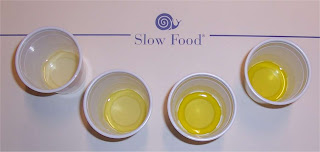

He said oil tastings were rare, even in Italy, and to do them as we were, by tasting oil from cups (rather than by dipping bread) was still fairly unusual. We tried four different kinds on each of the two days. Oil is what carries flavour to our tastebuds, and it does its job well; so, being oil, its flavour is hard to purge from the palate. We had to allow more time between tastings than we would for wine, and take sips of bottled water and slices of apple – granny smith being the apple of choice for oil tastings because it is the most acidic.

We heard about the craze for fresh, unfiltered oils in Bosticco’s own local oil-producing region (Tuscany): cloudy and bright-coloured, these oils are not, he said, good for the long run, because the particles in them are fibres that have not been extracted during filtration, and which will trap water which can in its turn trap bacteria. So murk or sediment will affect the oil’s flavour adversely over time, and he advised that if you intend to keep your oil more than a few weeks, to get a clearer one. Even then it’s not going to last more than about 18 months, with a steady decline in colour and flavour as time goes by. More than once he remarked that the oil you taste today is as good as it’s going to get: it is not a product that improves with aging. Rather it is a living thing that changes over its lifetime. And it’s vulnerable to heat and light, so store it accordingly

We got some pointers on reading labels, and learned about the legal designations of “olive oil”, “virgin olive oil” and “extra virgin olive oil”, as well as a few others, defined by the International Olive Oil Council.

Basically the big deal with extra Virgin Olive Oil is that it must be produced by mechanical means (which is always and inevitably cold pressing, so that phrase added to labels is just hyper marketing). This distinguishes it from the processes used to produce all other kinds of oils (except for specialised niche versions of course), which involve heat and chemicals. Extra virgin oil has to pass a chemical test (it can’t contain more than .8% oleic acid) and it then has to pass a taste test by a panel of experts. This doesn’t guarantee it will taste ‘good’ to everyone, but it gives a basic measure of quality. It may also be the result of blending more than one crop, including crops of different years, but is tested at bottling, so no new blending can taste place once it’s had its testing.

There’s a statement which for 2 years now must appear on bottles of Extra Virgin Olive Oil: it must be described as “superior quality oil obtained straight from olives using only mechanical means of production.” That again is no guarantee of flavour (which is subjective anyway) or origin. Most of the olive oil in Europe is produced in Spain, but Italy has the highest consumption, ergo much of what we describe as Italian olive oil is imported and only bottled in Italy.

So for those who want Italian and only Italian olive oil, there is a fairly recent DOP designation (Denominazione di Origine Protetta, or Protected Denomination of Origin) – a high falutin’ version of extra virgin, which is subject to standards governing where and how the olives may be grown, pressed and bottled as oil. This oil of course sells at a considerable premium. It would be one instance where the bottler will note the date of harvest on the bottle, giving you an indication of the freshness and therefore the power of the oil’s aroma and flavour.

Farther down the scale, what is sold simply as Olio d’Oliva, or Olive Oil, is a blend of refined (by chemical means) olive oil and virgin olive oils. Virgin Olive Oil is produced by mechanical means and has a higher measure of oleic acid than Extra Virgin.

Olive oil is used in its traditional market – Mediterranean, for example – for traditional reasons such as taste. In the newer and ever expanding world-wide markets, it’s been picked up for its health benefits, as it’s a pure unsaturated oil containing fat-soluble vitamins (A and E) and antioxidants. Among the many other advantages it has over other oils, as enumerated by the Oil Council, when you use it for frying, it adds less fat to fried foods because it forms a crust on the surface of the food that impedes the penetration of oil and improves the food’s flavour.

There are different taste preferences for olive oil that are partly cultural: people raised on animal fats tend to prefer milder olive oils to more pungent peppery ones with their bitter after-bite. We had a reinforcement of the advice about becoming a good taster: to taste and smell many different things in order to build an olfactory library, so you have a more comprehensive memory of tastes and flavours to compare.

Due to some weird global synergy, BBC Food Programme and NPR both had programs on olive oil this month.

We also had a first lesson on wine technology… ack – more chemistry. Still, we are paddling around in the sea of knowledge and one day it will all make sense.

We finished the week with a lesson on the physiology of taste from Mirco Marconi. We’d heard already about the classification of taste – sweet, salty, bitter and acid (plus the newcomer, umami, which reflects ‘meaty’ tastes). We learned that the position of taste buds on the tongue is not as static as had originally been supposed, with fixed areas for each taste, but that they are in fact in an overlapping range of regions with the central area of the tongue the least sensitive.

Bitter tastes linger longest because of their placement on the sides of the papillae where the flavour gets ‘stuck’ until it is washed out. We heard that there are varying proportions of the world’s population who are unable to taste bitter (3% in West Africa, 40% in India, 30% of white people in North America; 37% of Italians).

We heard about two theories of taste, which are called either molecular shape theory vs molecular vibrational theory, or docking criteria vs swipe card model. The first supposes that there is a ‘lock and key’ relationship between odorant and receptor: odorous molecules have shapes and sizes that “fit into” the shape and size of corresponding olfactory receptors. In the second, it’s supposed that receptors in the olfactory organs recognise molecules by their vibration, so the nose acts as a kind of spectroscope.

We got into hands-on mode for some tastings and sniffings. We sipped our way through nine samples representing sweet, salty, acid, bitter, umami and astringent – substances dissolved in water – comfortingly straightforward. We then finished by attempting to identify thirty different olfactory samples, ranging from smoke to mint, from cloves to coconut and saffron to bergamot. Fiendishly difficult.

And finally, we were welcomed to Parma officially before Christmas, and here’s the official photo!