Skip to content

olive oil

Spain 5: olive oil, peaches and lots of fish

With one down (massive cava hangover) and a few more beginning to falter (3 head colds, 1 sore back), we set off for Reus (birthplace of Antoni Gaudi!) where we had a tasting of DOP Siurana olive oil (made from small arbequina olives) at the beautiful art nouveau (modernisme) building housing the Consell Regulador de la Do Suriana:

and heard about various other geographically designated products, including rice, hazelnuts, potatoes and tangerines.

Next stop Cambrils, at the Cooperativa de Cambrils y Borges, where we observed the packaging of peaches, destined entirely (or maybe 90%, depending on who you asked) for external markets. Not an organic or artisanal coop, but a very busy one. We visited the agricultural museum which is part of its headquarters, and had a lunch of salad, spaghetti (Spanish local specialty?) and fried fish.

Off we sped to the docks, where we watched a fish market in action. Instead of an auction, like the one we’d seen in Puglia, here the prices are pre-determined, and buyers gather round a conveyor belt where they drop identifying tags on boxes of fish, and then pay the going rate at the end. Anything not sold off the boats in this way goes to the bigger markets at Valencia and Barcelona. We heard about the EU’s method of conserving fish stocks (they buy back the boats and licenses of small fishermen, removing them permanently from the sea — unfortunately as we’d learned elsewhere the slack is being taken up by large scale trawlers). We stepped onto a fishing boat to see the cleaning and sorting involved. The men were hand-sorting the takings from their dragger nets, which scour across the sand and bring up all manner of crabs, crustaceans and smaller sea life. Larger enterprises would chuck these back in the water, dead, but here they were hand-sorted and sold.

Crete part 4: phyllo finale

The Crete trip was drawing to a close. We moved along to Rethymnon on Saturday, via the National Agricultural Research Foundation in Messara, where we had a talk from another gracious speaker, Dr Manolis Kambourakis

who talked about some of the issues supporting the growth in organic olive farming in the Messara Valley; the most urgent of which was the degradation of natural resources such as water.

We enjoyed another Cretan lunch,

complete with koukouvaja (rusks with tomato and fresh cheese), tzatziki, halloumi and Greek salad. Afterwards he took us to a viewpoint to see the ancient ruins of Phaistos and the sweep of the valley with its new crop of greenhouses.

On to a cooking demonstration by our evening’s host, Othonas Hristoulakis,
who showed us how our meal would be shaping up. Salad, halloumi, baked feta and lamb with artichokes were on their way, with a lovely little fried pastry with candied oranges to finish.


But first — as we had come to understand, there is always one more thing to see, just as every meal has one more course we weren’t expecting. We navigated a few narrow streets away from the restaurant to watch a demonstration of the noble art of phyllo making. The rounds of pastry have been made in large circles; the fun comes in when it’s stretched in a seemingly effortless process, much like making a bed and tugging the sheets gently until they cover the required space. Forty or fifty years of practice is all it takes…


We had a day off on Sunday, and some of us spent it at the beach in south Crete: first at Palm Beach, near the Preveli monastery,

and then a scary drive along a narrow gravel cliffside road to Ligres, where a fabulous beach beckoned while our seafood was grilling.


And then, by gum, it was our last day. We dropped into the village of Maroulas to visit a herbalist, Marianna, where we bought remedies for all that ailed us,


and then pressed on back to Amari where we met again our friend Katarina the potter, who welcomed us with cheese and raki and biscuits made from wine must, and warm cheese fritters we ate with honey. She showed us some of her wares and let us have a go.


Finally: supper in Rethymnon, the night of Too Much Food…

After which a group of hardy souls managed an hour or two round a beach fire before heading back to the hotel to rest up for morning.

And as if a 4am departure wasn’t enough to tell us it really was over, we had to face this abomination on Aegean Airlines at breakfast time. At least the yogurt was good.

Exam shazaam & Vinitaly

I read somewhere that on this day in 1755, Jean-Anthelme Brillat-Savarin was born in France. He wrote The Physiology of Taste, about the pleasures of food, published in 1825 when he was just 69. I should like to add that a couple of centuries later, on this day in 1955, my dear departed parents were married; it was their enduring joke on the world to elope on April Fool’s day. The last anniversary they celebrated was their 46th, shortly after my return to Canada in 2001.

We wrote our much anticipated food technology exam on Friday which got me thinking, as I perused my notes in the lead-up, about how learning really takes place, particularly in an aging and over-full human brain. The information actually retained probably had more to do with affection for the instructor than interest in the subject. For example I’m not sure, having supposedly completed the course, that I even know what is meant by the term sensory analysis; my understanding of the term is all tangled up in my enduring incomprehension about statistical methods which appear to have been the main topic under discussion (for many reasons it was hard to know really what in that class was being discussed). On the other hand, I feel sound in my understanding of olive oil technology which included harvesting and milling operations as well as chemical make-up and regulatory issues around extra-virgin olive oil. Reading my notes again brought the pleasures of the class back to mind in a way that doesn’t normally happen, I think.


Our much-loved instructor in that class, Sandro Bosticco, who had also led us gently, kindly and knowledgeably through a couple of wine tasting classes last week (one of which I wretchedly had to miss, felled by another short-lived stomach bug), reappeared to lead us through the terrifying expanse of the Vinitaly show yesterday, which also features an olive oil exhibition, Sol. He took us through an oil tasting at a producer who was promoting a high quality blend of extra-virgin olive oils, called Gemini, which successfully combined the punch of Tuscan with the flavours of Sicilian. He then led us back into the Tuscan wine pavilion where we sampled some Vino Nobile di Montepulciano. Which of course is not to be confused with wine from the Montepulciano grape, as earlier explained by our Montepulciano-growing friends in Le Marche).

The rest of the day was an exhausting but pleasurable tour of a few select producers under the wing of our campus director, Carlo Catani, no slouch in the wine area himself, particularly when paired with another distinguished varietal, the university’s director Vittorio Manganelli. We lunched in the Puglian pavilion and saw again our old friends orecchiette and agnello, but the best thing on my plate was the starter, a lovely little timbale of melanzane bathing in a pool of fresh tomato sauce and jauntily garnished with shreds of cheese and a chapeau of basil leaf.

Would you go to a wine tasting in this pavilion?

Puglia Wednesday: wine and white cities

Wednesday’s schedule included a trip to la Riserva di Torre Guaceto where olive trees and other growing things are being protected. The olive trees we saw were at least 500 years old, and were part of a scheme to involve farmers in organic production methods by creating a co-op to produce and market organic extra-virgin olive oil.

There is also a marine park which includes the beach below, which we were told accommodates as many as 5000 visitors a day in the summer.

Although Italian marine parks like this one are off-limits to commercial fishermen, it seems that, through its conservation efforts, the reserve has enabled a 400% increase in fish stocks, and now a small local fishing enterprise is permitted, under strict scrutiny by the University of Lecce which monitors the size and type of fish that are caught.


We travelled next to a restored olive mill, Frantoio Locopagliaro, in the midst of a large olive grove. Underground mills were once the norm in this area, because they were practical to build – aboveground constructions required specialised labour – and their rock ceilings could withstand the pressure exerted by manual presses. The underground setting also maintained the oil and processing at optimal temperatures.

The press itself: after the olives and their stones were ground to a paste beneath horse-powered millstones, the paste was put in round woven baskets that were stacked and placed beneath the wooden screw which was turned by human effort. The oil was then separated from the rest of the liquid, and the paste was transferred for further pressing.

This olive crusher was used for the second crushing, to reduce the olive paste residue further for processing into lamp oil or other industrial use.

After a tasting of Puglian extra-virgin olive oils, we sat in intermittent sunshine to enjoy a terrific lunch which included such local novelties as chicory (a kind of spinach-like green) with pureed fava beans and roasted green peppers, a bit of burrata, some cacciocavallo, and a nice piece of capocollo tucked into an addictive little biscuit called taralli. And some lovely oily bread. And a glass of wine.

After this, we were whisked off to Ostuni – la Città Bianca – where we ascended to the summit for a quick look over the forests of olive trees below.


Then a speedy and very chilly visit to the vineyards, just starting to leaf, of Lomazzi & Sarli, who’d provided our previous night’s wines – including Dimastrodonato, a particularly good dessert wine made from a characteristic Pugliese grape (Aleatico) – and back we went to the hotel to rest up for supper.

A week in Le Marche – Olives


Ok, so I had never heard of Le Marche before I came to Italy. Well I had, I just didn’t know what “The Marches” meant – it was a phrase out of turn of the century literature, I thought; and if I’d thought about it I probably would have believed it was an old demarcation that no longer existed. And in fact the term, meaning “borders” or “boundaries” has been used to describe the margins of many different countries.

In Italy, the name was bandied around through history due to this area’s position between the north and south of Italy, which at one time marked the border of the Holy Roman Empire. It has been settled since paleolithic times, changing hands at intervals as the Picini gave way to the Romans who gave way to the Goths who gave way to alternating spheres of ownership by emperors and the papacy, until the fiefdoms gave way to free communes, and the area joined the kingdom of Italy in 1860 and that gave way to the republic in 1946. Now here we are in the modern era, watching successive colonisations by various armies of tourist and agribusiness.

We stayed pretty firmly in the central province of Ancona for our visit, named by previous owners for the “elbow” (agkonas)/Ancona, the eponymous industrial port that sits above Monte Conero, but caught glimpses of the others. Facing the Dalmation coast, Ancona is a big chunk of mountainous land well-provided with beaches for summer visitors.

Our hotel was in Porto San Giorgio, an off-season seaside town if ever there was one, the fronds of its palm trees bound up in bamboo against the winter storms, shutters drawn, shops and restaurants closed for the season. Or maybe not, since there are apparently a lot of out-of-towners from Rome and elsewhere with a proprietorial toe in the Adriatic who come up for weekends.


Among the many delights we tasted over the week, olive ascolane deserve special mention. These Italian equivalents of scotch eggs are made from olives (originally the nice big juicy Ascolana olives, of course) stuffed with or around meat filling, then breaded and fried. Lesser versions can be found in almost any supermarket in Italy, and there are many home-made versions. The ones we had were particularly fresh and tasty, so we’re spoiled (yet again) for life.
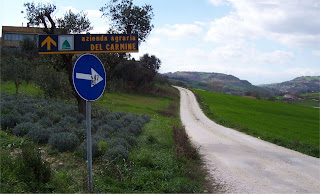

We managed to hit a warm, breezy day for our tour round the 25 hectare olive grove at Azienda del Carmine, where they grow Ascolana (the first to ripen, in May), Leccino (a smaller olive), Frantoio (the name means ‘olive press’ we learned), and other varietals.

Our translator explains the use of pheromone traps which the growers use to check the progress of the Bactrocera oleae, the olive fruit fly which is the main pest for olive growers. It lays eggs in the olives which not only destroy the fruit but make the crop unpalatable for use in olive oil; because of the volume of olives you need to put through the press, it’s impractical to try to sort the damaged olives, so prevention and chemicals are the only weapons there are. Instead of routinely treating their trees with pesticides as some of their neighbours do, these growers check the trees and fruit for flies and then treat only infested trees. Unfortunately it’s been a bad year for them this year.


Every ten years, the olive trees need a rigorous pruning, which takes them a year or two to recover from, so the grove is pruned in sequence, 5 hectares at a time.

After a welcome opportunity renewing and showing off our olive oil-tasting skills on a couple of their top oils, we were treated to a big spread of breads, cheeses, salumi and salads.
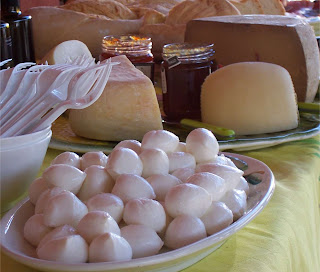
Yep, marvellous mozzarella – and a couple of different pecorinos, a young one (fresco) and a stagionato, all delicious with splodges of condiments which included a peperoncino jelly. The revelation for many of us was the wonderful combination of top quality olive oil taken in a single lingering mouthful with a chocolate shot cup, and an equally surprising and equally fine idea: drizzled over vanilla gelato.

Milk prices, wine history, more olive oil


We had a beautiful weekend in Parma: a cool and clear Sunday, ideal for a stroll by the river, after a sprinkling of snow on Friday. That was a meteorological Australia Day gift for our Ozzie colleague, who’d graced us that afternoon with bone fide Vegemite sandwiches, Mintos and Fantales. Friday night several of us checked out Shri Ganesh,the Indian restaurant in town, and it was good: wonderful tandoori chicken, dhal and samosas, and lots of other things too.

Meli has passed along a timely story from BBC News about milk prices and farmer underpayment: A woman sat in a bath of cold milk outside Parliament in protest at the price per litre dairy farmers are paid. (And if you want to support dairy farmers in a real way, you might like to pick one off your morning pint, if you’re lucky enough to get the ones with the lonely hearts ads on them.)

Meanwhile, more classes since the great pig farm visit of ’07. Since Wednesday, we’ve had some wine history, wine technology, sensory analysis, more olive oil tasting, and a dash of semiotics. Phew. Here are some highlights.

Wine history: I was delighted to hear Allen Grieco speak in support of Retsina, the Greek wine that was born from an ancient quest for preservatives – and one turned out to be pine resin, which led to a characteristic aroma and flavour, which nurtured a taste, which only began to die when foreign tourists started to swamp the tastes and production values in Greece within the last thirty years.

In my experience you are either born a retsina drinker or not. Our family was divided on that point. I’d like to suggest maybe it’s a genetic thing, like tongue-rolling? Anyway it made me look forward to visiting Crete again, as I remember well the delightful bottles of retsina made in Chania that perished on my last visit.

Sensory analysis… more statistics. Horrible stuff. And discretion forbids me from saying anything more about the nature of the class; indeed, the very need for discretion says all that should possibly be said about that.

And I would have thought that all that kind of complex thinking about communication in the form of signs (present through their absence) should have made me ready for yesterday’s start in semiotics. But not.

I prefer the oil and wine studies.

Oil tasting was, as always, delightful in every way. We had Greek olive oil day yesterday. The mystery factor was a second tasting of one of the oils after it had been heated to below the smoking point (which no doubt everyone but me always knew was 180 degrees c, right?). So even though it was just heated and cooled, with nothing cooked in it, the flavour was totally gone. It had none of the aroma of the original wine, and smelled and tasted a bit like popcorn. A helpful reminder about (a) keeping your olive oil cool, dark and away from exposure to oxygen; and (b) don’t cook with the good stuff! It’s meant to be added as a condiment after the cooking’s finished. Heat will bring out its flavours, but cooking it will only kill them. A fine line.

You can make it into mayonnaise, if it’s not too bitter or peppery: very pretty. (Guess which one was made – not from olive oil – by Kraft?)

Another useful tip for those of us maybe schlepping wondrous bottles of extra virgin olive oil thither and yon, fresh from some exquisite pressing in far-flung places: you can freeze it if you need to. But once you thaw it, use it up faster than you would fresh, as it will be that much more fragile. As we never tire of hearing, olive oil does not improve with age: its power, aroma and flavours dissipate as time goes by.