Skip to content

food markets

Eat Here Now… and we did

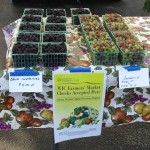
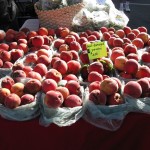
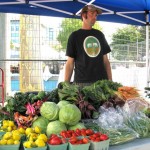
A glorious hot Sunday in the middle of Victoria, with food, music and more food. What could be better? The Downtown Public Market Society put on a great day in the interests of furthering interest in a permanent year-round downtown food market.  While I don’t know how far that goal is from being realized, the group certainly soldiered on through a bleak winter with regular markets offered in Market Square.

Last weekend it gathered together some fine local food food talent for a sunny celebration that featured food stands from local farms and small producers, including Hilary’s Cheese – promoting his new shop in Victoria – and the usual mob scene around Salt Spring Cheese’s ample samples, and Cottlestone Apiary with their wildflower, raw creamed and orange-infused tastes of heaven.


Baked, canned and hand-filled goods too…


Lots of farmers around, including my Haliburton friends


and City Harvest, Madrona Farm, Sun Trio (with their gorgeous lemon cucumbers) and many more.


There were food tickets on sale – a very reasonable $1 per ticket gave you a sample from most booths, stocked with everything from “kaleslaw” to cream puffs, and I proved to my own satisfaction that it was possible to eat extremely well for under $10. The barbecued salmon and boiled corn stands were mobbed for most of the time we were there; there were tasty treats from the likes of Canoe Brewpub, Bliss, Relish, Choux-Choux Charcuterie, AJ Organics and others…so after taking in all that with a taste of music and lots of sunshine we finally left, sated and laden with produce.

ASLE 4: farmers market and Banerjee on global warming

The Bloomington Farmers Market played an unusual role in ASLE 2011. Not part of the official program, it was located near enough to the campus to lure a number of Saturday morning wanderers away from the last day’s sessions for an hour or two. By happy coincidence, I was one of those wanderers, having run into  a like-minded traveller in the elevator.
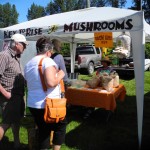
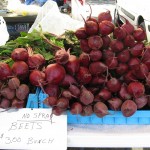
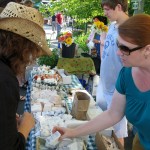
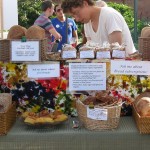
We learned later from the evening’s banquet speaker – an academic whose husband grows flowers and garlic to sell there – that it had been a fairly average day with some 75 vendors and about 8,000 visitors. The sun shone on our visit (but not too much) and we had a happy forage through the wares. Cheese there was, including the Wabash Cannonball, which I believe I’d noticed at Goose the Market earlier on my visit, but like so much on offer, I did not dare try to take home with me except in pictures. A bakery with a bread subscription program. Flowers, scapes, honey, maple syrup, lovely beets and salad greens. Some fine coffee sellers. And even a pipe (micro-) band from the local fire department, there to see off a team of local youngsters on a cycling tour to New England and New York. And some Jazzercizers (not the first I saw on this trip, in fact, as a much smaller group had been toiling away outside the market in in Indianapolis while we lolled about indoors tasting beer).


We returned with our spoils and hot-footed it over to hear the day’s plenary speaker, environmentalist photographer-writer Subhankar Banerjee, who walked us through some of the issues he’s been documenting. The Arctic, with its burden of interlocking catastrophes, was one. It was evident from Banerjee’s photos (some of which have had enough impact to be banned) that global warming is very real in the melting north, and is making wildlife migration and the subsistence hunting/fishing lives of aboriginal northerners precarious; it seems certain the impact of development and energy exploration will destroy this way of life.

His talk about the lives of his images and the verbal/visual battle he’s had with Shell Oil on his Huffington Post column was fascinating. His 2001 polar bear image has had, he thinks, some 40,000 reproductions, becoming one of the most well-known visual arguments against Arctic oil exploration; but Obama’s government was prepared to let it happen, until the Gulf of Mexico spill called a temporary halt to the plan. His Climatestorytellers.org website offers a forum for these and other stories of our times.

Banerjee lives in New Mexico and next showed us some images he’s been working on with desert flora, the cholla cactus in particular, in a series called Where I Live I Hope to Know. He’s trying to understand his surroundings by focusing on what’s unremarkable in his everyday landscape. But most interesting to me was his mention of the devastation of the piñon–juniper woodland. The piñon, New Mexico’s state tree, which gives us pine nuts, is (to put it mildly) a slow-growing tree; it reaches reproductive maturity at about 300 years, and can live as long as 1000 years. He says that about 90% of the mature piñons died between 2001-2005, because of development, erosion, fire and – where my ears pricked up – because of bark beetle infestation. Like the mountain pine beetle in BC (and elsewhere), global warming has meant that the beetle can survive the increasingly mild winters.

In the question and answer that followed, Banerjee remarked that in terms of fossil fuels,  we have exhausted “easy energy” sources; hereafter we’re calling on “extreme energy” where any extraction is dangerous and involves a magnitude of devastation, and being caught up doing or responding to that simply delays the debate on how to solve climate change. Our appetite for energy, he observed, from three countries alone – China, India and the US – has the ability to destroy the planet through extraction and consumption.

Borough Market

Treated myself to a soothing time at Borough Market today; Thursdays are less fraught than Saturdays, and the weather was fine and the food looking good as ever.

Some Spanish cheeses at Brindisi..

Nice sausages, and plenty of them.


Tis the season of squash.

No visit to Borough Market complete without dropping in at Neal’s Yard:


And it is, again and no doubt about it, mushroom season.


Note the giant puffball slices at the front…

and all manner of others.

Ginger Pig has lovely ham, and bacon, and a few faggots. And lots of sausages.

Fish, looking fresh.


But it was, above all, lunchtime. The man at the fish stall puts together a stew…

The Argentinian empanadas were popular.

Maybe a chocolate to finish?

And now I’m away to Italy, not taking my laptop so postings may be erratic till I catch up with myself. A presto…

Permaculture and wholesale markets

It’s been a busy week in London, somewhat typically so as it included sun, wind, rain, security alerts on the tube, too much food and drink, too many nights out in a row, a couple of days grappling with bureaucracy (2 days and 3 visits to Canadian high commission offices trying to get registered for a mail-in ballot for the upcoming Canadian election, somehow eclipsed by some other election I think is happening on that side of the pond).

The rest of the time I’m delighted to be back at Sustain for a very brief spell, working on some articles for the relaunch of the in-house magazine the Jellied Eel, which will soon be magically appearing all over London in full and glorious colour.

Tuesday was the London Food Link networking do followed by a wildly over-subscribed talk by Cuban biologist and permaculture activist Roberto Perez. The talk, prefaced by a preview of the irresistably-titled film The Power of Community: How Cuba Survived Peak Oil, covered bio-fuels, agribusiness & the food crisis. Perez works for the Antonio Núñez Jiménez Foundation for Nature and Humanity in Havana; it’s described as a socio-cultural environmental organisation which fronts research, advocacy and educational activities in environmental, sustainability and biodiversity. During questions, Perez revealed his great interest in worms, which it turns out were the subjects of his thesis; and I think we’ll hear more and more about them as vermiculture is a growing trend for building soil, in conjunction with composting.

Wednesday morning I crawled out of bed as early as I could (but not as early as some) to get down to join the crowd

at the New Covent Garden wholesale market for a tour and day of talks and workshops, a Local to London trade event designed to bring together producers, wholesalers and end users in a bid to encourage food service sector to source more regional produce.

There were master classes by an amazing fishmonger from James Knight, who dazzled with the speed of his knifework. He prepared fish

while chef Patrick Williams, of The Terrace in the Fields, demonstrated Caribbean-influenced dishes like this mackerel tartare, seasoned with vodka, lime and salt.
Andrew Sharp, butcher and Cumbrian meat advocate, who also displayed dazzling speed and facility with many different blades while talking about hill lamb and the use and aging of mutton and discussing some of the difficulties of marketing lesser known cuts. He is the marketing face of a farmers’ cooperative and sells beef and lamb at Borough Market under the name Farmer Sharp.
There was also a talk by a herb grower, who addressed some of the difficulties around growing herbs seasonally and importing others to feed a year-round demand for herbs in a climate that is only able to grow what it can for about 8 months of the year. And a fruit wholesaler talked about issues to do with seasonality, size and quality in British apples.

One popular stand: Food Fore Thought supplied the organic bacon and sausage sandwiches for breakfast and the lamb ones for lunch.

Saturday on the bay and Sunday at the Monkey

Saturday morning’s mission was shopping. We started at the Hubbards Farmers’ Market,

which, luckily, was in a barn, as it drizzled all morning. We found just about everything you could want on a Saturday morning: coffee

bread

jam

and lots of other good things.


In fact, by the time we got out of there, stuff was starting to grow in the back seat.

That didn’t stop us from stopping at another garden place

where the organic compost machines were living a pretty good life

and the bird houses came in all kinds of shapes, sizes and flotation devices.

We had a stop at Chester

where we paid our respects at the Matlady’s Gift Shop

and admired her giant clematis

and then went on to Mahone Bay, where the Deli Market and Bake Shop is rather beautiful

and the fancy swing doors are weighted with bags of carrots!

At the Cheesecake Cafe there was lots of local art, including some nifty stained glass. 3 out of 5 diners at our table enjoyed their meals.

Our real and ultimate destination, however, was Frenchy’s, a Maritime institution where you join a host of other shoppers all armed with big plastic laundry tubs, and poke through bins of old (and not so old) clothing to find bargains, priced to sell, and where (a different) 3 out of 5 shoppers found stuff.

Sunday we went to the Wooden Monkey,

where the food is organic and local and the ambience laid back.

And then it was Monday, and time to say farewell to Nova Scotia.