Skip to content

food markets

Parma farewell

A last walk round Parma on Wednesday, before I left.

Local artists have left their mark on the pots and pans since they first appeared in November.

Snowing in Borgo della Pace?

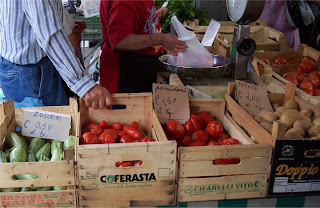
Market day as busy as ever.

Enoteca Fontana still makes the very best roast-beef panino con rucola in the whole world. I just had to check.

Jerusalem 1

After a desperately early start (0245 wake-up time) I left Heathrow on Thursday morning, landed at Zurich, and took off again — so that after a few hours, this…

gave way to this, and we landed at Ben Gurion Airport, Tel Aviv.

I caught a shuttle bus driven by an authentically wild Israeli driver who carried a dozen or so of us at a lively pace towards Jerusalem, and who during a hectic hour while he was busy doing his filing, shouting into his mobile and writing on bits of paper – sometimes simultaneously – had undertaken the further responsibility of encouraging all the other drivers with toots from his horn, and periodically swung swiftly around them while they paused at corners and stop signs to show them how it was done.

Fortunately when I was dropped in my turn, Susan and Bailey the dog were waving a welcome from the balcony and I was ushered inside a large airy flat. After feeding and watering I was ushered out again to try to find our friend and driver who was stuck in traffic around the corner. The reason he was stuck was apparently due to a “suspicious object” at a nearby bus stop. A child soldier with a machine gun held us back while it was being sorted out, and soon enough we were on our way. I had a fabulous tour of the city by night,

and a pause on the Mount of Olives (Robert Maxwell’s in there somewhere, apparently)

before driving down past Gethsemene and its splendid churches. Susan volunteered the interesting fact that “Gethsemene” actually means olive press.

Friday, she said, was an excellent day to visit The Shuk (market), as everyone is rushing around doing their shopping before everything – shops, transportation, the works – shuts down for the sabbath that starts at dusk.

And it was busy indeed. Everything you could need.. bread, tomatoes..

tea…

nuts, fish…

pastries…

enormous pomegranates..

many mushrooms…

squashes twice the size of a man’s head…

nuts, spices, honey…

and a few musicians.

Biodynamite

Saturday I overcame the weekend handicaps imposed by what are generously described as “improvements” on the Underground, and managed to arrive at Victoria coach station in time to welcome my classmate Jenn to London. Off we sped on the trusty number 11 bus, alighting beneath the shadow of St. Paul’s and walked unswayingly across the Millennium Bridge, and along the waterfront until we reached Borough Market,


in good time for the launch of Biodynamic Food Fortnight. We managed to source some fantastic snacks before events began: a toasted Montgomery cheddar cheese sandwich

(watching the cheddar raclette being assembled

made me so faint I was forced to take a native oyster or two from a seventh generation oyster seller.

Revived, we ascended many stairs into the massively crowded Borough Market boardroom. The celebration was all around biodynamic farming methods, which we’d heard about on our trip to Crete. Basically it is to do with sustainable agricultural practices – including respecting the natural seasons of what you grow; organic – chemical free – farming; humane animal husbandry; and some extras that have to do with moon cycles and spirituality which believers say puts the farming back into the earth’s natural cycles. It arises from the work of Rudolf Steiner.

With listeners spilling out the door we had a couple of lively welcomes from guest chefs Michel Roux (Jr.) and Cyrus Todiwala. Roux extolled at some length the beauty of the biodynamic produce and meat he uses, concluding that it was for him a science of respect for the living things we consume. And then Todiwala gave an endearingly sprawling talk which tied together biodynamic farming, Zoroastrianism, poisoned vultures and the omnivores of India. (The poisoned vultures theme was interesting: he was speaking about the use of the anti-inflammatory drug Diclofenac, which is administered to farm animals and which poisons the kidneys of vultures, whose ecological role includes consuming carrion so that wild dogs – who can spread rabies – don’t. He didn’t mention the fact that farmers also deliberately poison vultures, believing them to spread disease among their livestock; and they can be accidentally poisoned by hunters using poisoned bait for other purposes)

We were by this time perishing from heat and overcrowding and too long standing, so we plunged back into the market, which – holy overcrowding! – by now looked like this:

And pushed our way along, glimpsing wistfully a Comté cheese stand…

until we reached the oysters,

where we knocked a couple more back.

Then on to a whirlwind tour of Covent Garden, including of course Neals Yard Dairy, and a bite to eat at Food For Thought. And then through Chinatown and off into the wilds of Kensington to have a browse through Whole Foods, which – after the high street outside, and Borough Market, and just about everywhere else in London – really wasn’t that crowded. Lots and lots of everything there, but we left relatively unscathed.

Spain 7: markets, Barcelona, adios

Two were left behind with awful colds when we set off for Barcelona, and another was on her way to visit the hospital en route. But wait! While crossing the road to the train station I realised my hip had gone out, and rather than wait to see if it righted itself while doing a walking tour of the city markets, I turned tail and joined the fallen for a day of rest. The hip gradually recovered, and thanks to some strange fizzy Spanish anti-inflammatories, I was upright again by nightfall.

Lucky thing too, because Sunday was a free day, and we transferred to the excellently located Residencia Campus del Mar in Barcelona, where we were handed tickets for the Touristic Bus and set free until Monday morning. We took full advantage and circled the town in our yellow headphones, disembarking at the Miro museum an hour before it closed (early on a Sunday afternoon), so after a sprint round there we hopped back on and then wandered up the Rambla until we found somewhere to eat on a side street. Gazpacho, tortilla and paella did the job nicely and thus fortified we ploughed on to Sagrada Familia and Park Guell.

It was cooling off enough to dare riding the top of the bus, which we did until we reached Parc del Palau Reial de Pedralbes, where we made a tactical error by thinking we could sprint across the city to our hotel at Barceloneta faster by metro.

Not quite. It was so late that, nearly home, we stopped for a small but substandard Chinese meal before rousing the security guard – busy spraying flies in his office – and turning in for our last night in Spain.

We gathered at the bus in the morning, a couple of fallen comrades left to rest up, another taken to seek medical help for a mysterious swollen lip that appeared to be an allergic reaction. The rest of us had an excellent talk from communications and quality director Jordi Tolra about the markets of Barcelona, which number 46 (40 of them food markets) and which aim to allow the citizens to be within walking distance of at least one of them.

Would that other cities could follow this policy! Some of them had even made what seem to me unholy alliances with supermarkets – the one where we had our lecture, Santa Caterina (a former monastery which had been, before the monastery, an ancient food market), had a small supermarket within its walls. Tolra explained that the markets are gathered under one umbrella organisation, which is part of the city government, but that the stall-holders themselves are independent, but joined together by trade associations which organise them by food type. These associations, he said, are a long tradition in Catalonia, which was once an independent state with its own king and culture; after it was annexed by Spain, it kept its culture alive by creating Catalan associations, and trade assocations were the first of these.

The markets have received a lot of money which is used for renovation and modernisation of the buildings, to bring them into line with contemporary needs (logistical, technological, environmental).

A few of us who’d missed the Saturday tour were taken round and shown the foundations of the monastery, the seniors’ housing next door, built at the same time as the refurbishment, and the loading areas where a couple of the market’s delivery vans were parked. Hearing that all the stall holders bought their produce at the same wholesale market disillusioned us a bit. There were, our guide said, a few stall holders who sold their own produce, but they were in the minority, and there were hardly any organic stalls either.

While carefully negotiating a hefty lunch from the organic tapas stand at the well thronged Boqueria market, I mulled over what we’d heard.

So if the food markets are buying their produce at the same place as supermarkets, where does the difference lie? I guess the sales are distributed to more and smaller sellers, who have less overhead and perhaps employ (en masse) more people with better expertise in their area. But Tolra was definite on the point that he wanted to drive traffic away from supermarkets and into the city markets: families that packed the kids into the car and drove to a supermarket for the day should be bringing them here instead. His vision of family entertainment was more wholesome than supermarket kiddieland, though: his programs aim to educate school children and offspring of visiting shoppers on food and nutrition, to counteract ‘hamburger culture’ and to bring kids into contact with food producers and sellers as well as teachers and nutritionists.

It’s an interesting and busy area, and the markets have some impressive communication programs going. How successful the markets of the future will be will depend on whether the political winds continue to blow kindly and generously in the direction Tolra hopes to keep sailing.

Spain 5: olive oil, peaches and lots of fish

With one down (massive cava hangover) and a few more beginning to falter (3 head colds, 1 sore back), we set off for Reus (birthplace of Antoni Gaudi!) where we had a tasting of DOP Siurana olive oil (made from small arbequina olives) at the beautiful art nouveau (modernisme) building housing the Consell Regulador de la Do Suriana:

and heard about various other geographically designated products, including rice, hazelnuts, potatoes and tangerines.

Next stop Cambrils, at the Cooperativa de Cambrils y Borges, where we observed the packaging of peaches, destined entirely (or maybe 90%, depending on who you asked) for external markets. Not an organic or artisanal coop, but a very busy one. We visited the agricultural museum which is part of its headquarters, and had a lunch of salad, spaghetti (Spanish local specialty?) and fried fish.

Off we sped to the docks, where we watched a fish market in action. Instead of an auction, like the one we’d seen in Puglia, here the prices are pre-determined, and buyers gather round a conveyor belt where they drop identifying tags on boxes of fish, and then pay the going rate at the end. Anything not sold off the boats in this way goes to the bigger markets at Valencia and Barcelona. We heard about the EU’s method of conserving fish stocks (they buy back the boats and licenses of small fishermen, removing them permanently from the sea — unfortunately as we’d learned elsewhere the slack is being taken up by large scale trawlers). We stepped onto a fishing boat to see the cleaning and sorting involved. The men were hand-sorting the takings from their dragger nets, which scour across the sand and bring up all manner of crabs, crustaceans and smaller sea life. Larger enterprises would chuck these back in the water, dead, but here they were hand-sorted and sold.

Piemonte Thursday

We spent our last day touring Torino‘s ethnic markets with Vittorio Castellani, journalist, broadcaster and self-declared gastronomad, known locally as Chef Kumalé. An anthropologist by training, he has put his background to good use in communicating the issues, circumstances and foods of Torino’s ethnic communities. He’s a writer as well, and worked with our friends at Lavazzo to write Coffee Roots. He was kind enough to agree to an impromptu book signing at our meeting point, outside the Hamam, which originally served as the bath house to Torino’s immigrant workers. We toured the facility later: abandoned for 20 years, it’s been refurbished and offers meeting spaces, a cool and tempting basement restaurant and a turkish bath open on alternating days to men and women.

These are the tenements where the workers lived, above the market. Abandoned now, they held workers from the south of Italy and from many immigrant communities; they still host occasional squatters, many these days coming from China.

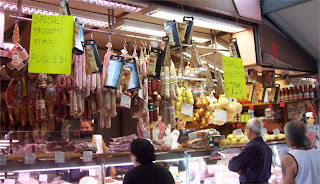
The food market is large and varied and sprawls across many streets and buildings: this is the farmer’s market section, an unusual feature in Italy where the food markets nowadays tend to be straight retail operations selling imported produce. One of Slow Food’s projects is to try to develop a network of farmer’s markets around the country.

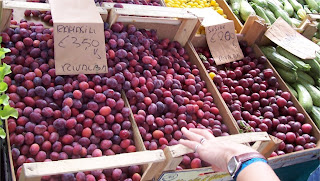
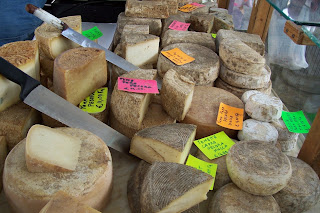
The market changes to reflect the communities it serves. In the enclosed section of the food market, Italian traditional producers now also sell cheeses and salumi tailored to Romanian tastes. There are areas of the market for all the different regions of Italy as well: we passed a little slice of Puglia, way up here in the north.
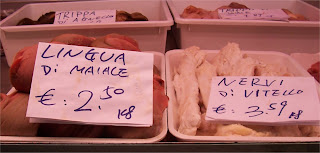
From an Asian-run stand, you can buy a bit of pork tongue or veal nerves. Why not?
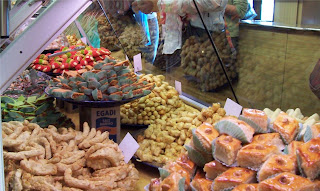
We checked out a local Moroccan bakery, serving that community’s needs for pastries and sweets. These are part of its culture; a social currency as well as a food tied to religious observance. When breaking Ramadan fast, sweets and pastries are some of the allowed items. Packed with dates, nuts and honey they are a quick, effective source of energy to bodies depleted by fasting.
In the courtyard at Torino’s mosque. It’s the simple grey door left of centre in the photo, situated in the courtyard of a tenement well hung with laundry and plastic sheeting. There were 24 of us there, which was comfortable; every Friday afternoon 20,000 moslems head in here for worship, aiming for one of the 200 spaces inside. The ensuing tension and conflict are widely reported, but nobody seems to know what to do about it.

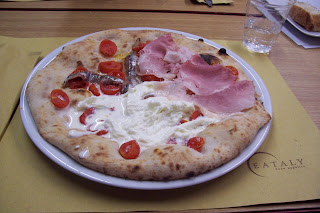
After we parted from Vittorio, we leapt back into the bus and sped off to Eataly for lunch. Built in a former vermouth factory, it’s a large and impressive edifice, one of the new wave of groceries (not unlike Whole Foods?) promising products for all budgets and offering a whole consumer experience. We started our day there with very good bread and lovely pizza (mine had fresh tomatoes, ham, anchovies and burrata – a fresh mozzarella with cream).
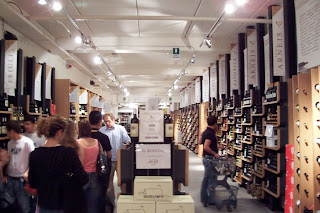
We travelled round the facility with Sebastiano Sardo, Slow Food’s man in Eataly. He shows us a whole lot of beer. Unusual for Italy.

A whole lot of wine. Not so unusual.
A Spanish wood fired oven explained in part why the bread and pizza were so good…

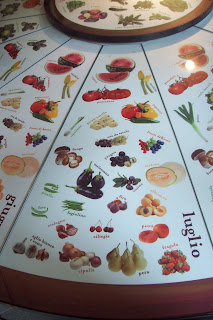
Education is a big part of the picture: the seasonal wheel shows families, as they enter the store, what’s in season here.
The store has a library where you can browse food guides, surf the internet and even buy books and Slow Food paraphernalia.

The foods of Piemonte, a special display which gives a bit of history and background to the foods of the area.
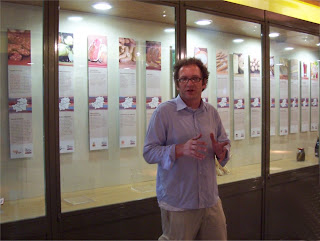
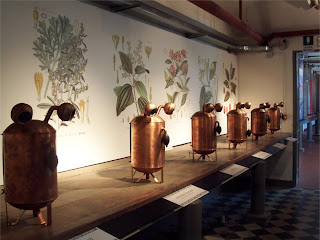
Paying tribute to the building’s origins, there’s a vermouth museum on the top floor, with these cool copper sniffing devices which give you a sense of the relevant aromas.