Skip to content

food tastings

Orford Ness & Game for Everything

Always an auspicious sign, the snail.

This one was living free on Orford Ness, in Suffolk, a blasted landscape in many senses, being a former military testing site and now a valuable nature preserve. A group of poets made a visit there on the weekend in search of inspiration.

It’s made up of 10 miles of seaward-exposed shingle, which we were told comprises 15% of the world’s habitat for coastal vegetative shingle (another 15% is at Dungeness). There are many signs pointing to its military past…

The National Trust man who showed us round told us the bomb disposal squad is still called out to deal with unexploded bombs some 15 to 20 times a year.

After our walk we returned to little Blaxhall

for some tea, and then made our way back to Orford for supper at the Butley Oysterage, where I dined handsomely on griddled squid

and grilled Dover Sole. A poetry workshop followed, accompanied by a very fine smoked salmon terrine with potatoes and leeks, and some of Orford’s best smoked chicken.

Then before I could turn around it was Tuesday, and time to join some of London’s Slow Foodies for a night of wild food from Mark Gilchrist, who shoots, butchers, dresses and cooks all his own game.

He started us off with a plate of assorted duck appetisers: Teal liver pate; Pintail confit; air-dried Pintail; salted, cured and smoked Widgeon, served with fresh brioche and kumquat jam.

Then a pan-fried fillet of Roe deer

And then he put on his butcher’s coat and demonstrated how to skin and joint a hare, and told us how to make a ragout of hare like the one he was about to serve on freshly-made tagliatelli.

The ultimate dish was Conference pear tarte tatin

which, containing molten caramel, must be turned onto its pastry base with care…

And of course it must be served with a drop of cream.

Spain 5: olive oil, peaches and lots of fish

With one down (massive cava hangover) and a few more beginning to falter (3 head colds, 1 sore back), we set off for Reus (birthplace of Antoni Gaudi!) where we had a tasting of DOP Siurana olive oil (made from small arbequina olives) at the beautiful art nouveau (modernisme) building housing the Consell Regulador de la Do Suriana:

and heard about various other geographically designated products, including rice, hazelnuts, potatoes and tangerines.

Next stop Cambrils, at the Cooperativa de Cambrils y Borges, where we observed the packaging of peaches, destined entirely (or maybe 90%, depending on who you asked) for external markets. Not an organic or artisanal coop, but a very busy one. We visited the agricultural museum which is part of its headquarters, and had a lunch of salad, spaghetti (Spanish local specialty?) and fried fish.

Off we sped to the docks, where we watched a fish market in action. Instead of an auction, like the one we’d seen in Puglia, here the prices are pre-determined, and buyers gather round a conveyor belt where they drop identifying tags on boxes of fish, and then pay the going rate at the end. Anything not sold off the boats in this way goes to the bigger markets at Valencia and Barcelona. We heard about the EU’s method of conserving fish stocks (they buy back the boats and licenses of small fishermen, removing them permanently from the sea — unfortunately as we’d learned elsewhere the slack is being taken up by large scale trawlers). We stepped onto a fishing boat to see the cleaning and sorting involved. The men were hand-sorting the takings from their dragger nets, which scour across the sand and bring up all manner of crabs, crustaceans and smaller sea life. Larger enterprises would chuck these back in the water, dead, but here they were hand-sorted and sold.

Spain 3: bread and sausage

On our second day in Spain, we headed to the University of Vic, also known as UVic (- and I guess, fair enough, they have more claim to the name than Victoria, which lacks a school of idioms).

On our way across campus, we passed a steely statue commemorating Catalonian poet, the letters of whose name had been picked off the base, so I can’t tell you who it was. But perhaps we can assume a towering intellect?

We had a presentation by a nouveau baker called Francesco Daviva who runs Forn de Pa Altarriba, where for 25 years he has been trying to radicalise bread. He talked about the shape of bread (there are only three: round, baguette, loaf/square), its presentation on restaurant tables, and the various ways of making it divisible for diners. Mediterranean tables seldom have bread plates, so there are issues about crumbs and cutting that quite naturally have to be considered: the sorts of things I suppose bakers used to instinctively incorporate into their work instead of giving a stand-up lecture. Although we passed a few rolls around to look at shape and colour and aroma, we were not offered anything material to chew on, and wandered off for an hour or so before reconvening for lunch in a campus cafeteria. (The bread at lunch was, well, unremarkable.)

It was blistering hot when we followed the leader to our next destination, Casa Riera Ordeix, to see some more sausage-making. Curious emblem over the door…

Fuet, (Salchichon de Vic) the sausage of Vic , has been made for about 150 years in the centre of Vic, run to this day as a family business. This was high quality meat: nothing but prime cuts of pork (well trimmed legs and pork belly for fat). They produce 3000 kg of sausage per week from January to July and then double the volume between September and Christmas, as it’s a product traditionally eaten at Christmas. They have a strictly scheduled week: Mondays they fill the casings; Tuesdays through Thursdays they trim the meat, as we saw:

Fridays they grind and season the meat, which is left to macerate over the weekend. The sausages are hung from nails in aging rooms where the temperature and humidity – much like prosciutto di parma – are regulated by opening and closing windows; the local flora of course play a part in the curing.

The sausages are brushed and re-hung periodically until they have done their two to three months’ stint. The product was absolutely delicious: spicy and peppery, firm and chewy. They sell the sausages everywhere in the world — except Canada and the US whose hygiene regulations exclude these and a great many artisanal products. (Hey y’all: the Europeans eat this stuff every day and are still standing…!)

(Except for the one who fell ill during the tour; perhaps heat, perhaps an early symptom of the flu that would catch up with her later.)

We packed our bags and headed to our next destination in Calafell, where we checked into the weird and somewhat horrible Hotel Solimar, a massive complex where we got to witness European-style mass tourism close up. Luckily our university escorts reviewed the offerings at the hotel buffet we were supposed to eat from that evening and realised it was in fact an inedible wasteland of fried and processed foods, prefixed by stacks of badly washed plates, and so we got to choose our meal in the somewhat better offerings along the seafront.

Spain 2: cured meat and wine

Our first day we left behind three casualties: two recovering from queasiness from the previous night’s tapas feed, and one sore throat.

We drove through the wooded hills – a surprise to many of us, expecting a parched, desert-like landscape – to sausage-maker Fussimanya, which has been operating for 35 years. It started life as a restaurant serving Catalan specialties, and, as we had a chance to discover, is still hugely popular (it was pretty much full on a Monday lunchtime when we left). They began by making sausages for the restaurant but now produce a full range of products which are sold through their own shops on the site and in Vic.

Here we watched the production of brisba, a hefty boiled sausage which comes in white (made from a lot of things you might not wish to see listed here) or black (made from blood, fat and meat).
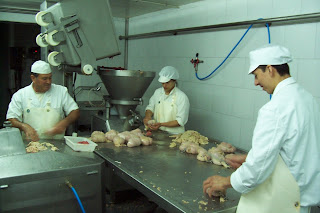
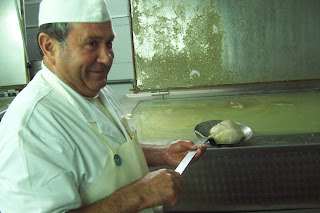
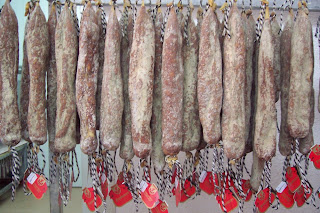
They also make five varieties of cured sausage: longaniza, churizada, chorizo, fuet and sumaya. This one, fuet, uses 3 grams of pepper per kilo of meat: whole peppercorns inside and ground pepper outside; it’s a firm, dry sausage, very moreish as we discovered in a tasting.
We also got to see how the traditional wine vessels are used:
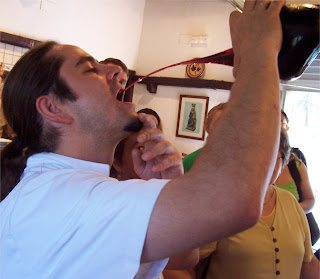
No wine was spilled, but one knee was grazed, ironically right after negotiating oh so carefully the slippery floor of the factory.

Afterwards we were taken for a look at Vall de Sau Collsacabra – a valley whose centre is a drowned village, its church steeple showing in times of drought – as now – from the middle of the lake. This was part of Franco’s legacy, the translator told us; he wanted to bring water to the country and created a series of artificial lakes through damming rivers and walling in valleys, and drowned more than one village in the process. I’m not sure what the villagers must have thought of it all, but such areas are now rich playgrounds, studded with posh hotels like the one we were standing in front of. Nearby was a former Benedictine monastery (Sant Pere de Casserres) which had been founded in 1005 but abandoned after the 14th century; it was restored in 1998 and is a popular attraction– but we didn’t get to see it.

Instead we headed back to Fussimanya for a long and excessive lunch:

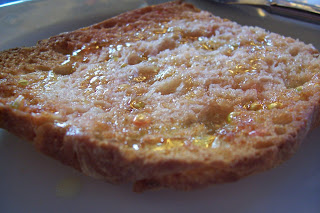
More pan con tomate..
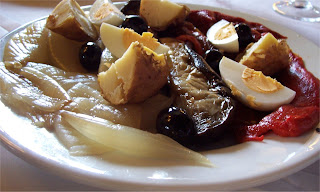
Cold roasted vegetables:
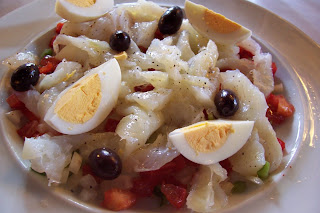
A platter of raw cod:
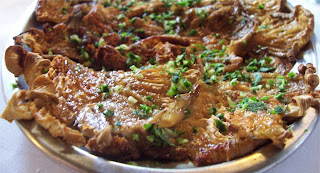
Some fried mushrooms:
The ever present aoli, called allioli in Catalonia:
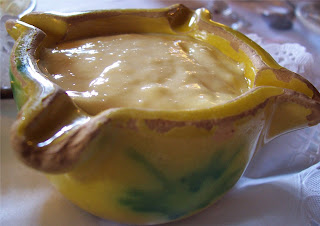
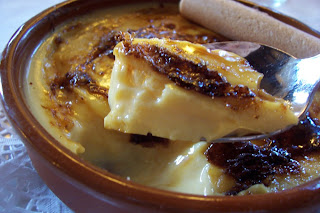
Crema Catalana: is it so different from Crème Brûlée? We thought maybe it was not as dense a custard. And served in this characteristic bowl, with the wafer.
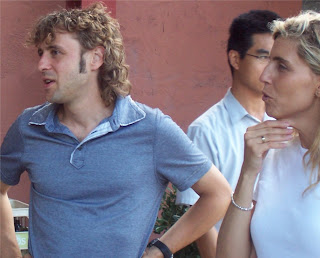
After lunch we drove to Santa Maria d’Horta d’Avinyo to visit the winery Bodegues Masia d’Avinyo, home of the Roqueta family, wine producers since the 12th century.

Most of the old bits and pieces from this history of winemaking are now part of a museum. We saw the sunken wine vats, over which were suspended ropes for the grape-treaders; a system of drains then allowed the juice to drain out by gravity. The vats had to be cleaned by hand, but it was very dangerous work, because there could be a lethal build-up of carbon dioxide, and so in a twist on the canary in a mineshaft idea, the winemakers suspended cats inside first; if they died, it wasn’t safe to go in. Lucky for the local felines, they later realised that candles worked just as well.

Here’s an olde worlde kind of way to put corks in your wine bottles:

We had a small lesson in historical market economics as we finished the museum tour. This was always a big wine producing area, and became even more so at the end of the nineteenth century, when phylloxera had devastated the vines of France and stepped up demand for Spanish wine. Many of the French workers moved to Spain. Once the French restored their industry (by grafting their vines onto phylloxera-resistant American root stock), and when phylloxera reached Spain in the 1890s, Spanish wine production dropped still further; with the arrival of the industrial revolution, the winemaking families turned to more reliable factory work, so it became difficult to convince workers to return to the vineyards. But the winery is now producing some 476,000 bottles a year, under the supervision of youthful oenologist Joan Soler.
They produce two labels (Roqueta and Avadal) and we enjoyed a tasting of some of Avadal’s offerings. Here’s the elegant tasting room, lined with barrels that have been autographed by visiting celebrities, including Ferran Adria who we’d be meeting just a few days later.
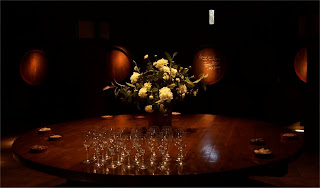
The wines included Picapoll – a local grape named for a Catalan word meaning how chickens peck. Quite an acidic one. Then a very nice Chardonnay, a couple of Merlots and a Cabernet Franc/Cabernet Sauvignon/Syrah blend.

And then back to Vic, where thanks to a free dinner, and a possible bad reaction to some gazpacho, two more of our classmates would fall to stomach ailments.

Piemonte Wednesday

We had a morning at the Pollenzo campus with some of the Slow Food folk on Wednesday. Representatives of the Slow Food International, Slow Food Editore and the Foundation for Biodiversity gave us a talk on their mandates and activities. It was a helpful boost to our understanding, half a year since our last talk from them, and was particularly useful for classmates hoping to do internship postings with the organisation. We left for Bra, where the offices and our lunch were waiting.

Where it all began: the restaurant in Bra where the Slow Food movement became a reality.

Italian sushi, quipped Piero Rondolino, who joined us for lunch. We had lardo, salsiccia di Bra – a delicately spiced raw veal sausage, and carne cruda battuta al coltello (raw, hand-cut veal). All delicious.

Then some pasta, followed by the best panna cotta in the world? Maybe, surely in the running, lots more research needed. It was sweet, soft, delicate. Creamy but not too rich. And very pretty.

Back on the bus, after a shuffle round the hot, closed-for-lunch town, and away we sped towards our final Italian winery in San Martino Alfieri. Not sure what was ahead, we strolled up the path…

Heading in the right direction for Marchesi Alfieri winery…

A very old grapevine (for table grapes)

And hey presto there we were in a castle with beautiful grounds, meeting our winemaker Mario Olivero, who gave us another talk about my beloved Barbera, which is the main one of the several varieties of red wines they produce. A neglected grape, it was dismissed as fit only for table wine until about fifteen years ago, when a few and then many Piemonte winemakers began to take it seriously for its fruit and body and capacity for ageing. Now there are some 50 million bottles produced in the region, and it’s the area’s second most important variety. We sampled a couple of different years each of Marchesi Alfieri’s Alfiera and La Tota wines, and yes they were very good indeed.

After the cellar tour, Marco introduced Elena Rovera, from Cascina del Cornale, the organic cooperative that is an agriturismo, restaurant and seller of organic products, situated in Magliano Alfieri, between Alba and Asti. And what a spread she put on for us…


Piemonte Tuesday

Breakfast on the road. Only at the best eateries in Italy? Surprised us all by having what might be the best croissants we’d ever tasted.

Unfortunately good taste did not extend to their selection of Hitler beer and dictator wines…

We arrived in Torino ready for our day of coffee at the Lavazza Training Centre, and sure enough we were coaxed into our seats after lashings of freshly made Lavazza espresso. After a morning learning about the ins and outs of Italian coffee production and marketing, and a bit of the bean’s history and geography, we went for a tasting session of a dozen different coffees, both robusta and arabica varieties.

There was a dramatic difference between all of them, tasted side by side like that. Under the natty tutelage of the company’s Golden Palate, we learned the sniff ‘n slurp method of coffee tasting, and heard about the differences between wet and dry processing: washed and unwashed beans, and the various ways of preparing them for roasting. We got a whole new tasting vocabulary, learning new defects like quakery, grassy, woody and fermented.

Lavazza has the biggest roasting operation in Italy and the lion’s share of the domestic market, and so it’s important to keep pressing forward to stay ahead of the competitors (…can I resist saying: in the poisonous growth economy we find ourselves in?) and we heard about a few of the new product lines, which ranged from worthy to silly. Many of them were spawned (and as you will shortly see I use the word advisedly) through the company’s partnership with Spanish foam-meister, chef Ferran Adria.

Here we see the Coffeesphere, a bit of complicated nonsense to create a hit of sweet, gooey coffee substance that has the shape and texture of a soft-boiled egg yolk.

And syringes, perforated plexiglass slabs and a snappy lab coat are required to make the same thing, only smaller, so they can call it coffee caviare.


There was also a sweet, sticky foam coffee that came out of a nitrogen canister, like the ones restaurants use for whipped cream, making something called Espesso that, being foam, is the coffee that doesn’t spill. They’ve even designed a special coffee spoon with a hole in the middle as if to prove to skeptics that it really isn’t a liquid anymore. Well, maybe in a market that finds Italian television watchable it could work, I don’t know.

And this miracle of twentieth century necessity: your very own tube of UHT milk foam for those moments of crisis when you must have spuma (foamed milk) now now now. If that’s the sort of thing that amuses you, you might want to invest in a special plastic cup with a divider in the middle to drink it from. I guess what I found most disturbing about the innovation section was the amount of packaging and plastic and all round waste it was generating for the sake of stimulating a saturated market. We’re a long way from a simple coffee bean here.

The company has other promotional devices, like their vamped up girlie calendar (shades of Italian television with its partially dressed presenters) that made me feel less and less Italian by the minute. But produces some excellent print publications. And there’s its worthy sustainability project, Tierra, which lets the company pump a bit of money and development aid back into coffee-growing economies. Long may that project last.

We finished our day with a tour of the highly automated factory, dodging unmanned forklifts and miles of conveyor belts, and pondered the acres of warehouse with its robotic shelf-stockers gliding silently up and down the towers of packaged coffee, reading bar codes and pulling pallets out and putting pallets in. Surreal and strange and not a little overwhelming.

And then we were turned out for a free hour or so in the hot streets of Torino – everything having just shut for the evening – until it was time for supper at Pizzeria Le Rondini, with its decidedly, and thankfully, manual production methods.

Many of us had the house specialty, which had a thick, chewy crust filled with fresh ricotta, and topped with buffalo mozzarella, fresh tomatoes and salami.

We dined with Piero Rondolino, owner of Tenuta Colombara, a farm which produces the estimable Acquerello Rice, whose business we sadly didn’t get to visit. He grows the prestige risotto rice variety, Carnaroli, and ages it to give it better flavour and texture. It’s an organic business, and he uses a number of creative methods to manage it; he told us about the dragonflies they introduce to the fields to eat the mosquitoes that breed there.

After supper, a few of us slipped away to bide our time in the neverending summer evening queue at Grom‘s mother ship.