Skip to content

food tastings

Lodi: mozzarella and ricotta

We had a day out today, and watched some small scale mozzarella cheese making in the Istituto Sperimentale Lattiero Caseario/Institute of Dairy Science in Lodi, not far from Milan. The lab is equipped with a cheese making facility and over the course of our day-long visit, the master cheesemaker whipped up a batch of mozzarella and a little ricotta for us.


Mozzarella curd: whole milk from the institute’s dairy farm has been acidified (lowering the pH from 6.8 to 5.85) with citric acid (interesting to see it’s useful for more than cleaning one’s kettle).


Mozzarella curd: cut, drained, cut and then left to drain again.


Mozzarella curd: cut, drained, cut, drained and now cut again.


Mozzarella curd: cut, drained, cut, drained, cut, drained and then put into the basin; cut once again. Then some hot water (around 90 degrees c) is added and the stretching begins.

Hand stretching the curd – a slower, lower-yield way to make mozza. The advantages are that any problems with texture can be dealt with right away, so you end up with a better quality cheese. But you’d go bust doing it: the volume of milk you need to process to make mozzarella, together with the greater loss of milk solids into the liquid, and the slower processing (man ain’t no machine) just aren’t cost effective these days.

Stretching the cheese; shaping it into balls. Stretchy stuff with characteristic threads (elongated casein strands, eh?): practical heat and chemistry.


Hand-adjusting the steam-heated vats to start making ricotta from the mozzarella whey. Ricotta, we now know, means ri-cotta, or re-cooked/twice cooked. (Want to make your own? Here’s an illustrated guide.)


The whey starts off at the same pH as the mozzarella curd (around 5.85 – lowered from milk’s natural pH of 6.8). Sodium hydroxide was added in order to raise the pH to what’s needed for ricotta, between 6 and 6.5; the pH is regulated and if it goes too high, more citric acid can be added to lower it again. In the process we watched, there was a mistake – the pH gauge was too close to the sodium hydroxide when that was added, and gave a faulty reading, so it never quite worked out while we were watching. Which was instructive: we saw the effect of curds that were too small to bind properly for ricotta. However, under optimum conditions, the whey begins to coagulate and – after adding milk (around 6% in this case, although up to 20% might be used) – the foam needs to be skimmed off. The ricotta is then poured into baskets to drain and set, and is used most often in pasta and cake fillings.


In one of the labs: Roberto Giangiacomo tells us about a piece of equipment called ‘the sniffer’ while Richard Gere and Clive Owen look on.

Raspberries and blueberries

A nice campus to visit is Virtual University. Cheap (US$20 for up to 4) classes and one useful freebie that’s already underway this week: How to Prevent Identity Theft and Online Fraud. They have courses in PaintShopPro for anyone that has this cheaper-than-Photoshop application, and some writing classes (but no poetry, at least not this time).

I happened upon a leaflet promoting the Urban Farm Market and Urban Feast Stage which are being offered (free!) as part of Open Air 2006 right through till September. Upcoming on July 23 is featured chef Christopher Moore of the Union Club, July 30: Rick Choy from Hotel Grand Pacific; August 6: Mike Upward, James Bay Inn; August 13: Patrick & Christabele Simpson, The Marriott Inner Harbour. I fear I might be turning into a food demo junkie…

Fresh fruit abounds. I weakened at the sight of a flat of raspberries at the Red Barn Market last week and brought them home to my freezer. I have a couple of good recipes already. I tried the very tasty Gâteau au Yaourt à la Framboise from a wonderful blog, Chocolate & Zucchini which Bonnie sent me a while ago. At that point I was a little short on raspberries so I used half blueberries and it worked well. I’m going to try her blueberry coffee cake recipe next.

From the Lighthearted Cookbook, I have long been a fan of Raspberry-Yogurt Küchen, which has a shortbread base and berries smothered in a baked creamy yogurt topping: particularly nice I think if you make it ahead and served chilled. This time I substituted mostly loganberries, which seemed to me to lack a little zip. Here’s a slightly amended version (I no longer own the cookbook so I’m not sure where I deviated):

Base
1½ cups flour
½ cup sugar
1½ tsp baking powder
1/3 cup butter
1 egg
1 tsp vanilla
3 cups fresh or frozen raspberries
Topping
2 tbsp plain flour
2 cups plain yogurt
1 egg lightly beaten
2/3 cup sugar
2 tsp grated lemon rind
1 tsp vanilla

  • Mix flour, sugar, baking powder, butter, egg and vanilla. Mix well and press into a 10″ square cake pan or springform or flan dish. Sprinkle with raspberries.
  • In a mixing bowl, sprinkle flour over yogurt. Add egg, sugar, lemon rind and vanilla and mix until smooth. Pour over berries.
  • Bake in 350f/180c oven for 70 minutes or until golden.

Peace reigns, most of the time, in the foster animal kingdom:

Is nothing safe?

Appalled to see that a salmonella outbreak in the UK was traced to Cadbury’s chocolate bars! But relieved to see that the source was not the chocolate but the crumb base. So purists can rest easy and carry on with that therapeutic intake.

Yesterday I found the perfect activity for the first gentle day of our heat wave: a visit to Merridale Cidery. We did the self-guided tour to see where and how the cider was made, admired the acres of apple trees and then enjoyed a small tasting of half a dozen of their products. Apple juice was thoughtfully provided for our under-age companion, who was at an age to enjoy the faerie fixtures that were strategically placed to help her endure the tour.

Scrumpy and Traditional Cider were my favourites. In West Country dialect, “scrump” meant to steal apples, and so Scrumpy was the name for pilfered apple cider. At 11% alcohol it was described as a “sit down” cider, and mercifully Merridale has departed from the traditional recipe which calls for raw pork as one of the ingredients.

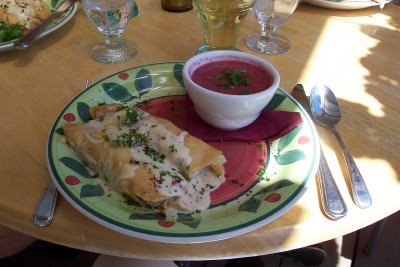
Merridale puts on a mean spread in La Pommeraie Bistro, where we sat outside on the covered veranda and admired the orchard. I had some very nice pulled pork and apple crepes and the soup of the day, a cold honeydew-raspberry concoction which the waitress accurately described as “a smoothie without all the sugar”. It was garnished with chopped mint and gently flavoured with dill and was just the thing for a warm summer day.

The perfect surprise for this melting heat we’re facing was the arrival of my copy of Loutro Poems, an anthology of poetry by writers who attended World Spirit poetry courses 200-2005, lavishly illustrated with colour photos. As if I could forget…