Skip to content

anthologies

Sublime

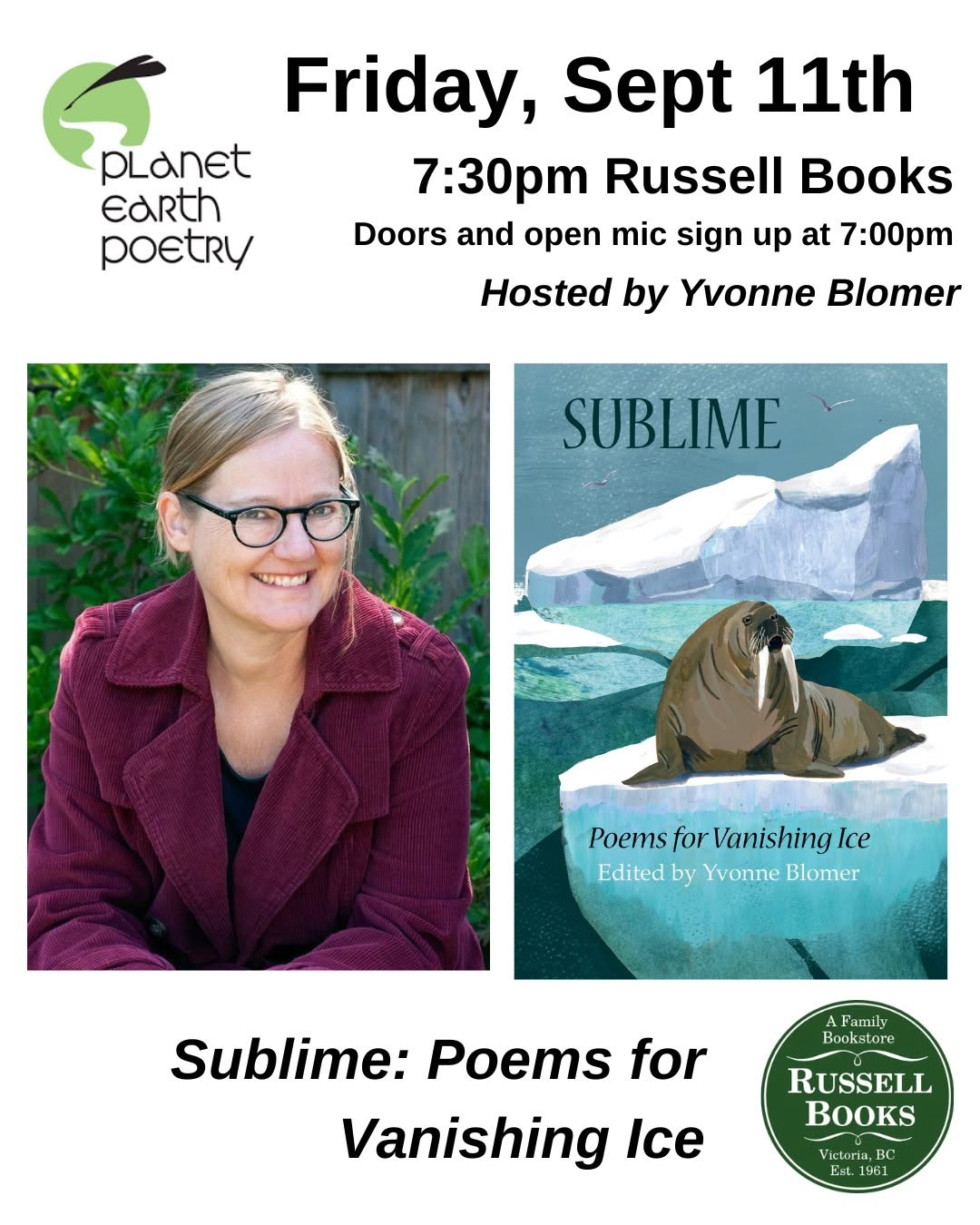
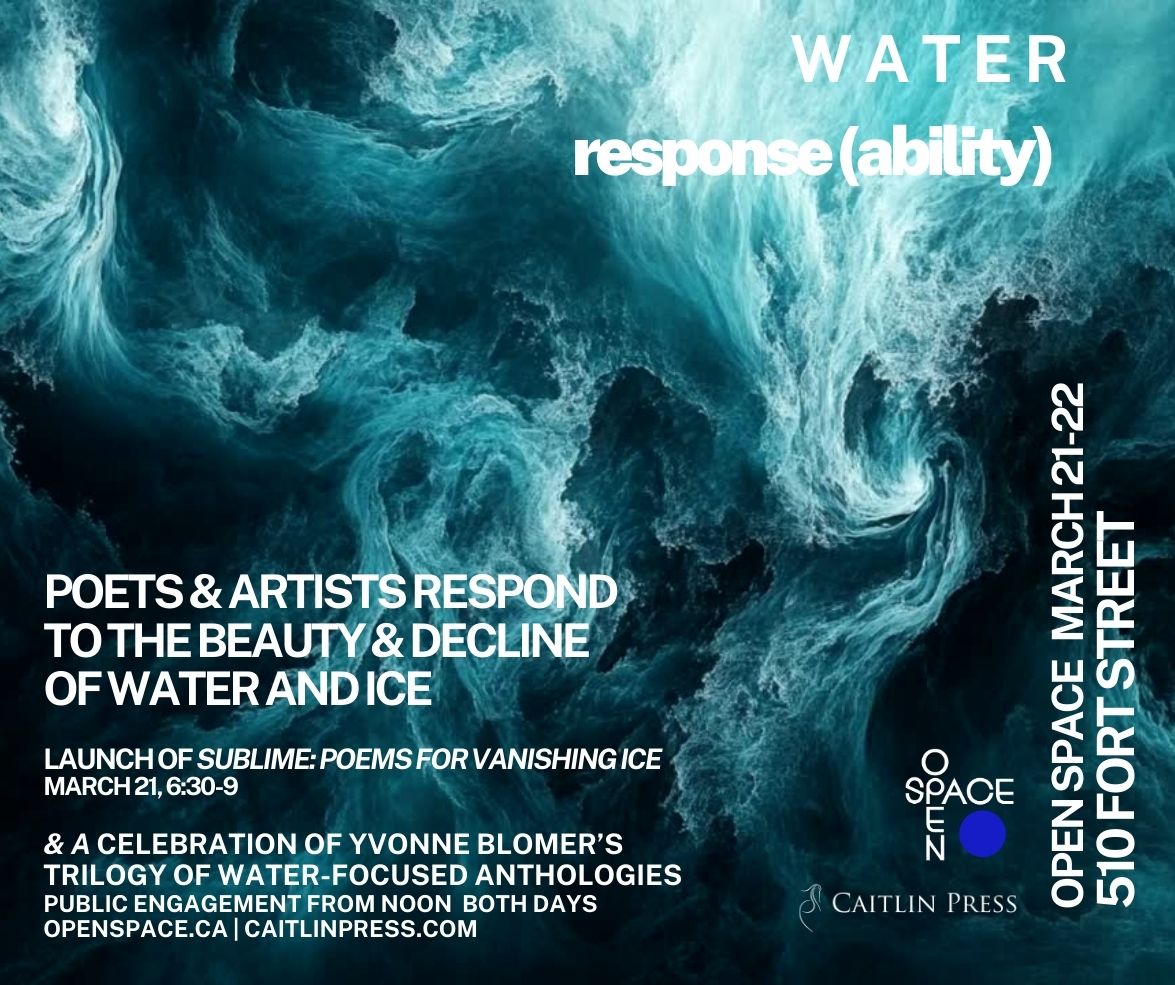
I was honoured to be one of the 110 poets included in Yvonne Blomer’s latest and last poetry anthology dealing with the difficult aspects of climate change and water.

Sublime: Poems for Vanishing Ice is now freshly launched, following two days of readings, commencing on what was appropriately both World Poetry Day and World Water Day.

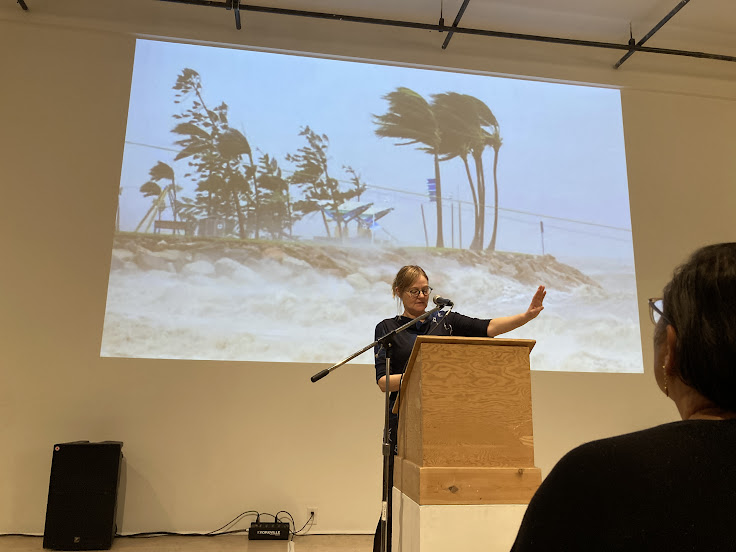
Not all 110 poets featured read, but 28 of us came from near and far, with pleasure, gratitude and admiration for Yvonne’s perseverance over the past decade of her work on the trilogy.


Three gorgeous posters for silent auction: Refugium, Sweet Water, and Sublime.

Sublime launch!

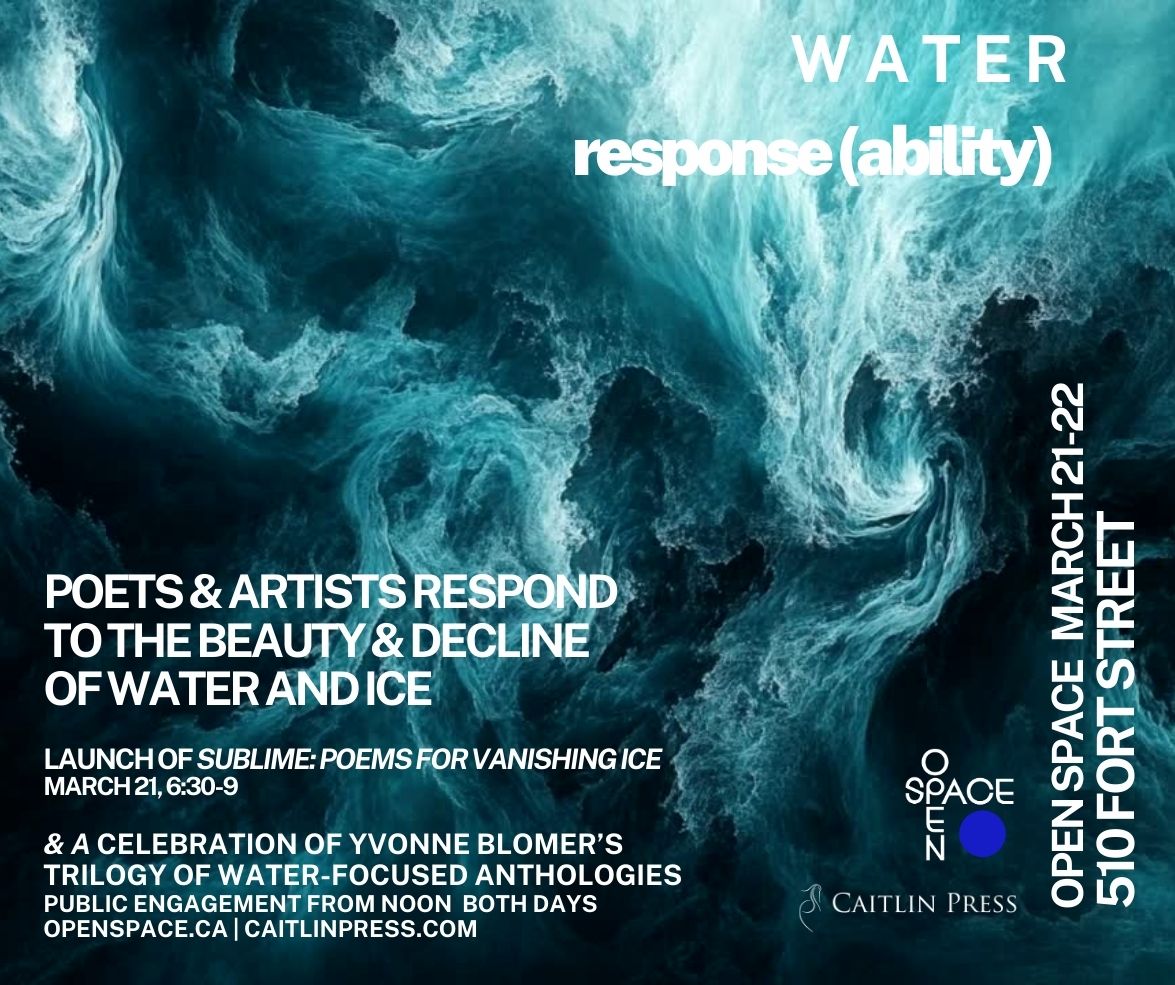
The amazing Yvonne Blomer has completed her massive editing project – a trilogy of poetry anthologies about water – Refugium addressed concerns about our oceans; Sweet Water, the watersheds; and now Sublime: Poems for Vanishing Ice makes its debut (with snowcones!) on World Poetry Day (March 21) and (March 22), at Open Space. The launch days include joyous mingling, workshops, and  lots of other stuff. Here’s the story so far – hope you can join us!

Saturday March 21 Gallery hours from 12-5
Launch from 5:30-9
12-9 – Exhibit of visual art, videos and knowledge displays
12:30-2 – Ekphrastic poetry and collage workshops
12-5 – CRD Table “A Drop of Water”
5:30 evening event begins: public coming to attend the reading can come early to view the art and videos and interact with the books and collage table
7:00 launch of Sublime: Poems for Vanishing Ice
Yvonne opens the evening reading and performance. Poets will read dispersed by performance art by Grace Salez, Judie Price, Jane Story
9:00 event ends.
Sunday March 22 Gallery from 12-5
12-5 – Exhibit of visual art, videos and knowledge displays
12:30-2 – Ekphrastic poetry and collage workshops
12-5 – CRD Table “A Drop of Water”
3-4:30 – Second reading with questions from audience
4:30-5 – mingle, chat, vide videos and art Auction of Cover Art posters


Worth More Standing – Nanaimo Launch

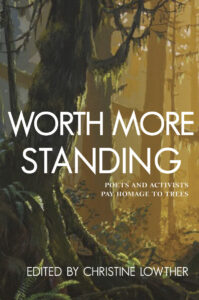
Followers of environmental news will know of the ongoing protests over old growth logging at Fairy Creek, southwest Vancouver Island. In tune with this, Christine Lowther named the substantial anthology she’s edited for Caitlin Press Worth More Standing.

Clocking in at 239 pages, the anthology is a veritable forest of Canadian poets paying homage to trees of all kinds. I am one who contributed two poems to this work, including a poem from Larder.

On Saturday May 28 I will join five other poets at the Harbourfront Library in Nanaimo to help launch this with a live, in-person reading.

Poets who will be reading at the Nanaimo launch include: Leanne McIntosh, Ann Graham Walker. Rhona McAdam, Nicole Moen, Sheena Robinson and Kim Goldberg.

The reading runs from 1-3pm and is free and open to all.

Reading at Malahat Review Fall Launch Wednesday November 9

Next Wednesday, November 9 The Malahat Review is holding its fall launch party at The Well in Victoria. The launch party is one of the things I really love about this magazine: never more than in these days of precarious arts funding, every literary publication deserves celebration. On this occasion I am delighted to be reading with Tom WaymanZoey PetersonRichard OslerJulie Paul.

I have crossed paths with Tom Wayman numerous times over the years, and did so again yesterday when we shared the airwaves on CFUV radio, being interviewed by Colin Dower and Brian Mason. Tom was asked about his passion for work poems: he’s edited a couple of anthologies of these, and my poem “The Grievance” (from Creating the Country) was included in the “Less Like Ants” section of  Paperwork, back in 1991. He also included “Infinite Beasts” (from Hour of the Pearl) in The Dominion of Love, an anthology of Canadian love poems published in 2001.

The publication of “Dowsing Stick” in Issue 176 marks my fourth appearance in Malahat Review since 1984, and I’m happy to be back in its pages. Hope to see you at the launch! 7:00 p.m. Wednesday, November 9th at The Well, 821 Fort Street, (between Quadra and Blanshard), Victoria BC. FREE Admission.

Is nothing safe?

Appalled to see that a salmonella outbreak in the UK was traced to Cadbury’s chocolate bars! But relieved to see that the source was not the chocolate but the crumb base. So purists can rest easy and carry on with that therapeutic intake.

Yesterday I found the perfect activity for the first gentle day of our heat wave: a visit to Merridale Cidery. We did the self-guided tour to see where and how the cider was made, admired the acres of apple trees and then enjoyed a small tasting of half a dozen of their products. Apple juice was thoughtfully provided for our under-age companion, who was at an age to enjoy the faerie fixtures that were strategically placed to help her endure the tour.

Scrumpy and Traditional Cider were my favourites. In West Country dialect, “scrump” meant to steal apples, and so Scrumpy was the name for pilfered apple cider. At 11% alcohol it was described as a “sit down” cider, and mercifully Merridale has departed from the traditional recipe which calls for raw pork as one of the ingredients.

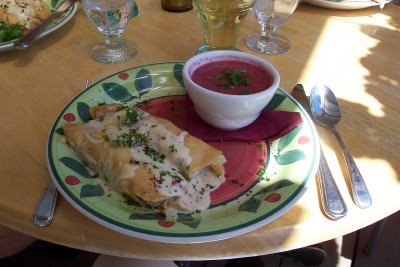
Merridale puts on a mean spread in La Pommeraie Bistro, where we sat outside on the covered veranda and admired the orchard. I had some very nice pulled pork and apple crepes and the soup of the day, a cold honeydew-raspberry concoction which the waitress accurately described as “a smoothie without all the sugar”. It was garnished with chopped mint and gently flavoured with dill and was just the thing for a warm summer day.

The perfect surprise for this melting heat we’re facing was the arrival of my copy of Loutro Poems, an anthology of poetry by writers who attended World Spirit poetry courses 200-2005, lavishly illustrated with colour photos. As if I could forget…

Chicken salad and the mysteries of poetic craft

In a weak moment I bought one of those pre-barbecued chickens, basted in salt and lathered with a toxic red substance. Still, it left me with enough cold chicken for a good old chicken salad, a food that – like tuna casserole – was mysteriously absent from my upbringing and which I have embraced in later life. Here’s a perfectly straightforward recipe, based on one from the Fanny Farmer Cookbook:

2 cups cooked chicken, skinned and chopped
1 chopped green onion
1 rib celery, chopped
1/2 cup mayonnaise
2 tbsp plain yogurt
1 tbsp wine vinegar
Salt and ground pepper to taste

Combine mayonnaise, yogurt and vinegar and blend well; add seasonings. Toss chicken, onion and celery with dressing until well mixed. Serve as a salad, on a bed of greens, or as a sandwich filling, on toasted English muffins. Why mess with simplicity? Have it with a lovely bowl of Edamame, drizzled with sesame oil and dusted with salt.

It hardly needs saying that Mark Strand is not a chicken, or a salad, nor even simple, but interesting to know he is Canadian-born (PEI). I first came across his name as co-editor (with Eavan Boland) of the form poetry anthology, The Making of a Poem. He’s also published a handy little book of essays on poetry called The Weather of Words. I’m finding it heavy going, but there are always moments in any such collection, and so I soldier on. I thought this, from the start of Notes on the Craft of Poetry, was an interesting take on it:

“Each poem demands that I treat it differently from the rest, come to terms with it, seek out its own best beginning and ending. And yet I would be kidding myself if I believed that nothing continuous existed in the transactions between myself and my poems. I suppose this is what we mean by craft: those transactions that become so continuous we not only associate ourselves with them but allow them to represent the means by which we make art… To a large extent these transactions I have chosen to call craft are the sole property of the individual poet and cannot be transferred to or adopted by others. One reason for this is that they are largely unknown at the time of writing and are discovered afterwards, if at all.”

He quotes Orwell’s rules of good writing, and questions whether these or any rules can really be applied to poetry: “For the poems that are of greatest value are those that inevitably, unselfconsciously break rules…”

His argument against craft is that it cannot work as a defining or diagnostic concept, because poetry “cannot be understood so much as absorbed.” He seems to be an advocate for mystery, arguing that we not attempt to impose a structure on the process of creating poems, because to do that is to imply a common purpose for poetry, which it eludes, because a poem’s purpose “…is not disclosure or storytelling or the telling of a daydream; nor is a poem a symptom. A poem is itself and is the act by which it is born. It is self-referential and is not necessarily preceded by any known order, except that of other poems.”