Skip to content

water

Sublime

I was honoured to be one of the 110 poets included in Yvonne Blomer’s latest and last poetry anthology dealing with the difficult aspects of climate change and water.

Sublime: Poems for Vanishing Ice is now freshly launched, following two days of readings, commencing on what was appropriately both World Poetry Day and World Water Day.

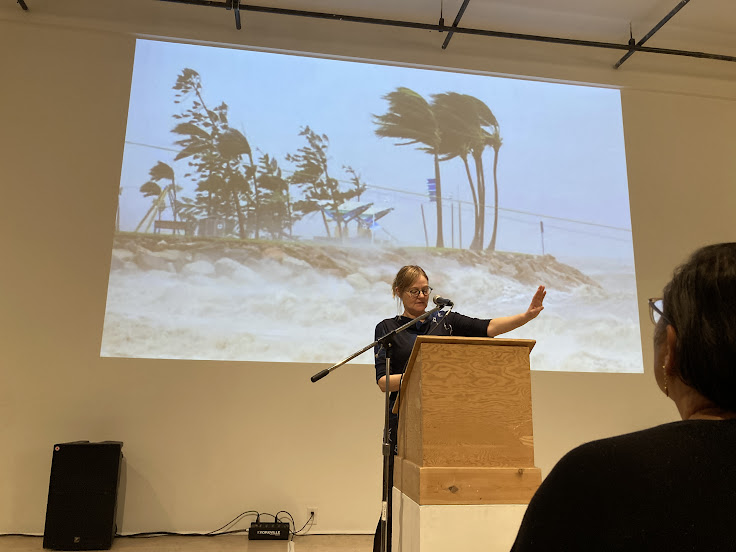
Not all 110 poets featured read, but 28 of us came from near and far, with pleasure, gratitude and admiration for Yvonne’s perseverance over the past decade of her work on the trilogy.


Three gorgeous posters for silent auction: Refugium, Sweet Water, and Sublime.

Sublime launch!

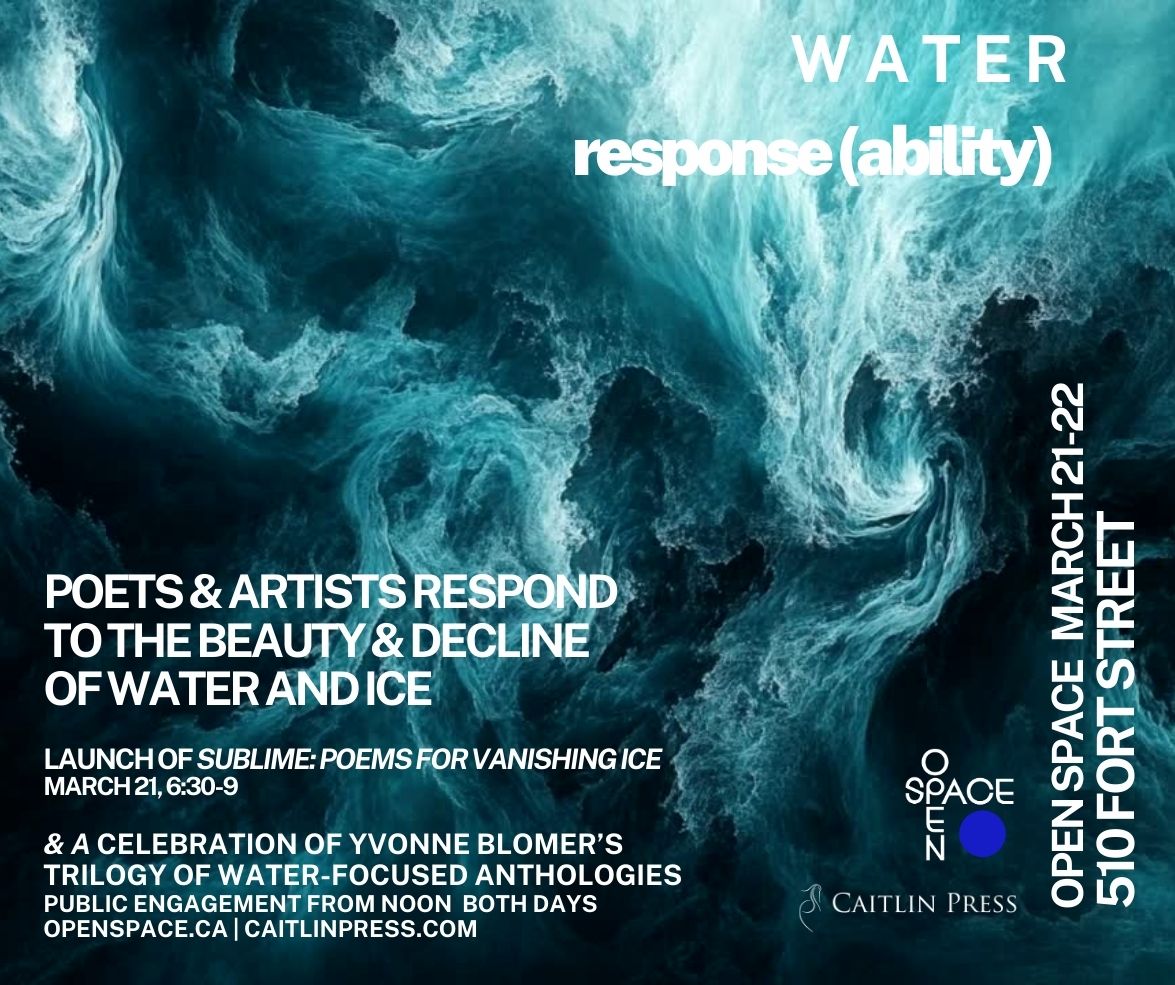
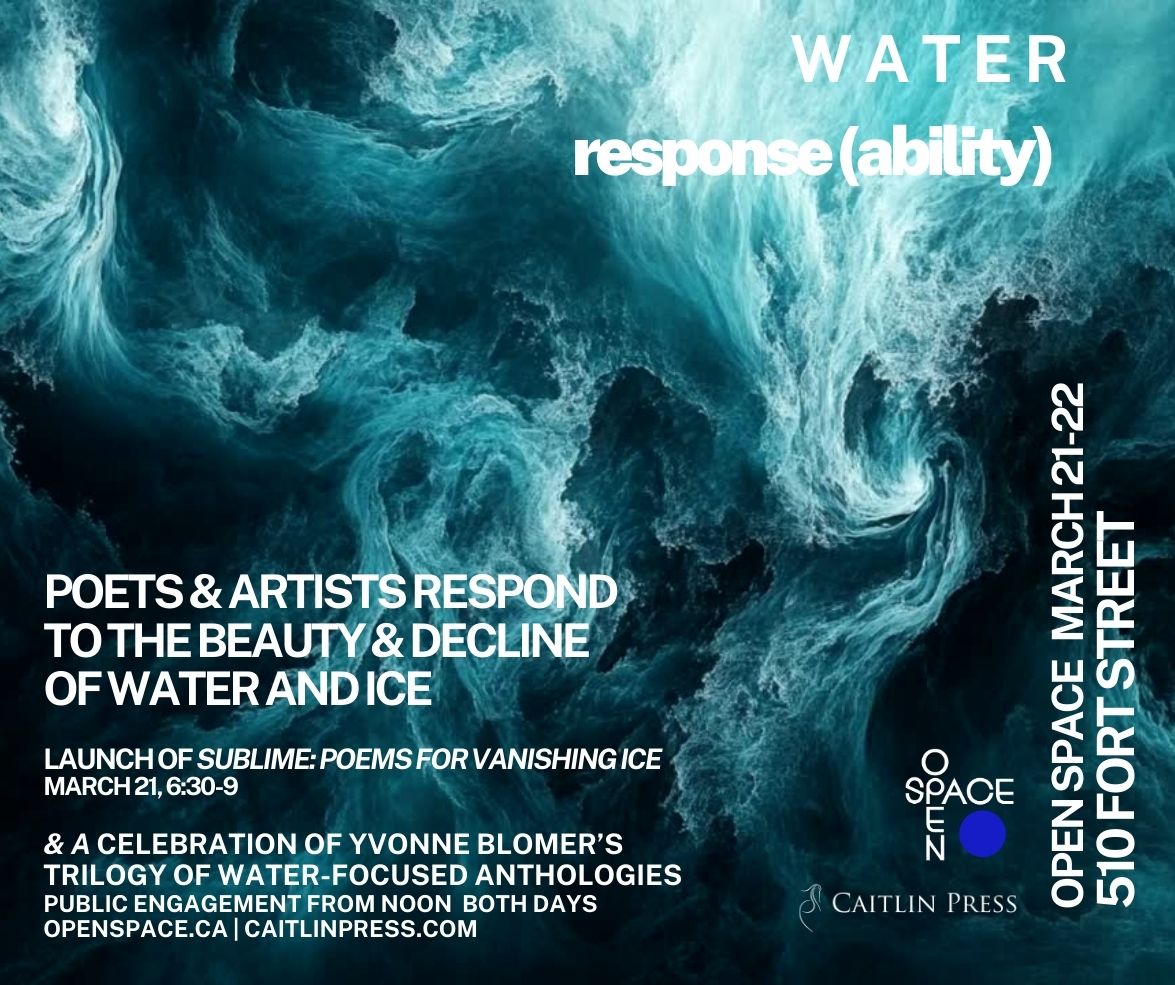
The amazing Yvonne Blomer has completed her massive editing project – a trilogy of poetry anthologies about water – Refugium addressed concerns about our oceans; Sweet Water, the watersheds; and now Sublime: Poems for Vanishing Ice makes its debut (with snowcones!) on World Poetry Day (March 21) and (March 22), at Open Space. The launch days include joyous mingling, workshops, and  lots of other stuff. Here’s the story so far – hope you can join us!

Saturday March 21 Gallery hours from 12-5
Launch from 5:30-9
12-9 – Exhibit of visual art, videos and knowledge displays
12:30-2 – Ekphrastic poetry and collage workshops
12-5 – CRD Table “A Drop of Water”
5:30 evening event begins: public coming to attend the reading can come early to view the art and videos and interact with the books and collage table
7:00 launch of Sublime: Poems for Vanishing Ice
Yvonne opens the evening reading and performance. Poets will read dispersed by performance art by Grace Salez, Judie Price, Jane Story
9:00 event ends.
Sunday March 22 Gallery from 12-5
12-5 – Exhibit of visual art, videos and knowledge displays
12:30-2 – Ekphrastic poetry and collage workshops
12-5 – CRD Table “A Drop of Water”
3-4:30 – Second reading with questions from audience
4:30-5 – mingle, chat, vide videos and art Auction of Cover Art posters


Genetically-modified October

There has been a fair amount of GMO action, good and bad, this month.

On October 10, the Healthy Saanich Advisory Committee bravely invited public input into their deliberations on the question of whether to allow Genetically-Modified (GM) seed crops into the municipal district. [For those who don’t live here, Saanich is one of the largest of our 13 municipal districts and 3 electoral areas that make up what is commonly known as Victoria (plus the Gulf Islands), but more accurately named the Capital Regional District. It is also a daunting mixture of urban, suburban and rural (peri-urban really, on this increasingly crowded tip of Vancouver Island) areas.] The Healthy Saanich Committee took the public input into their own deliberations, and will be making a recommendation against allowing GM crops to Saanich Council in November. One of the presenters requested that the meeting where the recommendation would be made should be one where the public could be present.

At least fifteen residents made written presentations to the committee, and another fourteen each made five-minute verbal presentations to the committee, who will have left the meeting groaning under the weight of much additional reading. Local farmers, gardeners, citizens, doctors, scientists and church groups were represented, and thirteen of the fourteen presenters spoke emphatically against allowing GMOs into the community.

In my five minutes I spoke as one of the millions of people in North America who have, for the past 18 years, been obliged to consume GM foods without our knowledge or consent, because our federal government has twice blocked the introduction of mandatory GM food labelling, thereby removing our choice over whether or not to eat it. And GM ingredients are present in, so the estimates go, some 70% of the foods in Canadian grocery stores (if you eat a lot of processed foods, your consumption is probably higher than that). Other presenters pointed out the failure of governments to require adequate long-term studies of GM products on animal and human health and on the environment. Still others argued that GM crops would increase the amount of pesticides used on our soil, and therefore the quantity of pesticides introduced into our diets and water supply.

In a timely reminder that the pesticide threat was no idle supposition, we’ve just had news that Canada is on the brink of approving GM corn and soybeans – destined for human and livestock consumption – designed for use with the pesticide 2,4-D (an ingredient in Agent Orange), which is needed because Roundup-Ready GM crops have created glyphosate-resistant weeds, creating what had been predicted from the outset: an increase in pesticide use, not the decrease originally promised by the biotech industry.

In Ontario, farmers gathered to protest the planned introduction of GM alfalfa into Canadian fields. The prospect is more than worrying, because alfalfa is a hugely important crop, which forms the bottom of our own food chain. Organic growers are heavily dependent on it both as a livestock feed, an export crop and a cover crop. Since the only alternative Canadians have if they don’t want to eat unlabelled GM foods is to buy certified organic (no GM ingredients or agricultural inputs are allowed in Canada’s certified organic production), this puts our whole organic food system at risk. Given the rates of contamination of non-GM corn, soy and canola by their GM counterparts in North America, and the sorry tale of the “Triffid” flax that killed Canada’s European flax export trade, it is a certainty that GM alfalfa will cross with non GM.

And finally, Michael Pollan has written a thoughtful analysis of California’s pending vote on mandatory labelling of food containing GMOs, coming up November 6, and the need in today’s damaged food system, for a more vigorous and less one-sided blending of food with politics.

ASLE 1: water

Every so often I end up temporarily on a new university campus, struggling to locate oddly-situated and randomly-numbered rooms in unmarked buildings. While I retrace miles of wasted footsteps, I have ample time to reflect on the importance of signposting and the absence of an inner compass which would allow me to make intended use of the maps and directional notes with which we start these journeys. The friendly young man who checked me into my dorm the other night, one of a clutch of sustainable buildings named for  trees (by his hand mine was spelled ceader) told me that I’d find most of the ASLE sessions by following a sort of path along a creek – “it’s kind of hard to explain,” he concluded.

I did eventually find that elusive path, and the buildings are starting to look more familiar. Somehow I’ve found my way to a few sessions over the past couple of days.

Aquatic Intelligence: A Panel to Explore Relationships with Water has been about the best panel I’ve been to so far  (aside from my own, ahem). Gyorgyi Voros started us off with an overview of the watery module in the Earth Sustainability course she taught, and particularly the role of the “Gathering of the waters” exercise, inspired by Basia Irland‘s similarly named 5-year project along the Rio Grande.

Kate Berry then stepped in to say a few words on Basia Irland’s behalf – as she’d had to cancel – about her Waterborne Micro-Pathogens project: she’s created “scrolls” from sari silk (because this is used in India to filter drinking water) with images of some of “the waterborne diseases that kill a child every eight seconds somewhere in the world.” They’re floated in rivers and hung in wells and other appropriate locations.

Berry, a geographer from the U of Nevada, then carried on with her own paper, The Rhetoric of Water Crises and Metrics of Drought, in which she deplored the shoe-horning of the term “crisis” into every contemporary environmental issue we face, and argued that while engagement is needed, crisis is not. Using this rhetoric pits those who acknowledge the crisis against those who don’t; and entangles it in bigger issues, making it something that endlessly changes and therefore becomes fundamentally unsolvable; and it tends to puts us in a position of having to master a crisis rather than adapting to a changing environment. Later a questioner commented on humanity’s search for stasis in a constantly changing world; although it was also agreed there’s a difference between evolving features and imposed/rapid change of the kind that does get labelled “crisis.”

Finally, Jennifer Wheat, from the U of Hawaii, spoke, in part from her own experience, on Never Turn Your Back on the Ocean: Wild Swimming and Eco-Activism, which touched on such aspects as the difficulty of engaging with something you can’t see – water can look clear but carry contaminants that can affect us by ingestion, immersion or accidental contact; she talked about the deliberate, Monsanto-funded poisoning of mangrove swamps that – though not native to Hawaii – do harbour native fish nurseries and protect against tsunamis; and the difficulties of ownership and custody of shared water.

The other end of the water pipe

Last week was National Drinking Water Week, and I celebrated by taking up a rare opportunity to go on a watershed tour – the Capital Regional District offers them only once each year – to see where my drinking water comes from.

The CRD has been pretty successful in getting people to reduce water waste, but Canada still has one of the highest water use rates in the world, second only to the USA. Nationally, we consume about 4,400 litres per capita per day. This figure includes industrial and agricultural use, of course, and we’re a big country with big irrigation systems in agribusiness, and a lot of manufacturing and processing, all of which uses water for such things as washing and cooling. In Canadian cities, the figure is 638 litres per day which includes personal consumption as well as water system leaks, firefighting and other municipal uses.

In 1994, Victoria’s consumption was 568 litres/day; in 2008 it was 400 (of which 280 was household use). Those figures come from two different sources so it depends on who you want to believe (and which way the wind is blowing?) when you start to compare. But the CRD has been doing a lot of work to inform its customers about water conservation, sponsoring irrigation workshops, native plant workshops (native plant gardens are best for conserving water because native plants are adapted to local soil and water conditions, and are more drought-tolerant than sissy imports); and offering this annual tour.

We were safely guided into the 20,549 ha (50,776 acre) watershed area by a CRD worker in an ambulance for just in case..
and after pausing to admire some local wildlife
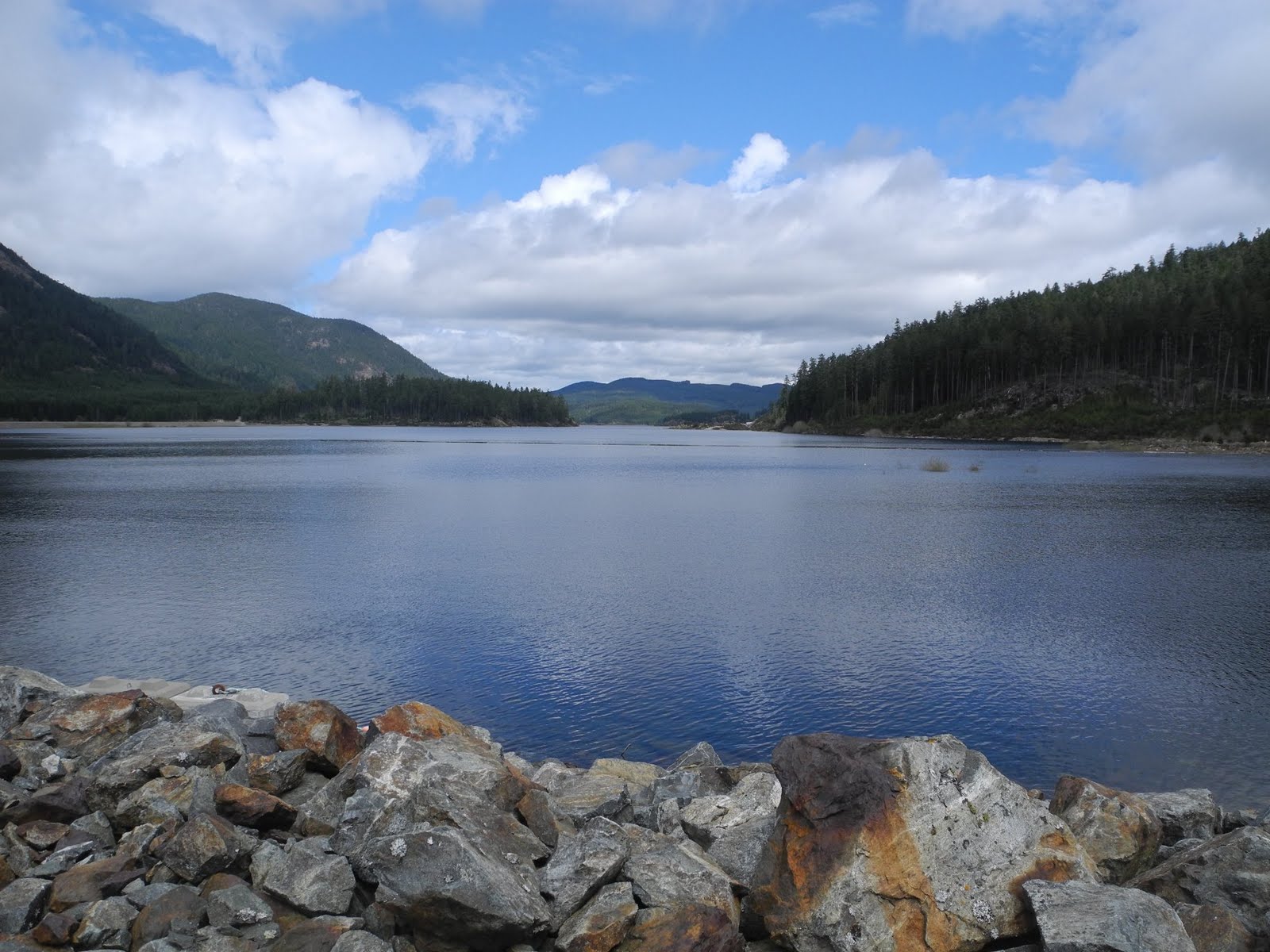
stopped at Sooke Lake,
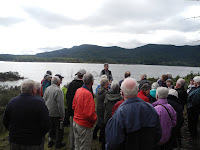
which is the reservoir for the CRD. Its capacity was increased a few years ago, and the drowned trees show the change of level. Even now we have the higher level, the CRD imposes routine watering restrictions from May through September, the times of peak use due to lawn and garden activity. This prevents us from draining the reservoir to a level where sediment and algae become a problem that would require additional water treatment; or the building of more expensive backup supplies.
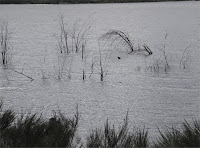
After the flooding, the new shoreline was dug and replanted with trees, which would help with filtration and prevent erosion, but the digging disturbed the seeds from one of Vancouver Island’s top invasive plant species, broom, which out-competed the seedlings and took over. It’s a very hard plant to eradicate, and chemical solutions – even if they worked – are obviously not under consideration in this location.
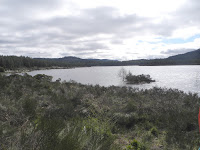
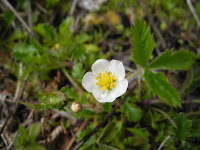
Lots of wild strawberries around…
On we went, stopping at Rithets Creek

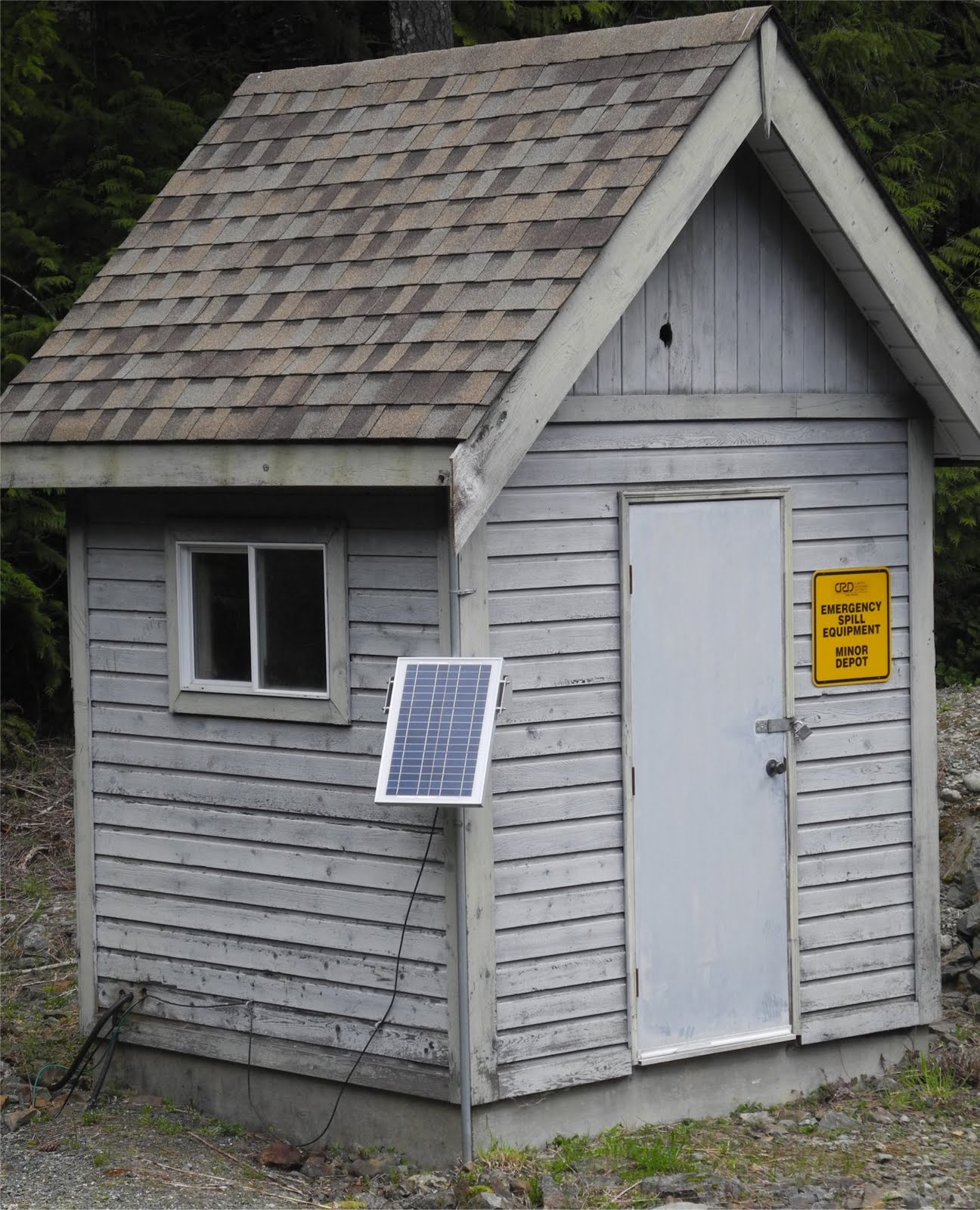
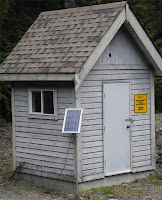
where there’s a weir, and a shed to measure water levels, which can get very high from spring runoff. Being up on a mountain, there’s no electricity for the equipment used, hence the solar panel.
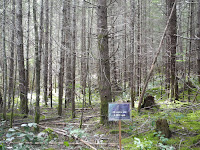
We had a forest walk to look at some of the forestry issues that go into protecting a watershed. The whole area is surrounded by more and more development. Developers on Malahat Mountain (except for Elkington Forest) tend to clear-cut the trees and then sell lots that are promptly covered with impermeable surfaces like driveways and houses, not to mention lawns with their addiction to fertilizers and pesticides, all of which puts stress on drainage and the purity of the water supply.

Here’s a 4000 sph replanting which is 40 years old. SPH = stems per hectare; a forestry term that curiously prefers the word “stem” to what it really means (“tree”).
And our provincial tree, the Western red cedar
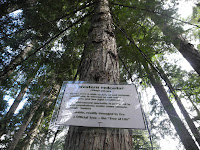
which our guide (a forester in his past life) said was probably not going to survive the drought caused by climate change. The douglas fir fares better in the wild swings of weather we have.

We lunched on top of the Sooke Dam, overlooking the lake
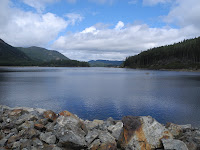
and then went for a look at Goldstream Dam
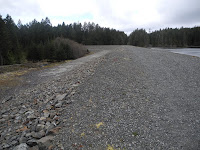
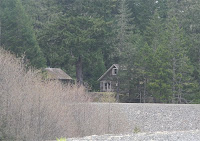
where watershed caretakers of yore used to live, and had to hike around the region to check on things.
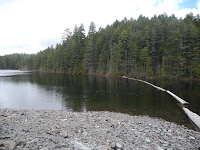
All the water bodies had these debris booms to prevent floating matter from finding its way through the system.
Last stop was Japan Gulch (and they’re not sure where the name came from as there aren’t a lot of records kept there) where the water is treated, first with ultraviolet light, which kills parasites
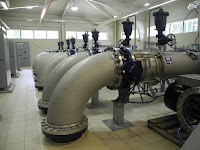

and then with cholorine and ammonia, which create chloramine (mustard gas, in higher concentrations) that kills viruses and bacteria. All in all, we’re fortunate the water is very pure so doesn’t need much treatment.

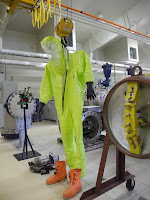
And then it was time to leave. Sadly we did not get a turn trying on this natty emergency suit.
All kinds of water

Hard not to start the year in a state of environmental angst. Water is always topical here on Vancouver Island: we either have too much or too little at any given time.

In this our water-fronted, rain-sodden wintertime in Victoria, it’s hard to look ahead to our annual drought season, or to grasp the issues around water waste through the year. So I was interested to hear Costing the Earth this week, which was about how each of us can make a small change to our lifestyles – including being more aware of water use – to improve our record on consumer waste, which contributes to all kinds of evil.

One of the things they talked about was the concept of embedded water – how much water does it take to produce, for example, a single pint of beer (170 litres). Meat is, as usual, the worst enemy: a hamburger (150g) takes 2,400 litres to produce, because of the water needed to raise the animal it comes from. That of course is before you factor in the climactic damage caused by clearing Amazonian rainforest to grow soya to feed northern hemisphere cattle.

The commentator spoke to an environmental activist who was so horrified by what he saw when he visited the Amazon some years ago, he came back to London and changed his life. Among the other things he did was to install solar panels – yes, in London – to heat his water, power his fridge and generate electricity in sufficient quantity to make him the first individual to sell power back to the national grid. He gathers rainwater from his roof to use for flushing his toilet and washing the floor, and meets 75% of his water needs that way.

Over and over the commentator asked, what about China? We could all bend backwards, lower the thermostat, keep our heating off when we’re not in the house, buy less of the things that will go to waste — and meanwhile the Chinese are striving for all they’re worth to be big wasteful consumers just like us.

And the answer was, set a new consumer/environmental standard for those who aspire to a good standard of living. And in doing that, remember that “every single small action you take does make a difference.”

Another bit of trivia I was reading about: the British Medical Journals discounting of the 8 glasses of water a day rule that used to cause us all to have a glass, if not a beaker, of water at our desks over the last decade or two.

“There’s a lack of medical evidence showing you need to down this much water daily,” says the Globe & Mail.

This common prescription can be traced to a 1945 medical recommendation that stated: “A suitable allowance of water for adults is 2.5 litres daily in most instances. An ordinary standard for diverse persons is one ml for each calorie of food. Most of this quantity is contained in prepared foods.”

If the last, crucial sentence is ignored, the statement could be interpreted as an instruction to drink eight glasses of water a day. Evidence suggests you can meet all your fluid needs through food and other beverages including juices, milk and even caffeinated drinks.

And finally, maybe if we don’t have to drink so many glasses of it, we can cut our use of bottled water – with its embedded packaging, transport and retail costs – and go back to the tap. Gosh, who remembers drinking fountains?