Skip to content

ASLE

Eco-lit in Portland

I’ve gone to quite a number of ASLE and ALECC conferences over the years. This year’s ASLE conference – its first post-pandemic gathering – was in Portland Oregon. Unusually for an organization that normally meets on campus in a smallish college town, it was a more corporate affair, a joint event with The Association for Environmental Studies and Sciences (AESS), at the Oregon Convention Centre. Which was itself a model of environmental building (LEED platinum) and stunning public art.
Eco-conferences do delve into sobering realities and there was no shortage of these in Portland. The plenary sessions included one that provided a lot of ecological context for concerns around deep sea mining. Which is being proposed to provide minerals for our ‘green economy’ – building batteries for our ‘sustainable’ electric cars and bikes, for example. Ocean mining companies have already been securing contracts in the waters around smaller coastal countries but the major headache was under discussion in Jamaica during the time of the conference: what about international waters? All a bit ludicrous in light of the fact that our oceans are all connected, so any damage done – destroying habitat for unknown species, creating plumes of silt that can choke the ocean floor for hundreds of kilometers – will in fact tamper with the substance of life on this planet, since we rely so heavily on the ocean to provide us with a breathable atmosphere.
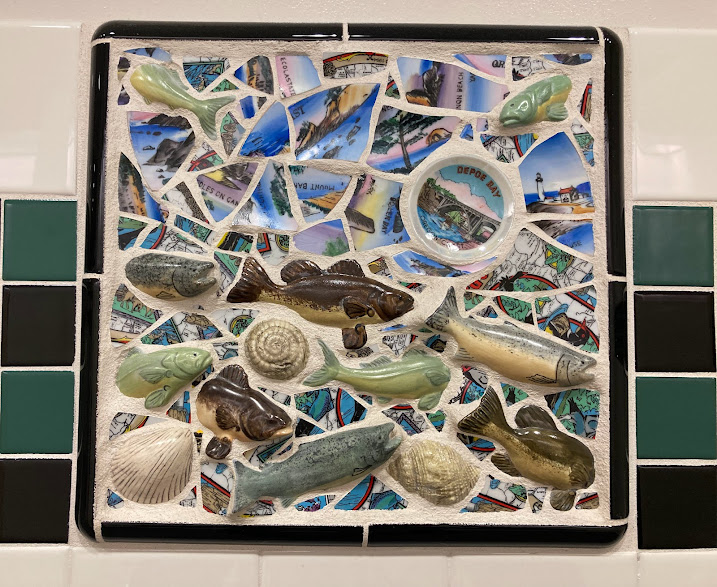
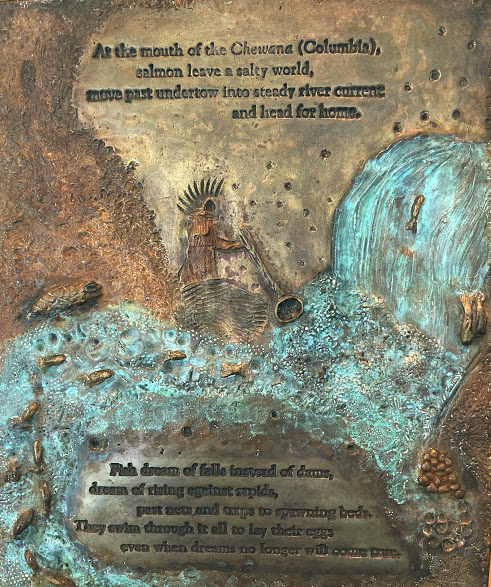
Another featured two first nations speakers from Yakima Nation, who spoke on concerns around the Yakima, an important salmon river in Washington state. As I’d learned years ago when I studied permaculture, salmon are the reason our coastal rain forests flourish – they provide the nutrients for local wildlife which in turn scatter nutrients on the forest floor. So it’s no small matter to learn that global warming will heat salmon rivers to the point where salmon cannot survive their spawning runs. What’s to be done? The modest efforts to remove dams along these rivers offers a small hope that the water can be cooled sufficiently in the short term at least. Beyond that, who knows.
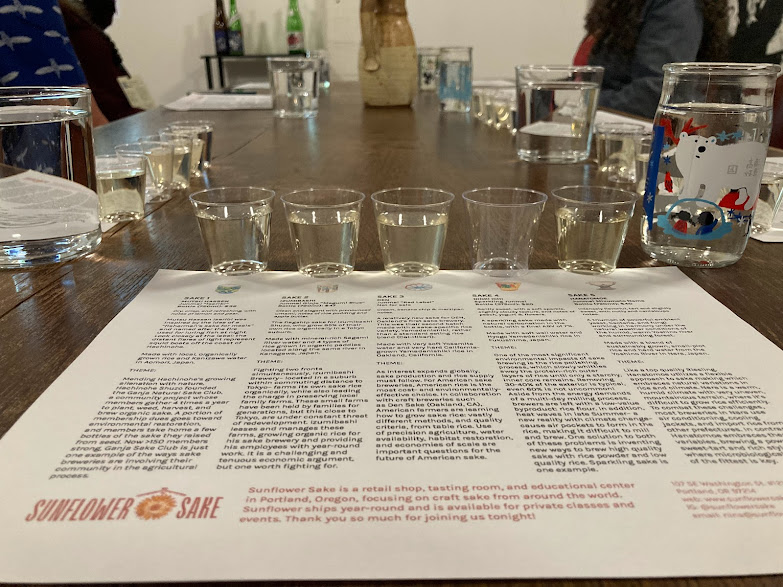
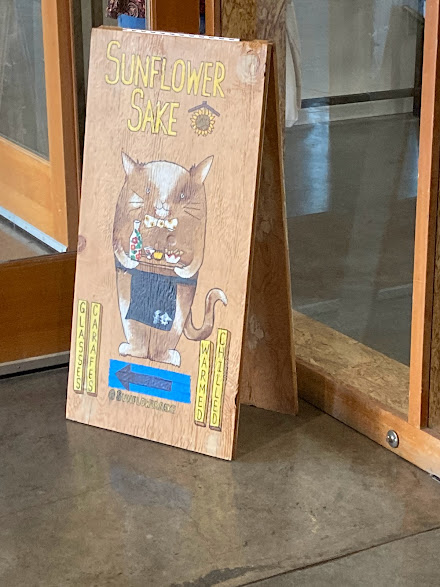
One popular feature of ASLE conferences have been the workshops and field trips before or after the main events, that are geared towards the themes or interests of the participants. This one featured a sake tasting at a local sake shop. It took me back to my wine tasting days at Unisg. All the sakes but one were offered slightly or well chilled, which was a different way, for me, of enjoying them.

And finally, early on the last morning of the conference, I read some of my poetry on the Poems & Poetics of the Commons panel, together with Lori DiPrete Brown, Sandy Feinstein and Trey Moody. As inevitably happens when random poets are placed together on a panel,  surprising conjunctions of mood and subject emerged from our readings. So it was a good way to wrap up the conference for me!

ASLE 2013 – plenaries, poetry & medicinal plants


I managed to get a long overdue poetry reading into my ASLE week, attending the plenary reading by Maine poet Jeffrey Thomson and Colombian writer Juan Carlos Galeano, who teaches in Florida. I had first encountered Galeano at my first ASLE at UVic in 2009, where he read some of his translated poems from Amazonia, a charming collection that draws its inspiration from Amazonian folk tales. This time he read from that, accompanied by projected translations, as well as from a new work just published (in Spanish) in Peru, Special Report on the Wind. Thomson read from several works, notably his 2009 collection Birdwatching in Wartime; his anecdote about hanging back while the sounds of a group of students he was with faded and observing the way the forest animated after the humans had left stayed with me as a good metaphor for what a lot of presentations touched on.

The Friday afternoon field trip I chose was a trip to the Native Medicinal Plant Research garden, which also houses the university’s community gardens. We were led down the garden path by the excellent Kelly Kindscher, a highly knowledgeable prairie ethnobotanist and wetlands advocate, who explained a bit about the program and let us pick, crush, sniff and ponder over many of the garden’s plants. The program’s main aim is to examine native plants for cancer-healing and antioxidant properties, and Kindscher made some interesting observations about the narrowness of that kind of research: what else might we be missing by focusing on molecules? As if to prove the point I caught myself asking which part of the immune-boosting Topeka Purple Coneflower (echinacea atrorubens) was used for tea. How locked we all are in our modes of thinking: had I not just heard Karin Kilpatrick say that one Western medicine’s many mistakes is failing to use the entire plant as native cultures do? Below, we look at Rattlesnake Master (Eryngium yuccifolium), Kelly demonstrates the invasive power of Milkweed (Asclepias syriaca. a good food – if cooked) ironically invading a patch of mint; and the star plant of the moment, the Long-Leafed Ground Cherry (Physalis longifolia) which is showing some powerful antioxidant properties, offering 14 new compounds that reduce tumour size in breast and pancreatic cancer.


Finally, my day came first thing on Saturday morning when I read my personal essay in the company of two quite different academic papers. I had not expected more than a couple of people to attend, since it was 8:30 in the morning and the room was murderously difficult to find, but we had a healthy gathering of 15 or so which was gratifying, and the discussion was interesting and friendly. The sessions I went to in the Species & Food subject stream were all pretty well attended; I understand it was the first time ASLE had had a food theme, so I expect it will continue. Since I have the floor, here is the panel in its entirety: Shamim Us-Saher Ansari, St. Louis Community College-Meramec: ‘You are What You Eat and How You Eat’: The Ethics and Aesthetics of Eating in French Canadian Culture as Dramatized in Willa Cather’s Shadows on the Rock; Bethany Ober, Penn State University: Expanding the Limits of Gender and Domesticity in Contemporary Ecofeminist Memoir; and Rhona McAdam, In your own backyard: Food sovereignty & the urban garden.

After that there was only time for one more session before I had to leave for the airport, and fortunately for me it was Daniel Wildcat. The title of his topic, After progress: Enacting systems of life-enhancement frankly put me off but I went anyway and was very glad I did, as he was an entertaining and persuasive speaker. Describing himself as a recovering academic, he spoke about how to respond to a damaged world, using “indigenous realism.” This is not, he stressed, naive romanticism: that label is better represented by the idea that humans are in charge of the balance of life on the planet. What we need, he said, is a cultural climate change, one that bridges the gap from knowing to doing and does not include a division between nature and culture. Storytelling is lost: the stories our children hear now are not the wisdom transmitted by their elders, but 30 second soundbites developed by corporations in order to teach kids to be consumers. We need to get from a sense of inalienable rights to one of inalienable responsibility, in a world of relationships not resources. The least each of us can do, if we can’t fix the planet, is to become a better relative and make the world a better place for nonhuman relatives.

ASLE 2013 – been & gone


Water could have been the theme at ASLE 2013. At the opening reception, the Provost of KU promised us that Kansas is a great place when it’s not raining or snowing… but life does end up being a lot about water management when you get, as Lawrence did, five inches of rain in three days.  Lots of impermeable surfaces on the hilltop campus mean lots of extra drainage. I guess it all ends up in the Kansas River, which ends up in the Missouri River, which ends up in the Mississippi and on into the Gulf of Mexico, instead of back in the groundwater. Although as we heard from Kelly Kindscher, the impassioned ethnobotanist who led our Friday afternoon tour of the university’s Native Medicinal Herb Garden, some of the topsoil is very deep and there are clay deposits of such depth that may be separating groundwater from deeper water deposits.

My first conference appearance was on Wednesday when I chaired a panel called Race, Gender, Garden, Region which rambled across Leslie Marmon Silko’s novel Gardens in the Dunes, gendered landscapes in early 20th century New England Ballads and an analysis of “A French Garden in England: A record of the successes & failures of a first year of intensive culture” by Helen Nussey and Olive J. Cockerell, a garden memoir from 1909, which sounded fascinating. It is charmingly illustrated by Cockerell – who had made a name illustrating fairytales – and faithfully records instructions, successes and failures. I’ll have to have a look next time I’m at the British Library.

The first plenary I attended featured Stacy Alaimo and Cary Wolfe. Alaimo kicked off her discussion of deep sea environmentalism with an apt New Yorker cartoon, and then took us through some of the decade’s worth of work from the Census of Marine Life. Wolfe, referring to his recent book Before the Law: Humans and Other Animals in a Biopolitical Frame, riffed on such thoughts as what kinds of creatures is it ok to do what to; and whose lives count as lives and whose life counts as a “grievable life”.

Picking a couple of favourite presentations from favourite sessions – hundreds? thousands? to choose from – I was particularly moved by a paper by Hillary J Fogerty, from  Missouri Southern State University,  the irresistably-titled Why she can`t stop talking about the farmers market: Considering the role of activism and Advocacy in Food Studies Pedagogy and Curriculum. She described a research course for English students which she rewrote to allow students – largely from disadvantaged socio-economic groups – to study their own food security, developing research and writing skills while keeping food diaries, analyzing food advertising and ultimately in many cases changing the way they ate. She described students three years later shouting across parking lots at her to share weight loss, dietary changes and other improvements which were all the more remarkable for taking place in a town that is the headquarters for Tyson Foods, with Walmart down the road and in the looming shadow of Monsanto. Those students were likely directly dependent on those companies by direct or indirect family ties.

My other favourite, a no-brainer, was the personal essay by Dan Philippon describing a visit to Italy where he guest-lectured at the University of Gastronomic Sciences and spent time with his family visiting food producers in the Piemonte region. His talk, Slow Food or Small Food? Learning from Italian Producers, hinged on his visit to a small flour and polenta mill, Mulino Marino, and what he learned there about perceptions of quality, marketing, tradition and technology. He summed up his findings – what the producers he spoke to believed – as:

1. quality matters
2. organic and natural do not equal quality
3. history and tradition matter, but so do technology and innovation
4. local cannot be untangled from global
5. small food good; big food bad

I will finish in my next posting to mention my own paper, two different but inspiring plenaries and a field trip.

ASLE 2013 – and I’d never been to Kansas

Bricks, Lawrence KSI arrived on the heels of a big thunderstorm that flooded basements and washed the place clean before disappearing off to neighbouring states. The air is still heavy with heat and humidity, and more storms are forecast but so far we’ve been lucky.

I flew into Kansas City, MO, which is across the Kansas River from Kansas City, KS, more or less. The Missouri River is also involved in ways I have yet to become clear on. Anyway I left that puzzle behind me and was whisked off to Lawrence, about 40 miles west, where Kansas University is hosting the tenth biennial ASLE conference, whose theme is Changing Nature: Migrations, Energies, Limits.

I spent Tuesday walking around the neighbourhood I’m staying in, which borders the university, and where there is, happily, no shortage of gardens to gawp at.


A bit of wildlife too. Funny to see the rabbits, not as pretty or numerous as the ones that entertained ASLE 2009. I throw in a gratuitous cat picture because I don’t have cats in my suitcases as often as I used to. And a Jaybird for the sports fans.


Pretty campus, on top of a steep hill which gets steeper during the hottest time of the day. And it has been warm. Not inside where the air conditioning is: there, it’s been very chilly. Never occurred to me to bring winter clothing for the meetings…


And finally, a couple more gardens. I suspect that exams and graduations got the better of the campus garden which does have some lettuce struggling for life against the weeds. But most gardens here suffer the effects of short growing seasons, which are short and powerful: hot sunny weather and lots of rain mean it’s hard to exert much control over what grows where once it starts. The school garden at right seems to be well in someone’s hands though, with the broccoli nearly ready. And that’s where I’ll leave it – more about the conference itself another time.


ASLE 6: my 2011 bibliography

Last time I attended ASLE I documented the most interesting (to me) books, articles and films that were discussed or even mentioned in various sessions I attended, so I thought I’d take a stab at it again this year to see what it reveals about the preoccupations of those presenters I followed, and my own wandering attentions. The list is much shorter for some reason; could be the sessions I attended or the paucity of my notes.

Bekoff, Marc: The Animal Manifesto: Six reasons for expanding our compassion footprint. and Animals at Play: Rules of the game. (books)
Berry, Wendell: “The Pleasures of Eating” (essay)
Brockman, Terra: The Seasons on Henry’s Farm. (book)
Busch, Akiko: Nine Ways to Cross a River. (book)
Caplow, Florence and Susan A. Cohen, editors: Wildbranch: An Anthology of Nature, Environmental, and Place-based Writing. (anthology)
Chamoiseau, Patrick: Texaco. (Book)
Deakin, Roger: Waterlog: A Swimmer’s Journey Through Britain.
Detor, Krista: Chocolate Paper Suites. (music)
Fischman, Robert L: “The Legal Challenge of Protecting Animal Migrations.” (essay)
Geyrhalter, Nikolaus: Our Daily Bread. (film)
Grandin, Temple: The World Needs All Kinds of Minds. (TED talk)
Hardin, Garrett: “The Tragedy of the Commons.” (essay)
Henderson, Fergus: Nose to Tail Eating. (cookbook)
Irland, Basia: Water Library. (book) and A Gathering of Waters: The Rio Grande, source to sea. (water art)
LaChapelle, Dolores: “Ritual is Essential“. (essay)
Laporte, Dominique: History of S**t. (book) (**I’m not being coy, I just don’t want your spam filters to block me for being too literal!)
Latulippe, Hugo: Bacon. (film)
Leopold, Aldo: “Land Ethic“. (essay)
LePan, Don: Animals. (book)
Mazeaud, Dominique: The Great Cleaning of the Rio Grande. (art project)
McDonough, William: Cradle To Cradle: Remaking the Way We Make Things. (book)
McKibben, Bill: Deep Economy: The wealth of communities and the durable future. (book)
Nestle, Marion: Safe Food: The politics of food safety. (book)
Psihoyos, Louie: The Cove. (film)
Reed, Ishmael: The Free-lance Pallbearers. (book)
Robinson, Jennifer M., and J. A. Hartenfeld: The Farmers’ Market Book: Growing Food, Cultivating Community. (book)
Sanders, Scott Russell, with Carrie Newcomer, Krista Detor, Tim Grimm, Tom Roznowski, Michael White: Wilderness Plots (performance)
Singer, Peter: “All Animals are Equal.” (essay)
Steinke, David: Green Fire: Aldo Leopold and a Land Ethic for Our Time. (film)
Walker, Barbara: The Little House Cookbook: Frontier Foods from Laura Ingalls Wilder’s Classic Stories. (cookbook)
Zurkow, Marina: Mesocosm. (animated landscape portrait)

ASLE 5: Mesocosm, animals and environmental law

ASLE plenary speakers were wide-ranging and various, and I didn’t always have my notebook handy. Una Chaudhuri and Helen Tiffin were the first I heard, on Wednesday. During Chaudhuri’s talk we watched Mesocosm playing out in the background (and heard that the figure in it is modelled on Leigh Bowery, which brought a few random things together for me: having arrived in England in the decade after his glory days, I’d only known of him because of Lucien Freud’s paintings)

Thursday’s plenary speaker Marc Bekoff was stranded because of airport disruptions, so he joined us from his wilderness hideaway by skype, which worked remarkably well, all things considered. He spoke generally about his work which has led to such publications as The Animal Manifesto and Animals at Play: Rules of the Game (which he said brought together his 30 years of research into play behaviour). But his theme, animal compassion, he summarized by saying “Anyone who says that life matters less to animal than our life means to us has never held in their hands an animal fighting for its life.”

He observed that humans have a confusing relationship with animals: claim to love them and yet hunt them or rear them in factory farms, and generally treat them in ways we wouldn’t treat a family pet. They’re very much like us, he said, but also different. Speciesism doesn’t work as a way of establishing a natural hierarchy, where we assign higher and lower designations to animal life using ourselves as a template, because in fact they do a lot of things better than us.

In the Q&A he was asked his opinion of Temple Grandin, which he answered carefully, saying they had met, and that they’d agreed to disagree. He acknowledged her work by saying she’s improved the lives of a minute fraction of the animals who go to slaughter, and acknowledged her “amazing effect,” with which she reaches a very wide audience, informs people about animal sentience. But in Bekoff’s view, she’s not improving the well-being of animals, and it is worth remembering she’s paid by the meat industry.

Next up was environmental lawyer Robert L. Fischman, who teaches at Indiana University Bloomington, and is known among environmentalists for his writings on animal migrations, spoke on themes that affect environmental law at present.

Climate change, he said, currently dominates scholarship and rule making. And observed that in environmental law there is a stark division between people studying pollution control, viewing the environment as a sink; and those studying conservation on other hand , viewing the environment as a treasure trove for goods (natural resources). Pollution control law grew out of public health concerns, while resource management is more rooted in judgements made law, and undergoes conservative incremental change, with changes in ideas of ownership and property.

Which led to discussion of land trusts, the big environmental issue in the US today. In 1980 there were about a tenth of a million acres in trust; tax laws changed around then and so did the interest in land trusts. By 2003 there were 5 million acres, and in 2005 some 12 million acres; and it’s probably doubled since then. Land trusts are a relatively new species of property right, placing values on land and water rather than on the monetary value of land for transformative development use.

Initially, land trusts were isolated zoo-like reserves, but they became stepping stones, and then lines on a map. By the 1980s, biology had taught us that webs of conservation are importan, so reserves must be nodes in a network. The realities of what we’ve already observed in climate change on land and what changes we anticipate mean that connecting our landscape will be very important in allowing both animals and ecological services to adapt and be resilient to climate change.

Bringing it home to the audience, he pointed out that in environmental law and policy, interdisciplinary work means working with social and natural scientists, not scholars from the arts and humanities. Yet what passes for research in this field really is related to the humanities: you search sources and make arguments based on your findings. Storytelling and rhetoric became uniquely important tools in this particular area of law.

Finally, he said, we need to think through to resilience issues rather than stopping with conservation of the present: for example, we have halted the species elimination of buffalo, but eliminated the migration aspects of their lives. We need to safeguard migration corridors as well as habitat. This “connectivity” is too broad a concept to capture public support, but migration conservation is a concept that might be possible to use to promote a more holistic cause.

In the Q&A, the topic of mountaintop removal in the coal industry came up; timely subject for this Vancouver Islander. Is this, the questioner wondered, as corrupt an industry as it seemed? Stepping lightly through his answer, Fischman chose instead to observe that this area rather demonstrates what a clumsy tool the clean water act is to use on mining and mountaintops.He noted that the Obama administration had at least revoked nationwide permits allowing free mountaintop removal. But the clean water act saved as much of the High Sierra as has been saved; negotiated solutions are still needed.