Skip to content

animal welfare

ASLE 2013 – been & gone


Water could have been the theme at ASLE 2013. At the opening reception, the Provost of KU promised us that Kansas is a great place when it’s not raining or snowing… but life does end up being a lot about water management when you get, as Lawrence did, five inches of rain in three days.  Lots of impermeable surfaces on the hilltop campus mean lots of extra drainage. I guess it all ends up in the Kansas River, which ends up in the Missouri River, which ends up in the Mississippi and on into the Gulf of Mexico, instead of back in the groundwater. Although as we heard from Kelly Kindscher, the impassioned ethnobotanist who led our Friday afternoon tour of the university’s Native Medicinal Herb Garden, some of the topsoil is very deep and there are clay deposits of such depth that may be separating groundwater from deeper water deposits.

My first conference appearance was on Wednesday when I chaired a panel called Race, Gender, Garden, Region which rambled across Leslie Marmon Silko’s novel Gardens in the Dunes, gendered landscapes in early 20th century New England Ballads and an analysis of “A French Garden in England: A record of the successes & failures of a first year of intensive culture” by Helen Nussey and Olive J. Cockerell, a garden memoir from 1909, which sounded fascinating. It is charmingly illustrated by Cockerell – who had made a name illustrating fairytales – and faithfully records instructions, successes and failures. I’ll have to have a look next time I’m at the British Library.

The first plenary I attended featured Stacy Alaimo and Cary Wolfe. Alaimo kicked off her discussion of deep sea environmentalism with an apt New Yorker cartoon, and then took us through some of the decade’s worth of work from the Census of Marine Life. Wolfe, referring to his recent book Before the Law: Humans and Other Animals in a Biopolitical Frame, riffed on such thoughts as what kinds of creatures is it ok to do what to; and whose lives count as lives and whose life counts as a “grievable life”.

Picking a couple of favourite presentations from favourite sessions – hundreds? thousands? to choose from – I was particularly moved by a paper by Hillary J Fogerty, from  Missouri Southern State University,  the irresistably-titled Why she can`t stop talking about the farmers market: Considering the role of activism and Advocacy in Food Studies Pedagogy and Curriculum. She described a research course for English students which she rewrote to allow students – largely from disadvantaged socio-economic groups – to study their own food security, developing research and writing skills while keeping food diaries, analyzing food advertising and ultimately in many cases changing the way they ate. She described students three years later shouting across parking lots at her to share weight loss, dietary changes and other improvements which were all the more remarkable for taking place in a town that is the headquarters for Tyson Foods, with Walmart down the road and in the looming shadow of Monsanto. Those students were likely directly dependent on those companies by direct or indirect family ties.

My other favourite, a no-brainer, was the personal essay by Dan Philippon describing a visit to Italy where he guest-lectured at the University of Gastronomic Sciences and spent time with his family visiting food producers in the Piemonte region. His talk, Slow Food or Small Food? Learning from Italian Producers, hinged on his visit to a small flour and polenta mill, Mulino Marino, and what he learned there about perceptions of quality, marketing, tradition and technology. He summed up his findings – what the producers he spoke to believed – as:

1. quality matters
2. organic and natural do not equal quality
3. history and tradition matter, but so do technology and innovation
4. local cannot be untangled from global
5. small food good; big food bad

I will finish in my next posting to mention my own paper, two different but inspiring plenaries and a field trip.

Oysters, Abattoir, perennial food crops and Eco-Fair

All blissfully quiet at my end of the Gorge these days, now that Craigflower Bridge has been closed for rebuilding and traffic re-routed. I was gratified to learn that not only were there viable oyster beds in the Gorge, but the planners had taken steps to relocate and preserve them so that the construction does not do away with this rare species (for the next eight months or so). These are our native Olympia oysters, not the Pacific upstarts introduced from Japan that now dominate the West Coast’s shoreline and oyster farming operations. I happened to pass what I assume to be the relocation action as it was unfolding and snapped them at it.

Meanwhile, I’ve been spreading myself thin in recent weeks, trying to keep up with different social media (Twitter, Facebook and most recently Pinterest), working on some of my own writing, and going nose to grindstone with my holistic nutrition studies. We’re deep into preventive nutrition this month, studying up on nutritional approaches to digestive, blood sugar, cardiovascular and arthritic conditions. Quite a ride.

On Friday I returned from Nanaimo via Salt Spring Island where the community abattoir was officially launched with an open house in the drizzly rain. I’d visited earlier this year but was interested to have a look at the finished structure. There is more work to be done if larger animals (cattle) are to be slaughtered here, but it’s up and running for poultry, rabbit, goat and lamb. It’s going very well so far: an arrangement with a local farmer has meant all the offal and skins are being composted, which has taken one of the main economic headaches for an abattoir out of the picture, and has solid community support – no small achievement for this kind of business.

Saturday I took in a workshop on perennial fruit crops at ALM Farm in Sooke, in which farmer Jordan took us for a tour of the farm’s apple, pear, fig and plum trees, kiwi vines, strawberries, raspberries, rhubarb, Jerusalem artichokes, hazelnuts, gooseberries, herbs and asparagus before I had to whistle off to take my place behind my books, alongside the Haliburton farmers at the Reynolds School Eco-Fair. It was a lively and well-attended event with speakers including Green Party leader Elizabeth May and Brandy Gallagher from O.U.R. Ecovillage, and lots of well-chosen information tables, including Pedal to Petal, LifeCycles, Growing Young Farmers, Organic Gardeners Pantry, BC Sustainable Energy Association and more. The Hali stand was peddling organic food boxes (CSA subscriptions), seeds, plants and good advice.

Palestinian food, Vancouver smokehouse and the Salt Spring abattoir

Chickens grazing at Bellingham b&b

I love the random and unusual places my food interests take me. But then, as we learned at food school, gastronomy touches every aspect of life; and food being life-giving, its universal reach should not surprise us.

So last week I returned from beautiful Bellingham and stopped briefly in vivacious Vancouver, where I was whistled off for a delectable Palestinian lunch at Tamam on East Hastings. All the food is made from scratch, and tastes fresh and

Tamam's hummus
authentic. We had a selection of treats, opting for the vegetarian menu – hummus, mutabbal (the Palestinian version of baba ganoush), mujadarah
Tamam's Kunafah
(rice & lentils with caramelized onion) with a lemony red cabbage salad, some house-made flatbread with za’atar and another with yogurt, followed by the very pretty kunafah dessert – spun pastry enfolding a couple of different kinds of cheese. I took away an order of Palestinian cabbage rolls (the cabbage is fermented, and stuffed with rice and vegetables) with a side of green salad, fuel for the ferry ride home. And it was a welcome respite from the indignities of BC Ferries’ franchised fast food offerings.

We stopped in at the Woodland Smokehouse & Commissary after that, and emerged with assorted house-smoked sausages, a salad of potato, bacon and mushrooms, and a long and wistful memory of the freezer cabinet and its load of Earnest Ice Cream, which is sold in reusable glass jars.

Once home I unpacked and readied myself for a trip to Salt Spring Island, where the CRFAIR roundtable meeting was treated to a tour of the newly/nearly finished community abattoir. Our guide and president of the abattoir society, Jean Brouard, made clear he was not the only vegetarian on the committee, and added that there were several vegans aboard as well.

After all, he told us, the foremost aim of this facility was to improve animal welfare. The draconian changes to farmgate meat processing several years ago had made it illegal for farmers to slaughter their own animals. Aimed at making large scale meat processing safer, the changes were devastating to small farm operations, particularly ones in remote locations. The financial and logistical repercussions of taking a small flock of chickens or a couple of lambs on the ferry for slaughter meant that meat production on Salt Spring dropped by nearly 50%. Local farmers and food activists were worried by the island’s corresponding drop in food security: having to import so much of the island’s protein put them at the mercy of steadily increasing ferry fares and put the few animals under production under considerable stress. Fundraising ensued and the island put plans together to build Canada’s first dual (red and white meat) abattoir.

Poultry cones

The community decided it wanted the facility to be a mobile abattoir, to share services with nearby Pender Island, and raised enough money in cash and grants to start building in January last year. Unfortunately, in the process of meeting the multiple and often contradictory requirements of the regulating agencies (municipal and provincial health authorities, CCDC and CFIA as well as building standards) the mobility dropped out of the picture. So did the first building inspector they’d worked with and his successor deemed it necessary that the building meet stringent seismic standards, adding nearly a third again to the not inconsiderable building costs. A new round of fundraising will soon begin to clear the debts incurred. The abattoir opened for bird business in late September, just in time for Canadian thanksgiving, and recently processed its first lambs. Adjustments and adaptations were in progress with carpenters and electricians fine-tuning reinforced boards and the new chiller equipment.

The abattoir is, like all those large and small, subject to rigorous inspection, with every animal checked by a federal meat inspector. It’s anyone’s guess what will happen if the federal government makes good on its promise to hand inspection over to the provinces – a move slowed by the recent Excel Meats disaster in Alberta, which showed that even the current system is fatally flawed.


Terra Nossa Farm tour

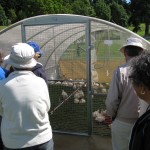
Berkshire PigLast Sunday I got down and dirty with the Victoria Horticultural Society’s Fruit & Vegetable Group, whose monthly meeting was a tour of Terra Nossa Farm. I’d often bought eggs or sausages or chicken from Evelyn, who commands a loyal queue each Saturday at Moss Street Market, so I was delighted to have a chance to see the farm she runs with her husband Jesse.

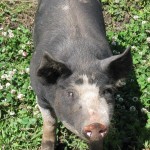
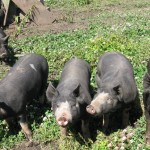
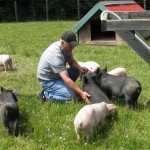
Labour of love about sums it up here. Jesse says of their pigs that they live their lives in Berkshire pigsheaven, and then they die. They’re fed organic grain, fresh greens and roast sweet potatoes grown on the farm. Ten of their Berkshires, purchased as piglets from Tom Henry (there are very few organic pig breeders, Evelyn remarked), were nearing their slaughter date, and were out frolicking in a field of greens. They came to greet us, flapping their enormous eyelashes and making us question who was looking at whom. I’ve been on pig farms before, and never have I been to one where there was not a whiff of stink: they have plenty of room to run and play, and shelters provided for both summer and winter comfort.

Terra Nossa pigletsJesse Perriera, Terra Nossa Farm, with pigletsTerra Nossa piglets-docked and undocked tails


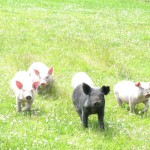
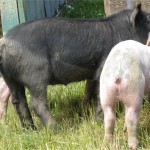
There were some piglets in another field: two varieties, black mule pigs (sourced from Lasqueti Island) and some Tamworth cross pigs bought from a commercial operation in Alberta. The white pigs were very skittish at first and prone to scattering when Jesse approached, but with patience he has been able to get them to become a bit more pig-like, curious and friendly. The white ones’ tails had been docked by the breeder, a common practice where they are kept in such overcrowded conditions they are likely to gnaw on their neighbours out of stress or for lack of anything better to do. Evelyn said they hadn’t checked their teeth but these were likely clipped as well, for similar reasons.

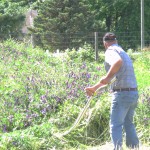
Terra Nossa meat birdsThe chickens are treated kindly at Terra Nossa as well, although in the case of the meat birds, this happy life is a short one. They are purchased as chicks from a commercial breeder, so they have, as Evelyn put it, had most of the chickenness bred out of them. They’re sent to slaughter at around 8-9 weeks (commercial operations only keep them half that time); they can’t be allowed to get any bigger because the way they’ve been bred means their bodies become too large for their legs to support them and they start developing painful injuries. Jesse was out scything some fresh vetch for theJesse Perriera, Terra Nossa Farmm, which they love, and they seemed to be enjoying the commodious chicken tractor, a top-of-the-line pen that keeps them shaded from the sun and lets them enjoy the view, the breeze, and the tasty snacks being delivered at regular intervals. And the tractor is an easy structure to move, which is the most important feature.

The Perrieras are choosy about where they sell their chickens. They’ve become disillusioned with restaurant sales, having experienced situations where chickens were sold to restaurants who put their farm’s name on the menu and then ceased buying from them. So now they limit their sales to the farm gate, the farmers markets they attend (Moss Street in the summer and the Downtown market in the winter), Ingredients Health Food and local food promoters Share Organics.

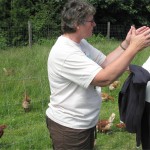
Terra Nossa Farm, Evelyn PerrieraThe laying hens have a nice big area to run in, and produce enough eggs to supply Moss Street Market, Origin Bakery, Terra Nossa’s farm shop and Share Organics. I noticed that they still peck one another’s tails – I suppose they are  just too numerous, and a few are lost from time to time to the bald eagles we saw circling during our visit. The farm has a license allowing them to keep 399 laying hens (the limit on small producers without such a license is 99 birds) but Evelyn says they won’t be renewing that. New rules are coming in that would mean the small producers with 399 layers would be forced to adopt the same biosecurity measures as industrial producers (meaning no more farm tours, for one thing); would not be allowed to let their chickens run outside on pasture as they do now; would not be allowed to raise meat birds as well as layers; would have to invest in impossibly high-cost equipment and potentially upgrade facilities for inspection. We would not have been allowed access to the farm without suiting up, for example. So the regulatory club is still swinging directly and heavily at small producers and forcing them out of the very markets where they are needed and appreciated.

Evelyn & Jesse are acutely aware of their dependence on imported livestock feed, since Feed supply for Terra Nossa livestockthere is no organic feed producer on Vancouver Island, they must have it shipped from the mainland by ferry. Like any Islander who thinks about food security, they are conscious of the fragility of their supply, so they try to keep a reasonable reserve in store. Because organic feed is more expensive than conventional, this means quite a substantial capital outlay, at about $1000 a pallet.

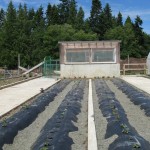
Terra Nossa sweet potatoesTowards the end of the tour we had a look at the sweet potatoes bravely growing under black plastic mulch. They were planted out in March, but the weather has been so chilly that they are not thriving, although with luck the summer heat should kick in and move them along. At the end of the rows is the winter pig barn, where the porkers can loll about enjoying the roasted sweet potatoes the Perrieras prepare for them (many of the larger sweet potatoes are considered unsaleable, so they go to the lucky pigs).

ASLE 5: Mesocosm, animals and environmental law

ASLE plenary speakers were wide-ranging and various, and I didn’t always have my notebook handy. Una Chaudhuri and Helen Tiffin were the first I heard, on Wednesday. During Chaudhuri’s talk we watched Mesocosm playing out in the background (and heard that the figure in it is modelled on Leigh Bowery, which brought a few random things together for me: having arrived in England in the decade after his glory days, I’d only known of him because of Lucien Freud’s paintings)

Thursday’s plenary speaker Marc Bekoff was stranded because of airport disruptions, so he joined us from his wilderness hideaway by skype, which worked remarkably well, all things considered. He spoke generally about his work which has led to such publications as The Animal Manifesto and Animals at Play: Rules of the Game (which he said brought together his 30 years of research into play behaviour). But his theme, animal compassion, he summarized by saying “Anyone who says that life matters less to animal than our life means to us has never held in their hands an animal fighting for its life.”

He observed that humans have a confusing relationship with animals: claim to love them and yet hunt them or rear them in factory farms, and generally treat them in ways we wouldn’t treat a family pet. They’re very much like us, he said, but also different. Speciesism doesn’t work as a way of establishing a natural hierarchy, where we assign higher and lower designations to animal life using ourselves as a template, because in fact they do a lot of things better than us.

In the Q&A he was asked his opinion of Temple Grandin, which he answered carefully, saying they had met, and that they’d agreed to disagree. He acknowledged her work by saying she’s improved the lives of a minute fraction of the animals who go to slaughter, and acknowledged her “amazing effect,” with which she reaches a very wide audience, informs people about animal sentience. But in Bekoff’s view, she’s not improving the well-being of animals, and it is worth remembering she’s paid by the meat industry.

Next up was environmental lawyer Robert L. Fischman, who teaches at Indiana University Bloomington, and is known among environmentalists for his writings on animal migrations, spoke on themes that affect environmental law at present.

Climate change, he said, currently dominates scholarship and rule making. And observed that in environmental law there is a stark division between people studying pollution control, viewing the environment as a sink; and those studying conservation on other hand , viewing the environment as a treasure trove for goods (natural resources). Pollution control law grew out of public health concerns, while resource management is more rooted in judgements made law, and undergoes conservative incremental change, with changes in ideas of ownership and property.

Which led to discussion of land trusts, the big environmental issue in the US today. In 1980 there were about a tenth of a million acres in trust; tax laws changed around then and so did the interest in land trusts. By 2003 there were 5 million acres, and in 2005 some 12 million acres; and it’s probably doubled since then. Land trusts are a relatively new species of property right, placing values on land and water rather than on the monetary value of land for transformative development use.

Initially, land trusts were isolated zoo-like reserves, but they became stepping stones, and then lines on a map. By the 1980s, biology had taught us that webs of conservation are importan, so reserves must be nodes in a network. The realities of what we’ve already observed in climate change on land and what changes we anticipate mean that connecting our landscape will be very important in allowing both animals and ecological services to adapt and be resilient to climate change.

Bringing it home to the audience, he pointed out that in environmental law and policy, interdisciplinary work means working with social and natural scientists, not scholars from the arts and humanities. Yet what passes for research in this field really is related to the humanities: you search sources and make arguments based on your findings. Storytelling and rhetoric became uniquely important tools in this particular area of law.

Finally, he said, we need to think through to resilience issues rather than stopping with conservation of the present: for example, we have halted the species elimination of buffalo, but eliminated the migration aspects of their lives. We need to safeguard migration corridors as well as habitat. This “connectivity” is too broad a concept to capture public support, but migration conservation is a concept that might be possible to use to promote a more holistic cause.

In the Q&A, the topic of mountaintop removal in the coal industry came up; timely subject for this Vancouver Islander. Is this, the questioner wondered, as corrupt an industry as it seemed? Stepping lightly through his answer, Fischman chose instead to observe that this area rather demonstrates what a clumsy tool the clean water act is to use on mining and mountaintops.He noted that the Obama administration had at least revoked nationwide permits allowing free mountaintop removal. But the clean water act saved as much of the High Sierra as has been saved; negotiated solutions are still needed.

Fast Food David, recent poetry readings, and some offal news about chicken feed

This one has been doing the email rounds; a cautionary vision for us all:

Wednesday saw Karen Solie at Open Space Gallery, where she stunned us with the strength of new work. An interview with Tim Lilburn afterwards revealed that she has been reading, among others, Denis Johnson and John Ashbery.

On Friday we heard new work from Joelene Heathcote at Planet Earth Poetry.

And.. just when you might have thought sanity about animal feed was at last prevailing, this creepy story that shows so clearly we have not not not learned our lessons yet: the EU would like to feed pigs to chickens. This is upsetting moslems, animal rights groups and, I should think, most sane consumers whose memory of the causes of BSE has not yet faded.

If that upsets you, maybe you should settle your nerves with a calming snack of home-made yogurt, with a spoonful of the best honey you can find.