As the organizers might have expected, registration for this evening on the circular food economy mushroomed when it was known that food would be offered!
Turns out there’s a lot happening in Victoria to rescue food from grocery outlets, then sort and redistribute it in various forms.
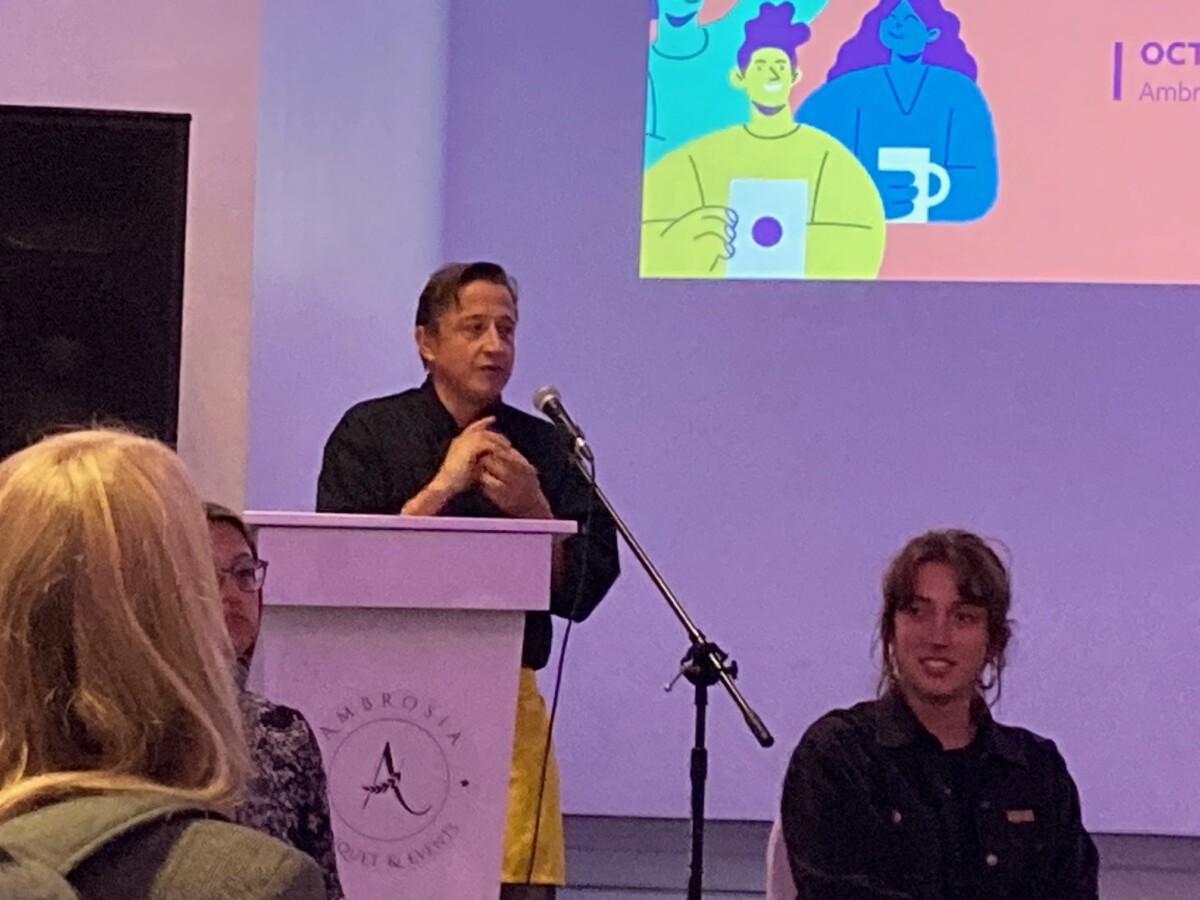
Chef Chris Hammer
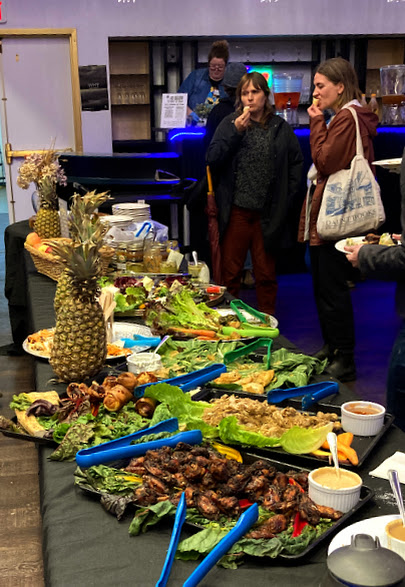
In keeping with the presentations, all the food on offer had been donated or rescued and then prepared for the participants. The buffet was vast and included vegetarian, vegan, omnivore and gluten free offerings. All the items were the same or similar to what would be provided to the recipients of some of the organizations represented. There was a predictable surge of interest in sampling some ice cream from 49 Below, and when we had eaten our fill, Mustard Seed’s chef Chris Hammer came out for a bow and a word on his creations.
I attended (virtually) the Oxford Symposium on Food & Cookery again this year, with much less time available to spend perusing the papers and attending the followup question and answer sessions, but it was delightful to spend some time with fellow food obsessives from around the world.
One of the keynote speakers this year was Rob Hoskins, founder of the Transition movement, speaking on “What is to What If”. I was much taken with his Rilke quote
The future must enter you long before it happens
which he used in the context of the power of imagination to make change in this world that so needs it. His talk coincided with the launch of the millionaire’s rocket and the inhumanity of that gesture in a time of such need.
“Capitalism sells us short term pleasure,” he remarked – together with all the social and personal perils that ensue when expectations don’t meet reality.
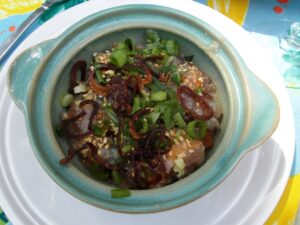
In a more grounded session, I got my hands dirty.. well, food-encrusted anyway, at a Kitchen Lab online workshop. Organized by Danish chef Birgitte Kampmann in Copenhagen and featuring a diplomatic chef in Ottawa, Cameron Stauch, we delved into several unusual ways with rice, inspired by Stauch’s cookbook, Vegetarian Viet Nam. Here’s my version of his delicious recipe for Mixed Mushroom Rice Porridge (Cháo Nấm) – well garnished with home made crispy shallots, toasted sesame seeds, cilantro and spring onions – which found its way that morning onto my brunch table… despite a momentary power outage in the midst of the session, which knocked out my modem long enough to miss a few crucial steps!
It was a fairly technical talk: Post explained the constraints of working with stem cells to create food. For example, the most popular cell culture medium in labs nowadays is derived from mouse tumours, and this would not sound, well, appetizing for food production. Instead he’s going to try using the protein fraction left over from algae-based biofuel production. Ultimately he’s aiming for a source of stem cells that doesn’t require bovine input – since he is trying to make cattle extinct, and he’s keen on sustainability. He seemed genuinely hurt that his work has been dubbed “frankenfood” and “lab burger”.
Because his aim in doing this work, he felt, was in the greater good. He wanted to raise awareness and offer solutions to the problems of food security in a time of mushrooming population growth. Humans, he said, have a taste for meat; in order to provide it, we must rethink our unsustainable methods of growing it, so that we can devote more of our dwindling arable land to growing fruits and vegetables.
There is so much wrong with his thinking I hardly know where to start. Firstly and most importantly (one might think), the nutritional value of cells grown in a medium consisting of amino acids, vitamins and sugar will never be comparable to that of food from animals raised on plants, water and sunshine. But his talk never touched on nutritional concerns.
Have humans learned nothing from our extensive attempts to mimic nature? Think margarine. Think beta-carotene supplements. Think high fructose corn syrup. Still, we’re facing a generation of humans who have lost their ability to cook, to identify foods, to taste the difference between real and artificial food flavours, or to take responsibility for their food choices. He cited a survey of Dutch people, 75% of whom had said they might be willing to give stem burgers a go. To those people, artificially grown meat might be an acceptable thing to put in their mouths, but it won’t properly nourish their brains and bodies: we will have to wait to see what the deficiencies do to our species.
Secondly, while current methods of intensive livestock production are certainly wrong and unsustainable, using arable land for industrial fruit and vegetable production has been shown repeatedly to be the least sustainable method of feeding a growing world. Post did not appear to be aware of the damage wrought to topsoil, ecosystems or microbial life by monocropping and large-scale agriculture. Nor did he give any sense he knew of better alternatives like permaculture or grasslands management.
But it is not in Post’s interests to know these things. A vascular biologist, his job is obtaining grants to do lab research. And he has been successful in doing this, with two years’ worth of funds in hand to try to eliminate animal-based cells from “meat” production; to improve the taste, smell and texture of stem cell “meat”; to bring down production costs; and to work on the regulatory path needed to approve this as a novel food.
The best and final question of the session came from a chef in the audience, who wondered if this substance from stem cells was going to be to meat as infant formula is to breast milk. Post did not seem to understand the question and with spectacular hubris said in fact he hoped they could make this product better than meat by isolating and removing the harmful qualities of it which cause, for example, colon cancer — once they figure out what those qualities are.
In a day parenthesized by chilly rain, the sun decided to shine on today’s Food for the Future rally at the BC Legislature. For an hour or so, a swelling crowd of young, old and four-footed fans of food and farming milled about, drinking free coffee, eating free apples and nibbling free granola bars. Up on the stage, speakers called for action against wrong-headed changes to BC’s Agricultural Land Reserve. The “father of the ALR”, Harold Steves, as well as farmer-dynamo Nathalie Chambers, food-broadcaster Jon Steinman and others were there to explain the need for action.
Harold Steves
And here’s the plan we were there to protest: BC’s government intends to put the administration of the Agricultural Land Reserve – which protects farmland from real estate and natural resources developers alike – in the hands of the oil and gas industry. The government claims to be committed to protecting our most productive farmland, but as any farming fool knows, “unproductive” farmland isn’t disposable: it is an integral part of sustainable farming. That “unproductive” land nurtures native vegetation, protects waterways and sequesters carbon. It provides habitat for the non-voting, non-human lives in our ecosystem: the greatly endangered pollinators of our crops and wild foods; the dwindling populations of fish, fowl and fur in our colonized landscapes; the irreplaceable minerals, mycorrhizae and bacterial life in our soil.
Anyone with concerns about this is urged to write directly to the one person who can stop this, BC’s oil & gas-industry-loving premier, Christy Clark. You can email her at premier@gov.bc.ca, or even better, send her a letter:
The Honourable Christy Clark
Premier of British Columbia
Box 9041. Station PROV GOVT
Victoria, BC V8W 9E1
Today’s class was about pediatric nutrition, and inevitably, we entered into discussions about obesity: how malnourished mothers give birth to the same problems in their babies as did those in the Dutch Famine Birth Cohort Study. That malnourishment nowadays is, of course, not necessarily tied to a lack of food, but to a lack of nutrients, which produces babies with impaired cognitive, functional and immune systems. The children are likely, like those in the Dutch study, to struggle with a life-long legacy of neural tube defects, schizophrenia, infertility, cancer, cardiovascular disease, respiratory dysfunctions, and obesity. And the issues persist into subsequent generations: their own children are likely to have shorter lives than normal.
Now that obesity rates have reached 1 billion in the developing world, it was timely to come upon Way Beyond Weight, a Brazilian documentary looking at obesity in children. Thanks to globalization of junk food, the story was much the same in Brazil as it would have been anywhere in the long-industrialized world.
The lives of these lonely overweight youngsters are already blighted by illnesses they are not old enough to understand or manage. The grim little titles that identify the conditions of the children interviewed – diabetes, thrombosis, arthritis and high cholesterol – hang in the memory as we witness their food choices: sodas, chocolate, chips, juice and cookies. One child confesses how often she fails to test her blood sugar and inject herself with insulin; another has a full-blown tantrum until his worn parents hand over the package of chips he’s after. Most are unable to identify common vegetables, but are experts in naming brands of junk food and directing their parents’ “food” buying patterns. McDonald’s and Nestle take a bow, showing the damage they can inflict through promotional toys and floating junk food supermarkets respectively.
Sugar content of infant formula Farinha Lactea
The proud, loving and anguished parents are as bewildered as their offspring: they wean their babies early and switch to high-sugar infant formula, misread nutrition labels, and stare stupefied at the amount of sugar and fat their children’s favourite snacks contain. The health officer and tribal chief of one indigenous village explains how to prepare the instant noodles which he soberly opines are a healthy food. There are other wry moments too: the biologist who took a bite from a cupcake some school children were snacking on and who shows that it has not rotted or grown mouldy in the year and a half since; the school cook who admits that the only part of the meals she actually cooks is rice or noodles: the rest comes from cans.
Many experts lend their voices to the film; some Brazilian, others familiar to North American food watchers: Jamie Oliver and Ann Cooper both figure. In the end, the most optimistic observation, by advertising whiz Alex Bogusky, is that our consumer dollar is the only thing that can cause change. To the mothers who observed that their local store does not even stock fruits or vegetables, that will not seem like much of a solution.
In what is pretty much a condensed version of Our Daily Bread, this six minute film gives us hundreds of thousands of good reasons to support small-scale, local, organic food production, processing and retailing.
 As the organizers might have expected, registration for this evening on the circular food economy mushroomed when it was known that food would be offered!