Skip to content

cooking workshops

Playing catch-up

Time has got away from me, but here are a few highlights of my doings since November.

Christmas came and went – abbreviated by pandemic restrictions, but enlivened by snow, which after a couple of days of heavy shovelling became old fairly soon, particularly when accompanied by a polar vortex. Which was then followed by an atmospheric river, though happily not to the degree we experienced in November.

And then some signs of spring (rhubarb) to come, though it’s frozen and thawed and frozen and thawed since then. It will be a while until the soil is warm and dry enough to start planting anything. Meanwhile, I’m sorting and swapping seeds with neighbours and getting ready to plan this year’s garden.

In literary news, one of my poems, Tasting Dirt (all about compost!) appears boldly on the front inner cover of the current issue of Small Farmer’s Journal (winter 2021). Fascinating and one of a kind journal, lavishly illustrated, with lots on farming with horses and oxen, and all kinds of interesting detail on everything from setting up a binder to a report on the apples of New York in 1908.

Another poem, Hügelkultur, which happens also to be on a soil-amendment theme, appeared in the autumn issue of the long running UK literary journal Acumen, and was featured as a guest poem.

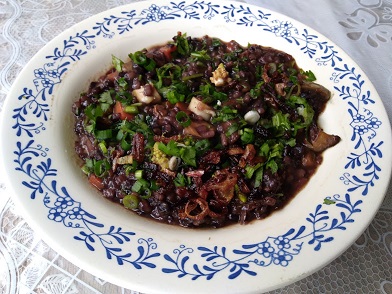
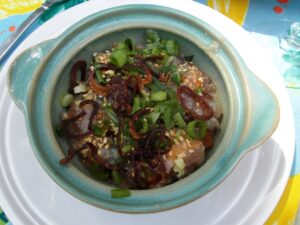
And finally, an update on the rice porridge post below, from last summer: I made some with black (“Forbidden”) rice and it was as delicious as I remembered. In addition to the spring onions, crispy shallots, cilantro, sesame oil etc, I added some winter broccoli and Romanesco florets, and fennel fronds and slices and a dash of gomasio. A perfect winter food.
The Future… and the Rice Porridge

I attended (virtually) the Oxford Symposium on Food & Cookery again this year, with much less time available to spend perusing the papers and attending the followup question and answer sessions, but it was delightful to spend some time with fellow food obsessives from around the world.

One of the keynote speakers this year was Rob Hoskins, founder of the Transition movement, speaking on “What is to What If”. I was much taken with his Rilke quote

The future must enter you long before it happens

which he used in the context of the power of imagination to make change in this world that so needs it. His talk coincided with the launch of the millionaire’s rocket and the inhumanity of that gesture in a time of such need.

“Capitalism sells us short term pleasure,” he remarked – together with all the social and personal perils that ensue when expectations don’t meet reality.

In a more grounded session, I got my hands dirty.. well, food-encrusted anyway, at a Kitchen Lab online workshop. Organized by Danish chef Birgitte Kampmann in Copenhagen and featuring a diplomatic chef in Ottawa, Cameron Stauch, we delved into several unusual ways with rice, inspired by Stauch’s cookbook, Vegetarian Viet Nam. Here’s my version of his delicious recipe for Mixed Mushroom Rice Porridge (Cháo Nấm) – well garnished with home made crispy shallots, toasted sesame seeds, cilantro and spring onions – which found its way that morning onto my brunch table… despite a momentary power outage in the midst of the session, which knocked out my modem long enough to miss a few crucial steps!

London Cooks

Recipease Building
Recipease, Notting Hill

More catch-up posting. London is receding into the recent past at alarming speed, as the present gallops along. Here are a few culinary memories of that still-recent visit. It was not as food -centred as some of my trips, as I was not there over long and more concerned with catching up than dining out, but there is much good food in London, and I had some very nice meals.

The Jamie Oliver cookery school/cafe in Notting Hill, Recipease, had lured us in for carrot pancakes, on Pancake Day – and then, near the end of my stay, to a cookery class. The school and cafe are perched a floor above the glass-walled Recipease kitchen and shop. Lessons are taught around an open square within which the instructors move from student station to student station, and diners can look on while they dine. We chose North Indian Thali, which turned out to entail a demonstration (dhal) and some hands-on (chickpea masala, crispy spiced okra, puri bread from scratch, and stir-fried vegetable salad) cooking. After which we ate our own cooking, accompanied by rice, dhal and a mango puree.


I’d also made the required pilgrimage to Ottolenghi‘s Islington shrine, where the meringues beckoned and the salads gleamed. Everything always so beautiful there.


And elsewhere: home cooking isn’t too shabby when it comes in the form of anchovy-draped tuna-stuffed peppers. Another day I had a nostalgically quirky dining experience at the Maja cafe, in the ground floor of the Polish Social & Cultural Centre, where the pierogies were ample and the golabki available in both meat and vegetarian forms; brought back memories of Edmonton’s Ukranian fare. On another day we went to the Black Dog in Vauxhall, accompanied – of course – by a black dog, who napped beneath the table while we tucked in – a perfectly beautiful beetroot salad (with three colours of beets!) for me. And (hear this, food inspectors everywhere!) even with a canine companion so close by, I can confidently state that nobody caught rabies, supped on dog hair or perished from being in the same room as an animal during that meal.


In which I revisit a couple of cooking sites

I was feeling so much better this evening, and checking a few food/recipe sites, testing my tolerance for pictures of food (still fairly low – glad that so far you don’t get aromas through the laptop) and I noticed a couple of major differences between two I’ve visited in the past, both by British food celebs.

Further to yesterday’s posting on recipe copyright I was interested to see, while stopping in at Nigella Lawson’s site that I think it has been revamped since my last visit. It’s very much a glossy marketing forum for books, dvds, kitchenware and of course Nigella herself. No Nigella recipes on offer; instead a clever wrinkle whereby she invites readers to post their own recipes. She does provide an index to her own – simply the recipe title and the name of the book it’s from. Drat, and me separated from my one Nigella cookbook by 7 or 8000 miles I think it is. (There are some of her recipes available at UKTV Food, including a good one for lemon risotto.)

Thankfully Delia Smith still offers a hefty selection of recipes, though some (would be interesting to know what percentage) of them are now locked into “premium content” which you have to pay for. (I wonder if more and more recipes will slip into the “premium” void?) While the site is also a serious marketing tool – you can buy kitchenware, books, online recipe collections and even wine – she has a number of added-value pages, like her online cookery school. If you’ve ever lamely wondered how to make shortcrust pastry, joint a raw chicken, or prepare and serve a mango, she gives you step by step instructions with photos. And if that leaves you thirsting for more she offers links to her own cooking school in Norwich (no she doesn’t teach the classes) and the Leith School in London.

On the other hand there is a page where she plugs products for McCain’s that she has developed to bulk up her football team (Norwich City). An interesting wrinkle – given the U.S. copyright controversy – is that she gives a few of the recipes for these away in case you want the hands-on challenge of making a high-carb, low-fat dish like Lean Shepherd’s Pie from scratch (–if “scratch” to you includes using McCain’s frozen mashed potatoes) (why on earth would anyone use frozen mashed potatoes for anything??). And she does tell the alert reader, flat-out, that a simple baked potato (not counting any fillings) is a better source of carbohydrates than anything McCain’s is offering.

Some live to travel, others travel to cook

When I was in Santa Fe last September, I took a few classes at the Santa Fe School of Cooking to get me oriented to my new surroundings. Mostly demonstration classes, except for a hands-on session on roasting chiles and pressing tortillas, they were a fabulous introduction to the town and the food, and a great way to pass the morning, ending with a gourmet lunch prepared before our eyes.

Our chef was Rocky Durham, who was absolutely wonderful: a passionate travel resource for his home town, a quirky advocate of southwestern cuisine – though marked forever by his classical French training – with a well-travelled palate to draw on, and of course a life-long love of good food. One of the best parts of the class were the dining Q and A: Rocky gave his unadulterated opinion of any local restaurant we cared to ask him about, and both tourists and locals (there were some in all the classes I attended) shared their picks as well. But if you go there… just don’t expect to leave without a bag of chiles and seasonings from the cooking school’s well provisioned gift shop.

Rocky gave us a few enduring tips for the road as well. One very useful one was to invest in a cheap electric coffee grinder, and another was not to buy ground spices, but rather to roast whole ones (cumin, cinnamon, oregano etc) as needed in a dry pan and then grind them in aforementioned grinder. It can be cleaned easily, he said, by whizzing a spoonful of plain white rice or salt or fresh bread crumbs. Works like a damn.

One of my classmates, by a strange coincidence, was an American expat living in London, who works at Divertimenti, a stellar cookware shop that has branched out into cooking classes. Though I still have some of their cookware, I’ve never attended their classes, but I have been to some at a much beloved cookbook shop in Notting Hill’s Portobello Market, Books for Cooks, which were endlessly interesting and delicious as well.

And now, after a morning canter along the Gorge with old Anton, I must return to a meditation on rhyme. I’m giving a short presentation on rhyme to the form class on Wednesday; so far I have identified 34 kinds of rhyme and around 40 poetry forms that use rhyme (including 5 different sonnet forms). My favourite kind of rhyme so far is Procrustean Rhyme: rhyme on words which have no conventional rhymes. Uses the method Procrustes used on his victims: stretching them if they were too short to fit his bed, and lopping something off if they were too long. So you end up truncating words (enjambing them awkwardly with hyphens) or extending them into phrases.