Skip to content

vegetarian

Playing catch-up

Time has got away from me, but here are a few highlights of my doings since November.

Christmas came and went – abbreviated by pandemic restrictions, but enlivened by snow, which after a couple of days of heavy shovelling became old fairly soon, particularly when accompanied by a polar vortex. Which was then followed by an atmospheric river, though happily not to the degree we experienced in November.

And then some signs of spring (rhubarb) to come, though it’s frozen and thawed and frozen and thawed since then. It will be a while until the soil is warm and dry enough to start planting anything. Meanwhile, I’m sorting and swapping seeds with neighbours and getting ready to plan this year’s garden.

In literary news, one of my poems, Tasting Dirt (all about compost!) appears boldly on the front inner cover of the current issue of Small Farmer’s Journal (winter 2021). Fascinating and one of a kind journal, lavishly illustrated, with lots on farming with horses and oxen, and all kinds of interesting detail on everything from setting up a binder to a report on the apples of New York in 1908.

Another poem, Hügelkultur, which happens also to be on a soil-amendment theme, appeared in the autumn issue of the long running UK literary journal Acumen, and was featured as a guest poem.

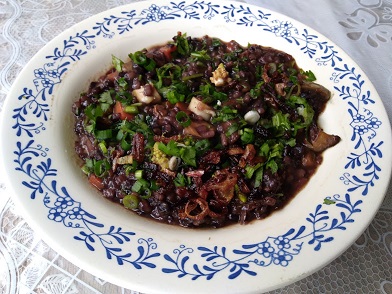
And finally, an update on the rice porridge post below, from last summer: I made some with black (“Forbidden”) rice and it was as delicious as I remembered. In addition to the spring onions, crispy shallots, cilantro, sesame oil etc, I added some winter broccoli and Romanesco florets, and fennel fronds and slices and a dash of gomasio. A perfect winter food.

Food and science

I’ve been grappling with the ins and outs of food for some years now, and my current concerns about how we should be eating for the health of the planet and ourselves have led me into some interesting places.

Recently I’ve been trying to understand who to believe in this “studies have shown” game. I thought Ben Goldacre cracked it for me in his TED talk about publication bias. There is another skeleton in the cupboard of health research though, and that of course is the question of vested interests.

A recent study on high protein diets and aging suggests (well, actually shouts) that high protein diets (especially animal foods) in middle age are dangerous, but as soon as you turn the corner to 65, they are necessary. In the interesting detail found in the paper’s funding, we can see that one of the named authors, Valter D. Longo, has equity interest in L-Nutra, a company that develops “medical food”. This medical food, it should not surprise us to learn, is a plant-based meal substitute, so there is a whiff of “follow the money” in the study’s conclusions. He appears to be the study’s designer (most? of the co-authors are his students)

Zoë Harcombe has analyzed this study and given a thoughtful assessment of its strengths and weaknesses. It’s a headline grabbing concept, she says, but the study doesn’t actually prove its case. She’s going to run the mortality numbers herself and see what they show.

Eat there then

Eat Here Now signI’m a week behind in my entries, so here goes the catch-up. Last Sunday’s Eat Here Now festival looked to me to have been enormously popular, with lots of food being eaten and bought and talked about in Market Square.

The square had been divided into an eating and entertainment side, and a vendors’ side. Crowds seemed to be milling evenly between the two by the time I left, but as I arrived at lunchtime, I headed with sooo many others to the taste for a toony buffet provided by locally-oriented restaurants. Cosmo Meens, as always, drew a crowd, this time offering a curried tofu soup with focaccia, an offering from his new Hot and cold Cafe. Relish was there with a “Vietnamese sub” of house-smoked pork terrine and asian vegetables; Sooke Harbour House’s lovely little quinoa salad with salmon, seaweed and other local delicacies, came with an all-too tasty edible scoop, but I’d be surprised if many of them lasted long enough to do their job. All in all it was a hard day for vegetarians: aside from those mentioned, and some mushroom ravioli from Cowichan Pasta, almost every stand offered meat; of which Kulu’s spicy sausage got my vote, if only because it came laden with kimchi! (Luckily for the non-carnivores, Green Cuisine was open for business on the fringes of the festival.)

Relish Vietnamese SubSooke Harbour House Salad


Canoe Brewpub's Pulled PorkKulu's Spicy SausageSmoken Bones Meaty Sandwiches


And then it was time to browse the vendors’ stalls, which of course included Haliburton Farm, where Farmers Nate & Mike were holding the fort; Libby Seabrook was doing a brisk trade in InfuseTea (her blueberry & rosemary blend is to die for, just for the record); Fry’s Bakery was selling mini-pizzas, blueberry scones and rather beautiful baguettes – can’t wait for them to open their shop on Craigflower Rd, which is rumoured to be happening later this month. City Harvest was there with urban abundance, Wildfire had some tempting shortbreads (lavender and local wheat were my picks) and Sun Trio’s tomatoes were as beautiful as the day was long and sunny.

Haliburton - Farmers Nate & MikeInfuseTea - Libby Seabrook

Frys BakeryFrys BaguettesFrys Blueberry SconesCity HarvestWildfire Bakery


Sun Trio Tomatoes

Meatlessness

After seeing Forks Over Knives, I tracked down an audio copy of The China Study, which was excellent listening material while I peeled and juiced a zillion apples earlier this month. And then I had occasion to watch the film again last weekend. Food for thought, as they say. Vegan food.

I’m always a little skeptical of dogmatists, and the book and film are very dogmatic in their condemnation of casein (milk, cheese, yogurt, butter.. ) and other animal proteins. They do present facts and figures to back up their assertions; and the case does seem overwhelming even on a superficial comparison between Western and Eastern diets, for example. Obesity and food-related illnesses are unquestionably out of control in countries that have adopted the Western diet, and rare in those that have stuck to simpler, vegetable-based fare.

The film showed a very dramatic chart from Norway before, during and after the Nazi occupation, which marked a dramatic drop in fatal heart attacks during the war and a steep climb afterwards, and we were told this was due to the population’s having been deprived of animal protein during this time. But that’s not all they were deprived of: cigarettes were also unavailable. The authors of a study reported last March  took a more well-rounded view, observing instead that during the Occupation, “Norwegians ate less fat, smoked less and were more physically active.” (The study compared recent improvements in Norway’s fatal heart attack figures with numbers last seen during the Occupation.)

Veganism is certainly not going to hurt you, which is more than can be said for the Western diet. But is it going to take off? I’m guessing not. Firstly, as a lifestyle it has a bad reputation (see how Anthony Bourdain shat upon it for example) for attracting dogmatists, animal rights extremists, and nutritional puritans. It can be hard for moderate, health-oriented eaters to self-identify with the term (although Bill Clinton’s entry into the fold has probably helped ease the way for others). And, as many of us have witnessed first-hand with vegan dining companions, it becomes really hard to eat [well] in restaurants – or in the homes of nonbelievers.

Secondly, it takes a lot longer to cook vegan food. Unless you plan to live entirely on salads or steamed vegetables, it can take a lot more planning. Whole foods (I’m assuming we’re talking whole food veganism rather than junk food veganism) take longer to cook (think brown rice vs white); dried beans or the seeds and nuts that raw food vegans use need hours of soaking. Fresh fruit and vegetables take chopping, paring and preparation. And we live in the age of convenience when half an hour’s cooking per day is fairly typical. Per day! (Statistics Canada’s 2005 census said .7 to 1.1 hours, including washing up)

Thirdly it’s just mostly not very interesting food. How I wish the film-makers had sprung for a food stylist instead of trotting out grey platters of rice and beans and less than vivid salads, and then showing the eaters oohing and ahhing over them. The book and film say this food is delicious as well as healthful. But I’m sorry, it’s just not inherently better tasting, or even anywhere as good in most cases. The China Study‘s directions are no added oil; whole grains only; no meat proteins. But oil is what carries flavours and lets them wallow in your tastebuds. Chefs and cooks of all nationalities have spent centuries developing recipes to please the human palate (not talking Western diet here, of course, although that has been developed to create a kind of addiction that can be mistaken for pleasure). And that food was designed for pleasure, for flavour, for texture and appearance. Not for health-giving benefits alone. As Bourdain also says, his body is not a temple, but a playground.

So we have a fundamental division of purpose. I don’t mind being pointed towards a healthier diet, but I do mind being told it’s delicious when it looks horrible, and too often tastes awful. I know that’s a sweeping generalization. And I also know there are some delicious foods in the vegan repertoire (kale chips! Green Cuisine‘s lasagna! Ottolenghi’s green bean salad!) and more to discover and experiment with, which I’m happy to do after a lifetime of meat-based cooking. I know it’s possible to eat really delicious Indian food that is vegan – but very far from fat-free.

And I also know there are lots of good reasons not to eat meat, and certainly not every day. Just in time, the Meatless Monday campaign has a new video:

What is Meatless Monday?

Vegan is as vegan does

How things change. A few years ago – 2006? – celebrity chef Anthony Bourdain visited Victoria to promote his latest book, which I believe was A Cook’s Tour. A strong showing of kitchen folk swelled the audience and there was a lively question and answer during which Bourdain talked about local food (nah, he said, I’m a chef: I seek the best ingredients no matter where they come from), most amazing food experience (attending a pig slaughter, coincidentally an episode recounted in his latest book) and worst food experience (a vegan feast in California). Not surprising from a meat-evangelist; he was very much in the thick of the nose-to-tail eating trend of those years, and vegans are an easy target. In his bestselling Kitchen Confidential he’d already opined that

“Vegetarians, and their Hezbollah-like splinter-faction, the vegans, are a persistent irritant to any chef worth a damn.

To me, life without veal stock, pork fat, sausage, organ meat, demi-glace, or even stinky cheese is a life not worth living.

Vegetarians are the enemy of everything good and decent in the human spirit, an affront to all I stand for, the pure enjoyment of food. The body, these waterheads imagine, is a temple that should not be polluted by animal protein. It’s healthier, they insist, though every vegetarian waiter I’ve worked with is brought down by any rumor of a cold.

Oh, I’ll accommodate them, I’ll rummage around for something to feed them, for a ‘vegetarian plate’, if called on to do so. Fourteen dollars for a few slices of grilled eggplant and zucchini suits my food cost fine.”

Last night I attended a screening of Forks Over Knives which leans heavily on a very different sort of book, The China Study, and maintains that plant-based diets will prevent and possibly even reverse the diet-related illnesses of our time: cancer, diabetes, heart and arterial disease. It was entertaining and informative enough, although there was a puzzling lack of comment about its assertions that added oils (including vegetable oils) are toxic, and a complete absence of discussion about the role that exercise plays in disease prevention and control, even though all the patients featured in the film were exercising like mad.

But this kind of advice has been around, and largely ignored, for years. In 2007 the buzz in Britain was that cured meats (and sedentary lifestyles) were the demons. Stay away from bacon, they said, even there in the land of the bacon butty. Not to mention the Full English Breakfast (and all its Scottish, Welsh and Irish counterparts).

It’s something that Marion Nestle, Michael Pollen and Mark Bittman have also been writing about for a while. Nestle has, like the film, pointed out the excessive influence of the meat and dairy industries on American food policies – and in particular the dietary recommendations represented most recently by the USDA’s MyPlate, which doggedly continues to include meat and dairy. So does Canada’s Food Guide, although it is careful to give alternatives equal weight.

It’s worth reminding ourselves how little protein we actually need vs how much we consume if we’re eating meat and dairy. To calculate what you need, multiply body weight in kilograms by .8, or weight in pounds by .37  to get the number of grams. For a 150 lb person, that amounts to 55g (a bit less than 2 ounces) per day: the entire daily protein needs could be met by 2 hamburger patties. But almost everything we eat has some protein in it, so if we’re eating a balanced diet with enough calories, we can clock up a healthy amount of protein without trying too hard.

So there’s no question we can get all the protein we need from plant-based diets, a point the American Dietetics Association made in its 2009 recommendation that vegetarian – and vegan – diets are safe for babies, children and adults, and recommended as a way to prevent chronic illnesses of the sort the film discusses.

Though I’ve reduced my meat consumption hugely in recent years, the sticking points for me would be cheese, yogurt, eggs and butter. And milk in my tea. And the fact that eating away from home becomes such a headache: so many restaurants, caterers and the like simply don’t make nice food without meat in it. In less cosmopolitan towns and cities, the vegetarian options on menus are too often ineptly executed stir-fries. Ah well. Not to worry about just now: lots of nice vegetables and fruits in my fridge this fine summer day. And soon, they promise, Green Cuisine will re-open.


Meaty quiz

A day late will perhaps be better than none, by the time you read this. Thanks to Meatless Monday for passing along this Meat Eaters Guide which includes a quiz that lets you test your knowledge about protein sources and find out where yours sits along the sustainability scale.

Actually although I applaud the idea, I think the quiz as written is terrible, and not a lot of fun – unless you happen to have memorized a lot of figures on American meat production, greenhouse gas emissions and cropland usage. I also think it’s far too long at 18 questions; very few people will make it to the end of the quiz and check the answers.

I have encountered a lot of this sort of thing in recent years, as well-intentioned organizations search for new ways of catching the notice of consumers who’ve heard it all before and really don’t want to change their lifestyles.

The fact is that if you design a quiz for a public website, you have to give your public – which has a wide, wide range of knowledge about your subject, and the slimmest of attention spans – a fighting chance to answer the questions. Asking a lot of multiple choice questions about trade figures and crop statistics is not fair play, and most sane participants will give up after the first or second such question.

And with that I will go back to reflecting on the delicious meatless meal we enjoyed tonight: after a starter of kale chips (tossed in tahini dressing and then dehydrated for a couple of hours) and freshly picked snow peas with garlic tahini dip, we had Spaghetti al Vino Rosso (much like this recipe, but also including parsley and Bowl of Cherriessome chopped toasted walnuts). Followed by a handful of freshly picked trailing blackberries in (sorry) cream and sugar, and a few organic cherries.

The rest of which are bound for the freezer and/or dehydrator and/or canner tomorrow. What fun we will have with my new cherry pitter!