Skip to content
Home » dairy

dairy

Growth hormones in dairy, and National Poetry Month in Canada

Shocked by a grim if slightly dated tale about rBST – recombinant bovine somatotropin, marketed under the name “Nutrilac” – a synthetic hormone, developed by Monsanto through genetic engineering, that increases a cow’s ability to produce milk – which is allowed in US dairy cattle but banned in Canada and the EU. Despite intense lobbying by Monsanto, and a made-in-Canada whistle-blower scandal, eventually further study showed cause for concern over introducing it to the human food chain: but it is even more harmful to the health of dairy cattle, who suffer greater risk of lameness, infections and sterility when given it.

Bear that in mind when buying anything containing dairy products from the US. I’m not sure if there are any regulations at all that limit the use of US dairy products in this country – the regs only say we can’t give the hormones to our cattle. A number of dairy producers in the US now label their products as hormone-free, which is causing Monsanto to protest that such claims might make consumers think the hormone-free products are in some way ‘better’ than those which are produced with the benefits of Monsanto’s chemicals. Gosh…

More about milk another day. Meanwhile, National Poetry Month looms in Canada, and starting April 1st, the League of Canadian Poets will showcase poems by its members on a blog, whose theme is “Poetry Without Borders.”

Lodi: mozzarella and ricotta

We had a day out today, and watched some small scale mozzarella cheese making in the Istituto Sperimentale Lattiero Caseario/Institute of Dairy Science in Lodi, not far from Milan. The lab is equipped with a cheese making facility and over the course of our day-long visit, the master cheesemaker whipped up a batch of mozzarella and a little ricotta for us.


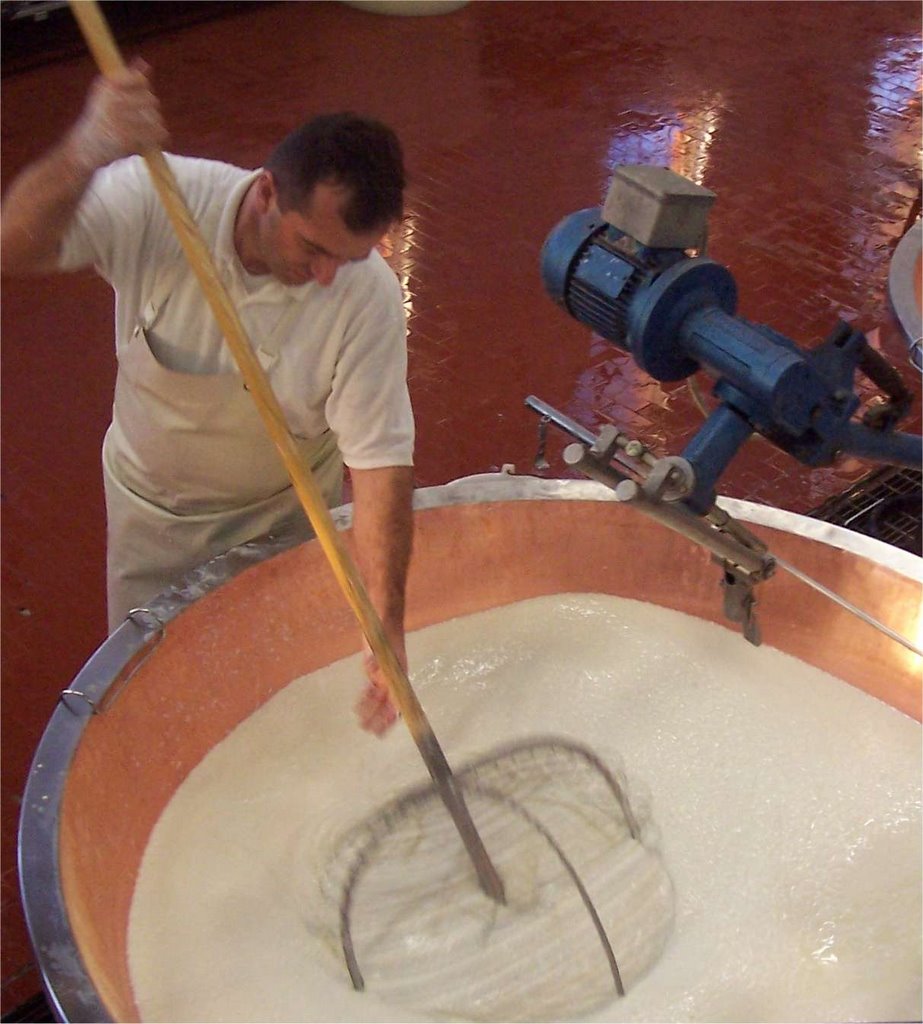
Mozzarella curd: whole milk from the institute’s dairy farm has been acidified (lowering the pH from 6.8 to 5.85) with citric acid (interesting to see it’s useful for more than cleaning one’s kettle).


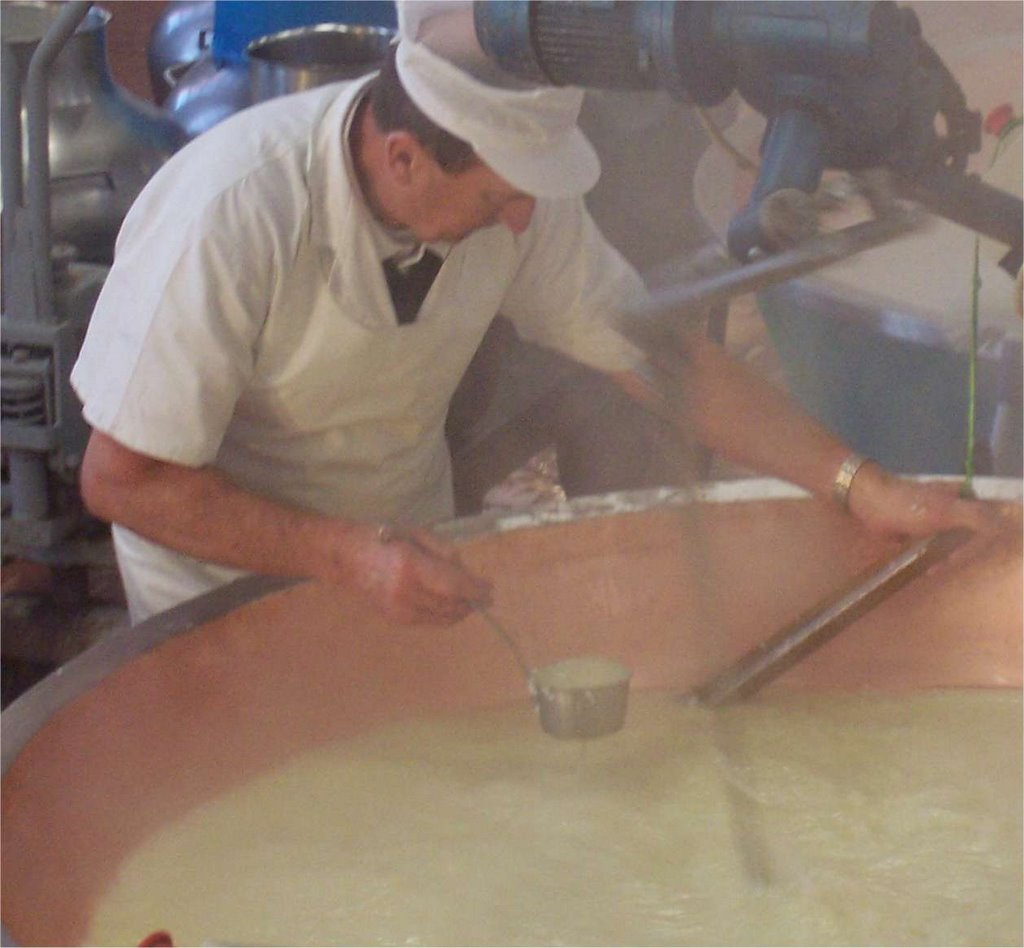
Mozzarella curd: cut, drained, cut and then left to drain again.


Mozzarella curd: cut, drained, cut, drained and now cut again.


Mozzarella curd: cut, drained, cut, drained, cut, drained and then put into the basin; cut once again. Then some hot water (around 90 degrees c) is added and the stretching begins.

Hand stretching the curd – a slower, lower-yield way to make mozza. The advantages are that any problems with texture can be dealt with right away, so you end up with a better quality cheese. But you’d go bust doing it: the volume of milk you need to process to make mozzarella, together with the greater loss of milk solids into the liquid, and the slower processing (man ain’t no machine) just aren’t cost effective these days.

Stretching the cheese; shaping it into balls. Stretchy stuff with characteristic threads (elongated casein strands, eh?): practical heat and chemistry.


Hand-adjusting the steam-heated vats to start making ricotta from the mozzarella whey. Ricotta, we now know, means ri-cotta, or re-cooked/twice cooked. (Want to make your own? Here’s an illustrated guide.)


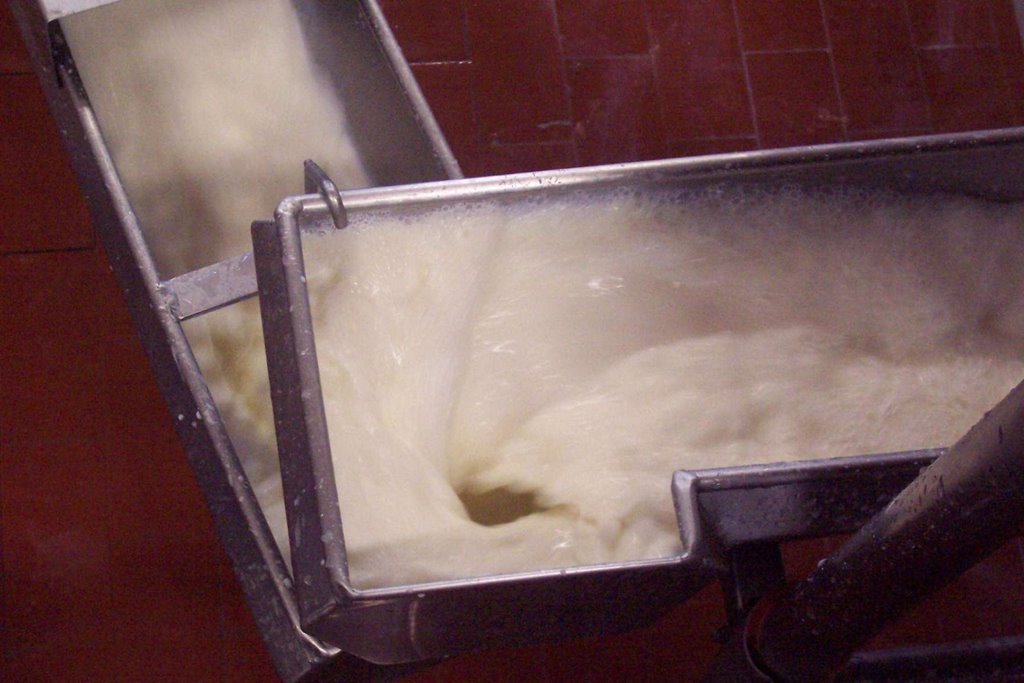
The whey starts off at the same pH as the mozzarella curd (around 5.85 – lowered from milk’s natural pH of 6.8). Sodium hydroxide was added in order to raise the pH to what’s needed for ricotta, between 6 and 6.5; the pH is regulated and if it goes too high, more citric acid can be added to lower it again. In the process we watched, there was a mistake – the pH gauge was too close to the sodium hydroxide when that was added, and gave a faulty reading, so it never quite worked out while we were watching. Which was instructive: we saw the effect of curds that were too small to bind properly for ricotta. However, under optimum conditions, the whey begins to coagulate and – after adding milk (around 6% in this case, although up to 20% might be used) – the foam needs to be skimmed off. The ricotta is then poured into baskets to drain and set, and is used most often in pasta and cake fillings.


In one of the labs: Roberto Giangiacomo tells us about a piece of equipment called ‘the sniffer’ while Richard Gere and Clive Owen look on.

Where the milk comes from

So today’s trip was to the dairy farm:
we got in the bus
to go to the farm
to meet the man
who owns the cows
who give the milk
that makes the cheese…


But before the farm, there was the Christmas market, and a stall selling small round edibles of a Sicilian persuasion.

Then there was the farm. More round things.


In addition to a persimmon tree, they had 200 cows, about half of which are giving milk at any time while the others are either growing up or getting ready to give birth. This farm had only Friesians, which came from Canada and the U.S. The farmer belonged to a dairy co-op of 11 farms and was very near his cheese factory, convenient for making that 2 hour deadline to deliver the milk. The other restriction on milking for Parmigiano-Reggiano is that the actual milking must be completed within four hours, start to finish (this farm managed it in one and a half hours, twice a day).


Hmm… these remind me of something I’ve seen lately… cylindrical, straw-coloured, stacked to the ceiling… The Parmigiano-Reggiano consortium obliges its dairy farms to produce – on-site – at least 50% of the feed for their cattle; this farm produces 90% of its feed. No animal products can be included in the diet of the dairy cattle, and no silage or wet grass, all to preserve the safety of the cheese, the reliability of the ripening process, and the purity of the flavour.


My fellow Canadian?


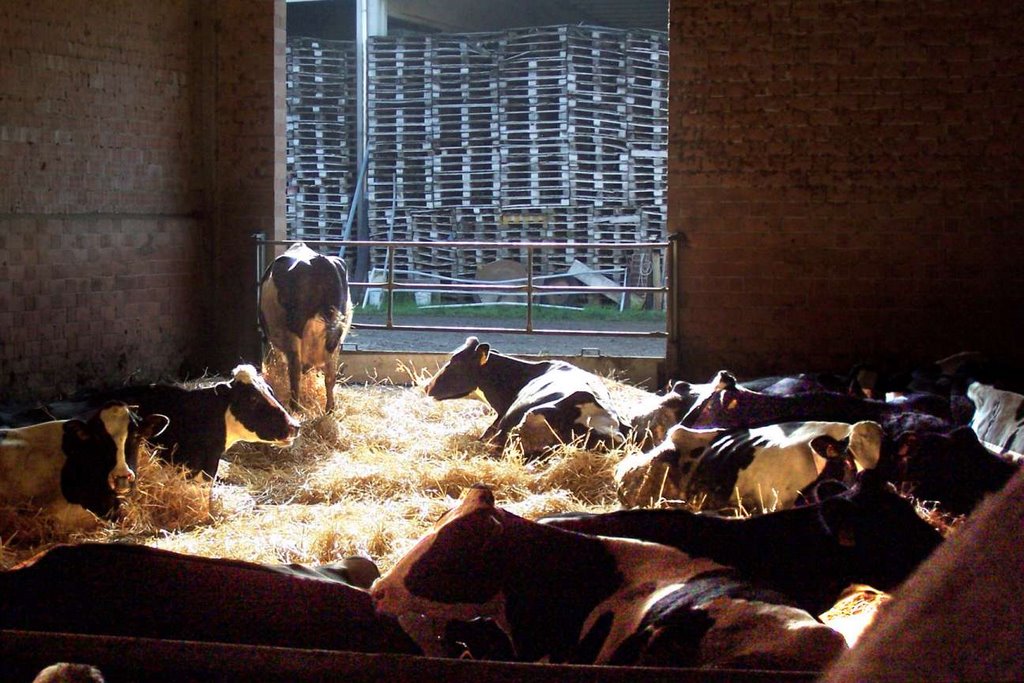
We observed the bedroom of the cows.


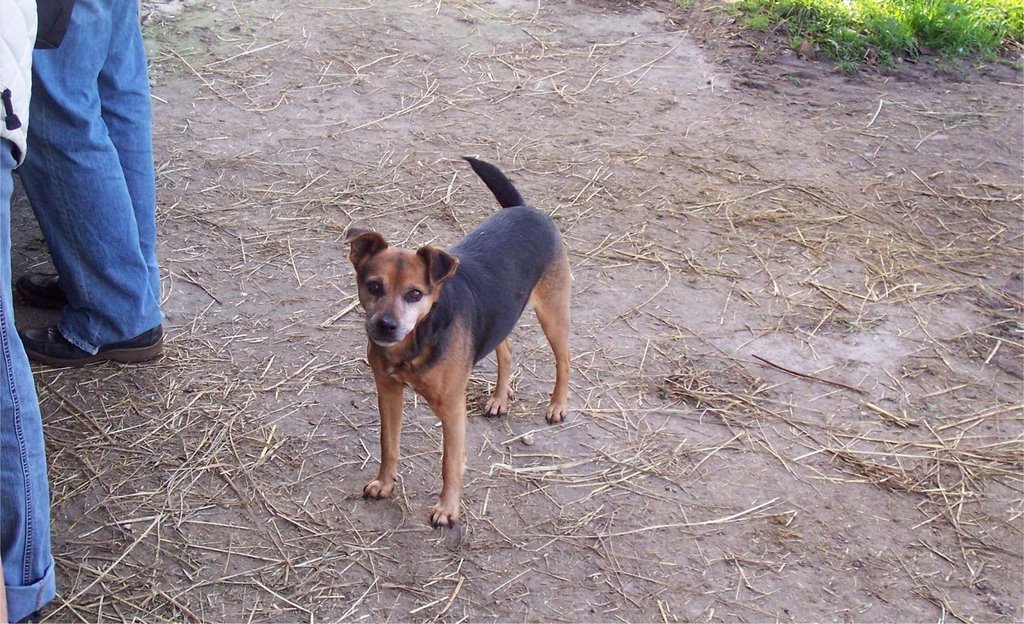
Scary farm dog.


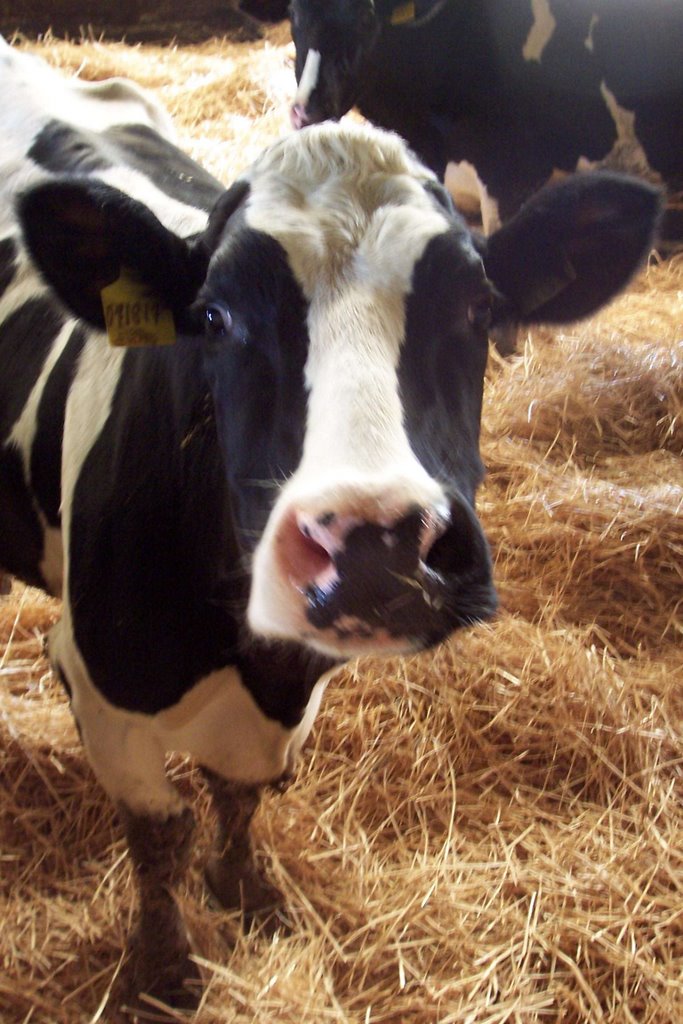
And on that farm there was a cow…


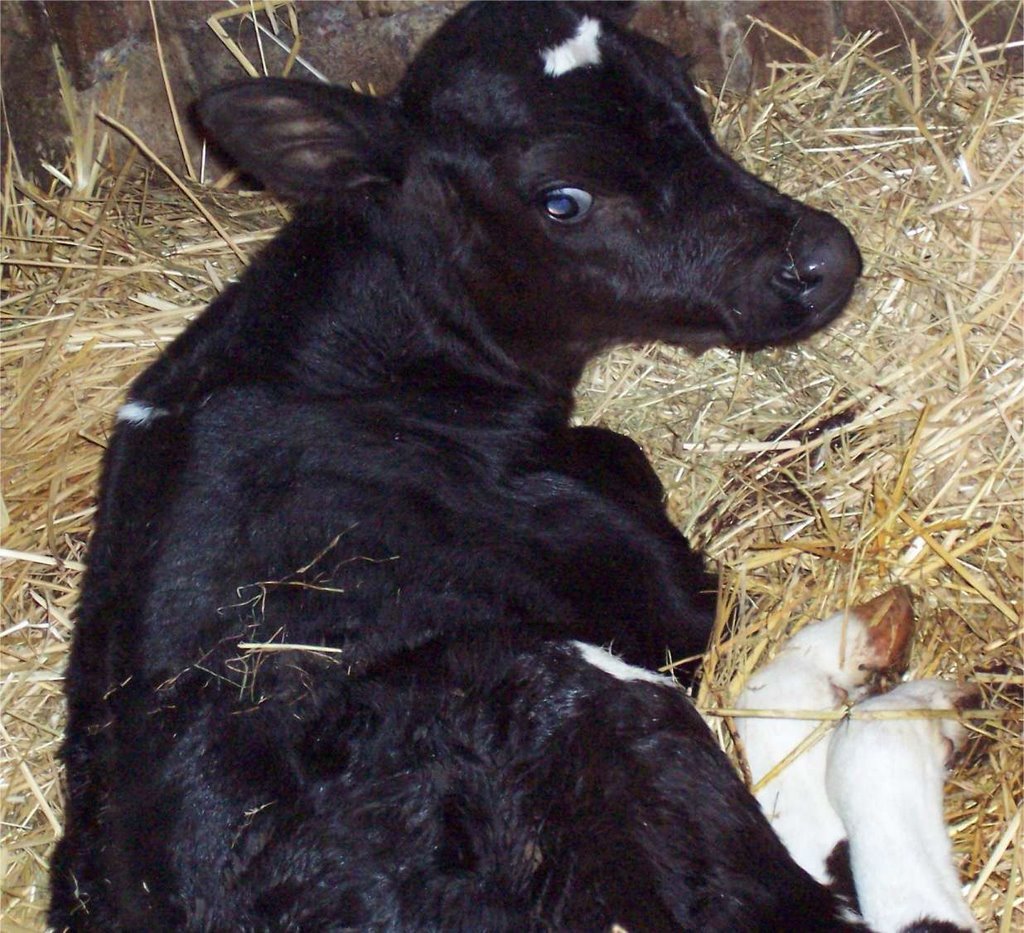
Why yes, as a matter of fact, I was born yesterday.

The real thing – Parmigiano-Reggiano

Again the sciopero raises its ugly head. We had been scheduled to visit a cheesemaking factory and then a dairy farm on Wednesday and Thursday, but the bus strike would have affected our, um, bus, so the visit and our classes were rescheduled so we could go Thursday and Friday instead. Then the Wednesday strike was cancelled. Then we heard an all-out strike (buses, trains, planes) was planned for Friday instead. Then that was cancelled. Or was it? All so confusing.

Anyway we were, on Thursday, very happy to visit a Parmigiano-Reggiano cheese factory in nearby Baganzolino on Thursday and see all that had been described to us actually happen before our eyes. We arrived at 8am in time to see the whole range of the day’s cheese production. and were well briefed on the bus.

The milk that arrives at the factory must be delivered within two hours of milking, so there was no time to lose. Everybody went wild with cameras and I think several thousand images were taken as we watched it all unfold; here are a few of mine.


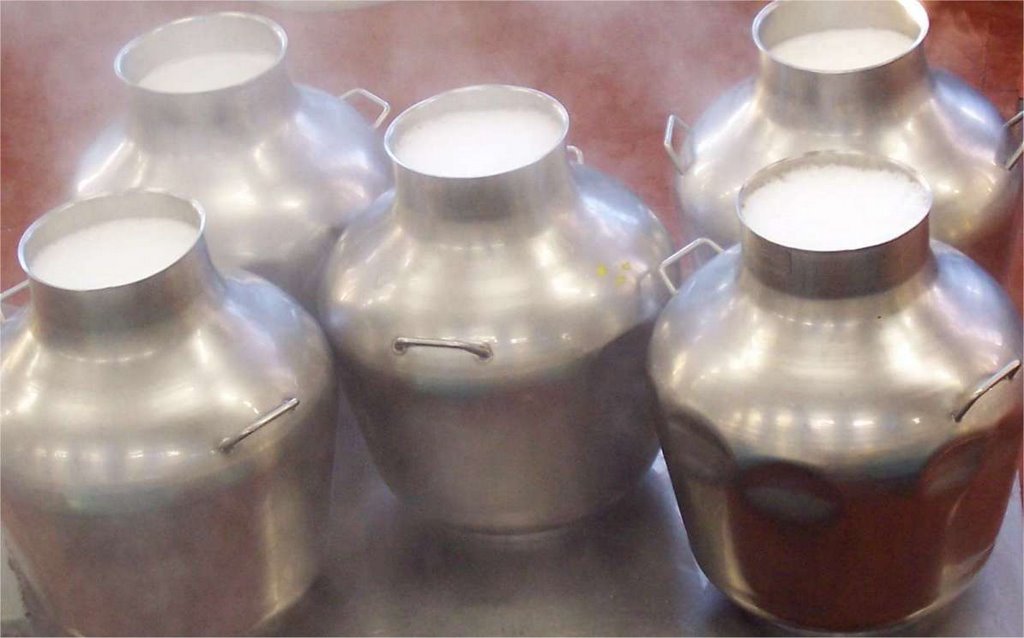
The milk from the evening milking is set out in trays to separate overnight. The cream is skimmed off and this milk is mixed with that of the morning milking, so it’s genuinely partly skimmed. It’s then heated, and whey (naturally fermented from the previous milking) and rennet are added.


The whey and rennet have been added to the milk; it has coagulated and the curds are being broken up into grains the size of wheat kernels. For this task they use the spino, a whisk unique to Parmigiano-Reggiano cheese-making, named for the thorn branches that were originally used (hawthorne, according to our Italian teacher).


The master cheesemaker – we were told that, like the cows, he never gets a day off – checks the temperature and curd. Once he deems it cooked, the heat is switched off. Traditionally and practically, copper urns are used because of their excellent conductivity: and their ability to both heat up and cool down quickly.


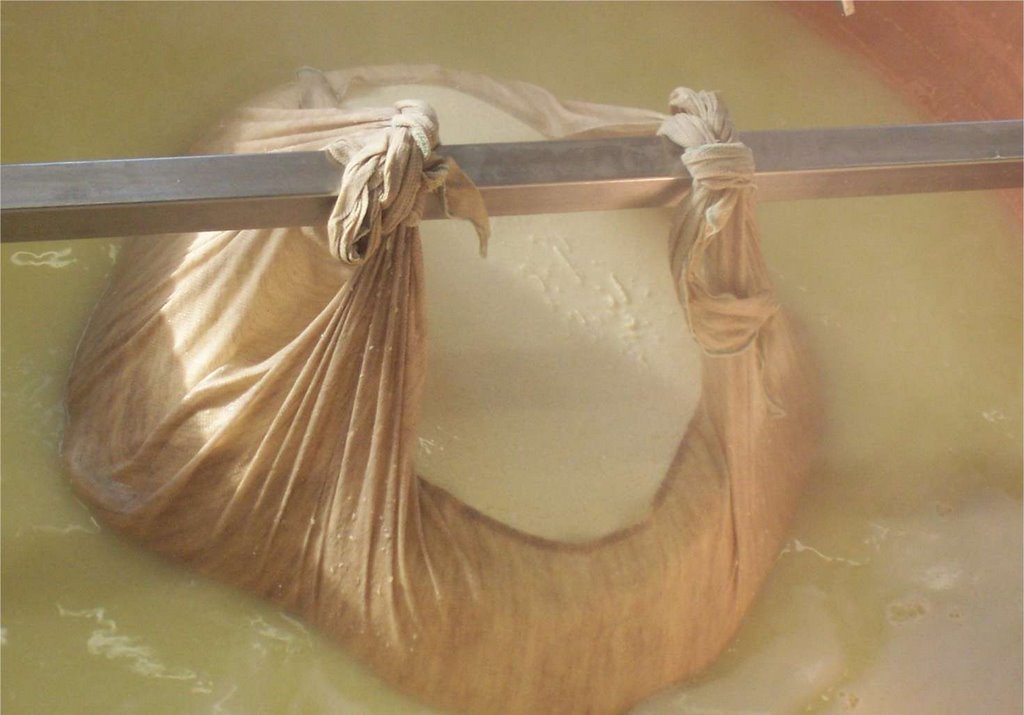
The cheese has coagulated into a nice big ball. It’s cut in half after this; each vat makes two cheeses, a total – for this factory – of 24 cheeses a day.


Most of the whey goes to the pigs (this be prosciutto country after all); some is made into ricotta; this batch will be used for the next day’s cheesemaking.


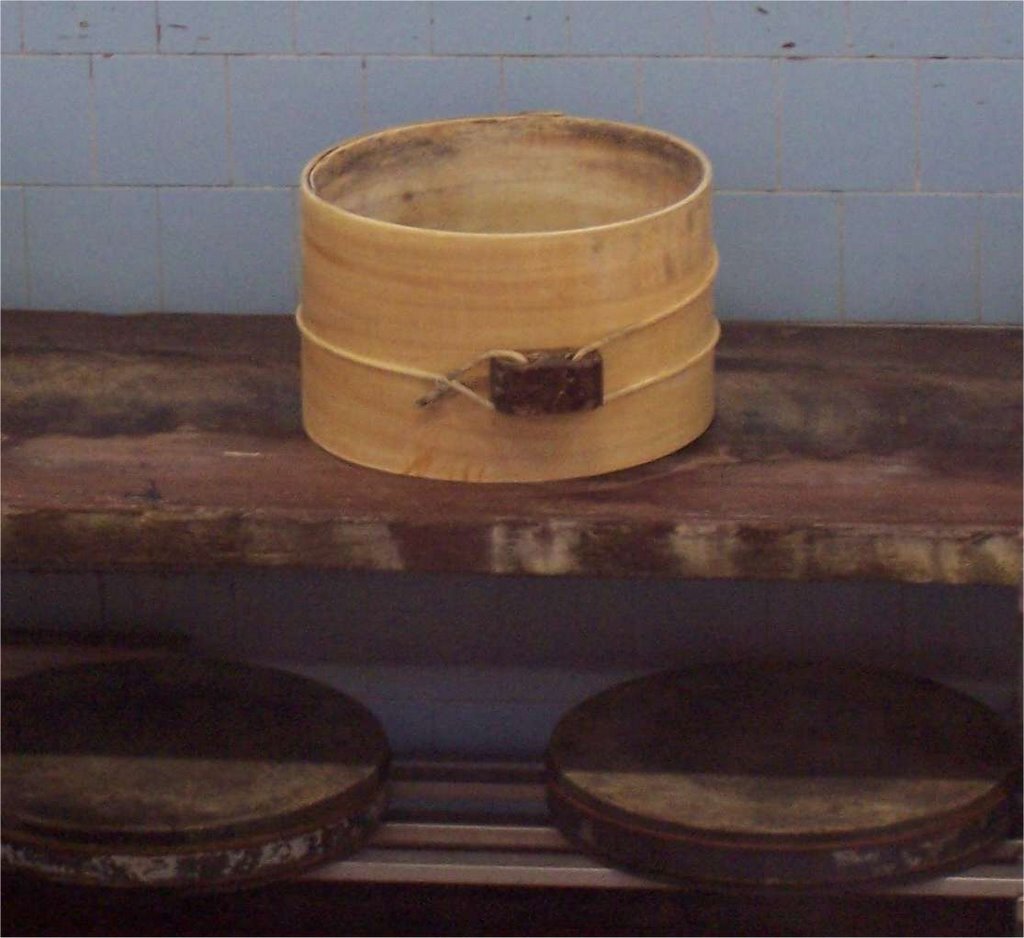
The first mould for the cheese.
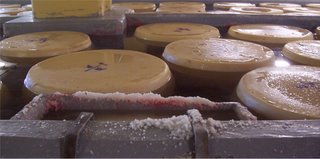

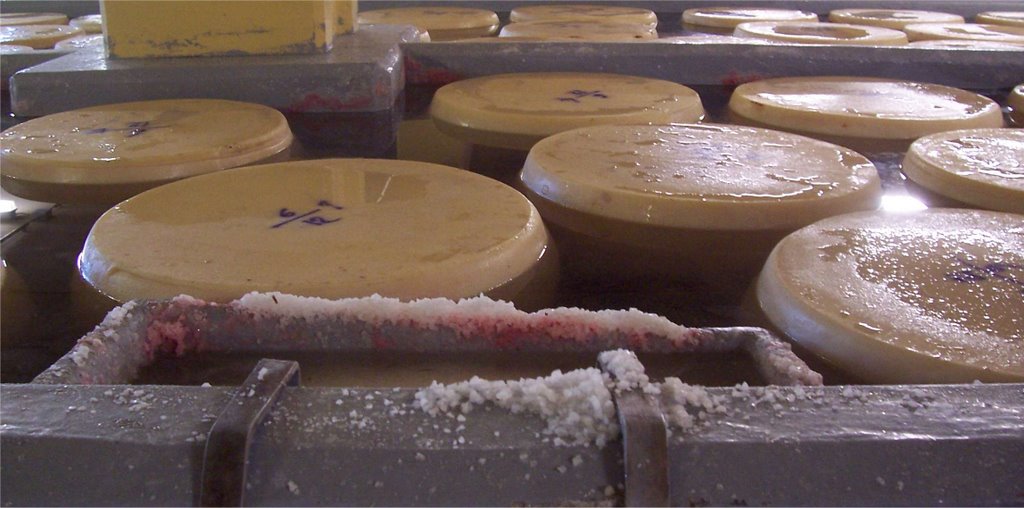
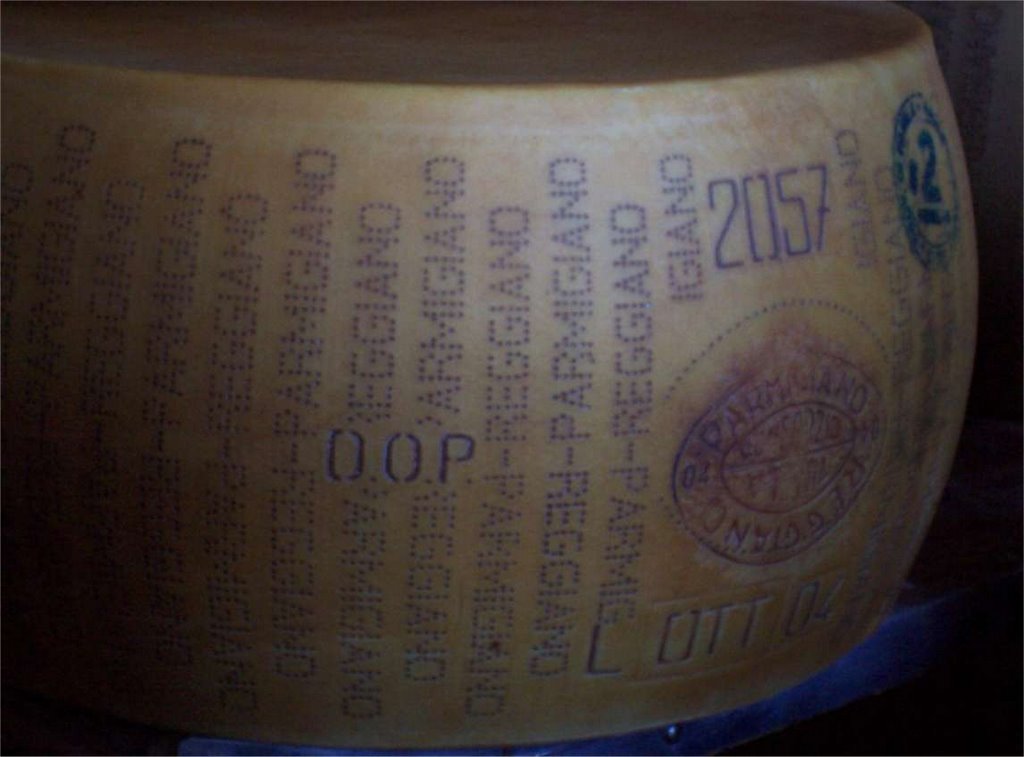
After two days – the Parmigiano-Reggiano brand having been imprinted the first day and the cheese shaped in metal moulds the next – the cheeses are floated in brine for 20-odd days, to firm up the rinds and allow osmosis to do the work of removing excess moisture and prepare the texture for a good long aging process. The cheeses are turned and re-salted regularly. Salt is the only preservative allowed in Parmigiano-Reggiano.


Look up… look wheeeeeyy up!


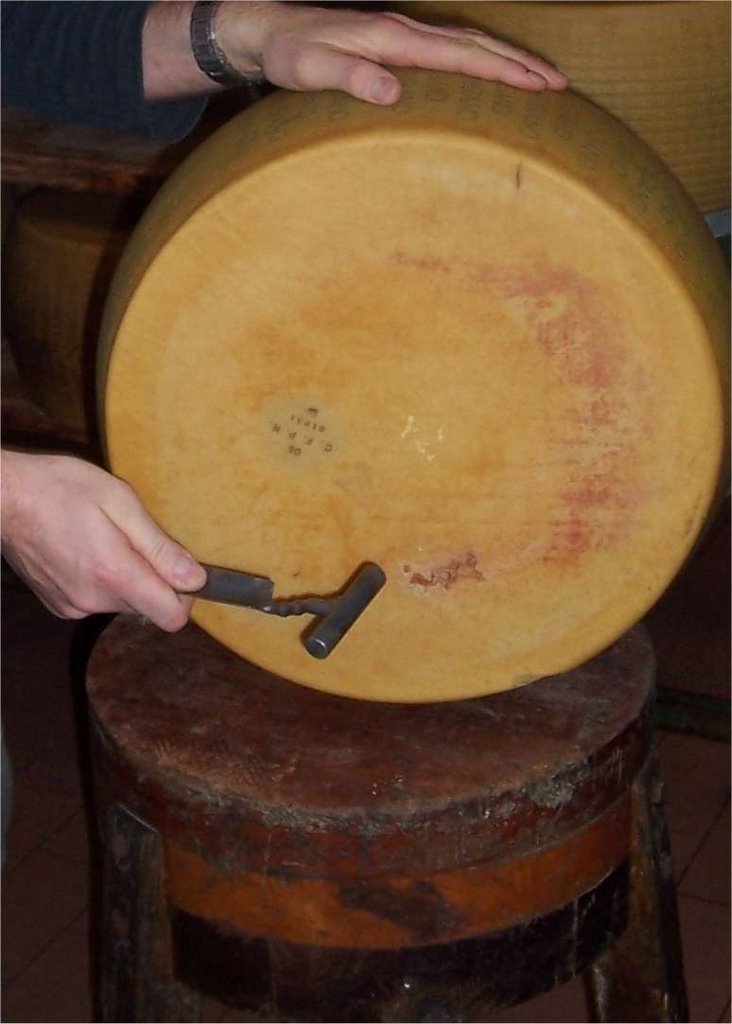
Once aged, the cheeses are tested by experts (battitore) who use a hammer to determine the depth of the rind and the quality of the cheese through sound alone. A hollow note can indicate uneven texture or holes (eyes). We’ve heard from several directions that holes are an impermissible defect in Parmigiano-Reggiano; formed by fermentation within the cheese paste, they can allow bacterial growth and spoil the flavour. The farmers go to great lengths to prevent the cows from eating wet grass, and neither are they permitted to eat silage, because these can promote lactic fermentation that could spoil the cheese during aging; so notes on permissible feed for the cows have been included in the regulations that govern Parmigiano-Reggiano production.

Much of the cheese is sold after 12 months, just to pay the bills. We were told that currently the Parmigiano-Reggiano consortium cheesemakers are operating at a loss, and the earliest they can sell their product is 12 months, at which point it is fine for grating, though the preferred age for eating it as a table cheese is after 24 months. Its digestibility and flavour improve, but its texture gets drier as it ages. One of the distinguishing features of the well-aged Parmigiano-Reggiano is the presence of small white crystals – an amino acid called tyrosine – which you find also in other long-aged hard cheeses such as (yum) gouda.

British cookery writer Delia Smith visited this region and learned about Parmigiano-Reggiano and documented her take on it on her website. I especially liked what she revealed about its noble history in England:

During the Great Fire of London, that most discerning of diners, Samuel Pepys, thought the cheese so precious that he dug a hole to bury his Parmigiano Reggiano to preserve it from the flames.