Skip to content

cheese

Raw and milky

I’ve been easing off the dairy products lately, though my cheese drawer still groans with long-lived goodness. One of the items that will always remain there is a hefty chunk of Parmigiano-Reggiano, a staple in my kitchen, as in many others I’m sure. It would probably startle many North Americans to discover that this is a raw milk cheese. Our governments allow it because it’s been aged over 60 days. It’s also salt-cured, which is a preserving process in many food products that helps to ensure food is safe by driving out liquids that can harbour pathogens, and making a generally unpleasant living environment  for them.

One of my classmates at Unisg was Australian and she shocked us by revealing that the Australian government allows no raw milk cheeses at all, including Parmigiano-Reggiano! This is still the case, and there are rumblings that the 60-day threshold in the US could change. Here in Canada only Quebec cheesemakers are allowed to make raw milk cheeses: I have not heard of reports of an increase in sudden deaths in that province since the regulations were changed in 2008.

In the Rest Of Canada, as we are known, we have watched a long and painful battle between Michael Schmidt, who wants to share the right of informed citizens to drink raw milk (or turn it in to cheese I suppose) and the government turn sour; he’s currently on a hunger strike to protest the reversal of his earlier court victory upon appeal by the province of Ontario, after heavy lobbying by the province’s milk marketing board.

Into the fray comes Slow Food. Although they do not seem to be following the Schmidt case, they are tracking developments in other countries, including Australia, and have set up a Raw Milk website to promote the cause, which they take up largely for the sake of cheesemaking. Slow Food is, after all, the champion of good food: raw milk cheeses are simply better than pasteurized in many ways, including flavour and texture.

Raw milk contains microflora and natural enzymes that allow for more complex flavours and textures in cheese. Pasteurization destroys these as well as vitamins A and D which must then be added back to milk products in artificial form. Minerals such as calcium and iron are altered by pasteurization, as are the fats, and the digestibility of the final product. One of the arguments against the findings of the China Study was that it failed to make a distinction between pasteurized and unpasteurized milk products.

For drinkers of raw milk, there seems no respite from the government ban. In order to drink raw milk you need to own your own cow, and tell nobody. For the immune-compromised, it’s probably not a good idea to drink it, but among the healthy adults who prefer it, there are many arguments in its favour (as long advocated by the Weston A. Price Foundation). I drank it while in Italy, where the law allows people to make their own choice, by filling the milk bottle themselves (in my case from a dispenser provided by a local dairy that also sold cheese and other food products in a shopping mall). Despite the official warning signs posted on the machine, I watched a heavily pregnant woman fill her bottle; the presence of a small child with her suggested she may have survived a raw-milk fuelled first pregnancy already.

It is, as raw milk supporters would say, a puzzle why raw milk should be targeted when so many government-approved toxic substances are already on our tables. There is no ban on fracked tapwater, for example, nor on processed foods high in salt, sugar and fats which are proven to cause catastrophic health problems.
Kneading Conference West – day 2

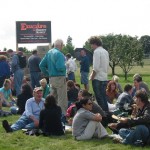
Sun broke out on day 2, causing some basking on the grass at lunchtime.

We began the day with a PowerPoint tour of local and small scale wheat producers from non-wheat areas; wheat breeder and conference organizer Stephen Jones showed maps revealing the transition to commodity scale production, which has redrawn the country’s pattern of wheat production. While almost every state in the US used to produce wheat, now the focus is on large scale production – nothing less than 1000 acres shows on the maps. But there’s a welcome resurgence across the board with small producers from Whidbey Island – where Ebey’s Prairie farmers once held the world record for productivity (119 bushels/acre in 1919 – a figure that dwarfs today’s industrial scale yields of around 45 bushels/acre) to Vermont – where farmer Jack Lazor has dealt with the loss of infrastructure by building his own grain elevator. Here at the Mount Vernon Research & Extension Centre (where the conference is being held) Jones is working on developing varieties that are resistant to local problems – notably rust – and has been working closely with local producers and bakers.

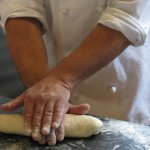
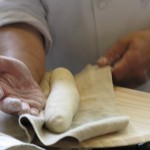
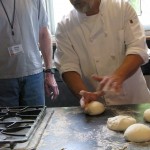
Starting to get hard to choose between sessions. I stopped for a few minutes at various points to watch Seattle baker George DePasquale on Artisan Sourdough for Home Bakers where he had some smooth moves for shaping boules, batards and baguettes,


and offered advice on setting each on the couche, as well as transferring from the couche to the peel. He also took his scissors to a baguette to demonstrate the making of an épi de blé – remarking it was a tricky one to get in and out of the oven in one piece.

On to a panel discussion: A Question of Scale, where farmers and bakers talked through some issues to do wtih ethics and economics of producing local and organic.

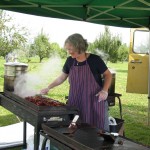
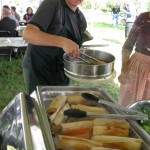
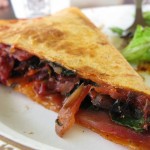
Lunch beckoned aromatically from the tent where the Patty Pan Grill folk were preparing the innards of our meal, which, alongside an excellent salad and three kinds of tamales, offered a spectacular discovery for me: it is possible to enjoy a quesadilla, if it is prepared from beets and other nicely turned veg together with some good cheese.

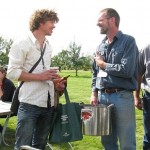
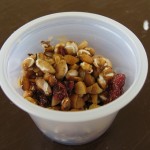
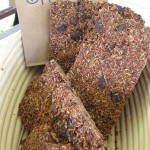
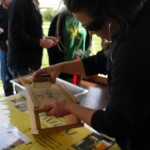
Some Vancouver Island talent: Fol Epi baker/owner Cliff Leir with “beer farmer” Mike Doehnel. Mike walked us through the barley malting process, after an introduction to barley breeding by Patrick Hayes, who set us loose on samples of hull-less and hulled barley, perled barley and even an incredibly good toasted barley snack (with local hazelnuts and cranberries) that’s soon to be marketed.


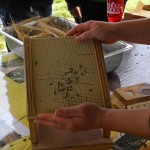
There was also discussion of something called Bappir, an ancient trail food made with barley, honey and dates which served a dual purpose: it could be soaked in water where it would be colonized by wild yeasts and serve as the foundation to early beers. We were also encouraged to try a barley head thresher – a basic manual model or an automated version – and a barley perler.

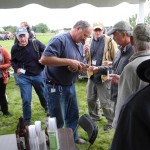
Some beer tasting ensued while Mike managed a demonstration barley mash in the background, eventually offering sips of the wort (if I followed the process correctly) which is the sweet dregs of the washed mash. It can be cooked down into malt extract for baking, or carried through the process and combined with hops to make beer. Of which we’d sampled five versions – four of them local, and some quite excellent. Thus fortified we wandered off to wait for… a beer and cheese tasting.

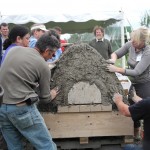
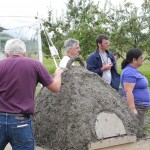
Behind us there was a small commotion of slapping and patting, which was the wood fired oven workshop group putting the finishing touches on their labour of love, which was to be silently auctioned off later in the evening, with proceeds to go towards the next Kneading Conference West – a worthy cause in my view. All you needed was the means to take it home with you…

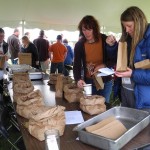
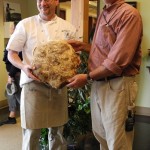
Elsewhere I happened upon Michael Eggebrecht and Stephen Jones wrangling a giant loaf from the Professional Baking workshop – came off a large rack of loaves that were on the way to the food tents where we covered them in more local cheese – a dill/garlic herbed number and an aged gouda style – before settling in to a dinner of barbequed chicken, corn and beans. And that was our Friday.


I retire with trepidation, for tomorrow’s schedule is too tempting and I cannot decide between four simultaneous sessions…

épi de blé

Cheesy farewell to Toronto

I was thinking it would be nice to take some Eastern cheeses back west with me, and when I asked about cheese shops, Sandra suggested Nancy’s Cheese on Dupont at Spadina. I duly sweltered along there in the late morning heat of departure day, and was able to take a good long look at the current offerings while Nancy set up an order for someone’s cheese tasting party.

I was pleased to see the cheese selection was relatively modest

– decision-making is hard enough – and Nancy

was generous with the samples and her knowledge.

It was mostly Ontario and Quebec cheese – just what I was after – plus a few well-chosen foreigners (Parmigiano-Reggiano, Gruyère, Brie de Meaux (raw milk brie), Aged Beemster).

Here’s some Bleu Bénédictin

which I didn’t buy, but I came away with a good and interesting selection:

Bleu D’Elizabeth (Quebec); Avonlea Cloth Bound Cheddar (PEI); Le 1608 (Quebec); Île-aux-Grues 2 Year Old Cheddar (Quebec); Cape Vessey (Ontario – washed-rind aged goat cheese which I encountered at its orgins in Picton County last year); Paradiso (Ontario – sheep’s milk cheese).

I like the informative labels and look forward to sharing…

Say cheese

GK Chesterton did, at length, and spawned a memorable quote:

Poets have been mysteriously silent on the subject of cheese.

And then there’s Clifton Fadiman, who observed:

A cheese may disappoint. It may be dull, it may be naive, it may be oversophisticated. Yet it remains cheese, milk’s leap toward immortality.

And if you have feta and parmesan cheeses on hand you might enjoy, as I did recently, some Potato, Artichoke and Feta Cheese Latkes.

Went to a couple of readings lately, which were indeed mysteriously cheeseless. On Friday, Acorn-Plantos winner Christine Smart read with the always excellent Don McKay

at the Red Brick Cafe in Sidney, where we had some very pleasant accordion music to enjoy in the before after and interval periods.

And then on Saturday to the Rona Murray Prize-giving, where we heard from the 8 shortlisted poets. DC Reid was introduced by organiser Peter Such

and Barbara Pelman read,

and so did Patricia Young, whose lizard poem shared the prize with an excellent villanelle by Marlene Grand-Maitre.

Scotland it ain’t

The company which provides my email has also decided to change my surname. So maybe you can understand why I dislike being in North America in general, and why I have a special hate on for the Beach Boys?

It is maybe not as specific and passionate a hatred as I have for Canada Post, that government agency which has the bare-faced cheek to charge tax when it sells us stamps, and who took my money for holding my mail and then sent a selection of it back to Italy. So now I can choose to enjoy playing a complicated long-distance game of hide and seek in Italian with Poste Italiane during the Christmas rush.

However. I did have an outstanding meal in London before I left, at La Trompette. Here’s the evidence:

A starter of mixed leaves – endive of two colours and rocket – with roquefort, walnuts and poached quince:

Followed by an exquisite piece of sea-bream, crunchy and melting, on a bed of pureed potatoes with a darling lettuce heart and perfectly roasted parsnips for company, in a chicken jus with capers.

We would not dare to call this delicious morsel Pineapple Fluff, but superficially, and passion fruit aside, the resemblance was striking…

And on my first visit to an Italian grocery in Vancouver, which shall remain nameless for the moment, I was able to spot my first instance of cheese fraud. They had vac-packed Grana Padano and were selling it as Parmigiano-Reggiano; you can tell by the markings on the rind, which are diamond-shaped for Grana, whereas Parmigiano-Reggiano simply has its name spelled out together with the production date (which makes it annoying not to get a specific answer when I asked the seller how old their Parmigiano-Reggiano was: basically you are looking for something in the 24-36 month range, but all she could tell me was the piece in my hand would be between 2 and 4 years… since the producers will have charged the wholesaler more for a 36 month wheel than for a 24, it does matter to me the consumer which I am buying).

Grana is a cheaper, industrial version of Parmigiano-Reggiano, so it is more than cheeky to try to pass it off as its higher-priced cousin. I told the clerk at the cheese counter that the cheese had been mislabelled; she looked confused but gamely started filling a basket to get the offending merchandise off the display. But when I looked again, most of it was still there. I will hold judgement and whistle-blowing until I have a chance to check them out again. I greatly fear that my year’s experience has only served to make me potentially unwelcome everywhere I go.

Biodynamite

Saturday I overcame the weekend handicaps imposed by what are generously described as “improvements” on the Underground, and managed to arrive at Victoria coach station in time to welcome my classmate Jenn to London. Off we sped on the trusty number 11 bus, alighting beneath the shadow of St. Paul’s and walked unswayingly across the Millennium Bridge, and along the waterfront until we reached Borough Market,


in good time for the launch of Biodynamic Food Fortnight. We managed to source some fantastic snacks before events began: a toasted Montgomery cheddar cheese sandwich

(watching the cheddar raclette being assembled

made me so faint I was forced to take a native oyster or two from a seventh generation oyster seller.

Revived, we ascended many stairs into the massively crowded Borough Market boardroom. The celebration was all around biodynamic farming methods, which we’d heard about on our trip to Crete. Basically it is to do with sustainable agricultural practices – including respecting the natural seasons of what you grow; organic – chemical free – farming; humane animal husbandry; and some extras that have to do with moon cycles and spirituality which believers say puts the farming back into the earth’s natural cycles. It arises from the work of Rudolf Steiner.

With listeners spilling out the door we had a couple of lively welcomes from guest chefs Michel Roux (Jr.) and Cyrus Todiwala. Roux extolled at some length the beauty of the biodynamic produce and meat he uses, concluding that it was for him a science of respect for the living things we consume. And then Todiwala gave an endearingly sprawling talk which tied together biodynamic farming, Zoroastrianism, poisoned vultures and the omnivores of India. (The poisoned vultures theme was interesting: he was speaking about the use of the anti-inflammatory drug Diclofenac, which is administered to farm animals and which poisons the kidneys of vultures, whose ecological role includes consuming carrion so that wild dogs – who can spread rabies – don’t. He didn’t mention the fact that farmers also deliberately poison vultures, believing them to spread disease among their livestock; and they can be accidentally poisoned by hunters using poisoned bait for other purposes)

We were by this time perishing from heat and overcrowding and too long standing, so we plunged back into the market, which – holy overcrowding! – by now looked like this:

And pushed our way along, glimpsing wistfully a Comté cheese stand…

until we reached the oysters,

where we knocked a couple more back.

Then on to a whirlwind tour of Covent Garden, including of course Neals Yard Dairy, and a bite to eat at Food For Thought. And then through Chinatown and off into the wilds of Kensington to have a browse through Whole Foods, which – after the high street outside, and Borough Market, and just about everywhere else in London – really wasn’t that crowded. Lots and lots of everything there, but we left relatively unscathed.