Skip to content

baking

Fun at the Fair

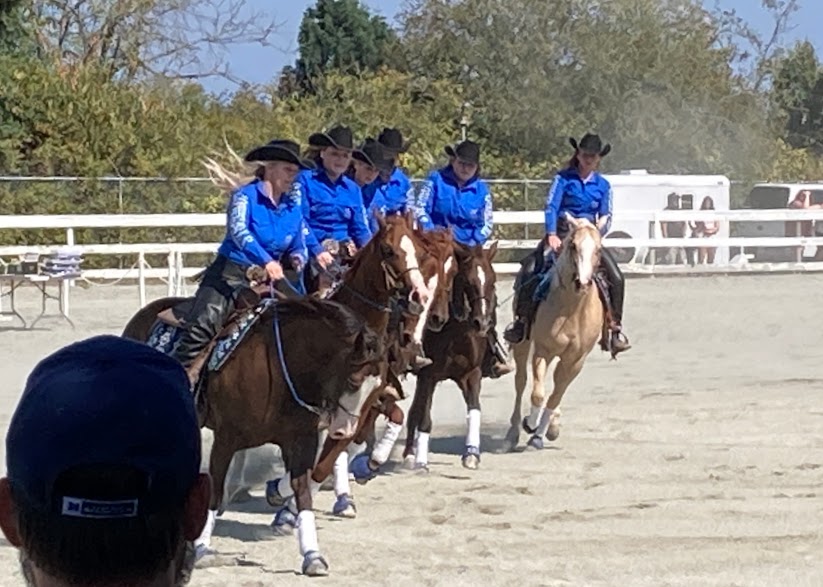
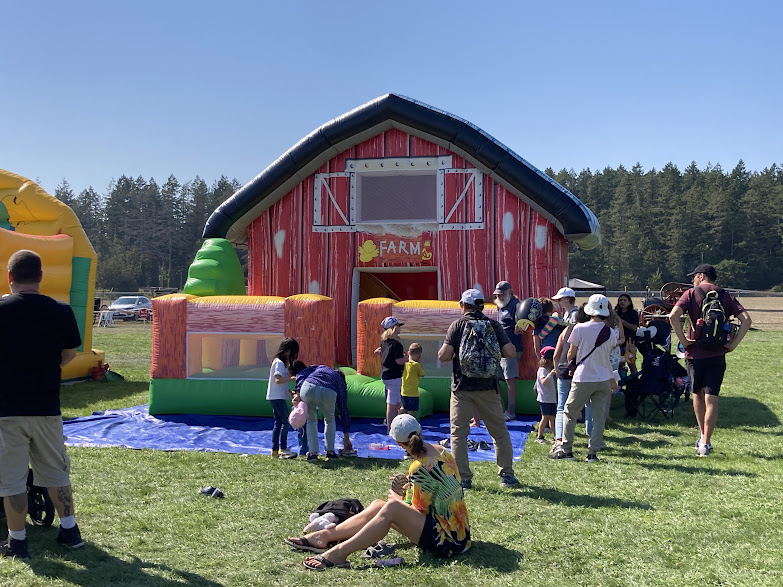
The Saanich Fair has been going since 1868, and is a Labour Day favourite. The weather was perfect, and for me the day began with an exuberant noon performance of the Coastal Cowgirls, who have been riding together since 2014. Just wonderful.

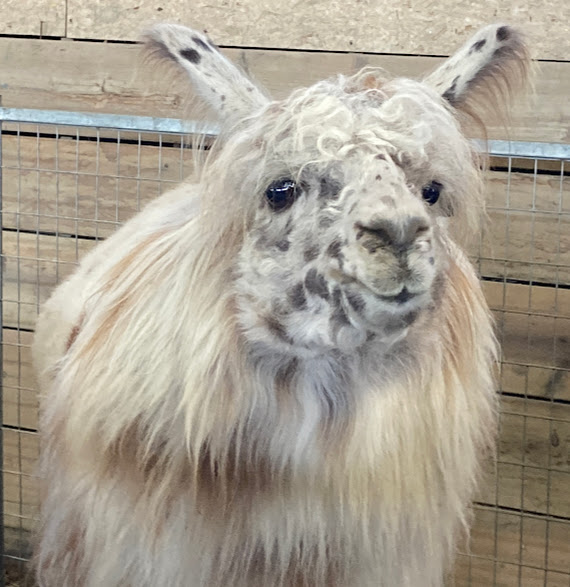
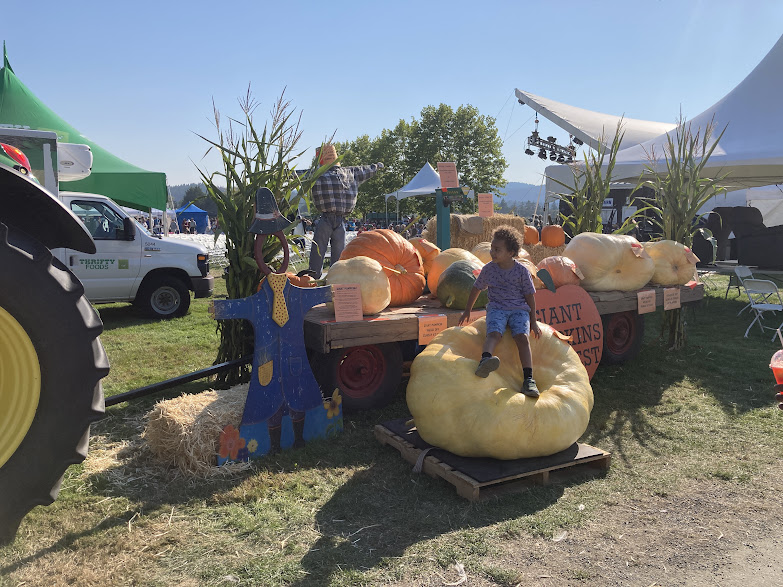
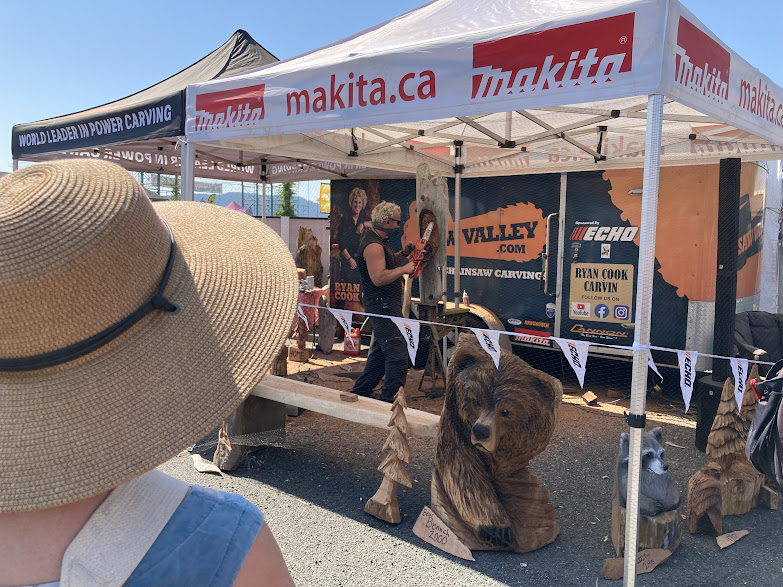
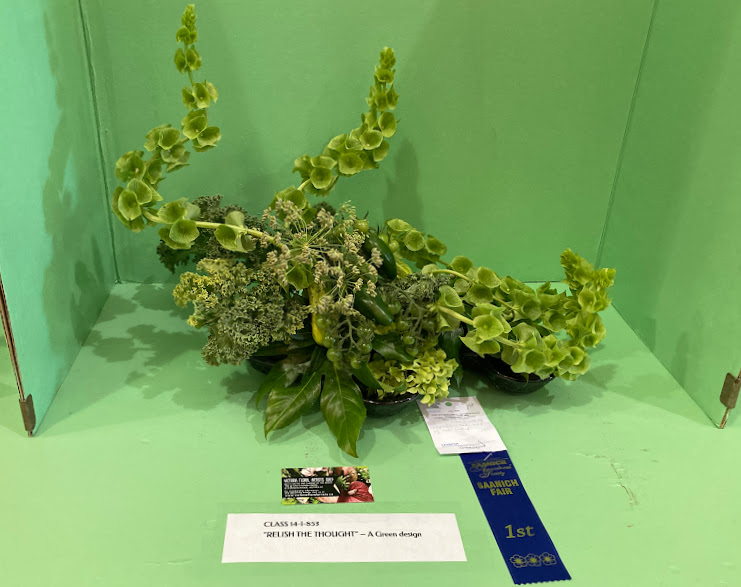
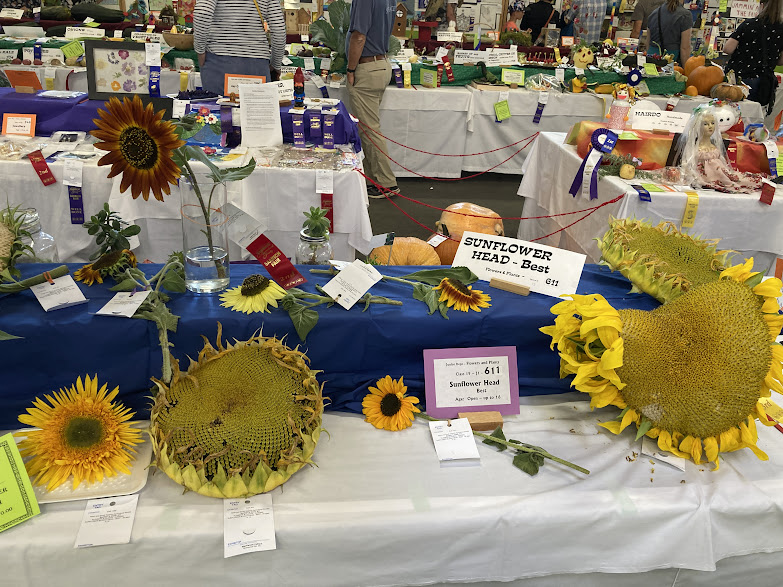
Then on to all the sorts of things we go to an agricultural fair to see. Giant pumpkins, llamas and alpacas, horses, goats, rabbits, chickens, stock dogs, a midway, flower arrangements, decorated vegetables, chainsaw art, home baking, needle arts, photography, a farmers market and food of all kinds strategically scattered around the fairgrounds.


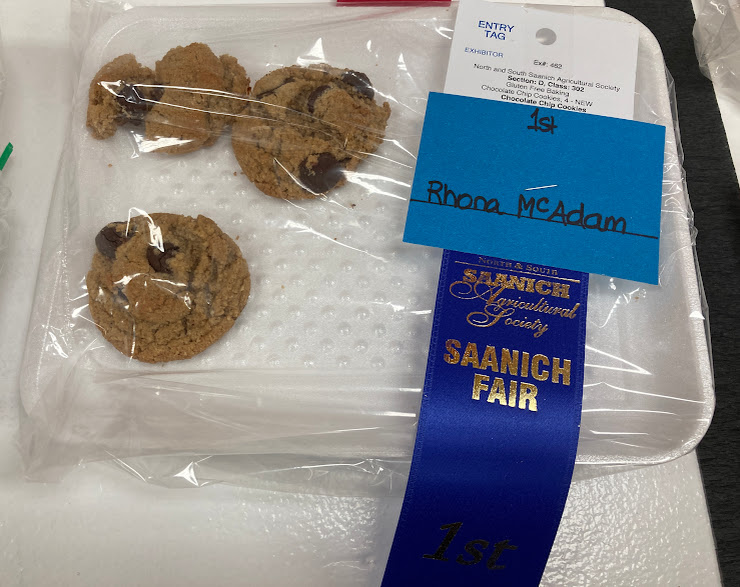
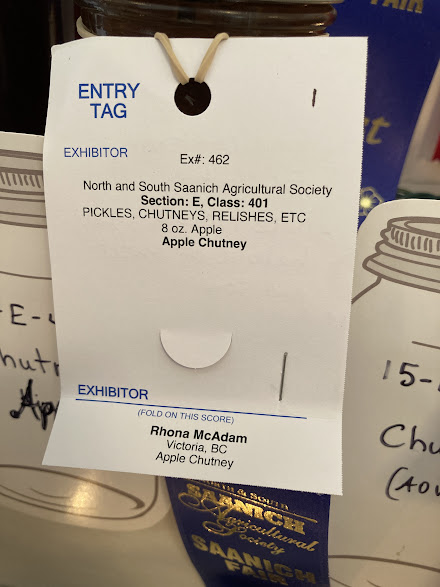
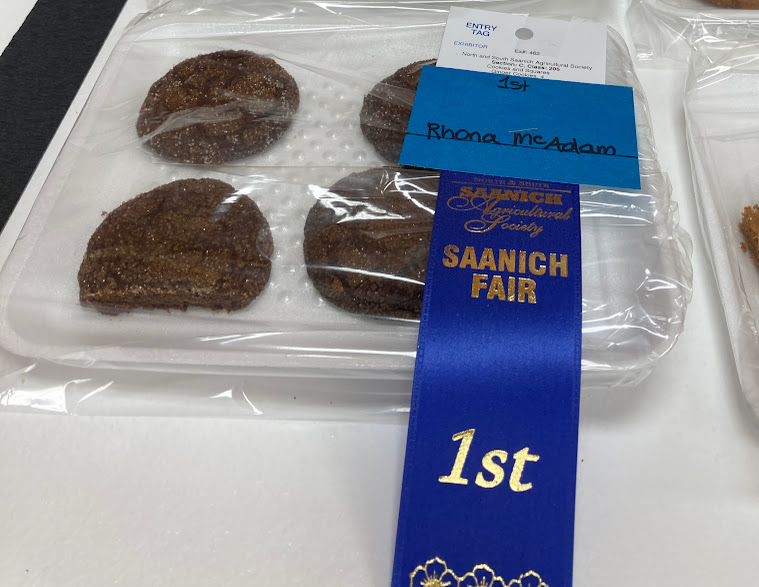
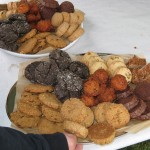
And of course there was home baking, and there were preserves. I have entered items in both categories for the past few years and was pleased to manage a few more blue ribbons:

Gluten free choc chip cookies
Apple chutney
Gingersnaps

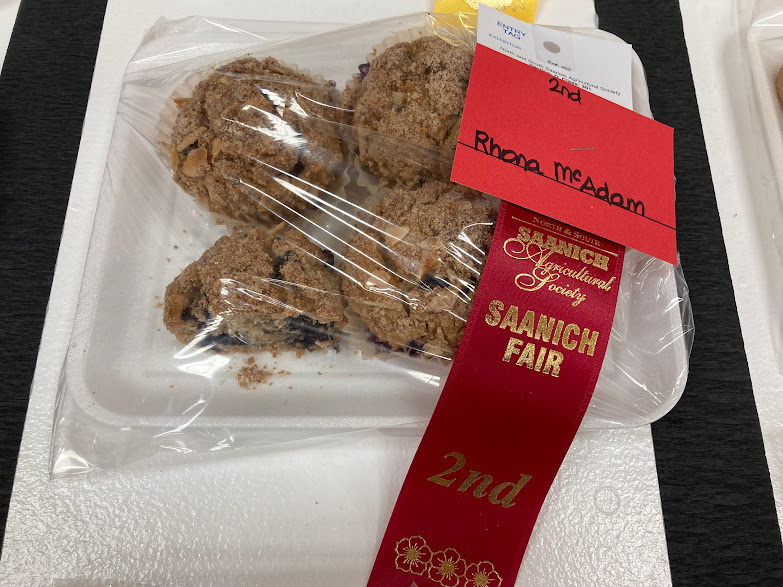
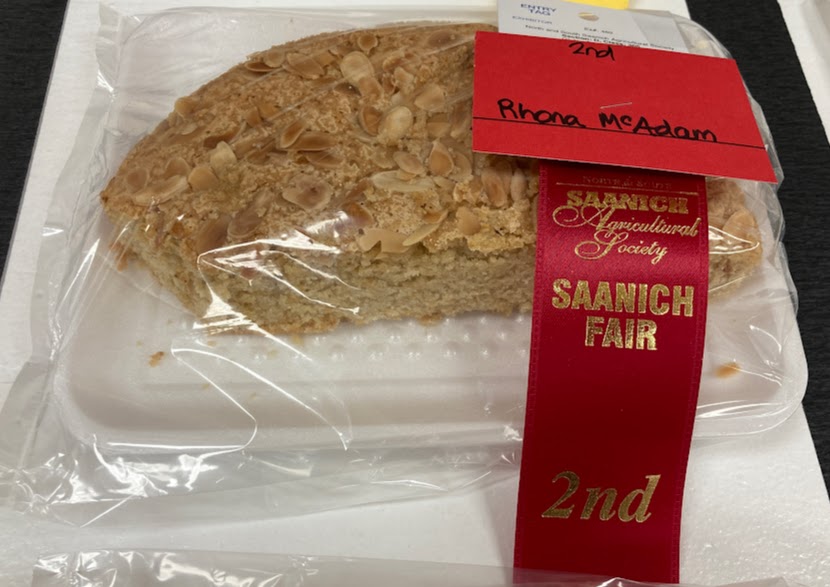
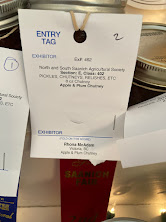
And a couple of red ones too:

GF blueberry muffins
GF almond cake
Apple & plum chutney

Stir-up Sunday

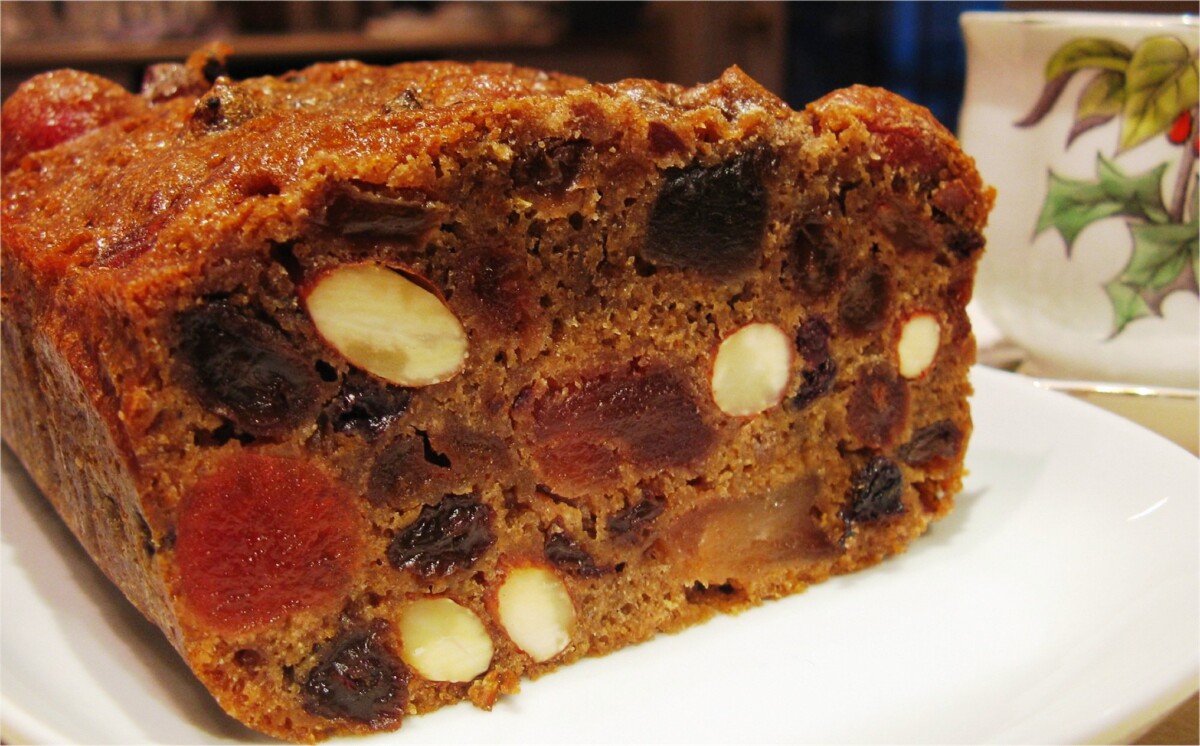
I blush to admit I learned about Stir-up Sunday by listening to the Archers… But it’s here: the last Sunday before Advent is the day to make your Christmas pudding, cake etc, and I am making fruit cake today, despite popular wisdom that few people actually like them. I’ll make a plum pudding as well, since I have plums a-plenty in my freezer.

For years, my school friend Michelle’s mother used to send me a fruit cake each Christmas, and I use her recipe now. Mine will go to people I know will want them as I do, and they keep superbly with all that brandy for preservative.

It’s a labour of love, a heavy batter. My recipe calls for 6 pounds of dried fruit, a quart of brandy, 10 eggs.. even with that recipe cut in half, considerable effort goes into the soaking, the grating, the juicing and the mixing..

its heaviness a wish
upon a wooden spoon, child’s hand
beneath a mother’s,
turning a hard tide once,
twice, thrice, invoking luck…
(Fruit Cake, from Larder)

The ingredients represent considerable luxury even today. Currants, sultanas, raisins, mixed peel, candied cherries and pineapple – all ways to preserve fruits in season I suppose, if you have sufficient means (sugar, time, heat) but they are and always have been exotic imports for northern kitchens. Oranges (juice and peel required) are not yet in season closer to home (California in this case). Almonds have questionable sustainability creds – as do most things really when produced in the excessive quantities needed to meet every Western whim.

My ingredients include a few home-made versions. I made (for the experience, and probably not to be repeated) candied BC cherries this year; and I load my dehydrator each autumn with a neighbour’s green seedless grapes – each laboriously hand-pricked to dry more evenly – and make the best raisins I’ve ever tasted. I’ve added some candied lemon peel I made when making natural pectin for jam this summer. These are tokens but they put a bit of myself into the gifts the cakes will be.

The cakes are made, the pans lined and filled, and are sitting quietly overnight as the recipe instructs. Tomorrow my house will be fragrant and once they come out of the oven, warm and delectable, the question will be how many loaves will remain by Christmas?

Kneading Conference West – over and out

How fast can three days go? Pretty darn fast when you’re soaking up as much information as we did. The last day of the conference – Saturday – had an escalating number of “next year”s punctuating the proceedings as the weekend wore on, and even a sprinkling of rain as the formal events ended was not enough to damp the enthusiasm of the Western kneaders.

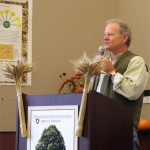
Our morning’s plenary was a capsule review of Jeffrey Hamelman‘s career – which started with a baking apprenticeship in the mid-seventies, under the eccentric tutelage of both German and French bakers. He shared some of his guiding principles, gleaned from the likes of David Pye’s The Nature and Art of Workmanship, who talked about the workmanship of certainty and the workmanship of risk; the latter being as applicable I’d say to poetry as to artisanal baking, where “we celebrate the fact we cannot make an identical product time after time”. He quoted Pablo Neruda’s Nobel speech, excerpting the concluding words from this passage held dearest by bakers (and vintners and poets of course):

I have often maintained that the best poet is he who prepares our daily bread: the nearest baker who does not imagine himself to be a god. He does his majestic and unpretentious work of kneading the dough, consigning it to the oven, baking it in golden colours and handing us our daily bread as a duty of fellowship. And, if the poet succeeds in achieving this simple consciousness, this too will be transformed into an element in an immense activity, in a simple or complicated structure which constitutes the building of a community, the changing of the conditions which surround mankind, the handing over of mankind’s products: bread, truth, wine, dreams.

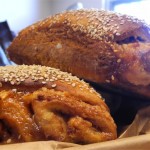
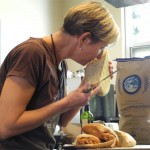
After that, it was a day of impossible choices. I decided to learn about baking with barley, since that was an idea that had never crossed my mind. Two impeccably qualified bakers showed us some tricks and discussed the challenges of working with a flour that is flavourful and high in beta glucan, but pretty much completely lacking in tensile strength, so it needs to be paired with a high gluten flour. Leslie Mackie, of Macrina Bakery, had used barley flour in her Monkey Bread and gave us a firsthand view of how a recipe is developed. Here she checks the crumb of two sample batches of  a barley Pugliese loaf, which is made with 20-30% barley flour.


Andrew Ross, who teaches Crop & Food Science at Oregon State University but has a background as a baker, showed us some 50% barley bread, a 10% barley levain and then proceeded to make barley pita breads and lye-dipped barley pretzels.


I scooted into a panel I’d wanted to hear – Growing the grain is just the start: Connecting farmers, millers and bakers – and caught the end of an animated discussion about commodity pricing vs buying/selling locally and setting a price that allows farmers, millers and bakers to pay their staff living wages and offer them benefits, including healthcare. One farmer, whose farm’s motto is “Grown while you watch by people you know”talked about differentiating small, quality-driven operations from the cheaper, profit-driven ones. There was discussion around flavour of local products; one farmer remarked this is less magical than it seems, and more to do with the six week age difference between fresh dug carrot and one bought in grocery store. “When your name is on the package, accountability and care goes up” remarked another. Near the end, the elephant in the room was named. Stephen Jones was asked about genetically modified wheat, and he replied that his research centre has a moratorium on GM research; Monsanto was doing a lot of work on Roundup-ready wheat but stopped seven years ago when Japan and other countries said they would not import it (he did question whether the research actually stopped). But as far as he knows it’s ready to go and Monsanto will be reshaping the sales pitch around higher nutritional value. All it will take is the political will (or weakness, more accurately) to let it through the gates.

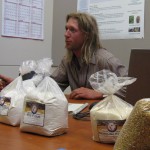
Then it was lunch and on to the finale: tours of a local mill, farm and bakery. Fairhaven Organic Flour Mill was our first stop, where owner Kevin Christenson told us about his experiences since taking over the mill in 2007. He went into the question of gluten-free milling and explained some of the difficulties around that, where there’s limited equipment and more demand for other flours. They clean their equipment as best they can but it’s not a perfect system.


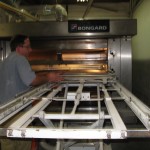
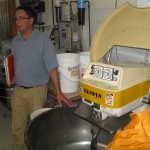
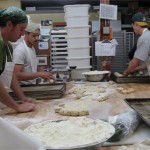
Then on to the Breadfarm, which had been providing us with some delectable treats over the weekend. Owner Scott Mangold showed us his mixer, his ovens and his methods while his bakers toiled away in the background. His shop is open from the counter to the back of the preparation area so that customers can see what’s happening while they buy their bread; a nice touch, but Scott added, a rather dusty one.


The last tour of the day was to Hedlin Farms, where fourth generation farmer Kai Ottesen showed us round this family farm. The scion had left it in shares to his offspring – meaning the farm could not be parcelled off without the consent of all concerned. And so it goes on today, with some innovations. The hothouse tomatoes are a relatively small operation, geared to supply farmers markets and restaurants, from about May each year. The twining of the stems (string supports are moved along as the stems grow) is a fairly standard arrangement in greenhouses, as are the biological controls which are bought in. It’s hard to get organic certification for greenhouses – you have to have an organic fertilizer that will work with irrigation systems that are notoriously finicky, so Hedlin has spray-free greenhouse tomatoes as well as certified organic tomatoes grown in earth in a polytunnel.


They also have a heck of a farm dog. She makes up for her size in sheer persistence: can dribble and fetch her ball till the cows come home.


Kneading Conference West – day 2

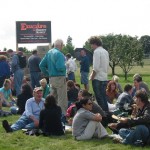
Sun broke out on day 2, causing some basking on the grass at lunchtime.

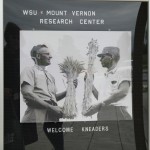
We began the day with a PowerPoint tour of local and small scale wheat producers from non-wheat areas; wheat breeder and conference organizer Stephen Jones showed maps revealing the transition to commodity scale production, which has redrawn the country’s pattern of wheat production. While almost every state in the US used to produce wheat, now the focus is on large scale production – nothing less than 1000 acres shows on the maps. But there’s a welcome resurgence across the board with small producers from Whidbey Island – where Ebey’s Prairie farmers once held the world record for productivity (119 bushels/acre in 1919 – a figure that dwarfs today’s industrial scale yields of around 45 bushels/acre) to Vermont – where farmer Jack Lazor has dealt with the loss of infrastructure by building his own grain elevator. Here at the Mount Vernon Research & Extension Centre (where the conference is being held) Jones is working on developing varieties that are resistant to local problems – notably rust – and has been working closely with local producers and bakers.

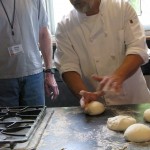
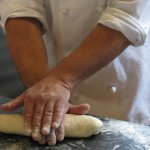
Starting to get hard to choose between sessions. I stopped for a few minutes at various points to watch Seattle baker George DePasquale on Artisan Sourdough for Home Bakers where he had some smooth moves for shaping boules, batards and baguettes,


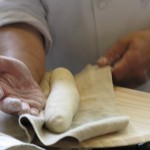
and offered advice on setting each on the couche, as well as transferring from the couche to the peel. He also took his scissors to a baguette to demonstrate the making of an épi de blé – remarking it was a tricky one to get in and out of the oven in one piece.

On to a panel discussion: A Question of Scale, where farmers and bakers talked through some issues to do wtih ethics and economics of producing local and organic.

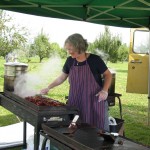
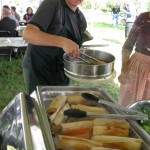
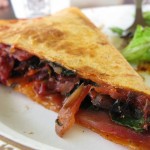
Lunch beckoned aromatically from the tent where the Patty Pan Grill folk were preparing the innards of our meal, which, alongside an excellent salad and three kinds of tamales, offered a spectacular discovery for me: it is possible to enjoy a quesadilla, if it is prepared from beets and other nicely turned veg together with some good cheese.

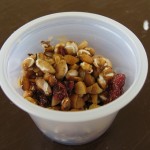
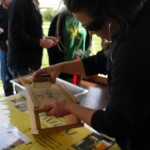
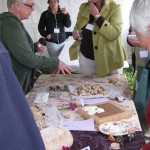
Some Vancouver Island talent: Fol Epi baker/owner Cliff Leir with “beer farmer” Mike Doehnel. Mike walked us through the barley malting process, after an introduction to barley breeding by Patrick Hayes, who set us loose on samples of hull-less and hulled barley, perled barley and even an incredibly good toasted barley snack (with local hazelnuts and cranberries) that’s soon to be marketed.


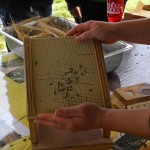
There was also discussion of something called Bappir, an ancient trail food made with barley, honey and dates which served a dual purpose: it could be soaked in water where it would be colonized by wild yeasts and serve as the foundation to early beers. We were also encouraged to try a barley head thresher – a basic manual model or an automated version – and a barley perler.

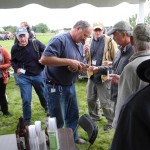
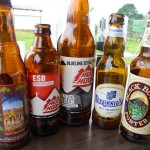
Some beer tasting ensued while Mike managed a demonstration barley mash in the background, eventually offering sips of the wort (if I followed the process correctly) which is the sweet dregs of the washed mash. It can be cooked down into malt extract for baking, or carried through the process and combined with hops to make beer. Of which we’d sampled five versions – four of them local, and some quite excellent. Thus fortified we wandered off to wait for… a beer and cheese tasting.

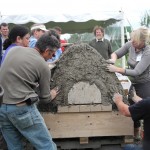
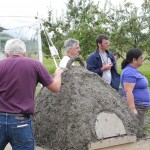
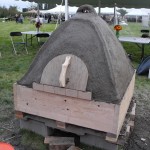
Behind us there was a small commotion of slapping and patting, which was the wood fired oven workshop group putting the finishing touches on their labour of love, which was to be silently auctioned off later in the evening, with proceeds to go towards the next Kneading Conference West – a worthy cause in my view. All you needed was the means to take it home with you…

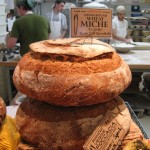
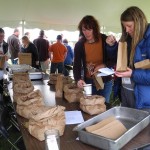
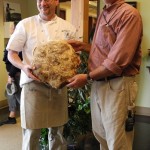
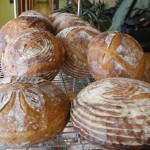
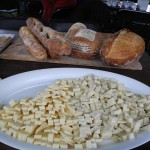
Elsewhere I happened upon Michael Eggebrecht and Stephen Jones wrangling a giant loaf from the Professional Baking workshop – came off a large rack of loaves that were on the way to the food tents where we covered them in more local cheese – a dill/garlic herbed number and an aged gouda style – before settling in to a dinner of barbequed chicken, corn and beans. And that was our Friday.


I retire with trepidation, for tomorrow’s schedule is too tempting and I cannot decide between four simultaneous sessions…

épi de blé

Kneading Conference West: day 1

Drove to Mount Vernon, WA yesterday: a long day, but a gorgeous drive through lush northwest Washington. Headed to the first Kneading Conference West, which is modelled on Maine’s long established and hugely popular Kneading Conference. The idea is to bring together bakers, millers, farmers and interested bystanders like myself – writers, home bakers and researchers.

Arrived in time to take a stroll through the orchard and the many lovely gardens at the conference venue, the Mount Vernon Research & Education Centre – herb, vegetable, “water-wise”, Japanese and others. The land is owned by the university but orchard and gardens are managed by volunteers from the Master Gardener program. It was grey and spitty weather and the tables beneath tents in the field looked less than inviting, but we were cheered to learn these were for meals, and most of the workshops are indoors.

As was the first I attended: A Realistic Approach to Making Grain Work – An On-Farm Example. David Mostue turned out to be a riveting speaker: after graduating from architectural studies he returned to a 230 acre family farm and set to repairing and upgrading the century-old infrastructure and rethinking its purpose. It had been started as a pear orchard, but pears are one of the many crops that have become, as he put it, a casualty of international trade and scale: labour is cheaper elsewhere, and they’re a labour-intensive crop.

He spoke well enough to fix a couple of dozen of us to our seats in a very small room for about three hours. He covered the practical issues around making it as a grain farmer, whether large or small scale. He pointed out that grain is a great crop for poor soil and challenging conditions – his farm is in the Rogue Valley in southern Oregon, where temperatures average 95-100 degrees fahrenheit in the summer, and there’s a lot of heavy clay: this means that a crop like winter wheat (so named because it grows through the winter, but is harvested in summer) which can be planted in the fall is a better choice, since clay is sodden all winter and rock hard in summer, so has a small window for planting in spring.

He spoke about the qualities of different wheats – of particular interest to the bakers, and to farmers like him who need to understand the uses to which bakers put their flour. High gluten (protein) content flour, used in industrial baking, needs high soil fertility (often using artificial fertilizer). Artisanal bakers can cope with a lower protein flour (11-12%), because they use fermentation and long risings instead of the large quantities of dry yeast typical of high-speed industrial methods. Long risings, as Andrew Whitley will tell you, give the gluten time to develop and also make the bread more digestible. Lower protein still are soft white wheats (6-10%) that make pastry flour; or rye or alternative wheats (emmer, spelt et al) that are popular in artisanal baking. The highest gluten levels are in durum wheat (his clocked in at nearly 15% last year), used for semolina flour: Mostue had wanted to make his own whole grain pasta, which he found to have an unbeatable flavour and dense texture that made it more fliling than its commercial counterpart.

But of course nothing is simple, and Mostue explained the many other aspects of grain production – preparing the soil (he uses a five year rotation so that he can build soil fertility naturally, rather than using artificial fertilizer), seeding (we learned a lot about seed drills), weeding and harvesting (who knew combines could be so interesting?). He had progressive ideas about marketing the farm and its products, using social media but also building a market by getting people to understand and be interested in the farm; using innovative variations on standard CSA programs (including use of Survey Monkey for ordering), farm dinners… and plenty of wine (which they happen to produce on farm!)

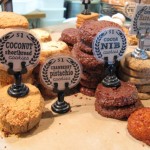
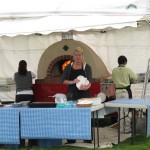
Reluctantly we left for the fruit garden and a cider and goat cheese tasting, followed by abundant pizzas fresh from the mobile wood-fired ovens, and salads of wheatberries and donated vegetables – carrots and beets – that were roasted in the ovens, followed in turn by seriously good cookies from the Breadfarm.

Crete part 2: Amari Valley; wild greens, pastry and sing for your supper


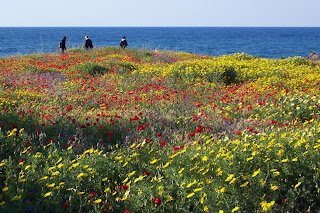
It may have felt on the wintry side at times, but we were in Crete at a perfect time to catch the full glory of wildflowers.

Our Thursday morning was spent gathering wild greens from the hillside, and preparing them for lunch. Kostas led us up the trail and he, Aris (a cave specialist and companion on many of our outings) and Lambros (owner of the taverna where we were based) showed us what treasures we were trampling and filled us in on some of the legends, food and folk medicine around the greens we were collecting and observing.
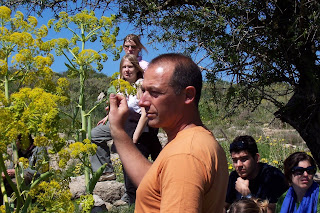

Giant fennel, not really fennel – in fact its poisonous cousin – but Ferula communis makes a dandy walking stick when it dries out, and it’s a handy torch as well. As Prometheus discovered, and used it to steal fire from Zeus to give to mortals.
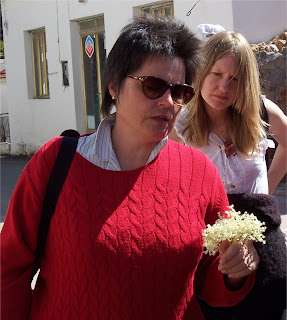

Jutta, a visiting German botanist who happened to be there with her botanist husband, tells us about the curative powers of Sambucus nigra, Elderflower. She said the tree and its flowers were considered lucky, and the flowers used to be hung above a cradle to protect the child. When I told her I’d heard elderberry wine was a popular concoction, she said the berries are edible only after cooking -which I guess happens during winemaking – and are otherwise toxic.
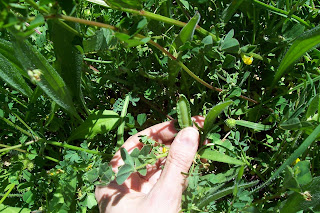

Some frilly midget beans; so so tasty. Pan-fry them (in Cretan olive oil!) and then put them in your omelette.
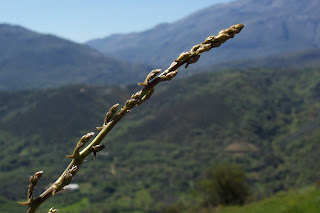

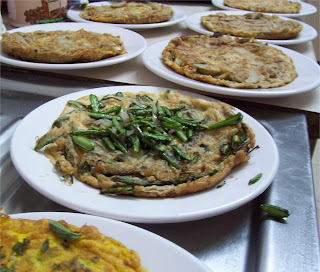
Wild asparagus: very hard to spot by amateur foragers, but lovely to nibble on raw and a favourite for omelettes.
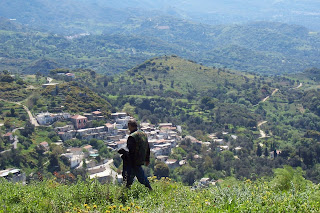

A shepherd we passed on the way up the slopes. I never saw the sheep, but then some people saw the sheep and not the shepherd. Anyway; nice view.
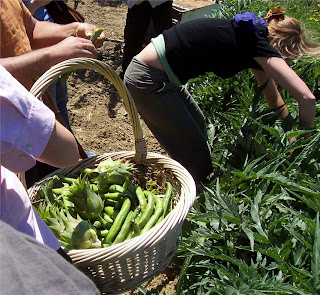

The greens basket, filling, filling. We harvest fava (broad) beans and artichokes on a nearby field.


Sorting the greens; the bowl on the left has asparagus fern fiddleheads; the one on the right has frilly beans.
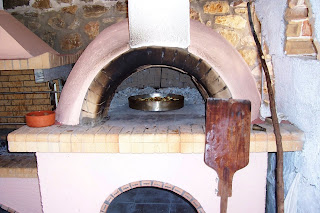

A kind of summer kitchen outside the taverna had a handy oven like many we saw in Crete, ideal for roasting potatoes.


Women make food.
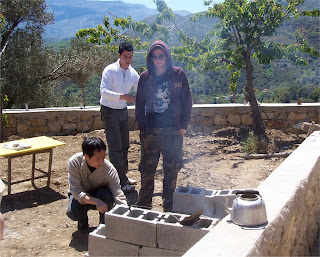

Men make fire.

Everybody eats omelettes; there’s also a sweet omelette (not in this picture) made with elderflower.
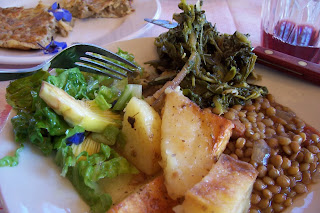
The finale: salad with raw artichoke, wild greens, borage flowers; boiled wild greens with fava beans and artichokes; potatoes roasted in goat fat; lentils; wild greens omelettes.
After lunch we departed for nearby Aghia Fotini, where we had a cooking demonstration, all about making stafidoto (filled cookies), baklava…
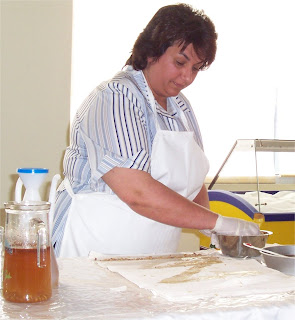
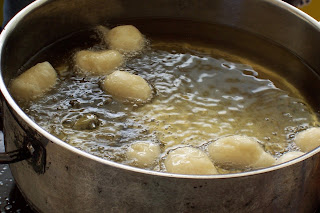
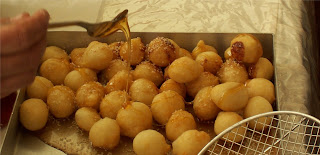
and these lovely Loukoumàdes (breakfast donuts), fried in olive oil and drenched in cinnamon syrup, Cretan honey and sesame seeds. At last, I thought, I have the secret to the Cretan diet: you start your day with donuts and raki and you will live forever.
Katarina the potter, who we were to visit later on, came to the town hall and presented us with a branch of rosemary from her garden which we were to wear behind one ear, as a kind of instant wreath. It showed our fellowship and was also intended to give us clear thinking in the meeting, which was much needed after all those donuts.
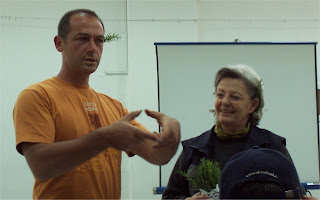
We had a presentation by Aris about caves, flora and fauna; there was a brief presentation by a local man who told us, among other things, about the tendency in this area to uproot old olive groves and replace the healthy, hardy local varieties of olives with dwarf varieties better suited to mechanical harvesting and producing olives with flavour more in keeping with contemporary tastes. Kostas told us a little more about MedASH, and its work to encourage hotels to compost their landscaping waste, to educate children in organic planting. His discussion of soil health included the memorable description of soil as the “stomach of the plant”; growing things are really all one organism, he said; roots tangle in the earth, and microorganisms connect them.

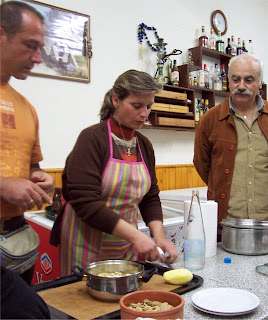
And after that… ack. More food?!? Supper that night in Gerakari village started with a quick demonstration of some of the things we’d be eating: fava bean puree, raw artichokes.
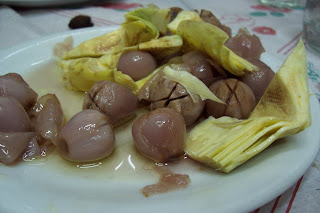
Wild onions and raw artichokes…
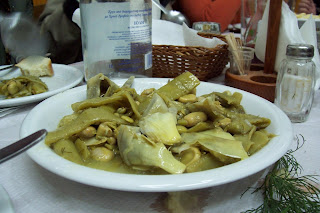
Boiled favas and artichokes…
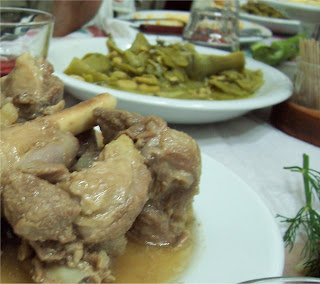
A nice bit of lamb…
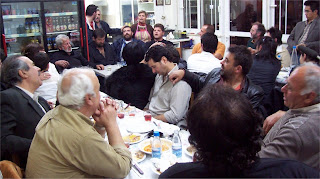
After the meal, singing and more singing. Everyone had to take a turn, by country. The Americans were a hit with “Comin’ Round the Mountain” to which they added a “yee-haw” chorus which so delighted our hosts they asked for an encore. Alas the three Canadians discovered we had only our national anthem in common, so that’s what we sang .
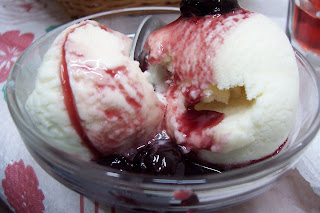
After the singing we were rewarded with ice cream with local cherries on top.