Skip to content

food presevation

Stir-up Sunday

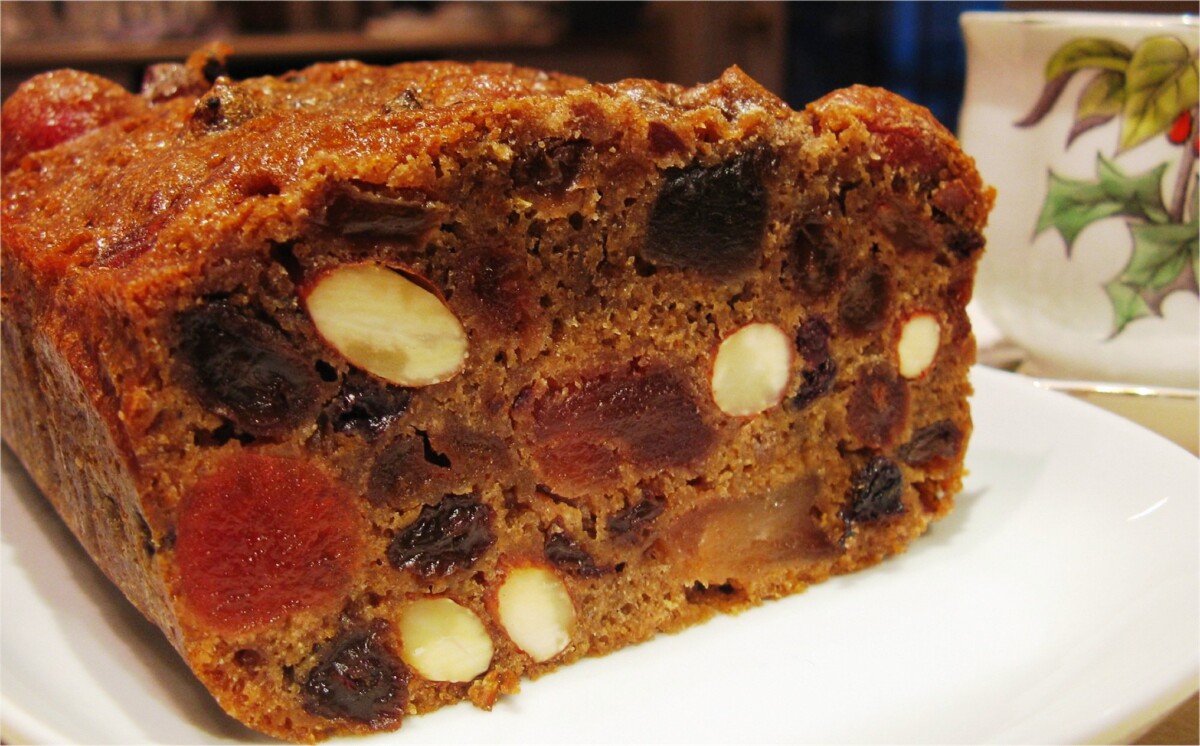
I blush to admit I learned about Stir-up Sunday by listening to the Archers… But it’s here: the last Sunday before Advent is the day to make your Christmas pudding, cake etc, and I am making fruit cake today, despite popular wisdom that few people actually like them. I’ll make a plum pudding as well, since I have plums a-plenty in my freezer.

For years, my school friend Michelle’s mother used to send me a fruit cake each Christmas, and I use her recipe now. Mine will go to people I know will want them as I do, and they keep superbly with all that brandy for preservative.

It’s a labour of love, a heavy batter. My recipe calls for 6 pounds of dried fruit, a quart of brandy, 10 eggs.. even with that recipe cut in half, considerable effort goes into the soaking, the grating, the juicing and the mixing..

its heaviness a wish
upon a wooden spoon, child’s hand
beneath a mother’s,
turning a hard tide once,
twice, thrice, invoking luck…
(Fruit Cake, from Larder)

The ingredients represent considerable luxury even today. Currants, sultanas, raisins, mixed peel, candied cherries and pineapple – all ways to preserve fruits in season I suppose, if you have sufficient means (sugar, time, heat) but they are and always have been exotic imports for northern kitchens. Oranges (juice and peel required) are not yet in season closer to home (California in this case). Almonds have questionable sustainability creds – as do most things really when produced in the excessive quantities needed to meet every Western whim.

My ingredients include a few home-made versions. I made (for the experience, and probably not to be repeated) candied BC cherries this year; and I load my dehydrator each autumn with a neighbour’s green seedless grapes – each laboriously hand-pricked to dry more evenly – and make the best raisins I’ve ever tasted. I’ve added some candied lemon peel I made when making natural pectin for jam this summer. These are tokens but they put a bit of myself into the gifts the cakes will be.

The cakes are made, the pans lined and filled, and are sitting quietly overnight as the recipe instructs. Tomorrow my house will be fragrant and once they come out of the oven, warm and delectable, the question will be how many loaves will remain by Christmas?

Juggling jam jars and polishing poems

Exhausting times in the kitchens of chaos. Blackberry season is upon us, the apples are waxing and the corn has hit the shelves, or rather the bins of Silver Rill. The jam jars are filling, batch by batch. This week I’ve made two kinds: plum and blackberry, and salal, raspberry and blackberry. I’ve stewed blackberries and apples and picked some oregon grapes and juiced them ready for the next batch. I have accepted the cruel truth that there is not one plum to be had from my trees and am biding my time till the apples are fully ripe, dusting off the juicer in anticipation. I thawed some frozen apple, blackberry and carrot juice I made last summer and agreed with myself that baby carrots are the bee’s knees in a combo like that.

Between cauldrons of jam I looked up some information about writing competitions that’s come my way. Alors, you can sense the coming of autumn when you hear that the CBC Literary Awards competition is open already. The deadline this year is November 1st, 2006. Poets are advised to note that the word limits for poetry have been changed to between 1000 and 2000 words. A first prize of $6000 and a second prize of $4000 are awarded in each category, poetry, short story, and creative nonfiction. Winning texts are also published in enRoute magazine and broadcast on CBC Radio.

Well in advance of deadline, I visited the site of Poet’s Letter to read about the Beowulf Poetry Competition, whose first prize is a staggering £10,000.00, and which gives you until July 31, 2007 to get your entries in. The theme for the 2006/07 Prize is Poetry of Cities (anything and everything about cities: living, growing up, working, falling in love, buildings, architecture, engineering, arts, culture, food, suffering, agonies and joys).

The July issue of Poet’s Letter magazine features our very own Victorian, Yvonne Blomer, who had wandered off to England for year to earn her University of East Anglia MA.

Rhubarb rhubarb rhubarb

I have a pair of rhubarb plants that despite my neglectful stewardship manage to rouse themselves every year to give me a couple of batches of fruit. Not enough to do too much with, but at the very least I like stewed rhubarb: it is transformed with a bit of grated orange zest and the juice of half or a quarter of an orange. And sugar of course. Nice with plain yogurt for breakfast. If you have lots on hand, try a rhubarb custard pie sometime: my my my my my but it’s good. More orange zest called for there, and maybe a dollop of nice vanilla ice cream if the pie is still warm when you get to it.

My cousin Shirley had an old newspaper recipe for Rhubarb Marmalade which sounds a lot like one I had a few years ago and still dream about, and which kindly expects that you may not have an abundance growing in your garden when the mood strikes.

2 oranges
2 lb frozen rhubarb
1/2 cup water
3-1/2 cups sugar
1 cup golden raisins
Cut oranges in half lengthwise. Place them cut side down and slice paper thin, discarding seeds. Cut slices in half, and put them with rhubarb and water in a large saucepan. Bring to the boil, turn down to medium and boil 10 minutes, stirring often. Add sugar and cook slowly until thick, about 20 minutes. Stir often. Add raisins and boil 1 minute. Ladle into hot sterilized jars and seal. Makes about 48 ounces.

The February 2006 issue of Poetry Magazine surfaced during a night table re-engineering exercise, and I read The Bowl of Diogenes, an entertaining article about poetry criticism by William Logan, who sits on both sides of the critical fence.

“In most arts… there is a guild rule against writing criticism. One looks in vain for the ballet reviews of Twyla Tharp and the film reviews of Angelina Jolie. In poetry, as in few other arts (fiction is a partial exception), the critics are the artists themselves — even though many poets, and wise poets they are, have sworn an oath of omerta, never to breathe a word of criticism against a fellow of the guild.”

He explains his position and his passion for crossing over anyway:

“I turned to criticism myself, not out of a messianic instinct or the will to martyrdom, but out of the terrible knowledge that I was a better reader when I read for hire, that I read more intently when driven by necessity.
…criticism has forced me to read books I would otherwise have ignored. I’ve read far more contemporary poetry than most people, and far more than I would have if left to my own devices. I’ve probably read more dreary and ordinary books of verse than is healthy… Yet, on a rare occasion, I’ve felt like Balboa staring out across an unknown sea or Herschel seeing Uranus swim before his telescope… I’ve found a book that reminds me, not just why I write criticism, but why I write poetry.”

He argues firmly against accessibility as the primary goal of contemporary poetry:

“There are, even now, publishers and readers and even poets who think poetry far too obscure, who think poetry ought to be so simple it hardly needs to be read at all… The best poetry has often been difficult, has often been so obscure that readers have fought passionately over it…
For two centuries, well-meaning vandals have been trying to dumb down Shakespeare, wanting to make him common enough for the common reader, in the doltish belief that, introduced to poetry this way, the common reader will turn to the original. Yet the reader almost never does. He’s satisfied with a poor simulacrum of poetry, never realizing that Shakespeare without the poetry isn’t Shakespeare at all. The beauty of poetry is in the difficulty, in the refusal of the words to make the plain sense immediately plain, in the dark magic and profound mistrust of words themselves…
Surely we read poetry because it gives us a sense of the depths of language, meaning nudging meaning, then darting away, down to the unfathomed and muddy bottom. Critics, generations of critics, have devoted themselves to revealing how those words work, to showing that each sense depends on other senses. Not every poem has to be as devious and shimmering as Shakespeare (there is room for plain speaking, too); but the best poetry depends on the subtlety and suggestiveness of its language. If we demand that poetry be so plain that plain readers can drink it the whole plain day, we will have lost whatever makes poetry poetry.”

Last moments at the writers and artists colony

So, Tracy explained about the Thursday night party which ended the 2006 Winter Colony. As she was in Saskatoon reading from the works of Al Purdy, she missed our final group reading, alas, although she was there in spirit, having composed a sonnet which she printed on wood shavings, glued to bark strips, and left in her place: we were well impressed. And we had studio presentations from our awesomely talented artists, Cherie and Frances, which were just breathtaking.

Here are some snaps of those gifted souls who shared their musical stylings with us.

Brother Kurt happened along and gave us some good old favourites.


Mari-Lou brought a new classical guitar and a Leonard Cohen songbook to her hermitage and we got to hear the results of her cloistered toil. She’s promised us a full Beatles repertoire next year.


And Terry O’Flanagan – who thought he had come to St Peter’s to re-build the college entryway – became part of the colony, and all the more so (was it the snappy cowboy shirt? the Johnny Cash numbers?) that last night.

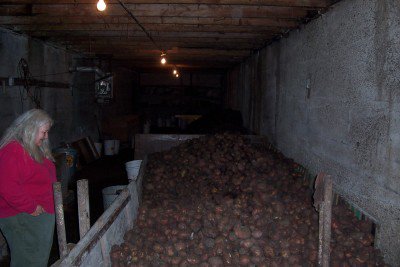
On to the next and final morning. I heard tell there was a food cellar at the Abbey, and I asked our Colony Coordinator Anne if I could have a look, and so this is what I got to see before I left.

Imagine a whole room full of potatoes!

And then there was the canned goods collection. Who could not be comforted by all those big, beautiful jars of food? And all of it grown on the Abbey’s farm. Fabulous and delicious.