Skip to content

Uncategorized

Seedy Saturday, Pandemic Style

I’m back online after a long absence! It seems right to pick up the thread here with news of this year’s Seedy Saturday.

Autumn is the time gardeners and farmers are starting to pore over seed catalogs, and community organizers are normally well into booking venues and speakers and seed vendors for that fine Canadian tradition known as Seedy Saturday.

But back in the fall of 2020, infection numbers were starting their winter ascent, and we were beginning to hunker down for more isolation after a carefully sociable summer. So the folks from Vancouver’s Farm Folk City Folk took the bit between their teeth and invited regional Seedy Saturday organizers into a series of brainstorming meetings to see if we wanted to put all our seeds in one provincial basket.

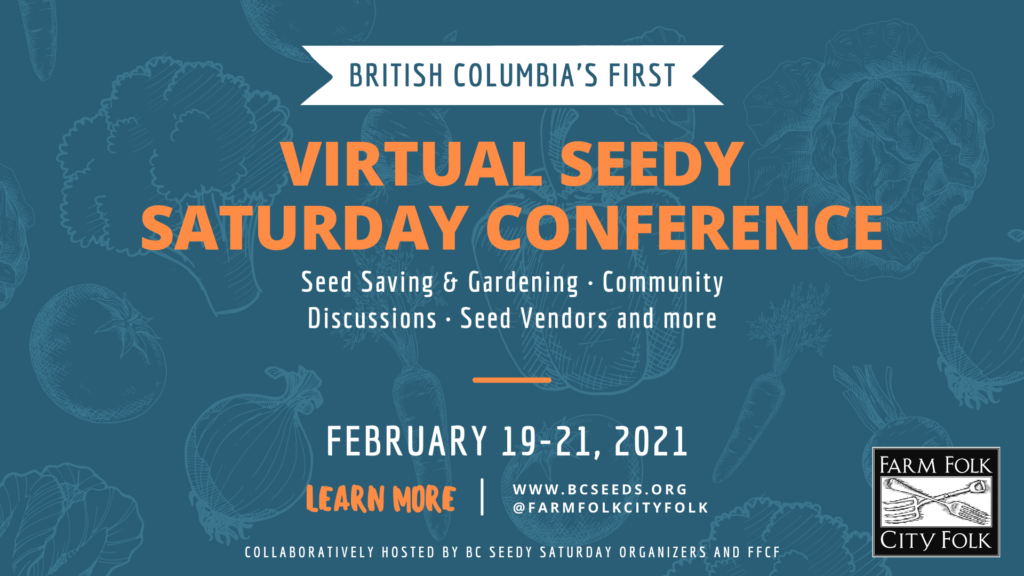
The consensus was a resounding YES. And FFCF has done a remarkable job of engaging seedy folk from around British Columbia to prepare a rich and fertile schedule for BC’s Virtual Seedy Saturday from Feb 19-21.

The nonprofit groups who organize local Seedy Saturday events in ‘normal’ times have lost this valuable source of income, and FFCF is sharing whatever profit may ensue with those groups. One of them, with which I’ve long been associated, is Haliburton Community Organic Farm.

Hali’s contribution is a talk by Kristen Miskelly of Saanich Native Plants, one of the longtime farm lessees on Hali’s land. She’ll be speaking on ‘Native Seed For Gardening and Restoration’.

I’ve also been working with Kelowna poet Nancy Holmes to coax poetry videos from BC poets. We approached those we thought would have a passion for seeds, gardens or similar, and our harvest will be scattered through the program. More on all this in upcoming posts!

Kneading Conference West – over and out

How fast can three days go? Pretty darn fast when you’re soaking up as much information as we did. The last day of the conference – Saturday – had an escalating number of “next year”s punctuating the proceedings as the weekend wore on, and even a sprinkling of rain as the formal events ended was not enough to damp the enthusiasm of the Western kneaders.

Our morning’s plenary was a capsule review of Jeffrey Hamelman‘s career – which started with a baking apprenticeship in the mid-seventies, under the eccentric tutelage of both German and French bakers. He shared some of his guiding principles, gleaned from the likes of David Pye’s The Nature and Art of Workmanship, who talked about the workmanship of certainty and the workmanship of risk; the latter being as applicable I’d say to poetry as to artisanal baking, where “we celebrate the fact we cannot make an identical product time after time”. He quoted Pablo Neruda’s Nobel speech, excerpting the concluding words from this passage held dearest by bakers (and vintners and poets of course):
I have often maintained that the best poet is he who prepares our daily bread: the nearest baker who does not imagine himself to be a god. He does his majestic and unpretentious work of kneading the dough, consigning it to the oven, baking it in golden colours and handing us our daily bread as a duty of fellowship. And, if the poet succeeds in achieving this simple consciousness, this too will be transformed into an element in an immense activity, in a simple or complicated structure which constitutes the building of a community, the changing of the conditions which surround mankind, the handing over of mankind’s products: bread, truth, wine, dreams.

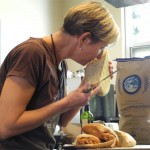
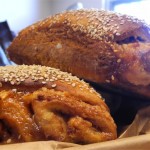
After that, it was a day of impossible choices. I decided to learn about baking with barley, since that was an idea that had never crossed my mind. Two impeccably qualified bakers showed us some tricks and discussed the challenges of working with a flour that is flavourful and high in beta glucan, but pretty much completely lacking in tensile strength, so it needs to be paired with a high gluten flour. Leslie Mackie, of Macrina Bakery, had used barley flour in her Monkey Bread and gave us a firsthand view of how a recipe is developed. Here she checks the crumb of two sample batches of  a barley Pugliese loaf, which is made with 20-30% barley flour.


Andrew Ross, who teaches Crop & Food Science at Oregon State University but has a background as a baker, showed us some 50% barley bread, a 10% barley levain and then proceeded to make barley pita breads and lye-dipped barley pretzels.


I scooted into a panel I’d wanted to hear – Growing the grain is just the start: Connecting farmers, millers and bakers – and caught the end of an animated discussion about commodity pricing vs buying/selling locally and setting a price that allows farmers, millers and bakers to pay their staff living wages and offer them benefits, including healthcare. One farmer, whose farm’s motto is “Grown while you watch by people you know”talked about differentiating small, quality-driven operations from the cheaper, profit-driven ones. There was discussion around flavour of local products; one farmer remarked this is less magical than it seems, and more to do with the six week age difference between fresh dug carrot and one bought in grocery store. “When your name is on the package, accountability and care goes up” remarked another. Near the end, the elephant in the room was named. Stephen Jones was asked about genetically modified wheat, and he replied that his research centre has a moratorium on GM research; Monsanto was doing a lot of work on Roundup-ready wheat but stopped seven years ago when Japan and other countries said they would not import it (he did question whether the research actually stopped). But as far as he knows it’s ready to go and Monsanto will be reshaping the sales pitch around higher nutritional value. All it will take is the political will (or weakness, more accurately) to let it through the gates.

Then it was lunch and on to the finale: tours of a local mill, farm and bakery. Fairhaven Organic Flour Mill was our first stop, where owner Kevin Christenson told us about his experiences since taking over the mill in 2007. He went into the question of gluten-free milling and explained some of the difficulties around that, where there’s limited equipment and more demand for other flours. They clean their equipment as best they can but it’s not a perfect system.


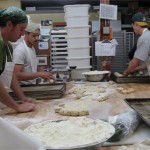
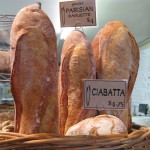
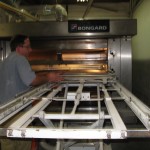
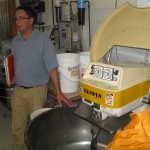
Then on to the Breadfarm, which had been providing us with some delectable treats over the weekend. Owner Scott Mangold showed us his mixer, his ovens and his methods while his bakers toiled away in the background. His shop is open from the counter to the back of the preparation area so that customers can see what’s happening while they buy their bread; a nice touch, but Scott added, a rather dusty one.


The last tour of the day was to Hedlin Farms, where fourth generation farmer Kai Ottesen showed us round this family farm. The scion had left it in shares to his offspring – meaning the farm could not be parcelled off without the consent of all concerned. And so it goes on today, with some innovations. The hothouse tomatoes are a relatively small operation, geared to supply farmers markets and restaurants, from about May each year. The twining of the stems (string supports are moved along as the stems grow) is a fairly standard arrangement in greenhouses, as are the biological controls which are bought in. It’s hard to get organic certification for greenhouses – you have to have an organic fertilizer that will work with irrigation systems that are notoriously finicky, so Hedlin has spray-free greenhouse tomatoes as well as certified organic tomatoes grown in earth in a polytunnel.


They also have a heck of a farm dog. She makes up for her size in sheer persistence: can dribble and fetch her ball till the cows come home.


Home on the farm, with apples and blackberries

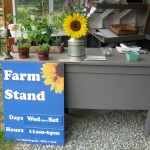
I’ve been enjoying my afternoons on the farm stand. People drift in and browse the offerings. Mostly they buy something. Sometimes they ask questions: do we sell pea shoots? How do you cook fava beans? What do you do with collard greens? Sometimes I can’t contain myself and show them obscure and beautiful vegetables, and sometimes they buy those too, as they are a curious and interested segment of the population. I’ve been bringing in cookbooks – especially the wonderful Jane Grigson‘s entertainingly written Vegetable Book and the exemplary Farmer John’s Real Dirt on Vegetables.

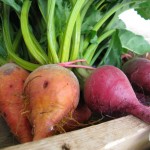
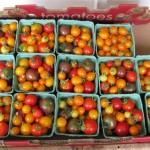
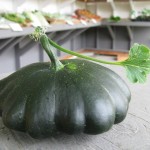
Here are some of last week’s farm stand offerings. Chioggia beets are the ones with the exquisitely pretty striped interiors. There’s a dazzing variety of cherry tomatoes, and several kinds of pattypan squash (also called custard marrow) – yellow, pale green (=white) and green.

Chioggia BeetsCherry Tomatoes Green Pattypan


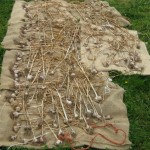
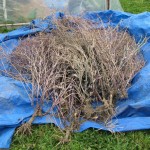
Tis the season for seed saving and some of that is going on as well. Some of the garlic harvest will be saved for seed. And the plants that have gone to seed are often dried las shown on tarps to keep them from self-seeding in the beds. Once they’ve dried out, the heads will be removed and the seeds culled and sorted.

Garlic Drying August 2011Seed Saving August 2011Dried Dill August 2011


There’s a fair amount to do in the fields, so the farmers and work parties are keeping busy.

Farmer Mike Working August 2011Farmer Nate Working August 2011Work Party August 2011


As am I with my apple tree which is laden. Here it is before and after picking a first basket of apples (est. 30 lbs).


Will be juicing some with blackberries, if we ever get enough hot sunshine to sweeten the berries that are tempting us from ditches and hillsides.

The Alfalfa thing and final debate & vote on C-474

A year or two ago I was interviewing someone about organic issues and genetically modified something or other and the topic of GM alfalfa came up. She told me that GM wheat had been on the regulatory table some years ago, but the public outcry was such that it was soundly defeated.

Which she thought was great, but the real problem would come when GM alfalfa came knocking at Canada’s door. That, she said, would kill organics, and the public wouldn’t even know to get excited because who cares about alfalfa? Wheat we can identify with; it’s part of being Canadian. But alfalfa’s just hay or something, right? Actually it’s at the bottom of our food chain, and so you had better care deeply, because it’s about to change your life.

As you may have heard, the American government has not just opened the door but laid down a red carpet for GM alfalfa, so it seems we have pretty much lost the battle before the bugle has even sounded. Alfalfa is the fourth most widely-grown crop in the United States behind corn, wheat and soybeans.

It is the primary animal feed – forage crop – in Canada. It is heavily used to feed dairy cattle, as well as horses, beef cattle, sheep, chickens, turkeys and other farm animals. Which means it feeds the dairy industry and the meat and egg industries. It’s popular in animal feeds because it’s high in protein, vitamins and minerals; this is why people eat alfalfa sprouts as well.

Organic producers are not allowed to use genetically modified ingredients or feeds, so if you buy organic eggs, milk, cheese, butter or meat, get ready to kiss them goodbye. Likewise organic alfalfa sprouts.

One thing to know about alfalfa is that it’s pollinated by bees, so it will travel. The bees who pollinate it are specialized (alfalfa leafcutter bees/Megachile rotundata). Honeybees can’t do the work because of the mechanics of the flower and the size and shape of the bee. Alfalfa leafcutters do not have the range of honeybees, but travel they will, and the GM alfalfa pollen with them.

Alfalfa is hugely important in farming because it’s a legume, meaning it has nitrogen-fixing qualities for gardens as well as farms, and so it’s frequently grown as a cover crop, as well as a forage crop.

Because of its position in our food chain, contamination of organic alfalfa with GM alfalfa means no more organic meat, eggs, dairy or sprouts for us, but it also means no more organic *or* conventional meat, egg or dairy products can be exported by Canada to protected markets like the EU which refuses to buy GM foods.

Surely this situation gives Canada grounds to sue the USA for violation of NAFTA’s environmental and trade protections? I think we should be questioning long and loud why Obama’s government’s love affair with the biotech industry is allowed to rob Canada of the right to choose whether or not to allow GM plants and foods into our environment and agricultural production. Won’t the American decision cause Canada clear economic losses by crippling our ability to produce organic foods and supply our export markets?

Therefore, this is a particularly important time to heed CEBan’s call to action over Bill C-474 which is thoroughly entangled in the alfalfa issue. Bill C-474 aims to protect farmers who wish to export non-GM crops into protected markets; it came up because of the accidental contamination of Canadian flaxseed with GM flax.

The final debate takes place February 8; the final vote on February 9. We need the Liberals to vote for this bill, so if you are in a liberal (or even conservative) riding (or care to drop a line to Michael Ignatieff and Stephen Harper) write, phone or otherwise harangue your MP today.

Write to Tom Vilsack and Barack Obama while you’re at it. Do not let them say that nobody complained so they did what they liked.

Canadian Copyright

Thanks to Mona for passing along this article from the Georgia Straight by the excellent Bill Freeman, one of Canada’s best spokespeople on the topic of copyright, and chair of the Creators’ Copyright Coalition, an organization of 17 of the largest creator groups in the country, representing over 100,000 Canadian creators.

As Freeman says, once things were simple; then along came the internet and that changed everything. And the proposed amendment (Bill C-32) to the Canadian copyright act, which has received second reading and is now before a legislative committee, threatens the livelihood of anyone who hopes to make a living from a creative profession.

It seems that the internet, which started life as a tool for free dissemination of just about everything, is starting to become another floor in the towering edifice of our have/have not society. Wealth is so polarized for so many of us now — and it’s worsening by the day.

Have a listen to CBC Spark‘s recent program on innovation, and particularly to Barbara van Shewick who explains how and why changes to the internet’s architecture will put an end to innovation of the kind that spawned eBay and Facebook. She outlines the kinds of harm that can be done when internet service providers are allowed to limit access to information, and explains why developers of the future will have to have money and power behind them. Gone the days of making a killer app from the comfort and safety of your basement… Oh wait, I never did get the hang of that either…

Petition to save the CBC

From the Friends of the CBC website:

On November 23rd, Stephen Harper’s secret plan for the CBC was revealed when the Parliamentary Secretary to the Minister of Canadian Heritage mused publicly about killing our public broadcaster! You can hear the audio for yourself here.

On Dec 6th, the matter of the government’s plan for the CBC was raised in Parliament. The Heritage Minister was asked to disavow his Parliamentary Secretary’s idea of cutting all funding to the CBC. Twice Minister Moore was asked to dismiss the notion that the government should kill public broadcasting. And, twice he refused to do so. You can see the exchange in the House of Commons here.

It’s widely known that the Prime Minister Harper exercises absolute control of his government’s messaging. None of his Ministers, Parliamentary Secretaries or MPs speak out without prior approval from the Prime Minister’s Office.

We recognize the threat posed by Harper could be the most serious peril CBC has ever faced. Now is the time for all of us who love and depend on the CBC to stand up and be counted.

Please sign the petition and help spread the word!

http://act.friends.ca/ea-campaign/flash/campaign.swf?xml=http%3A%2F%2Fact.friends.ca%2Fea-dataservice%2Fdata.service%3Fservice%3DGetCampaignWidget%26token%3D46f4f32c-5a04-41f6-bcc4-562a59750653%26widgetId%3D96%26ea.tracking.id%3D40627523