Skip to content

writers

The world, the world

There’s that parlour game – ‘who would you most like to have a conversation with’? and I’ve always felt like I’d be too awestruck to speak with many of my heroes. But I’ve been an admirer of David Foster Wallace since discovering a book of his essays at my cousin’s house a few years ago.  I’ve never read his fiction (so far) but he did some notable interviews during his lifetime, and after watching some of them, I feel like he’d have been great to natter with.

Here’s one with a German interviewer, from 2003, which is alarmingly prescient in its range of topics, from citizenship, corrupting power of corporate sponsorship, silence (absence of, importance of, for reading and thinking). I also like that he’s not wearing his characteristic bandana!
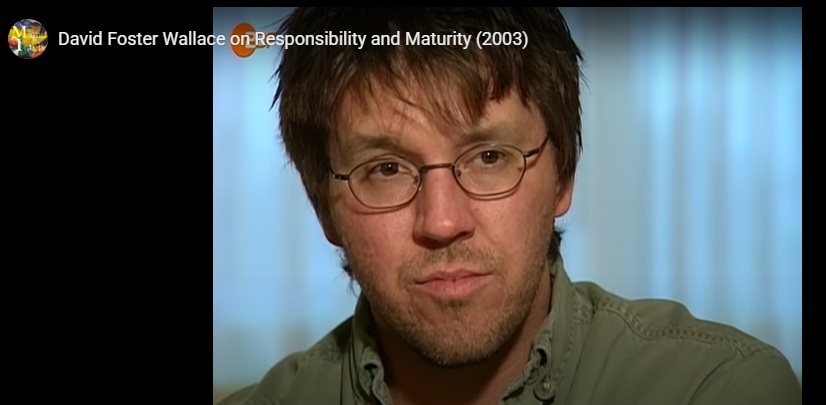
“I don’t think this is an evil country, I don’t think Americans are evil, I think we’ve had it very easy materially for a long time and we’ve gotten very little help in understanding things that are important besides being comfortable. I don’t think anybody knows how we will react if things get really hard here. And the fact that we’re strong militarily and economically is a good thing, but it’s also a frightening thing.

“My feeling is that the kind of rebellion that will change anything meaningfully here will be very quiet and very individual and probably not all that interesting to look at from the outside…

“Violence is interesting and horrible corruption and scandals is interesting. Rattling sabres and talking about war and demonizing a billion people of a different faith: all that is interesting… “Sitting in a chair and thinking about what all this means, and why what I drive might have something to do with how people in other parts of the world might feel about me probably isn’t that interesting to anybody else.

“I’m a writer, I’m not a politician, I’m not a political thinker. I’m just a scared little American living in California.”

(Full unedited interview is here)

Party statements about issues affecting writers, in advance of Monday’s Canadian election

Interesting to see the party that didn’t respond to pre-election questions posed by The Writers’ Union of Canada…

Party Responses to TWUC Election Questions-1

Communicating with our tax dollars

This Open letter to Canadian Journalists should really be read by readers of Canadian media as well, as it affects all of us, and our right to know what our government is doing in our name and with our tax money:

Civil servants – scientists, doctors, regulators, auditors and policy experts, those who draft public policy and can explain it best to the population — cannot speak to the media. Instead, reporters have to deal with an armada of press officers who know very little or nothing at all about a reporter’s topic and who answer tough questions with vague talking points vetted by layers of political staff and delivered by email only.

Politicians should not get to decide what information is released. This information belongs to Canadians, the taxpayers who paid for its production. Its release should be based on public interest, not political expediency.

This breeds contempt and suspicion of government. How can people know the maternal-health initiative has been well thought out or that the monitoring of aboriginal bands has been done properly if all Canadians hear is: “Trust us”?

Canadian Association of Journalists, April 2011

A question to ask your Conservative – and other visitants – during the current election campaign is:

  • What will your party do to repair what Stephen Harper has done to the taxpayer’s ability to know how the government is spending our money?

(Perhaps you’ll get an answer from the Conservatives by email from the election’s public affairs staff…?)

Stories

We were in the company of about 150 others last night, at the Harvey Stevenson Southam lecture given by Ojibwa story-teller Richard Wagamese.

Invoking the likes of CS Lewis and Norval Morrisseau, Wagamese spoke on the roles of stories in self-actualization; affirming childhood’s freedom with narrative; community building; and even the building of garden sheds. Demonstrating with a few stories of his own, and framing the talk with an Ojibwa story about the bringing of light into the world by a spider (which is also the story behind dream-catchers) he spoke to an attentive audience, mostly white, partially students. Wagamese is one who embraces contemporary tools – Facebook, Twitter, blog – unapologetically (“I welcome all those who are friends I don’t know..”). I confess my favourite lessons were those of Lewis (You don’t have a soul. You are a Soul. You have a body.) and Morriseau (who urged Wagamese to tell the story for the story’s sake). Perhaps that only affirms the role of the story teller as sharer of wider wisdoms.

Textbooks

I have been a student in my day. Several times over in fact. And I know the pain of textbook costs, which is a large pain. As a poet, I also know the pleasure of being included in textbooks, and it is a large pleasure. Though relative to the pleasure of a living wage, it is a veritable widow’s mite.

I know we live in Google’s world, which promises to deliver free information to everyone, and I know that Google doesn’t really care how that information is created or obtained, so long as it’s provided free to the user in ways that help Google boost its revenues through other channels.

And in keeping with this spirit of largesse, the Chronicle of Higher Education recently published a revealing article (which, it has to be said, I read for free) about the struggles of Washington State to meet the cap of $30 per online textbook that will unlock a large grant from Bill & Melissa Gates, with the aim of reducing textbook costs for the state’s students.

What I find most interesting about this article is that it makes not the slightest attempt to address the reasons why textbooks are expensive, which include – but are not limited to – that irritating cog in the wheel of free information: the textbook’s author, who must be paid. Or more typically, the several authors and/or editors who put the material together. All the article does is bemoan the fact that it’s very hard to find good quality educational materials for free or cheap.

Like many of us, I sit on both sides of this particular fence. I benefit greatly from all the free information that’s available online. On the other hand, for many of the past few years if I were living on my earnings from writing alone I couldn’t have afforded to pay for what I accessed, had the authors been fairly compensated for their work. Because the opportunities for me to earn a living wage from my writing – once a respectable and reasonably lucrative profession – dwindle with the days.

In discussing course materials for the online course I teach, for a college with a less than ample budget, it became clear that new online program areas in bricks ‘n mortar institutions take a while to catch up with details like copyright fees and electronic rights. So for the time being I point students to a lot of free newspaper articles and other freely available materials to augment the (reasonably priced) textbook.

Are these freebies the best available materials? Possibly not, but who knows? It’s as hard for academic publishers to keep up with changing trends and topics as it is for today’s academics to monitor the listservs and discussion boards, the conferences and webinars and workshops, the tweets and the blogs. And of course the published materials, whether online or in paper.