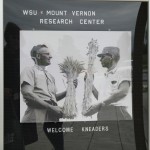
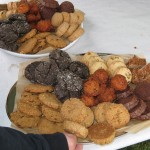
I’d been looking forward to the second offering of the Kneading Conference West, held in the idyllic gardens and fruit orchard of the Mount Vernon Research Station, where grains are being grown, tested and much discussed. Over this past September weekend they were also being ground, mixed, cooked and tasted to delicious ends.
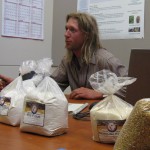
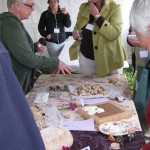
There was enough variety to keep the 200 or so various types of grain geeks amused, from tasting sessions – grains baked into crackers or breads, or liquified into beer – to talks on the science of baking (complete with easy-to-grasp 3D models) to demos on how pizza can turn into pita.


There were baking workshops too. Last year I’d missed most of George de Pasquale‘s session on sourdough/artisan bread for home bakers so made sure to attend it this year, though it was packed to the rafters. He walked us through equipment, explained ingredients, and guided those able to reach the counter on mixing, kneading, shaping and fermenting bread dough.


He demonstrated with a few swift cuts how to make Epi


And he critiqued a baked loaf, explaining some of the features to test for done-ness and the physical clues of underproofed and properly baked loaves. There were other demos too: one of the keynote speakers, food writer Naomi Duguid, demonstrated some of her favourite flatbreads (Finnish barley bread, Naan, Pugliese and Burmese breads) with help from Toronto baker Dawn Woodward. Oregon barley scientist Pat Hayes was there showing off his wares and giving out samples of his team’s Streaker (naked) Barley, so named for its hullessness.


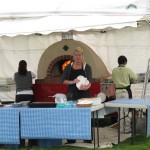
Then there were the mud people, led by Kiko Denzer, who slapped together a wood-fired oven in less than a day. One minute he was demonstrating an oversized hand blender in a bucket of mud and water, the next he was tamping down the base, and a few hours later it was done and decorated. Miraculous.


Andrew Whitley – who’d enlivened a panel on Thursday, discussing grain quality with Tom Dunston (an Oregon miller with Camas Country Mill) and Cliff Leir (of Victoria’s own Fol Epi Bakery) among others was the keynote speaker on Friday morning, introduced by last year’s barley baker, Andrew Ross from Oregon State University, and he gave us a rousing talk about his own history as a baker and small-scale grain grower, having started off in a spirit of self-sufficiency growing wheat for his own bread. He started and ran the Village Bakery in Cumbria for more than 30 years, during which time he produced rye bread that I had, to my delight, discovered at my local Waitrose in London when I lived there back in the nineties.


After reviewing his past life as a rural wholegrain baker using only local wheat in 1970s England, with a business plan someone had once summarized for him as “going to a place where there were no people, making a product for which there was no demand, from a material that was impossible to work with for its purpose,” Whitley’s talk ranged over issues facing all today’s eaters. There are the centralized production and monocropping issues that reduce choice for all of us and mean that in wheat breeding we’ve allowed production requirements to trump nutrition and taste (the only grains measured for such are for feedstock); the nutritional issues – the decline in nutritional value through breeding and milling “advances” (we have lost important mineral content through the change from stone ground to roller milled wheat, for example). And there’s the accelerated production time demanded by industrial operations, that rob our bread of the lactic acids and enzymes that work on naturally leavened bread to make it more digestible (not to mention tasty). He talked a bit about the Community Supported Bakery he’s supporting, the work of the Real Bread Campaign, and offered some ideas for bringing good bread to people who might not feel comfortable crossing the threshold of an artisan bakery. Bring our bread back home, he said, and gain liberation from larger corporations who don’t have our interests at heart.
And few would argue with that, enjoying excellent baked goods all weekend. We were certainly well fed and entertained through a superbly sunny and pleasant weekend. And really, how many times will someone offer you a slice of pie, freshly made with duck fat pastry and filled with caramelized apples? Not many, I’d say. I’ll be back…


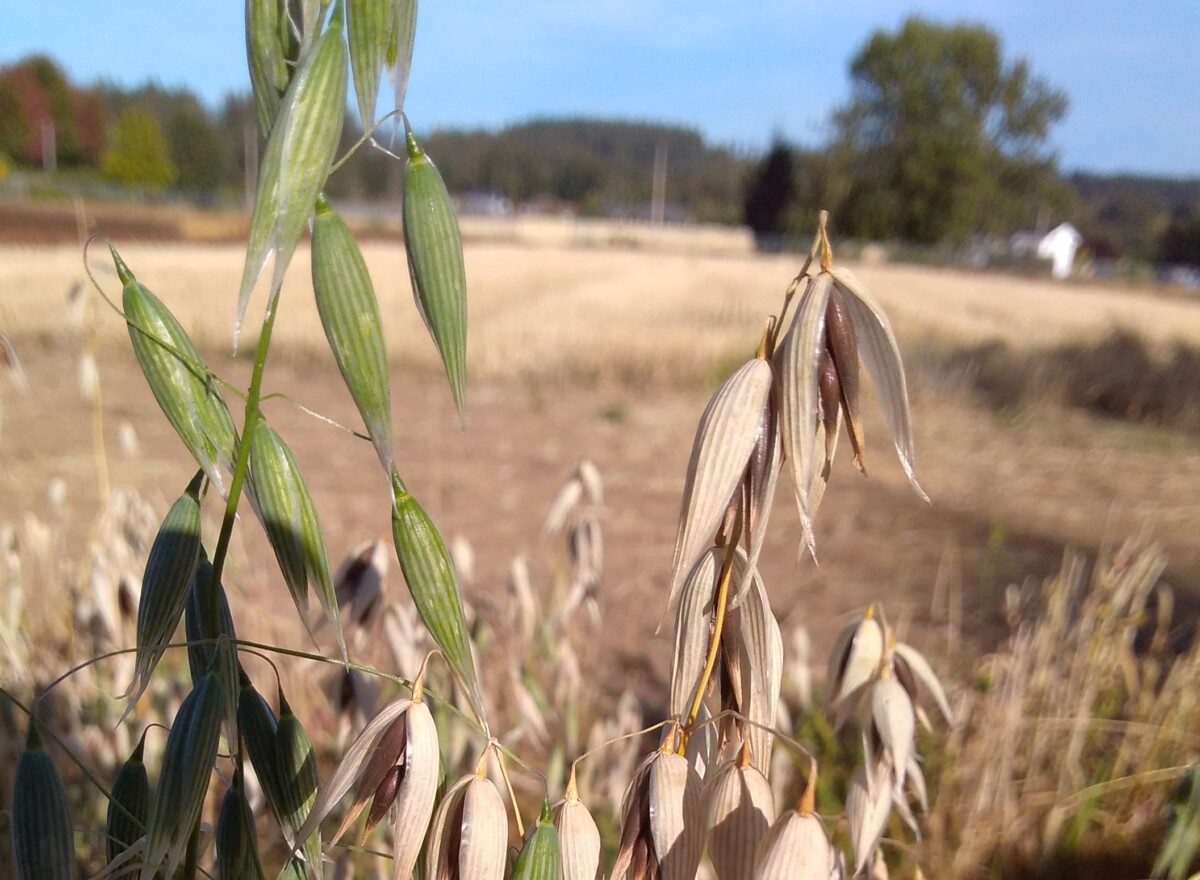 Saturday was a beautiful day for a farm party and tour of the facilities at Field 5 Farm, where Farm Folk City Folk was also showing off a new mobile seed cleaner. Farm and city folk gathered to sample some local whiskey and beer made from Field 5 malts, enjoy some music and learn a bit more about local grains and watch some seed cleaning demos.
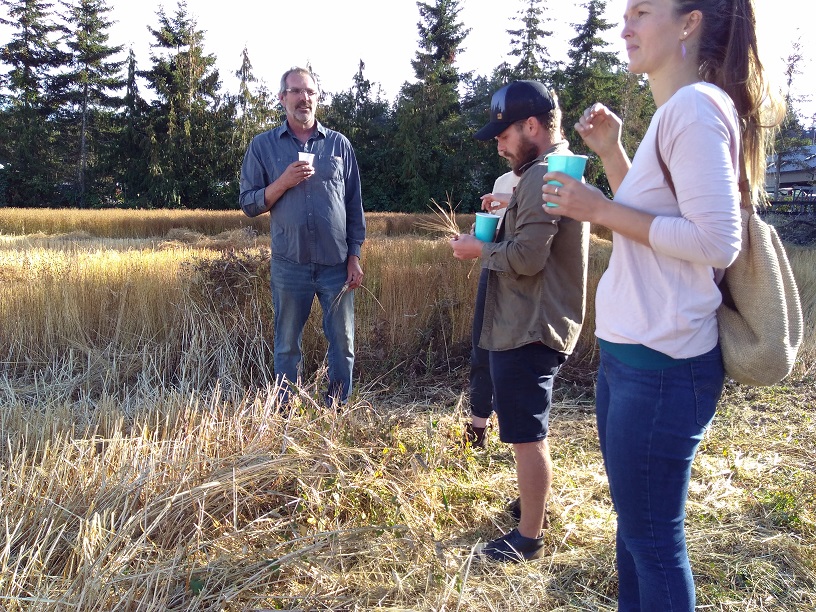 Mike Doehnel, last seen at a Kneading Conference some years ago in Mount Vernon, is now farming with Field 5 and gave some info about what’s being grown and the challenges of harvesting small scale for different purposes. Two different flax plots growing, one for a cover crop and the other for the very flax farmer I’d seen (during last month’s North Saanich Flavour Trail at Sandown), whose interest is in producing local linen. Photo above shows black oats, and here Mike talks about khorasan wheat, an ancient grain.
 Lisa Willot (FFCF‘s Vancouver Island Seed Security Program Coordinator)checks on the equipment in the mobile seed cleaner, which she’ll be taking on the road soon. It will allow small scale producers to save more local seed. Which improves local food security by allowing farmers to plant more locally produced crops adapted to changing climactic conditions.