Skip to content

barley

Kneading with a k

I’d been looking forward to the second offering of the Kneading Conference West, held in the idyllic gardens and fruit orchard of the Mount Vernon Research Station, where grains are being grown, tested and much discussed. Over this past September weekend they were also being ground, mixed, cooked and tasted to delicious ends.

There was enough variety to keep the 200 or so various types of grain geeks amused, from tasting sessions – grains baked into crackers or breads, or liquified into beer – to talks on the science of baking (complete with easy-to-grasp 3D models) to demos on how pizza can turn into pita.

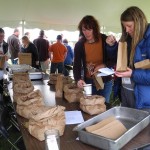
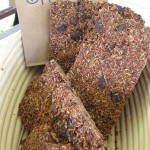
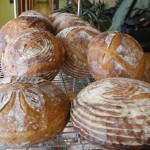
Local wheat test loaves


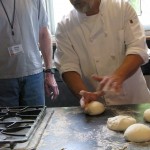
There were baking workshops too. Last year I’d missed most of George de Pasquale‘s session on sourdough/artisan bread for home bakers so made sure to attend it this year, though it was packed to the rafters. He walked us through equipment, explained ingredients, and guided those able to reach the counter on mixing, kneading, shaping and fermenting bread dough.


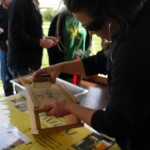
He demonstrated with a few swift cuts how to make Epi


And he critiqued a baked loaf, explaining some of the features to test for done-ness and the physical clues of underproofed and properly baked loaves. There were other demos too: one of the keynote speakers, food writer Naomi Duguid, demonstrated some of her favourite flatbreads (Finnish barley bread, Naan, Pugliese and Burmese breads) with help from Toronto baker Dawn Woodward. Oregon barley scientist Pat Hayes was there showing off his wares and giving out samples of his team’s Streaker (naked) Barley, so named for its hullessness.


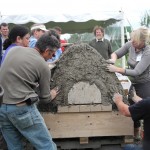
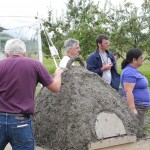
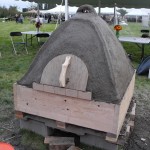
Then there were the mud people, led by Kiko Denzer, who slapped together a wood-fired oven in less than a day. One minute he was demonstrating an oversized hand blender in a bucket of mud and water, the next he was tamping down the base, and a few hours later it was done and decorated. Miraculous.


Andrew Whitley – who’d enlivened a panel on Thursday, discussing grain quality with Tom Dunston (an Oregon miller with Camas Country Mill) and Cliff Leir (of Victoria’s own Fol Epi Bakery) among others was the keynote speaker on Friday morning, introduced by last year’s barley baker, Andrew Ross from Oregon State University, and he gave us a rousing talk about his own history as a baker and small-scale grain grower, having started off in a spirit of self-sufficiency growing wheat for his own bread. He started and ran the Village Bakery in Cumbria for more than 30 years, during which time he produced rye bread that I had, to my delight, discovered at my local Waitrose in London when I lived there back in the nineties.


After reviewing his past life as a rural wholegrain baker using only local wheat in 1970s England, with a business plan someone had once summarized for him as “going to a place where there were no people, making a product for which there was no demand, from a material that was impossible to work with for its purpose,” Whitley’s talk ranged over issues facing all today’s eaters. There are the centralized production and monocropping issues that reduce choice for all of us and mean that in wheat breeding we’ve allowed production requirements to trump nutrition and taste (the only grains measured for such are for feedstock); the nutritional issues – the decline in nutritional value through breeding and milling “advances” (we have lost important mineral content through the change from stone ground to roller milled wheat, for example). And there’s the accelerated production time demanded by industrial operations, that rob our bread of the lactic acids and enzymes that work on naturally leavened bread to make it more digestible (not to mention tasty). He talked a bit about the Community Supported Bakery he’s supporting, the work of the Real Bread Campaign, and offered some ideas for bringing good bread to people who might not feel comfortable crossing the threshold of an artisan bakery. Bring our bread back home, he said, and gain liberation from larger corporations who don’t have our interests at heart.

And few would argue with that, enjoying excellent baked goods all weekend. We were certainly well fed and entertained through a superbly sunny and pleasant weekend. And really, how many times will someone offer you a slice of pie, freshly made with duck fat pastry and filled with caramelized apples? Not many, I’d say. I’ll be back…

Silence, prawns and barley

Tent caterpillar
Tent caterpillar with 3 predatory tachinid fly larvae attached.

I have been off-line for a while. In this space should have been some amusing tidbits from the Writers Union AGM which I unfortunately missed in its entirety due to what I am calling Italian influenza, since I received it from someone who brought it back with her from Rome.

I have passed the time of my recovery (and then some) picking tent caterpillars off my roses, blueberries and rhubarb. Not nearly enough of them have the tachinid fly larvae attached, but those that do seem to have two or three, which is hopeful, as the tachinids are helpful against caterpillars of many kinds, so I’m letting those afflicted eat their fill before they get the last headache of their lives.. and will be planting lots of tachinid-friendly plants like dill, parsley and Queen Anne’s Lace.

Meanwhile, BBC has been broadcasting Strands on its Book of the Week (sigh.. I remember when CBC used to have such offerings) by poet Jean Sprackland. In the second installment, she discusses the effects of anti-depressants on prawns. The excess fluoxetine excreted by Prozac users ends up in the ocean. It affects prawns by causing them to throw caution to the winds and swim towards the light… whereupon they become easy pickings for predators. This chemical also affects reproduction in mussels and has been found in fish near Montreal. Who knows, after that, how the fluoxetine travels through the food chain.

Add this to what we already know – the effects on fish of excreted birth control pill hormones, the drugs that we’re obliged to ingest through drinking water and produce grown in fields fertilized with sewage sludge – and to all we don’t yet know about the effects on other organisms.

In this anthropocentric world, we have invented a reality in which curing human ailments trumps any effect on other living beings. There are no legal checks on pharmaceutical companies to prove their products will not harm other species, or even humans who find them in their drinking water or vegetables down the line. Surely it’s long past time big  pharma should be required to prove its products will not harm the rest of our ecosystem?

I have become a barley bore while plodding away these past few weeks on an article that will appear in a future issue of Small Farm Canada. I had a lot of great information I couldn’t include so here are some of my overflow facts that prove barley is the best thing ever:

  • Our oldest grain, barley has been cultivated for around 10,000 years: it was found in Egyptian tombs and has a long and varied history, as a grain, a flour and a beer starter among others.
  • It’s the grain highest in beta glucan, a soluble fibre which slows digestion of glucose, making it helpful for diabetics, and is getting attention for potential in fighting obesity and heart disease.
  • In Nepal and Tibet tsampa (sampa) is a staple:  toasted barley flour that is mixed with yak butter to make a nutritious (B vitamins, minerals and of course that all important beta glucan) bread or cake called pa. (A disheartening news item in the Nepali Times reports that tsampa is losing ground to instant noodles which are nutritionally bankrupt. The result of course is an increasingly malnourished population.)
  • In parts of India, the beverage sattu is made of roasted barley, wheat/rice/chickpea flour, jaggery (raw sugar) and water. It’s quenching, nutritious and a long established fast food for travellers.
  • In the British Isles, barley water is an old traditional drink whose benefits are said to include: clearing the complexion, preventing wrinkles, soothing the digestion, cleansing the kidneys, curing cystitis, treating atherosclerosis and preventing gallstones.
  • In Italy, roasted barley is brewed as a coffee substitute: caffe orzo (not to be confused with the pasta)
  • Roasted barley tea is called mugicha (麦茶?) in Japanese, dàmàichá (大麦茶) or màichá (麦茶 or 麥茶) in Mandarin Chinese, and boricha (보리차) in Korean.
  • Barley has been studied for use in bioremediation:
    • Bioremediation of coal bed methane product water
    • Bioremediation of CCA-treated wood (using malted barley as a nutrient source for the metal-tolerant bacterium Bacillus licheniformis)
    • Barley is a metallothionein (as are wheat, peas and soy): in animals they have been shown to bind copper, cadmium, zinc and silver and to detoxify normally lethal concentrations of cadmium and copper in yeast
    • Barley is salt-tolerant and has been used to extract sodium chloride to reclaim sea water-flooded fields (it’s being studied as a way to remediate the tsunami-damaged farmland in Japan)
    • Barley is thought to be an aluminum hyperaccumulator.
    • Barley straw is a traditional treatment to prevent blue-green algae in ponds.


Kneading Conference West – day 2

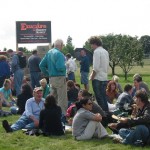
Sun broke out on day 2, causing some basking on the grass at lunchtime.

We began the day with a PowerPoint tour of local and small scale wheat producers from non-wheat areas; wheat breeder and conference organizer Stephen Jones showed maps revealing the transition to commodity scale production, which has redrawn the country’s pattern of wheat production. While almost every state in the US used to produce wheat, now the focus is on large scale production – nothing less than 1000 acres shows on the maps. But there’s a welcome resurgence across the board with small producers from Whidbey Island – where Ebey’s Prairie farmers once held the world record for productivity (119 bushels/acre in 1919 – a figure that dwarfs today’s industrial scale yields of around 45 bushels/acre) to Vermont – where farmer Jack Lazor has dealt with the loss of infrastructure by building his own grain elevator. Here at the Mount Vernon Research & Extension Centre (where the conference is being held) Jones is working on developing varieties that are resistant to local problems – notably rust – and has been working closely with local producers and bakers.

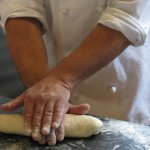
Starting to get hard to choose between sessions. I stopped for a few minutes at various points to watch Seattle baker George DePasquale on Artisan Sourdough for Home Bakers where he had some smooth moves for shaping boules, batards and baguettes,


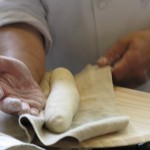
and offered advice on setting each on the couche, as well as transferring from the couche to the peel. He also took his scissors to a baguette to demonstrate the making of an épi de blé – remarking it was a tricky one to get in and out of the oven in one piece.

On to a panel discussion: A Question of Scale, where farmers and bakers talked through some issues to do wtih ethics and economics of producing local and organic.

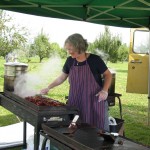
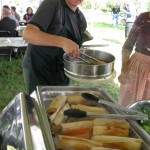
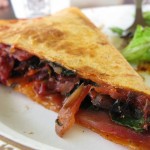
Lunch beckoned aromatically from the tent where the Patty Pan Grill folk were preparing the innards of our meal, which, alongside an excellent salad and three kinds of tamales, offered a spectacular discovery for me: it is possible to enjoy a quesadilla, if it is prepared from beets and other nicely turned veg together with some good cheese.

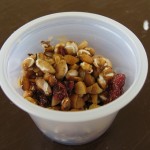
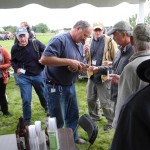
Some Vancouver Island talent: Fol Epi baker/owner Cliff Leir with “beer farmer” Mike Doehnel. Mike walked us through the barley malting process, after an introduction to barley breeding by Patrick Hayes, who set us loose on samples of hull-less and hulled barley, perled barley and even an incredibly good toasted barley snack (with local hazelnuts and cranberries) that’s soon to be marketed.


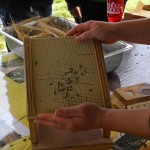
There was also discussion of something called Bappir, an ancient trail food made with barley, honey and dates which served a dual purpose: it could be soaked in water where it would be colonized by wild yeasts and serve as the foundation to early beers. We were also encouraged to try a barley head thresher – a basic manual model or an automated version – and a barley perler.

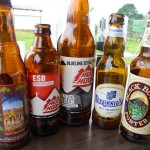
Some beer tasting ensued while Mike managed a demonstration barley mash in the background, eventually offering sips of the wort (if I followed the process correctly) which is the sweet dregs of the washed mash. It can be cooked down into malt extract for baking, or carried through the process and combined with hops to make beer. Of which we’d sampled five versions – four of them local, and some quite excellent. Thus fortified we wandered off to wait for… a beer and cheese tasting.

Behind us there was a small commotion of slapping and patting, which was the wood fired oven workshop group putting the finishing touches on their labour of love, which was to be silently auctioned off later in the evening, with proceeds to go towards the next Kneading Conference West – a worthy cause in my view. All you needed was the means to take it home with you…

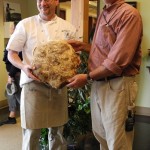
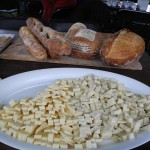
Elsewhere I happened upon Michael Eggebrecht and Stephen Jones wrangling a giant loaf from the Professional Baking workshop – came off a large rack of loaves that were on the way to the food tents where we covered them in more local cheese – a dill/garlic herbed number and an aged gouda style – before settling in to a dinner of barbequed chicken, corn and beans. And that was our Friday.


I retire with trepidation, for tomorrow’s schedule is too tempting and I cannot decide between four simultaneous sessions…

épi de blé