Skip to content

cheese

Still Cheeselessly in Parma

If you’re a believer in signs, when you read my tale you will perhaps understand why I gave up my attempts to get to Cheese this morning.

First, the friend who was going to come with me had pulled out before I left London. Next, I found out on Thursday that the plans to visit a winery Friday morning with another classmate had changed – the rental car wasn’t rented after all and there was no way for me to get there without leaving on Thursday and staying an extra night — somewhere. I was busy to-ing and fro-ing with packages to the post office and various other errands and just couldn’t manage it, so decided to go on Saturday. Then arose the possibility of getting a ride with someone else to Bra on Saturday morning, but that fell through on Friday. So I went to the train station Friday night and bought a ticket for a train leaving at 5.53 this morning, which would have got me to Bra at around 10.

Got up 4.30, walked to the train station and arrived I guess at about 5.51 – with just enough time to reach the platform and watch my train pull out, in the full knowledge that the next train wouldn’t get me there until an hour after the start time of the talk I most wanted to hear.

I took all this to mean the cosmos was indicating my presence was not required at Cheese this year, so I turned around and walked back home, since it was still too early for the buses to be running. Well at least I got my exercise. And was spared a three-stage, four hour train trip each way. The way things were going, chances are excellent that I would have missed one of those connections and ended up late anyway.

I don’t know how many of you out there have tried to plan trips using Trenitalia‘s rather good website, but it does have one major flaw, which is that it doesn’t tell you the ultimate destination of the train you will be catching/connecting with or the platform you’ll need, which means you have to figure that out on the fly by checking the departure list posted on the platform, and then find the platform listed, and hope it hasn’t changed. A lot to manage in a strange station with sometimes only three or four minutes between trains.

Think I’ll go out and buy myself some… cheese.

The week that ended with cheese and sunshine

Another quite pleasant partially sunny day today, after a week of same.

I began the week with a quintessential London moment. Walked down a street called, promisingly, Post Office Way, hoping to find a post office at the end of it, but no. The kindly woman in the Post Office logo-ed glass booth said no foot traffic was allowed there; I would have to walk all the way back and around the front of the building. Which I did and encountered a second kindly woman in a second glass booth who told me I couldn’t actually mail anything there, I would need a Post Office Counter, and she thought there was one a couple of bus stops up the road. But it was getting late by then so I gave up for one day. It’s already clear that ever more post office branches are being closed just now anyway, in my hour of need, when the queues at many of them go out the door regularly, so it’s only going to get worse. There, my first London whinge of the season.

An Italian-style crop of signs on a nearby gate.

I’ve been enjoying the office, where we have good citizen mugs to read while we sip our tea

and an excellent bakery around the corner (where I bought a fabulous pumpkin loaf the other day – a cheery orange colour with pumpkin seeds throughout).

I take the tube to get there; I’m glad I don’t have a bicycle. There is amusing evidence all over London demonstrating how this city just doesn’t get the concept of bike lanes.. Naturally cyclists ignore this little strip of insanity and ride in the bus lanes, hoping for the best.

Today’s outings included a jaunt up to St John’s Wood High Street where I visited its three or four charity shops and came away a couple of books heavier: a couple of Bill Bryson hardcovers I couldn’t pass up: I’m A Stranger Here Myself; and A Short History of Nearly Everything. And then I met Judi and we descended into the crowded cheerful basement of Food For Thought, where I had one of my favourite things, a big plate of their quiche and mixed salad.

I never have room for their fruit crumbles but that’s just as well. We went on to Neal’s Yard Dairy and tasted several of the wonderful things we were offered.

I bought some Coolea and some Berkswell and then we had tea around the corner in Neal’s Yard,

where a couple of tuneful buskers passed through with accordions. And then we had a flying visit at the Photographer’s Gallery where the excellent Keith Arnatt was having a show, and got kicked out as it was closing time, and had a glass at the Coach and Horses and called it a day, as she was nursing the beginnings of a cold and I was finishing mine off.

Meat and cheese

Today when the UK is again struggling with Foot & Mouth disease, I have retreated to the couch where I have been reading a terrific book, Last Chance to Eat, by a Canadian (via England) food writer, Gina Mallet.

Although it’s full of interesting facts, figures, anecdotes and recipes, I’ve found (thanks to this year’s education) two factual errors. One of the errors – that sent me running for my cheese technology notes – has to do with Parmigiano Reggiano cheese, which she says can only, according to the rules of the “Dominazione di Origine Controllata… be made only between 15 April and 11 November, when the cattle – producers of a quality milk called Pezzato Rosso – are grazing on fresh grass rather than eating silage.”

What is wrong with this statement is: there is no date restriction on production of Parmigiano-Reggiano cheese (it’s made year round); and the cattle are not allowed to eat silage or to graze on fresh grass because of the risk they might eat wet grass that has the same fermentative effect as silage. Fermented feed puts the milk at risk of developing heat-resistant bacteria, butyric clostridia, which causes cracks and holes in the cheese paste, making the cheese unsaleable as Parmigiano-Reggiano. (The cows producing milk for Parmigiano-Reggiano are, for this reason, not free range; they spend their lives in cow sheds.)

The regulations actually specify no silage, to preserve the safety of the cheese, the reliability of the ripening process, and the purity of the flavour. The rules are laid out and administered by the Consorzio del Formaggio Parmigiano-Reggiano.

The Pezzata Rossa she mentions is a traditional breed of cow once widely used for Parmigiano-Reggiano production, and is still used for a more exclusive product, Parmigiano-Reggiano delle Vacche Rosse. But since there is no restriction on the type of cow used for Parmigiano-Reggiano, dairies use higher yield breeds like Friesians.

The other error I came upon is to do with BSE, mad cow disease and its human incarnation, variant CJD, which Mallet attributes to 109 sufferers identified in 1993 having eaten more veal than others. But I remembered it being reported that the 10 sufferers identified in 1996 had eaten more beef (except for the one case who was vegetarian, presumably) – the highly processed kind, found in pre-fab meat pies, frozen burgers and the like, where presumably there is more animal byproduct than you’d normally be consuming.

And according to a WHO fact sheet on the subject, “infectivity is mainly found in the brain and spinal cord of clinically ill animals over two years of age.”

Anyway, the latest statistics for world-wide infection show that there have been a world-wide total of 201 infected through to July 2007. So I’m not sure where the figure of 109 UK cases came from; perhaps there was some early confusion between sporadic CJD and variant CJD.

Anyway it led me into some interesting reading around veal, including a piece by the rather fierce Guardian food writer, Joanna Blythman, which is a good summary of the ‘why to eat more veal’ argument – which hinges on the biological fact of dairy, namely that cows must get pregnant and give birth in order to lactate and give us milk and dairy products, resulting in a living byproduct, namely veal. Which is a point most of us, in our blissful detachment from the source of our food, have never considered, in our haste to condemn veal crates, which are banned in Europe from this year in any case.

An amusing animation about dairy farming in the US…

And finally, if you liked The Matrix, you’ll love The Meatrix.

Dijon continued: more wine, a few smoking barrels and a nice bit of cheese

On Friday, we visited the Château de Corton-André, to hear about the wines of Pierre André from Christian Ciamos. He told us first about the yellow tiled roof of the chateau, which had come from Bruges and which was one of few in the area, an emblem of nobility dating back to the power days of the dukes of Burgundy. The château itself had been built on Cistercian cellars: the Cistercian monks were the first vintners of the area and established most of the vineyards and techniques still in use in Burgundy wines.

In the fields, he talked about the moves to organic and biodynamic methods of cultivation that he and other winemakers are making. Basically, he said, it’s a question of respecting nature. Hence the roses still grown at the ends of many vineyards: they are prone to the same fungal attacks as vines and will show evidence before the vines do.

The vines of Pierre André are treated for disease, he said, not the risk of disease, otherwise you kill both the illness and the ecosystem. He and others we’d heard from during the week came back to their incontrovertable truth: that living things that are not routinely treated with chemicals (whether pesticides or antibiotics) are fundamentally more healthy and able to resist disease than those you make dependent on chemical cures. There is again no irrigation in use here: the vines are made healthier by having to sink their roots deep into the soil to find water.

We then retired to the cellar to have a tasting of wines from 2003 and 2004, and picked up an interesting snippet about wine tasting: there are three noses in wine – when it’s just poured in the glass; when it’s been swirled; and when the glass is empty.

A big excitement later that afternoon was the visit to François Frères Cooperage, where we watched barrels being made. The company makes most of its own staves from lumber purchased at auction, and trims the pieces to size in a small mill on its property. The staves are then aged for two years before being trimmed again and formed into barrels. The most dramatic moment was the toasting, where the half made barrels are placed over fires so that the heat relaxes the wood and flavours it to the specification of the buyer.

Before we knew it, Monday had arrived and it was our last day in France.

We visited Gaugry, a family-run cheese factory near Dijon, to learn about the making of Epoisses. This is one of the soft smelly French cheeses that I’ve never been wild about, but I enjoyed the tastings, and found my favourite of the three we tried was mild, creamy and firm – a much gentler taste than the aroma suggested. It was nice, though not enough to cause me to risk the aromatic integrity of my fridge in Parma by bringing some back with me, but I will look forward to tasting it again one day.

It’s a slow-coagulated, hand-salted cheese that is molded and dried before beginning a month or so of washings several times a week in marc de bourgogne (a wine solution) which gives it the orange colour we know it by.

We tried three different versions: two raw milk (one a farmer’s cheese and the other made at the Gaugry factory) and one pasteurised, for markets like the US where raw milk cheeses can’t be sold. A tip for the interested is that pasteurised versions are runnier than raw milk ones, so it’s easy to spot the outsider among these three:


We had a few hours in a very warm room at the top of the Burgundy school of business in Dijon, where Peter Dunn walked us through the massively confusing layers of names and quality marks for Burgundy wines. It was new information to me on the Bordeaux Classification of 1855 and some helpful review of AOC requirements for French wine. It was more on exposure, water, soil, limestone, marl and weather systems, and a bit on pruning and vinification.

But before that, we were subjected to what may be the worst meal ever served (and not, in most cases, eaten): the cafeteria of the business school in Dijon. Curiously, they were offering this abomination during a student recruitment drive. The first photo was an unidentifiable deep fried something that was described as having a ‘bolognese’ filling; it was served on a mystery grain.

The vegetables had been cooked into some kind of alternate chemical existence; it was as if they had gone beyond their roles as long dead plants into some new and appalling incarnation that could not properly be described as a life form.

It was puzzling to us: why had we been brought here? Was there a learning point in this mealtime? This was not slow food; but neither was it particularly fast, and it was fairly certainly not even food.

When we had completed our close observation and dissection of the substances, and drunk our cups of water, we were directed to a large bin in the corner where everything – the ‘food’, plastic cutlery, plastic plates, paper cups and napkins – were tipped into a plastic-lined void. A perfect finale: this school doesn’t trouble itself with either edible meals or recycling. I wonder what other lessons the business students take away from this place when they graduate.

Visitations and celebrations

The week has been largely social, beginning with my return from London on Monday. Tuesday we arrived in Colorno to find the morning class cancelled, so filled the time with a British and Irish cheese tasting – Berkswell, Caerphilly, Double Gloucester, Durrus, Stilton, Swaledale and even a little Vignotte, just because, well why not, we’re off to France this weekend. I’d brought some Dunkerton’s Cider to wash things down, and some oat cakes and digestives and Cornish wafers.

A big party on Tuesday night, which started with a rooftop aperitivo party – passing through a nicely decorated laundry line – here it is with Jess the artiste:

and on to an al fresco dinner at the Santa Chiara Trattoria, which featured traditional starters including torta fritta with culatello and prosciutto, and a parmesan torte drizzled with balsamico.
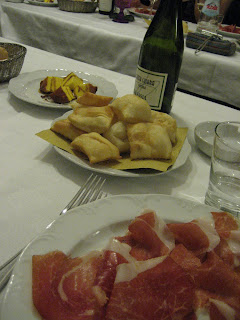
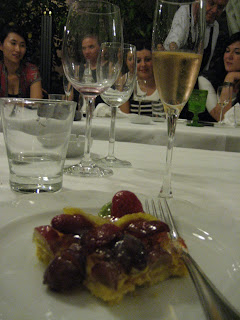
I was indulged in my year-long project to try every Barbera wine I can find (and this one was lovely). Then had a nice bit of duck followed by a fruit tart, as well as toasts and songs in many languages.
Next, I was blessed by visiting Canadians, although the difficulties of arranging a nice time became somewhat operatic in everything except musical elegance.

The day of departure the Parma B&B;, found online and booked a couple of weeks earlier, cancelled my friends’ stay… I guess on the positive side at least they actually let them know they were pulling the rug before arrival, but it was nearly impossible to arrange a room at such short notice, and so instead of a charming centrally located abode, they ended up in an airport hotel with a higher than expected taxi bill and no place to eat except the hotel restaurant. Not much of a welcome to Parma. (If anyone wants the name of that b&b; in the interests of avoiding them in future, get in touch.)

After that, Geoff’s plane from Canada was caught up in a strike and his connection to Milan was cancelled so he had a bonding experience with some similarly afflicted fellow travellers in their circuitous route through Geneva and onwards by train, while his lovely wife kept vigil in the Milan train station all day.

The whole week has been a kind of precis of what can go wrong here when you try to make plans.

I had tried to book a restaurant for the supper I thought we’d have together in Parma on arrival night, but the one I tried had, according to its website, closing days of Tuesdays and Wednesday lunchtime. I tried to phone but the phone was on fax. I tried emailing a reservation, but didn’t hold out much hope for a reply, so I stopped by Wednesday evening but the place was shuttered with no indication of opening times posted on the door. So I gave up. Luckily, as it turned out.

I then attempted to book a rental car, and thought I’d try to support local businesses by booking locally. After my opening remarks and my first “scusi?” to the voluminous reply, the helping hand at Maggiore used it to put the phone down on me. I gave up and went to Hertz, booked online and hey presto.

I also attempted to book an agriturismo we’d found online, which had nice pictures of its room but no room rates posted. So I tried emailing them (in pidgin Italian) to ask about room rates, but there was no reply, so I had a more fluent friend call on my behalf (grazie Corrie) and succeeded in landing the rooms. Which turned out to be first rate and we had a perfect stay at the gorgeous and welcoming Campo del Pillo. The owner was friendly and generous; when he saw us tucking into an al fresco antipasti of Pecorino Sardo and wild boar salame, he sniffed manfully and returned moments later with some 30 month old parmigiano-reggiano, drizzled with 35 year old balsamico, and accompanied by organic salame and spalla cruda.
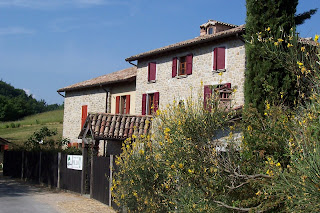
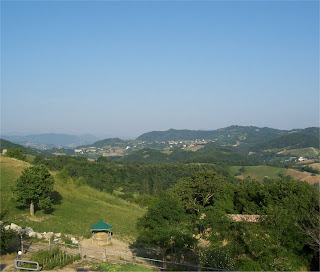
A bella vista out the windows:
And the old grey mare…

Next on the agenda was attempting to book dinner at a Slow Food recommended restaurant, Il Capolinea. After numerous attempts over two days with failed phone connections, I finally got through. After my opening remarks, the other end hung up on me. Let’s say the sound quality was bad. In any case, I phoned back, and this time he heard me out and took my booking.

And we had a fantastic meal in very friendly and capable hands; a mixed starter of pork salad (insalatina di maiale), vegetable frittata, pickled onions, salame and culatello,

followed by roast lamb (coscia d’agnello biologico al forno) and roast beef (drizzled with balsamico),
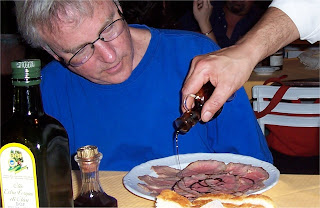
accompanied by a comfortable selection of vegetables, followed by four star desserts: stunningly good fresh strawberries with gelato and balsamico; and chocolate mousse so good I wanted to lick the plate. Afterwards we made friends with a neighbouring table and were rewarded with a glass of nocino; and after that the proprietor brought us some beautiful dessert wine and exquisite almond macaroons.
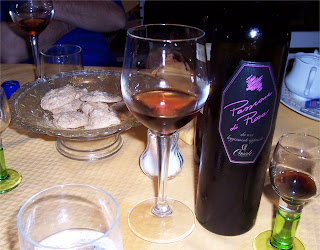
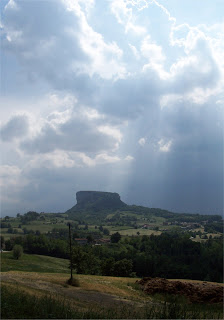
Awesome. We discovered later that Castelnovo ne’ Monti is in fact a Slow City, so we were destined for a good meal no matter what, but I think we struck it lucky nonetheless. Scenic place, with its characteristic tabletop mountain, La Pietra di Bismantova, which is said to have inspired Dante’s Monte del Purgatorio.
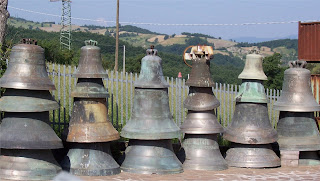
We also discovered that the town is known as the City of Bells because of a long-standing bell foundry (Capanni Bells) where they’ve been ringing the changes since 1500.
On the way home today we paid a visit to the Museo del Sughero (cork museum) in the pretty Appenine spa town of Cervarezza Terme.

Crete part 3: shepherds, cheese and village feast


One morning we ascended a steep, gravel road and shortly found ourselves a lot of the way up a mountain, at an open-air milking parlour.

The goats were corralled and driven at intervals by a pair of well trained dogs towards the shepherds who wrangled them into position, milked them and sent them off to spend the day on the mountainside.


Our host models the traditional shepherd’s bag – which used to include one essential you don’t see much nowadays: a mending kit to allow them to stitch up their boots and clothing to get through the weeks and months they might have had to spend in the mountains.

He produced platters of fresh cheese, home made biscuits, and a bottle of raki. We were told we had to eat all the cheese. So we ate cheese.

And we ate cheese.

And we ate a bit more cheese.

And then we were down to the last piece of cheese. And when that was gone, it was time to see how it was made, so we descended again and visited – what else? – a local cheesemaker.

The milk has been coagulated, the curds have been cut, and then put into baskets to drain and firm up into cheese.

Afterwards, we were offered a very tasty gruyere-style cheese, Graviera, served with rusks (paximathia) and raki. And then, full of cheese, were called away to lunch.

Talk about a village welcome!
Men make fire..


Popi, who organised the cooking, read us a poem of welcome. The four-line poem is a popular and traditional poetic form on Crete, and ideally sized for inscription on the blades of the knives that form part of the traditional costume for men.


We were walked around the room, meeting the people behind the dishes, admiring the dishes, and finally eating the dishes. As Kostas said, the beauty of the event was not just the generosity of the welcome or the extent of the food that had been prepared for us, but the fact that it had been made from what these men and women had grown, raised or foraged themselves.


We had a cooking demo – how to make wild greens pies (Kalitsoùnia).


Lots of wine to sample.

We tasted many new things, and some we’d already tried; snails finally broke free of the leaves and plants we’d been seeing them on, everywhere, and rolled right onto our dinner plates. So much food! So many impossible choices. This was one affair where we couldn’t try a little of everything, not even close.


Xerotigana

Afterwards, the men kicked up their heels.

We had a last drink, and wended our way towards a couple of hours’ relaxation before supper.