Skip to content

wine tasting

We can’t believe…

How did it happen? A year flits by and all of a sudden it’s tearful farewells and no more pig farms, Unisg cheers, bus rides, charter airlines, wine tastings… how will we cope in the months to come?

The final week shaped up kind of like last week’s, commencing with an exam and then moving swiftly through food marketing, journalism and a great big party. We had lunch on a riverboat on the Po


(photo from Andy)

with Carlo Petrini and our university staff and dignitaries.

After the food we had a little wisdom from the brow of Petrini,

and then some goofy awards and another gem of a slideshow (so there WAS a reason for taking those – must be literally millions of frames – cameras everywhere we turned all year) by our animators Don and Marta.

Next stop was Polesine Parmense, where we revisited the scene of last winter’s visit when we learned about culatello di zibello.


(Photo from Andy)

We were attending the annual Spigaroli Awards (to local food heroes of various kinds) at the beautifully refurbished Antica Corte Pallavicina, which was about half finished on our last visit. It’s now ready to roll as a swanky agriturismo for visitors who want a short and scenic walk to their dinner at Al Cavallino Bianco.

But on Wednesday tables had been set up around the perimeter of the courtyard and the Spigaroli brothers, Massimo and Luciano, were busy seeing to the comfort of their hundreds of guests. The hay bale corral in the middle holds a flock of black piglets who made up part of the award, one for each recipient: the Spigarolis would raise, slaughter and cure them, so the prize – in good Slow Food form – would be years in the making. We had some wonderful culatello, of course, including two kinds made from white and black pigs, each culatello aged 36 months.

And a wonderful tortelli in brodo with some exquisite cheese filled pastas in a light and warming broth – bliss to be in the cooling air eating such things. Fortified, the guests then enjoyed the awards ceremony, which included a special prize for Carlo Petrini.

And then it was the last couple of classes – marketing and wine tasting from Matteo Baldi, journalism from Clodagh McKenna, the last lunch together,

the last bus home,

the last visit to Tabarro,


rounds of signings (our brand new copies of Slow Food Nation, serving as school autograph albums)

and some emotional farewells…

The week that ended with Balsamico

Reports, exams and internet problems have been interfering with this blog. More to come on Spain, but maybe not for a couple of days. Meanwhile, back in Parma…

We are counting down now. Ten more days of classes and we’re done, ready to scatter for the summer and then for two months of internships.

Odd to think that after months and months of constant contact we won’t be seeing one another until graduation in November. Good and bad it’s been, and I when I heard Leonard Cohen talking about monastic life in a recent BBC interview, it struck a chord:

“People think of this activity as somehow remote, isolated and serene, whereas it’s much more abrasive than ordinary civilian life. In ordinary civilian life you close your doors at the end of the day and more or less you’re alone with your television set, but in a monastery.. there’s a zen saying: like pebbles in a bag, the monks polish one another.

We are, I think, well polished gastro-pebbles by now.

It’s been a steamy week in Parma with the temperature set to rise and rise into next week; I can’t say I’ll miss the weather here (damp and cold in the winter; hot and humid in the summer, just the way the prosciutti like it). Nor will I miss my visits to supermercato Standa, where you can enjoy spiritual debasement with the rest of the long-suffering Oltretorrentini: standing in long, tedious queues which may randomly end with a terse “E chiuso” from the attending demon, at which point we all shuffle into another long, dispirited queue, and are then hectored into giving up complicated combinations of coins because from all appearances the check-out cashiers are charged for their change floats.

So here we melt. By night we toss in our hot rooms, only to rise welted and itchy from insect bites: spiders, mosquitoes, who knows. To judge by the volume of chittering along the river, the frogs are doing their best to control the numbers; the rondini (swallows) who took on the springtime airborne have all left for what I assume are cooler climates. There’s an abandoned bird nest in the air vent in our kitchen that only coughs a bit of dust on the floor these days, no more face to face confrontation with the parents who for a couple of weeks hovered fiercely at the window, moths in beak, to demand what we were doing so near their home.

This week, several of those who didn’t fall to Spanish ailments began to drop, and our numbers were reduced by nearly half for most of our classes. The end of Consumption Psychology: no more than a recap really of what we talked about before we left for Spain – who we are and our social circumstances influence what we eat and how we think about food – nothing too new there. Then Sociology of Food Consumption, where we talked about branding and advertising techniques as applied to food. Mostly it felt like a depressing recount of mergers and aquisitions among the likes of PepsiCo and Coca-Cola, with less to do with artisanal brands or alternative markets. Then we had two delightful final tastings with Sandro Bosticco, who led us through discussions about the role of oxygen in winemaking, with a finale that featured four Pinot Noirs (three from Burgundy and one from New Zealand) and then group tastings of sparkling (Prosecco), red (Amarone) and sweet (Moscato – passito) wines.

Friday we got on our stage bus for the last time, leaving behind a host of fallen comrades (some suffering from late-breaking flu and others perhaps from a mild case of Friday nightis), to study balsamic vinegar production from industrial prosciutto makers Ferrarini, who as a family have the slightly surprising hobby of artisanal vinegar making. As balsamico derives its name from ‘balsam’ – as in healing substance – it was a shame we couldn’t all be there to breathe the purifying perfumes, and taste the rapture, spoon by blessed spoon.
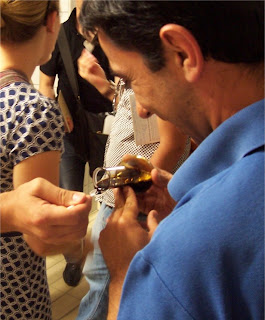
We learned about the rather lax standards for the substance known as Aceto Balsamico di Modena (“Modena Balsamic Vinegar”) – which require that it be of a minimum acidity of 6%, made from grape must (minimum 20%) and vinegar, caramel (maximum 2%, for colour and flavour), with a minimum 60 days aging. Ferrarini make a higher quality product which is aged a minimum of 8 to 10 years, but on the grocery shelf, consumers won’t understand the difference (other than price) when it’s ranked against the lower end products. This version is the balsamico you use for cooking and salad dressings. The more precious condiment is another story entirely.

What we may think we’re getting when we see the words balsamico and Modena and vinegar on a label is in fact correctly known as Tradizionale Balsamico, and there are two strains of it, one from Reggio-Emilia and one from Modena, made in more or less the same way but with a different balance of density and acidity, and bottled in different areas. They also have different quality standards: there are three quality levels for Tradizionale Balsamico di Reggio Emilia (red, silver and gold) and two for Tradizionale Balsamico di Modena. This is the highest end product, a thick, sticky goo that takes at least 12 years to make and should be doled out by the drop, as a condiment on strawberries or parmigiano-reggiano cheese, or even drunk from thimble-sized glasses after a meal or, according to Anna del Conte, diluted with ice and sweetened with a little sugar.
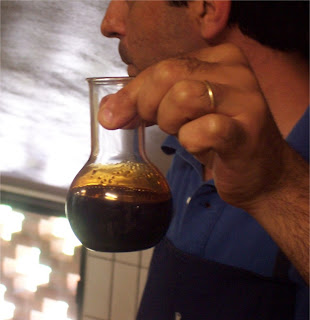
Before you get to that point, though, the stuff has to be made. According to tradition and regulation, it’s made only from grape must: local grapes are crushed and cooked until the volume has reduced by 50-60%, leaving a high density, sweet syrup. It’s fermented in barrels with only natural yeasts (present in air or the grapes themselves) for company. At the end of the year it will have reached about 6 or 7% alcohol, with lots and lots of residual sugars. A small quantity of older balsamico is added, containing live bacteria, and another two years or so go by while these bacteria carry out the acidification process which transforms the alcohol into acid.
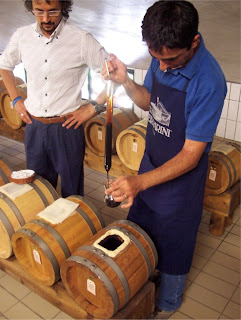
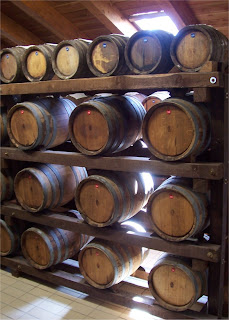
Then the real fun begins, when it’s decanted into a series of barrels of diminishing size, made of different woods: chestnut, oak, ash, mulberry, cherry and locust wood, which all add different flavours. There will be at least three but not more than ten casks, which are not sealed, the opening on the top covered with muslin to allow the liquid to thicken through evaporation. They are stored in vaults where the local climate can play its part: the cold winters concentrating the flavours, the hot summers evaporating the water content.
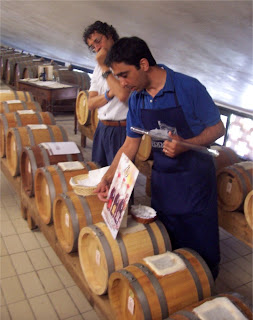
The barrels lose about a litre a year, so they are topped up in a formal process: the smallest barrel gets a litre from the next largest; that one gets two litres from its neighbour, and so on up the chain until the largest barrel receives about 30 to 40% newly acidified balsamico. This chain continues for between 12 and 25 years, at which point between 5-10% of the smallest barrel’s content is decanted and sent to the consortium for testing.

The consortium determines which of the three levels the balsamico will be sold as. These are related to age, but not completely determined by it, as the tasting is the final arbiter. The “lobster red” labelled balsamico is at least 12 years old; the silver is 12-25 years; and the gold is at least 25 years old.
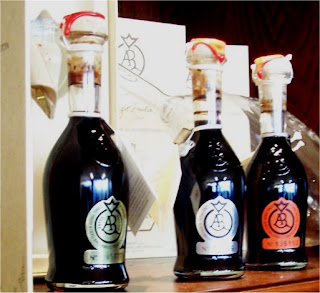
Because vinegar is a preservative, once you’ve invested your money (at least 30 euros for the red label, and upwards of 75 euros for the gold – in Italy; more if you buy it in other countries), you won’t ever have to worry about it going off (perhaps you’d like to pass a bottle down to your grandchildren?). It does behave much like honey though, and has a tendency to crystallise; but, like honey, it can be restored to liquid state by gently heating the bottle in water.
We got back to sticky Parma in time to rest up before supper. A group of us went to see chef Davide at Ristorante Mosaiko and ate ourselves into a happy stupour, with my favourites being an outstanding guinea fowl salad, dreamy gnocchetti topped with amazing mozzarella, and an even better than last time slice of bonet for dessert. I’m still digesting today…

Spain 6: wine and Bulli

We arrived at Viticultors Espelt, a winery in Girona that opened in 2000, and decanted the able-bodied for tour and tasting, while a pair of sufferers and their translators headed to hospital in search of antibiotics for respiratory tract infections.

We were presented with jolly orange sun-hats in which we set off in hot windy sunshine for a look at the vineyards.

It’s a new estate, only aquired three years ago, and the winemakers are busy learning about their terroir, by experimenting with different harvests, agings and blendings. In this baking climate, the plantings are done strategically, matching the varietal to sun exposure, and using stronger vines like grenache to protect more fragile ones like syrah from the wind that blows in from the sea, visible from the hilltop we were standing on. The terraces along the hillside are being restored by dry stone walling, three km achieved in two years, by two people working full time. Global warming is playing its part here, and the harvests are coming earlier each year: traditionally done in mid September, they are now taking place in mid to late August. Such is the heat, the harvest takes place between 4am and 11am, otherwise the grapes would start fermenting in their skins as soon as they were picked.

As we walked back for our tasting, we passed a charming but unremarkable farmhouse, which the winemaker told us was by night a very exclusive and popular disco, Ranch Frank, started by Salvador Dali and his American girlfriend.

We dashed through the tasting – Mareny 2006 (Sauvignon Blanc and Muscat), Quinze Roures 2006 (Grenaches gris and blanc); some nice full-bodied reds, Saulo 2006 (Grenache and Carinyena) and Terres Negres 2004 (Carinyena and Cabernet); and finished off with Airam 1998, a sweet wine made in very limited quantities from Grenache grapes, using the Solera (“fractional blending”) method, which is also used for sherry. It’s aged in half full barriques using a complicated method of adding partially aged wines to the new (in a process I’d be reminded of when we learned about balsamico tradizionale) all of which allows controlled oxidation to leave its mark.

The bus with its slowly reviving occupants arrived and whisked us off to a lively seafront town called Roses,

where we had an excellent tapas lunch – sweet shots of gazpacho; mussels both in a cold vinaigrette and hot stuffed; a gorgeous but too-small school of anchovies in garlic oil; quail eggs;

calimari; octopus; patatas bravas;

and then some noodle-style paella with, of course, allioli, and strawberries and ice cream to finish, all washed down with lots of sangria.

A lucky thing we’d eaten well as we weren’t offered so much as a speck of foam at El Bulli where all hands were busy preparing for supper.

A spectacular and slightly terrifying cliff-side drive from Roses, the much revered restaurant is only open six months a year, and they begin taking reservations from October.

The numbers involved are revealing… of something. In order to assure newcomers a place in the experience (which is around 30-35 small and ever-changing dishes for 185 euros per head plus wine and taxes) they have a policy of booking half the total 8,000 seasonal seats in repeat business and half new diners. There are 1,700 items on the book-like wine list, representing some 19,000 bottles in their cellars, and so the sommelier recommends you consult online before they start pouring into one of the 60 different wine glasses and 5 types of decanters. They have an electronic menu which you can use to filter your wine selections through your 30 food items if you want to complicate your life further; and of course there is a water list to choose from too.

The staff (67) outnumber the diners (50) but are not all paid employees, since there are 45 trainees (4 this year will be selected from 4000 applicants).

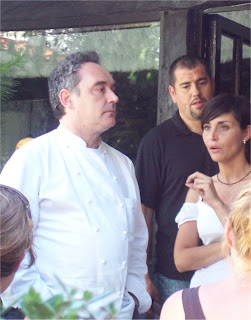
Ferran Adria stepped out of the kitchen long enough to engage in a bit of verbal ping pong about what is art (El Bulli is officially known this year as Pavilion G in the German art festival Documenta) and revealed he spends about 30 percent of his time talking to media and conferences.

After one last look at the dandy view from El Bulli’s courtyard, we hopped back on our bus and arrived at Mataro, which Carlo explained was another word for Mourvedre, very appropriate. It was a nice hotel in a bad location – across the road from what I heard was not a great beach, and a couple of kms from town, so taxis were needed for any expeditions. After we tried the first night’s hotel restaurant fare, we concluded these would henceforth have to include supper. Gazpacho in a wine glass? Phooey.

Spain 4: bubbly

It being the fourth of July, and our class more than fifty percent American, we celebrated their holiday by first visiting Freixenet, the market leader in cava (a word meaning sparkling wine produced in a cave). It’s a massive enterprise, with three areas: traditional, mostly manual production; mechanised production; and fully automated (robotic) production.

The scale of the cellars is awesome, as you would expect from a company that exports 140 million bottles a year of this serious competitor in the sparkling wine market. Such a company also requires a high degree of standardisation, so unlike some of the smaller wineries we’ve produced, who accept that the grape is a growing thing that will differ in quality and flavour each year, Freixenet has had to marshal many techniques to standardise its product, and relies therefore on cultivated yeasts (artisanal producers use wild ones, whose flavour will vary) and blending the three base wines they produce from Macabeo, Xarello and Parellada grapes.

The Spanish grape varietals they use are what makes the wine distinct in flavour from French champagne, which is made from blends of Chardonnay and Pinots (Noir and Meunier). But the same method of production is used: methode champenoise, which must now, because of geographical protection legislation for Champagne, be called methode traditionnelle. The basic technique involves crushing the grapes, filtering and fermenting the grape juice in vats or barrels, and then putting it through a secondary fermentation in the bottle: to each is added a bit of sweet liqueur (made from yeast, sugar and wine); the bottles are turned by hand (in the manual production area) or by machine or robot in the other areas, at intervals until the fermentation is complete, between one and four years at low temperatures.

Later that evening, one of us already sporting the most exotic injury of the trip (a jellyfish sting), we laid into the cava and an excellent spread including tortilla, cold chicken and (what American party would be complete without it) Lay’s potato chips, as well as a chocolate cake. Despite the airborne arrival of one randomly thrown egg (which missed hitting celebrants) the party went well and included rousing versions of Star Spangled Banner and Take Me Out to the Ball Game. The grand finale was a surprise appearance from the Freixenet bubble girl…

Spain 2: cured meat and wine

Our first day we left behind three casualties: two recovering from queasiness from the previous night’s tapas feed, and one sore throat.

We drove through the wooded hills – a surprise to many of us, expecting a parched, desert-like landscape – to sausage-maker Fussimanya, which has been operating for 35 years. It started life as a restaurant serving Catalan specialties, and, as we had a chance to discover, is still hugely popular (it was pretty much full on a Monday lunchtime when we left). They began by making sausages for the restaurant but now produce a full range of products which are sold through their own shops on the site and in Vic.

Here we watched the production of brisba, a hefty boiled sausage which comes in white (made from a lot of things you might not wish to see listed here) or black (made from blood, fat and meat).

They also make five varieties of cured sausage: longaniza, churizada, chorizo, fuet and sumaya. This one, fuet, uses 3 grams of pepper per kilo of meat: whole peppercorns inside and ground pepper outside; it’s a firm, dry sausage, very moreish as we discovered in a tasting.

We also got to see how the traditional wine vessels are used:

No wine was spilled, but one knee was grazed, ironically right after negotiating oh so carefully the slippery floor of the factory.

Afterwards we were taken for a look at Vall de Sau Collsacabra – a valley whose centre is a drowned village, its church steeple showing in times of drought – as now – from the middle of the lake. This was part of Franco’s legacy, the translator told us; he wanted to bring water to the country and created a series of artificial lakes through damming rivers and walling in valleys, and drowned more than one village in the process. I’m not sure what the villagers must have thought of it all, but such areas are now rich playgrounds, studded with posh hotels like the one we were standing in front of. Nearby was a former Benedictine monastery (Sant Pere de Casserres) which had been founded in 1005 but abandoned after the 14th century; it was restored in 1998 and is a popular attraction– but we didn’t get to see it.

Instead we headed back to Fussimanya for a long and excessive lunch:

More pan con tomate..

Cold roasted vegetables:

A platter of raw cod:

Some fried mushrooms:

The ever present aoli, called allioli in Catalonia:

Crema Catalana: is it so different from Crème Brûlée? We thought maybe it was not as dense a custard. And served in this characteristic bowl, with the wafer.

After lunch we drove to Santa Maria d’Horta d’Avinyo to visit the winery Bodegues Masia d’Avinyo, home of the Roqueta family, wine producers since the 12th century.

Most of the old bits and pieces from this history of winemaking are now part of a museum. We saw the sunken wine vats, over which were suspended ropes for the grape-treaders; a system of drains then allowed the juice to drain out by gravity. The vats had to be cleaned by hand, but it was very dangerous work, because there could be a lethal build-up of carbon dioxide, and so in a twist on the canary in a mineshaft idea, the winemakers suspended cats inside first; if they died, it wasn’t safe to go in. Lucky for the local felines, they later realised that candles worked just as well.

Here’s an olde worlde kind of way to put corks in your wine bottles:

We had a small lesson in historical market economics as we finished the museum tour. This was always a big wine producing area, and became even more so at the end of the nineteenth century, when phylloxera had devastated the vines of France and stepped up demand for Spanish wine. Many of the French workers moved to Spain. Once the French restored their industry (by grafting their vines onto phylloxera-resistant American root stock), and when phylloxera reached Spain in the 1890s, Spanish wine production dropped still further; with the arrival of the industrial revolution, the winemaking families turned to more reliable factory work, so it became difficult to convince workers to return to the vineyards. But the winery is now producing some 476,000 bottles a year, under the supervision of youthful oenologist Joan Soler.

They produce two labels (Roqueta and Avadal) and we enjoyed a tasting of some of Avadal’s offerings. Here’s the elegant tasting room, lined with barrels that have been autographed by visiting celebrities, including Ferran Adria who we’d be meeting just a few days later.

The wines included Picapoll – a local grape named for a Catalan word meaning how chickens peck. Quite an acidic one. Then a very nice Chardonnay, a couple of Merlots and a Cabernet Franc/Cabernet Sauvignon/Syrah blend.

And then back to Vic, where thanks to a free dinner, and a possible bad reaction to some gazpacho, two more of our classmates would fall to stomach ailments.

Massa to Mosaiko

Last weekend, in an attempt to escape the unending heat of Parma, we took a trip to the seaside, in search of cooling breezes and nice chilly marble museums. We found a breeze or two, and a few other things of interest.

We arrived in Massa and hopped a bus to the seaside which was large and developed. While looking for the information office we passed a rabbit park which was, well, hopping with rabbits. And little horses. And a lot of signs, like these ones.


A half hour or so in the information office was enough to convince us we didn’t need to stay in Massa, and while searching for other diversions, we spotted a castle in Aulla, which if all else failed was at least on the way back to Parma. And indeed it was a castle, the Brunella Fortress. Its address is number 3 Via Fortezza (why not number 1??) and within it we found a small natural history museum, with a few items of interest including a collection of rather sad looking stuffed animals. Nice views, though.


We walked up the hill and then down the hill. We passed a nifty looking fence.

And then in town, I made the acquaintance of a poet, Ceccardo Roccatagliata Ceccardi (1871-1919), who touched down for a few formative years in Massa (but not as far as I can make out in Aulla) during his life of poverty and peregrination. It was some consolation to having missed the Parma poetry festival

We escaped back to Parma having found only this in the way of sustenance: is it Italy’s answer to Cheez Whiz?

After that, mercifully, it cooled down for a few days in Parma. We had our wine tutor Sandro Bosticco back for some informative tastings, and then spent the rest of the week alternately in a journalism workshop with Corby Kummer and learning about consumer psychology from Nadia Olivero.

Last night, a return visit to Ristorante Mosaiko: very nice indeed. We talked to chef Davide who told us his training route included France, England, Japan and Australia, and before that enjoyed the tasting menus: seafood for me, including in-house smoked salmon (with a touch of wasabi), followed by a mosaic of octopus on a tart nicoisey salad of green beans, potatoes, carrots, capers and more:

followed by some awesomely artfully seared tuna with fennel, oranges, olives and tomatoes and a tantalising pinch of je ne sais quois:

and what do you do when you can’t decide which dessert to have? Have them all of course. That Piemonte classic, bounet, like a chocolate/nut creme caramel as Corrie so rightly observed:

Tart lemon tart:

And the winner was… simple is best? delicious strawberries laced with citrus and topped with yogurt gelato:

And with that it will be over and out, for a while, as we head to Catalunya tomorrow.