Skip to content

wine tasting

Piemonte Wednesday

We had a morning at the Pollenzo campus with some of the Slow Food folk on Wednesday. Representatives of the Slow Food International, Slow Food Editore and the Foundation for Biodiversity gave us a talk on their mandates and activities. It was a helpful boost to our understanding, half a year since our last talk from them, and was particularly useful for classmates hoping to do internship postings with the organisation. We left for Bra, where the offices and our lunch were waiting.

Where it all began: the restaurant in Bra where the Slow Food movement became a reality.

Italian sushi, quipped Piero Rondolino, who joined us for lunch. We had lardo, salsiccia di Bra – a delicately spiced raw veal sausage, and carne cruda battuta al coltello (raw, hand-cut veal). All delicious.

Then some pasta, followed by the best panna cotta in the world? Maybe, surely in the running, lots more research needed. It was sweet, soft, delicate. Creamy but not too rich. And very pretty.

Back on the bus, after a shuffle round the hot, closed-for-lunch town, and away we sped towards our final Italian winery in San Martino Alfieri. Not sure what was ahead, we strolled up the path…

Heading in the right direction for Marchesi Alfieri winery…

A very old grapevine (for table grapes)

And hey presto there we were in a castle with beautiful grounds, meeting our winemaker Mario Olivero, who gave us another talk about my beloved Barbera, which is the main one of the several varieties of red wines they produce. A neglected grape, it was dismissed as fit only for table wine until about fifteen years ago, when a few and then many Piemonte winemakers began to take it seriously for its fruit and body and capacity for ageing. Now there are some 50 million bottles produced in the region, and it’s the area’s second most important variety. We sampled a couple of different years each of Marchesi Alfieri’s Alfiera and La Tota wines, and yes they were very good indeed.

After the cellar tour, Marco introduced Elena Rovera, from Cascina del Cornale, the organic cooperative that is an agriturismo, restaurant and seller of organic products, situated in Magliano Alfieri, between Alba and Asti. And what a spread she put on for us…


Piemonte Monday

We had four busy days exploring Piemonte (Piedmont), in north-western Italy. We made an early start from Parma and lunched in Pollenzo, at the campus cafeteria of the first and other campus of our university, and were able to exchange notes with a couple of students on the degree course, which lasts three years and has a much higher enrollment (60) than our master’s program. The first group of students in this program is due to graduate this year, after many travels and many experiences. It’s an expensive proposition, but even so the tuition only covers half the expenses: with tours stretching as far afield as India, Australia and Scotland, it can be pricey and complicated to administer.

After lunch we met the first of two winemakers from the region. Michele Chiarlo specialises in two famous Piemonte grapes: nebbiolo and barbera. I had fallen in love with Barbera wine this year so was thrilled to taste a couple of excellent examples, and some excellent Barolo, while hearing about the winery’s operations from oenologist Stefano Chiarlo. The interesting details he explained included setting the corks (only natural ones – like others we’d met, he maintained that artificial materials don’t work in wines that need to age in the bottle more than three years) with the bottles upright; after two weeks, the bottles are all turned by hand into the horizontal position. He feels this keeps the cork in better condition for aging.

After the tour and the tasting, we had a particular treat when he took us up into the hills to see a barbera vineyard. He told us about the green harvest, which is the pruning, over the summer, of excess grapes, so that the plants can pour their energies into producing more concentrated flavours in the remaining bunches. He also explained that the vineyard had originally been owned by Tuscans, who brought the cypress trees in the background, which are now about 250 years old.

His family are art lovers, and there were some very cool things to see alongside the grapes.

New takes on an old tradition which posted heads on every road, as protection against malady. Note the ubiquitous rose bushes which here too play their important role in predicting fungal attacks.

They also host a summer festival in the vineyard, with music and wine.

That evening we were treated to dinner in a special osteria, the Ristorante ‘Belbo Da Bardon’ where we had some excellent meat-filled pasta, some very tender veal with broad beans, and a lovely slab of creme caramel.


Dijon continued: more wine, a few smoking barrels and a nice bit of cheese

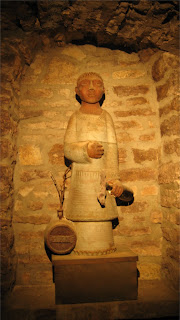
On Friday, we visited the Château de Corton-André, to hear about the wines of Pierre André from Christian Ciamos. He told us first about the yellow tiled roof of the chateau, which had come from Bruges and which was one of few in the area, an emblem of nobility dating back to the power days of the dukes of Burgundy. The château itself had been built on Cistercian cellars: the Cistercian monks were the first vintners of the area and established most of the vineyards and techniques still in use in Burgundy wines.

In the fields, he talked about the moves to organic and biodynamic methods of cultivation that he and other winemakers are making. Basically, he said, it’s a question of respecting nature. Hence the roses still grown at the ends of many vineyards: they are prone to the same fungal attacks as vines and will show evidence before the vines do.
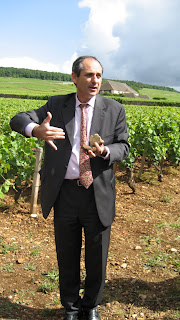
The vines of Pierre André are treated for disease, he said, not the risk of disease, otherwise you kill both the illness and the ecosystem. He and others we’d heard from during the week came back to their incontrovertable truth: that living things that are not routinely treated with chemicals (whether pesticides or antibiotics) are fundamentally more healthy and able to resist disease than those you make dependent on chemical cures. There is again no irrigation in use here: the vines are made healthier by having to sink their roots deep into the soil to find water.

We then retired to the cellar to have a tasting of wines from 2003 and 2004, and picked up an interesting snippet about wine tasting: there are three noses in wine – when it’s just poured in the glass; when it’s been swirled; and when the glass is empty.
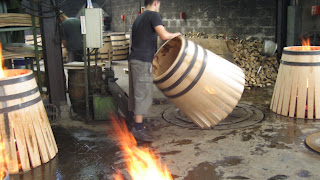
A big excitement later that afternoon was the visit to François Frères Cooperage, where we watched barrels being made. The company makes most of its own staves from lumber purchased at auction, and trims the pieces to size in a small mill on its property. The staves are then aged for two years before being trimmed again and formed into barrels. The most dramatic moment was the toasting, where the half made barrels are placed over fires so that the heat relaxes the wood and flavours it to the specification of the buyer.
Before we knew it, Monday had arrived and it was our last day in France.
We visited Gaugry, a family-run cheese factory near Dijon, to learn about the making of Epoisses. This is one of the soft smelly French cheeses that I’ve never been wild about, but I enjoyed the tastings, and found my favourite of the three we tried was mild, creamy and firm – a much gentler taste than the aroma suggested. It was nice, though not enough to cause me to risk the aromatic integrity of my fridge in Parma by bringing some back with me, but I will look forward to tasting it again one day.
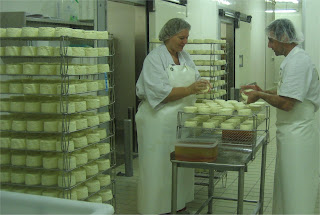
It’s a slow-coagulated, hand-salted cheese that is molded and dried before beginning a month or so of washings several times a week in marc de bourgogne (a wine solution) which gives it the orange colour we know it by.

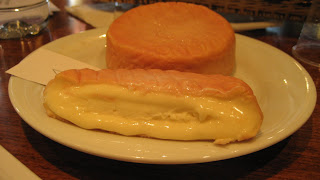
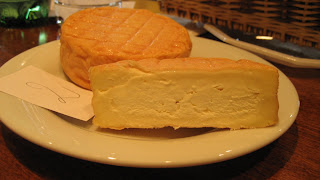
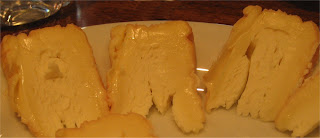
We tried three different versions: two raw milk (one a farmer’s cheese and the other made at the Gaugry factory) and one pasteurised, for markets like the US where raw milk cheeses can’t be sold. A tip for the interested is that pasteurised versions are runnier than raw milk ones, so it’s easy to spot the outsider among these three:
We had a few hours in a very warm room at the top of the Burgundy school of business in Dijon, where Peter Dunn walked us through the massively confusing layers of names and quality marks for Burgundy wines. It was new information to me on the Bordeaux Classification of 1855 and some helpful review of AOC requirements for French wine. It was more on exposure, water, soil, limestone, marl and weather systems, and a bit on pruning and vinification.

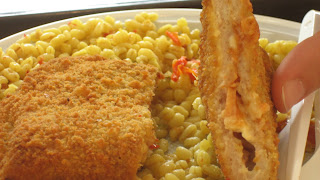
But before that, we were subjected to what may be the worst meal ever served (and not, in most cases, eaten): the cafeteria of the business school in Dijon. Curiously, they were offering this abomination during a student recruitment drive. The first photo was an unidentifiable deep fried something that was described as having a ‘bolognese’ filling; it was served on a mystery grain.
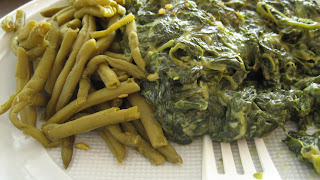
The vegetables had been cooked into some kind of alternate chemical existence; it was as if they had gone beyond their roles as long dead plants into some new and appalling incarnation that could not properly be described as a life form.
It was puzzling to us: why had we been brought here? Was there a learning point in this mealtime? This was not slow food; but neither was it particularly fast, and it was fairly certainly not even food.

When we had completed our close observation and dissection of the substances, and drunk our cups of water, we were directed to a large bin in the corner where everything – the ‘food’, plastic cutlery, plastic plates, paper cups and napkins – were tipped into a plastic-lined void. A perfect finale: this school doesn’t trouble itself with either edible meals or recycling. I wonder what other lessons the business students take away from this place when they graduate.

Burgundy mustard, pork and beaucoup du vin

Wednesday was mustard day. We left Lyon and stopped for a couple of hours’ free ramble round Beaune, looking pretty in the sunshine. The wine museum beckoned a couple of us, and we learned many things, including the six different ways one can drive a vine stake into the ground. Who knew??

After lunch we all trooped into the Fallot mustard mill, which still makes its mustard in the traditional way, using stone grinding. We were surprised to hear that 98% of the mustard seed used in French mustard, including Dijon (which is not a geographical designation, so it can be made anywhere). The Fallot mill makes a Burgundy mustard which has nearly achieved its AOC designation, and which uses only locally grown mustard seed, some of that elusive 2%.

After a tour of the interactive museum and a small tasting, we headed off to Dijon, where we dined near the market at Au Bon Pantagruel on some duck in armagnac sauce that did not linger quite long enough in the pan for most, and had to be wrestled onto the fork, followed by a chocolate mousse that left us wanting, well, a better chocolate mousse.

It’s entirely possible one can have a much better meal there if there are not 25 of you with a block dinner order. Let us hope.

Thursday we went to Volnay, to visit the Chateau de Puligny, where Etienne de Montille took us out to the fields to show us the terroir. His fields are organic, without irrigation, and he looked rather pleased when he said he couldn’t show us any unhealthy plants because they were all doing so well.

We tasted a small and delightful selection before departing to la Ferme des Levees in Lusigny-sur-Ouche.

Born again pig farmer Jacques Volatier told us he’d given up life as an engineer and town planner in order to do something more socially useful, environmentally sound, and agricultural, serving a local market – in protest against the industrialization of food production and long-haul food transportation. So, he raises pigs year round, outside, without antibiotics, and produces pork products on the farm. He doesn’t breed the pigs himself because that would require conformity with EU hygiene regulations which are so strict (like making the farm a war zone, he remarked) they would make it impossible for him to do what he needs to do, which is to show the people who buy his pork where it comes from.

It’s a small scale enterprise, in which he slaughters about three pigs a week, and sells the meat and products at markets and from the farm shop.

We sampled some jambon persille, jambon a la moutarde, pates en croute, gratons, salad and some home made elderflower cordial (he planted the elderflower as shade for the pigs, and began turning it into a saleable product as a sideline), followed by fromage blanc, a bit like cream cheese, from a farmer up the road, served with thick spooning cream and sugar or salt. Kind of like a do it yourself cheesecake, someone remarked.

And off we went to another vineyard, this time the Domaine Dujac, where as we dodged spitting rain and thunder, Jeremy Seysses told us about his vines and wines.

We had a spin round the cave and then he gave us a horizontal tasting of 2001 wines, chardonnay and pinot noir, followed by a special and delectable glass of 1976 pinot.

Thursday night was another free meal, and after a drizzly walk seeing the sights of Dijon, we ended up nearly back at the hotel with our noses pressed to the menu board of Allo Nem, an Asian restaurant – when, like magic, our Taiwanese food guru Andy popped his head out the door and said the magic words: “it’s good!” And he was right.

Crete part 1: snail tales from central Crete


We’ve just returned from a fantastic week on Crete, which I’ll attempt to document by day, with a very selective sampling from the 700+ photos I returned with; best I can do since I can’t share the feeling of being there.

We were hosted by the excellent and encyclopedic Kostas Bouyouris, agronomist and co-founder of the Mediterranean Association for Soil Health, who led us through Cretan food products in an enlightening and hands-on week of visits.

Our first stop was at the village of Kroussonas, where a group of women got together to start a baking cooperative; they now have a kitchen, shop and catering business. Seventeen of them get together to make traditional Cretan pastries and other baked goods, including one of our favourites: fried (in olive oil of course) pastries filled with wild greens.

Also beautiful, beautiful hand-decorated breads for weddings and other celebrations:

There was a pause when a pickup truck laden with vegetables pulled up, and we waited for some of the bakers to do their produce shopping, Cretan style. I thought this was so clever: have one guy in a truck come to the village, instead of everyone in the village driving to the shops.

We pressed on through staggering landscapes

to Gangales, in the south of Crete, to visit the Melko pasta factory where we were particularly interested to watch them make xinohondros, a traditional “pasta” made of cracked wheat, mixed with acidified fresh sheep and goat milk, cut by hand, shaped into portions and dried. It’s cooked with oil, tomato, potato, onion and celery and often with snails, and as it’s a kind of fortified pasta-cum-thickener, is one of the foods served during periods of religious fasting.

We had a tart and nourishing soup made from this pasta for supper, followed by many other traditional dishes including a platter of boiled goat.

Day two began as had day one, with luscious bowls of fresh yogurt, honey, bread, sesame halwa and strong coffee. We trooped upstairs to have a talk from another inspiring Cretan agronomist, Sotites Bampagiouris, who talked us through the enterprise known as Bio Forum, a ten-year-old economically viable organic farming enterprise.

A marvel of thrift and economy, Bio Forum creates composting heaps made of olive leaves (by-product of the olive harvest), and straw bales from mushroom cultivation, among other organic matter. They don’t use manure for these since the compost is used on vegetables and would therefore come into direct and possibly dangerous contact with food; manure can be used for composting fruit trees.

Seeds are nurtured in greenhouses and then transplanted when they are big enough to stand up against the weeds and insects.

Weeds are not automatically seen as enemies in this field: they act as wind screens, provide a refuge for insects that would otherwise head for more edible homes, help to create an anchor for topsoil through their root systems, and act as natural compost when the soil is turned after harvest. These greens were plump, spicy and delicious; members of the mustard family are particularly useful in areas where soil is compacted as their roots help to break it up, and provide salad greens while they’re at it.

After an organic fruit break at the farm, we zipped off to the Boutari winery, Fantaxometocho (“domain of the phantoms”), for a tour and lunch. The Cretan operation is only three years old, although the mainland company has been going since 1879. On Crete, the vinyards are totally organic, and, even more shocking to me, the vines are grown without irrigation. They say this makes for a lower yield, but a better wine since the plants produce healthier, sweeter grapes with more concentrated aromas; irrigation plumps the grapes up but also waters down the contents. Their late harvested grapes produce a delectable sweet wine which we were lucky enough to sample at lunch.

On the way to our new base in the Amari valley, we stopped for a retail moment in one of the Bio Forum outlets in Iraklion; Don samples a little cheese with basil.

Supper at Aravanes taverna where we began with a salad of lettuce and wild greens, fresh cheese, olives, bread… and went on to have tart rice, lentil stew and more boiled goat.

We finished with baklava we had brought from a pastry shop which we were to return to the next day for a cooking demo. More than ready for bed we crashed….

Exam shazaam & Vinitaly

I read somewhere that on this day in 1755, Jean-Anthelme Brillat-Savarin was born in France. He wrote The Physiology of Taste, about the pleasures of food, published in 1825 when he was just 69. I should like to add that a couple of centuries later, on this day in 1955, my dear departed parents were married; it was their enduring joke on the world to elope on April Fool’s day. The last anniversary they celebrated was their 46th, shortly after my return to Canada in 2001.

We wrote our much anticipated food technology exam on Friday which got me thinking, as I perused my notes in the lead-up, about how learning really takes place, particularly in an aging and over-full human brain. The information actually retained probably had more to do with affection for the instructor than interest in the subject. For example I’m not sure, having supposedly completed the course, that I even know what is meant by the term sensory analysis; my understanding of the term is all tangled up in my enduring incomprehension about statistical methods which appear to have been the main topic under discussion (for many reasons it was hard to know really what in that class was being discussed). On the other hand, I feel sound in my understanding of olive oil technology which included harvesting and milling operations as well as chemical make-up and regulatory issues around extra-virgin olive oil. Reading my notes again brought the pleasures of the class back to mind in a way that doesn’t normally happen, I think.


Our much-loved instructor in that class, Sandro Bosticco, who had also led us gently, kindly and knowledgeably through a couple of wine tasting classes last week (one of which I wretchedly had to miss, felled by another short-lived stomach bug), reappeared to lead us through the terrifying expanse of the Vinitaly show yesterday, which also features an olive oil exhibition, Sol. He took us through an oil tasting at a producer who was promoting a high quality blend of extra-virgin olive oils, called Gemini, which successfully combined the punch of Tuscan with the flavours of Sicilian. He then led us back into the Tuscan wine pavilion where we sampled some Vino Nobile di Montepulciano. Which of course is not to be confused with wine from the Montepulciano grape, as earlier explained by our Montepulciano-growing friends in Le Marche).

The rest of the day was an exhausting but pleasurable tour of a few select producers under the wing of our campus director, Carlo Catani, no slouch in the wine area himself, particularly when paired with another distinguished varietal, the university’s director Vittorio Manganelli. We lunched in the Puglian pavilion and saw again our old friends orecchiette and agnello, but the best thing on my plate was the starter, a lovely little timbale of melanzane bathing in a pool of fresh tomato sauce and jauntily garnished with shreds of cheese and a chapeau of basil leaf.

Would you go to a wine tasting in this pavilion?