Skip to content

pigs

Terra Nossa Farm tour
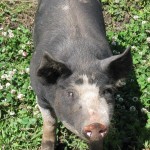
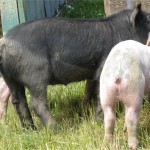
Berkshire PigLast Sunday I got down and dirty with the Victoria Horticultural Society’s Fruit & Vegetable Group, whose monthly meeting was a tour of Terra Nossa Farm. I’d often bought eggs or sausages or chicken from Evelyn, who commands a loyal queue each Saturday at Moss Street Market, so I was delighted to have a chance to see the farm she runs with her husband Jesse.

Labour of love about sums it up here. Jesse says of their pigs that they live their lives in Berkshire pigsheaven, and then they die. They’re fed organic grain, fresh greens and roast sweet potatoes grown on the farm. Ten of their Berkshires, purchased as piglets from Tom Henry (there are very few organic pig breeders, Evelyn remarked), were nearing their slaughter date, and were out frolicking in a field of greens. They came to greet us, flapping their enormous eyelashes and making us question who was looking at whom. I’ve been on pig farms before, and never have I been to one where there was not a whiff of stink: they have plenty of room to run and play, and shelters provided for both summer and winter comfort.
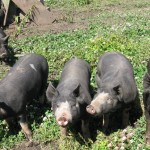
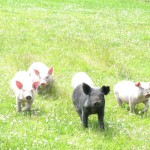
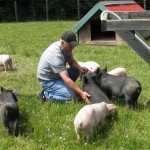
Terra Nossa pigletsJesse Perriera, Terra Nossa Farm, with pigletsTerra Nossa piglets-docked and undocked tails


There were some piglets in another field: two varieties, black mule pigs (sourced from Lasqueti Island) and some Tamworth cross pigs bought from a commercial operation in Alberta. The white pigs were very skittish at first and prone to scattering when Jesse approached, but with patience he has been able to get them to become a bit more pig-like, curious and friendly. The white ones’ tails had been docked by the breeder, a common practice where they are kept in such overcrowded conditions they are likely to gnaw on their neighbours out of stress or for lack of anything better to do. Evelyn said they hadn’t checked their teeth but these were likely clipped as well, for similar reasons.
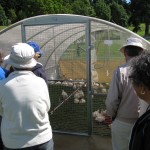
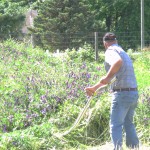
Terra Nossa meat birdsThe chickens are treated kindly at Terra Nossa as well, although in the case of the meat birds, this happy life is a short one. They are purchased as chicks from a commercial breeder, so they have, as Evelyn put it, had most of the chickenness bred out of them. They’re sent to slaughter at around 8-9 weeks (commercial operations only keep them half that time); they can’t be allowed to get any bigger because the way they’ve been bred means their bodies become too large for their legs to support them and they start developing painful injuries. Jesse was out scything some fresh vetch for theJesse Perriera, Terra Nossa Farmm, which they love, and they seemed to be enjoying the commodious chicken tractor, a top-of-the-line pen that keeps them shaded from the sun and lets them enjoy the view, the breeze, and the tasty snacks being delivered at regular intervals. And the tractor is an easy structure to move, which is the most important feature.
The Perrieras are choosy about where they sell their chickens. They’ve become disillusioned with restaurant sales, having experienced situations where chickens were sold to restaurants who put their farm’s name on the menu and then ceased buying from them. So now they limit their sales to the farm gate, the farmers markets they attend (Moss Street in the summer and the Downtown market in the winter), Ingredients Health Food and local food promoters Share Organics.
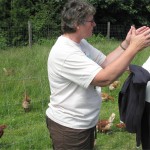
Terra Nossa Farm, Evelyn PerrieraThe laying hens have a nice big area to run in, and produce enough eggs to supply Moss Street Market, Origin Bakery, Terra Nossa’s farm shop and Share Organics. I noticed that they still peck one another’s tails – I suppose they are  just too numerous, and a few are lost from time to time to the bald eagles we saw circling during our visit. The farm has a license allowing them to keep 399 laying hens (the limit on small producers without such a license is 99 birds) but Evelyn says they won’t be renewing that. New rules are coming in that would mean the small producers with 399 layers would be forced to adopt the same biosecurity measures as industrial producers (meaning no more farm tours, for one thing); would not be allowed to let their chickens run outside on pasture as they do now; would not be allowed to raise meat birds as well as layers; would have to invest in impossibly high-cost equipment and potentially upgrade facilities for inspection. We would not have been allowed access to the farm without suiting up, for example. So the regulatory club is still swinging directly and heavily at small producers and forcing them out of the very markets where they are needed and appreciated.

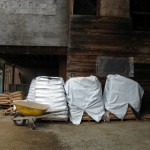
Evelyn & Jesse are acutely aware of their dependence on imported livestock feed, since Feed supply for Terra Nossa livestockthere is no organic feed producer on Vancouver Island, they must have it shipped from the mainland by ferry. Like any Islander who thinks about food security, they are conscious of the fragility of their supply, so they try to keep a reasonable reserve in store. Because organic feed is more expensive than conventional, this means quite a substantial capital outlay, at about $1000 a pallet.
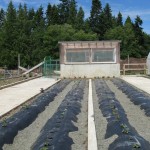
Terra Nossa sweet potatoesTowards the end of the tour we had a look at the sweet potatoes bravely growing under black plastic mulch. They were planted out in March, but the weather has been so chilly that they are not thriving, although with luck the summer heat should kick in and move them along. At the end of the rows is the winter pig barn, where the porkers can loll about enjoying the roasted sweet potatoes the Perrieras prepare for them (many of the larger sweet potatoes are considered unsaleable, so they go to the lucky pigs).

We can’t believe…

How did it happen? A year flits by and all of a sudden it’s tearful farewells and no more pig farms, Unisg cheers, bus rides, charter airlines, wine tastings… how will we cope in the months to come?

The final week shaped up kind of like last week’s, commencing with an exam and then moving swiftly through food marketing, journalism and a great big party. We had lunch on a riverboat on the Po


(photo from Andy)

with Carlo Petrini and our university staff and dignitaries.

After the food we had a little wisdom from the brow of Petrini,

and then some goofy awards and another gem of a slideshow (so there WAS a reason for taking those – must be literally millions of frames – cameras everywhere we turned all year) by our animators Don and Marta.

Next stop was Polesine Parmense, where we revisited the scene of last winter’s visit when we learned about culatello di zibello.


(Photo from Andy)

We were attending the annual Spigaroli Awards (to local food heroes of various kinds) at the beautifully refurbished Antica Corte Pallavicina, which was about half finished on our last visit. It’s now ready to roll as a swanky agriturismo for visitors who want a short and scenic walk to their dinner at Al Cavallino Bianco.

But on Wednesday tables had been set up around the perimeter of the courtyard and the Spigaroli brothers, Massimo and Luciano, were busy seeing to the comfort of their hundreds of guests. The hay bale corral in the middle holds a flock of black piglets who made up part of the award, one for each recipient: the Spigarolis would raise, slaughter and cure them, so the prize – in good Slow Food form – would be years in the making. We had some wonderful culatello, of course, including two kinds made from white and black pigs, each culatello aged 36 months.

And a wonderful tortelli in brodo with some exquisite cheese filled pastas in a light and warming broth – bliss to be in the cooling air eating such things. Fortified, the guests then enjoyed the awards ceremony, which included a special prize for Carlo Petrini.

And then it was the last couple of classes – marketing and wine tasting from Matteo Baldi, journalism from Clodagh McKenna, the last lunch together,

the last bus home,

the last visit to Tabarro,


rounds of signings (our brand new copies of Slow Food Nation, serving as school autograph albums)

and some emotional farewells…

Burgundy mustard, pork and beaucoup du vin

Wednesday was mustard day. We left Lyon and stopped for a couple of hours’ free ramble round Beaune, looking pretty in the sunshine. The wine museum beckoned a couple of us, and we learned many things, including the six different ways one can drive a vine stake into the ground. Who knew??

After lunch we all trooped into the Fallot mustard mill, which still makes its mustard in the traditional way, using stone grinding. We were surprised to hear that 98% of the mustard seed used in French mustard, including Dijon (which is not a geographical designation, so it can be made anywhere). The Fallot mill makes a Burgundy mustard which has nearly achieved its AOC designation, and which uses only locally grown mustard seed, some of that elusive 2%.

After a tour of the interactive museum and a small tasting, we headed off to Dijon, where we dined near the market at Au Bon Pantagruel on some duck in armagnac sauce that did not linger quite long enough in the pan for most, and had to be wrestled onto the fork, followed by a chocolate mousse that left us wanting, well, a better chocolate mousse.

It’s entirely possible one can have a much better meal there if there are not 25 of you with a block dinner order. Let us hope.

Thursday we went to Volnay, to visit the Chateau de Puligny, where Etienne de Montille took us out to the fields to show us the terroir. His fields are organic, without irrigation, and he looked rather pleased when he said he couldn’t show us any unhealthy plants because they were all doing so well.

We tasted a small and delightful selection before departing to la Ferme des Levees in Lusigny-sur-Ouche.

Born again pig farmer Jacques Volatier told us he’d given up life as an engineer and town planner in order to do something more socially useful, environmentally sound, and agricultural, serving a local market – in protest against the industrialization of food production and long-haul food transportation. So, he raises pigs year round, outside, without antibiotics, and produces pork products on the farm. He doesn’t breed the pigs himself because that would require conformity with EU hygiene regulations which are so strict (like making the farm a war zone, he remarked) they would make it impossible for him to do what he needs to do, which is to show the people who buy his pork where it comes from.

It’s a small scale enterprise, in which he slaughters about three pigs a week, and sells the meat and products at markets and from the farm shop.

We sampled some jambon persille, jambon a la moutarde, pates en croute, gratons, salad and some home made elderflower cordial (he planted the elderflower as shade for the pigs, and began turning it into a saleable product as a sideline), followed by fromage blanc, a bit like cream cheese, from a farmer up the road, served with thick spooning cream and sugar or salt. Kind of like a do it yourself cheesecake, someone remarked.

And off we went to another vineyard, this time the Domaine Dujac, where as we dodged spitting rain and thunder, Jeremy Seysses told us about his vines and wines.

We had a spin round the cave and then he gave us a horizontal tasting of 2001 wines, chardonnay and pinot noir, followed by a special and delectable glass of 1976 pinot.

Thursday night was another free meal, and after a drizzly walk seeing the sights of Dijon, we ended up nearly back at the hotel with our noses pressed to the menu board of Allo Nem, an Asian restaurant – when, like magic, our Taiwanese food guru Andy popped his head out the door and said the magic words: “it’s good!” And he was right.

Le Marche – Our Day of Pork


View from a Trattoria.

The topic of vegetarianism has been well discussed by all of us on this pork-fest we call food school. This is repeatedly no course for vegetarians; even as the borderline veggies among us are starting to scramble back to the clean side of the line, the omnivores are talking more and more obsessively about vegetables, between bites of whatever part of the pig we’re eating this meal. It was all taken to extremes on Wednesday when we had a food history lecture on pork, followed by a bit of salumi, followed by a six course meal of… pork.


Salumi, including (I hope I have these right): Ciavuscolo, a soft, spreadable salami flavoured with garlic; Salame di Fabriano, a knife-cut salami with whole peppercorns; and Testa in Cassetta, or head-cheese, this one including olives and almonds.

The lecture, by Prof. Hermes Ercoli, Università degli Studi di Macerata, took place in the breathtaking (view as well as temperature, which slowly plummeted through the afternoon) hilltop setting of Trattoria Damiani e Rossi.


First course: Filetto di maiale farcito con il suo fegato e pistacchi, salsa di bergamotto (the bergamot is what looks here like lemon rind but tastes like, well, Earl Grey tea!)

We watched the sun set over the Sibilline Mountains while we heard about the pig’s rise and fall in myth, religion and practical matters of the table (an excellent post-script for me, having listened only last week to Barbara Klar’s similarly broad-ranging treatment in Swine Before Pearls on CBC).


Second course: Maccheroni con il sugo delle costine.

We heard about the ‘intolerance soup‘ made of pork that was served in a far-right sponsored soup kitchen in Paris only last year, which sought to divide the hungry – through religious dietary observance – into the ‘real French’ and those who the group sought to exclude through a culture of food.


Third course: Zuppetta di trippa di mailale con fagiolina del lago Trasimeno (tripe soup: who knew it could be so delicate?)

Then on to the pig’s misfortunes which begin in etymology, its name tangling with the human body in Latin languages; in Italian, porco/corpo; in Latin, porcus/corpus; in French, porc/corp; and so on.


Fourth course: Polenta con sangue di maiale al profumo di arance. (Blood flavoured with oranges; we couldn’t quite work out, even after eating, which part was blood)

A forest-dwelling creature, and one whose diet makes it a competitor for food with a hungry human population, the pig’s fortunes suffered with the historical rise in agriculture and the reduction of its habitat. And religion stuck its oar in. St. Clement of Alexandria bad-mouthed it for its omnivorous and unwholesome appetites which might contaminate those who ate it with similar behaviours, and advised that a pure life is one without pork. Unfortunately for believers in pure theory, at the end of the Roman Empire, with Goths battling the Byzantines all over Le Marche, the area suffered a 98% reduction in its population, with whole villages committing suicide in times of imminent starvation. So the hungry inhabitants turned back to more practical pagan worship which at least allowed them to eat something that was gaining ground as the forest began to reclaim agricultural land.


Course five: Sella di Maiale arrostita con castagne e tartufo nero (with —ahh, even a bit of crackling, Italian style).

Needing to restore control, the pragmatists in the Christian church had to think of something. In accordance with the long tradition of Christian colonisation of pagan festivals, Feriae Sementivae, the winter feast of Ceres (Cerere / Demeter), the Roman goddess of grain, to whom swine were sacrificed, morphed into the feast of St. Anthony, who picked up the Christian thread and became friend to swine. At his feast there might be blessing of the animals, or the serving of bread, the crumbs of which would be taken home for the animals.


And finally, dessert: Savarin con gelato di pistacchi salata (as far as we could see, pork-free, but I’m not betting my life on that)

There is much more pig mythology we didn’t get into, and much more to say about pigs in general than can be reported here, but our speaker left us with a few tantalising thoughts: pigs helped us to reinvent our world, he suggested; should the American flag not more appropriately feature the hot dog rather than the stars or stripes?

Pig Week

Piggish in many ways. Started it off by snuffling and snorting my way through yet another cold. Surprised myself by getting up at 6.05 am on Tuesday to listen to Barbara’s Ideas program on pigs. And (thanks Gloria) enjoyed learning this was British Bacon Education Week. And of course we’re into the first week of the Chinese Year of the Pig, which the class will celebrate tonight, noses firmly in the trough, with a big Asian feed (thanks in advance Amy, Andy et al). One day perhaps I’ll get to the Bongseong Charcoal-broiled Pork Festival, or perhaps the Ballyjamesduff International Pork Festival, or one of the many American pork festivals: the Spamarama in Austin, TX sounds worth avoiding though. And if you want to see what 200 calories of bacon (and lots of other things) actually looks like on the plate, check out these pictures.

A year ago already

So, it’s been a year since the Iambic Cafe revealed itself – and my evolving involvement with the staples of life: food and poetry. What can I say: the journey continues.

One of those present at the writers retreat where it all began was Barbara Klar, whose Ideas radio program Swine Before Pearls is about to hit the airwaves (February 19, 9:05 pm, CBC Radio 1 – or however that translates for internet transmission in time zones other than Canadian ones: I think we’ll have to be tuning in during the wee hours of the 20th here in Europe). She’s going to explore the connection between our food animals and our own mortality, as we tip over into the Chinese Year of the Pig. It sounds promising.

Me, I’m also impatient to see Barbara’s new poetry collection which is due out from Brick Books — next year? Having heard a few of the poems as they wended their way onto the page, I know it will be more than noteworthy. So the conjunction of food and poetry is present everywhere, not just in my life. And speaking of Brick, another book I’ve been waiting for seems to be busting over the horizon: Lorri Neilsen Glenn‘s Combustion.

Here’s some food I’ve been enjoying now, mid-winter, when fresh vegetables and inspiration might seem at their lowest:

Celery and Apple Soup
(about 4 servings)
1 tbsp butter or oil
2 medium onions, peeled and diced
4-5 stalks fresh celery, including leaves, diced
1 medium potato, peeled and diced
2 large cooking apples, cored and chopped
4 cups vegetable stock
Salt and pepper
1 tsp brown sugar
1/4 cup fresh chopped parsley
1/4 cup Greek (or full-fat plain) yogurt or 1/4 cup heavy cream
Crumbled stilton or gorgonzola; or grated fresh parmigiano-reggiano; or freshly made croutons; or toasted almonds, to finish

  • In a large saucepan sweat the diced onion in the butter until transparent. Add the celery and potato to the onion and continue on a low heat for about 5 minutes.
  • Add the apple and heat through, another 5-10 minutes.
  • Add the stock, seasoning and sugar.
  • Bring to the boil, then simmer, covered, for 30 minutes. Stir in the parsley.
  • Allow to cool a little before liquidising thoroughly, and then pass it through a sieve.
  • Check seasoning and consistency, adding a little milk or broth if needed. Stir in about yogurt or cream, and crumble or grate one of the cheeses into the soup, or top with croutons or toasted almonds.