Skip to content

poetic form

Fry on Form and Anchovy Amnesty

A book that has, I’m told, not received the best of reviews lies open by my chair these days, and I’m enjoying it so far. The Ode Less Travelled is Stephen Fry’s guide to Unlocking the Poet Within. It’s a manual of metre, rhyme and form by someone who writes privately himself:

“I do not write poetry for publication, I write it for the same reason that, according to Wilde, one should write a diary, to have something sensational to read on the train.”

(If only we Canadians had trains to read on we might be better poets and diarists…?) He quotes Auden on the difficulties of writing free verse:

“The poet who writes ‘free’ verse is like Robinson Crusoe on his desert island: he must do all his cooking, laundry and darning for himself. In a few exceptional cases, this manly independence produces something original and impressive, but more often the result is squalor – dirty sheets on the unmade bed and empty bottles on the unswept floor.”

Lynne Rossetto Kasper has certainly produced something original and impressive in The Splendid Table, her 1992 guide to the cuisine of Emilia-Romagna, the Heartland of Northern Italian Food. Interesting and unusual recipes, including this pasta sauce (which I have only slightly tweaked) which she says comes from the cooks of Modena’s and Ferrara’s Jewish communities. It features a substance unfairly despised and misunderstood in North America: the amazing anchovy. Be not afraid, and you will be fed.

Lemon Anchovy Sauce (Bagnabrusca):
2 2-oz cans anchovy filets
1 cup cold water
6 tbsp extra virgin olive oil
1 large clove garlic, minced
1/2 cup water
2 large fresh tomatoes, peeled, cored and chopped
6 tbsp minced flat-leaf parsley
3 tbsp fresh lemon juice
Freshly ground black pepper to taste.

  • Rinse the anchovies and soak them in the cup of cold water for 10 minutes. Drain and coarsely chop.
  • In a 12-inch heavy skillet, heat the oil over medium heat. Add the garlic and saute until faintly golden but not brown.
  • Add the parsley and anchovies and heat briefly, 30 seconds or so. Immediately stir in the 1/2 cup water and cook over low heat about 2 minutes, until the anchovies melt (isn’t that the coolest thing??).
  • Blend in the tomatoes and lemon juice, raise the heat to medium, and cook 1 minute.
  • Generously season with black pepper and scrape the pan over hot drained pasta – tagliarini is recommended. Toss to coat. Sprinkle with a further tablespoon of chopped parsley and serve (without parmesan or other cheese).

London in the sun

I’ve been checking London’s pulse and it’s still bashing away long into the night, particularly hot steamy nights as we had last weekend. That got the sirens going late into early. The plane trees are in full leaf, the sidewalk cafes are heaving and the natives are unveiling the precise pearly shade of the Anglo Saxon post-winter skin, at least the Anglo Saxon natives are. And it’s football madness of course, as the World Cup draws alarmingly near.

But down in the cellars of the Troubadour on alternate Mondays, all is reassuringly still poetry (not to mention accordion music by mega award winning poet C.L. Dalat). This week’s ensemble was Sans Frontieres I, “celebrating the breadth of contemporary European poetry”. First up was Valeria Melchioretto, born in German-speaking Switzerland to Italian-speaking mother and writing compelling poetry in English. Nisia Studzinska was also very fluent, not surprising with her UEA MFA out of the way. Polish born Maria Jastrzebska was raised in Britain and read from her third poetry collection, Syrena, and some new poems as well. Practically a British literary landmark herself, Lotte Kramer has just published her tenth collection, Black Over Red, with Rockingham Press and read us the title poem (about Mark Rothko’s paintings) as well as some of her signature pieces drawing on her German heritage and dramatic pre-war move to London in 1939.

Andras Gerevich was quite a showstopper. Hungarian, he’s lived in five countries and though fluent in English, writes still in Hungarian. He had interesting things to say about translation. He likened it to a favourite recipe (my ears perked right up) which in the hands of a dear friend may produce a similar dish to the one you love, but it will taste different. Likewise he says, although he’s blessed with excellent translators (including no less than George Szirtes) he doesn’t recognise the translations as his own words, so much: the meaning may be right but the prosody is off, for example, and there’s nothing you can do. Start changing the words, he says, and you violate copyright. He remarked as well that because Hungarian is a genderless language, his love poems in his native tongue were androgynous, which had always grieved his gay friends, and he was bemused to discover his poetry had been outed by the English translations, where “he” vs “she” had to be specified.

On Sunday I visited another of my many spiritual homes here, the London Review of Books Bookshop, near the British Museum, where Marilyn Hacker was speaking about form in American poetry. The talk attracted a hearteningly full room despite the £9 ticket price and the perfection of the weather. Hosted by Fiona Sampson, Hacker was flanked and cheered by a good audience of local formalists which included George Szirtes, Mimi Khalvati, and Ruth Fainlight. To me, her most interesting comment was that she preferred form because she never knew where the poem would take her within its constraints: “the collaboration of form and language will take me somewhere freer than free verse, where the conscious mind has to tell you something.” She also observed that “rhyme is fun, but meter is the skeleton” and concluded the afternoon with a short reading from Squares and Courtyards ( a couple of complicated 15 line sonnet-like paragraphs whose form was invented by and results dedicated to Haydn Carruth) and Desesperanto (“Talking to Apollinaire”) .

Afterwards I joined Meli and friends for supper at The Duke, a gastro-pub in Clerkenwell. Meli’s pea pancakes were quite amazing – literally green peas within a pancake, topped with haloumi cheese and sweet roasted tomatoes, garnished with shallot marmelade.

More from the half read library, and turmeric

I was reading Adrienne Rich’s collection of essays, What Is Found There: Notebooks on Poetry and Politics. I thought she gave a very cogent summary of issues around form:

“Poetic forms – meters, rhyming patterns, the shaping of poems into symmetrical blocks of lines called couplets or stanzas – have existed since poetry was an oral activity. Such forms can easily become format, of course, where the dynamics of experience and desire are forced to fit a pattern to which they have no organic relationship. People are often taught in school to confuse closed poetic forms (or formulas) with poetry itself, the lifeblood of the poem. Or, that a poem consists merely in a series of sentences broken (formatted) into short lines called “free verse.” But a closed form like the sestina, the sonnet, the villanelle remains inert formula or format unless the “triggering subject,” as Richard Hugo called it, acts on the imagination to make the form evolve, become responsive, or works almost in resistance to the form. It’s a struggle not to let the form take over, lapse into format, assimilate the poetry; and that very struggle can produce a movement, a music, of its own.”

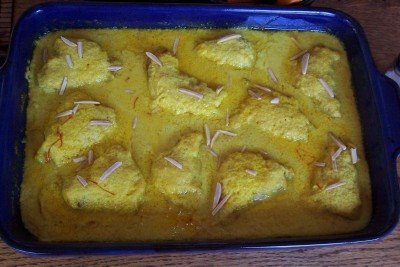
Last night’s dinner was Saffron Chicken. Very smooth, complex sauce, bright yellow from the turmeric, thickened, and slightly crunchy, with ground almonds. An excellent recipe which can be made well ahead of events and heated up when needed.

Turmeric may be the new snake oil. In recent years it has gained new currency as an anti-arthritis wonder food under the name of its active ingredient, curcumin. Long used as a food colourant and fabric dye (though it fades), it has been reported to be an anti-inflammatory and an anti-cancer agent; a cure for jaundice, indigestion, kidney stones, dysentery, sexually-transmitted diseases, cystic fibrosis, diabetes, stomach and liver ailments including Crohn’s and inflammatory bowel disease; even a preventative for Alzheimer’s disease and cardiovascular problems, and a treatment for poor vision. Externally it is used to heal sores and inflammations, including itching, Herpes, psoriasis, chickenpox and smallpox; as a depilatory, a cosmetic and to counteract aging processes. And as we saw in the movie Water, you can rub it on hotheads to cool them down!

Haiku, shrimp dumplings and weird Weight Watchers cards

Want to talk Haiku?
Petals fall on Vancouver.
Poets everywhere.

The annual Haiku Canada conference will be held in Vancouver over the Victoria Day weekend in May (19th -22nd) at UBC. Check the website for more information.

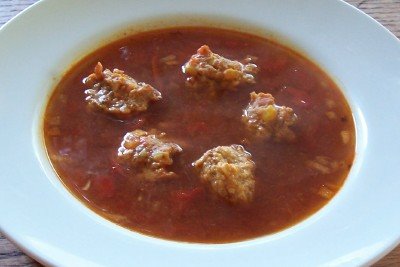
Last night I thought I’d try something that looked long and involved, but wasn’t as complicated as I’d thought: Sopa de albondigas de camaron from the excellent Coyote Café Cookbook. I had embarked on the whole sordid exercise because I lost my head in Austin and came back with a bag of dried ancho chiles from the wondrous larder of Farm to Market Grocery and happened to have chipotles in adobo sauce in my cupboard for some puzzling reason.

The soup was, to my tender northern palate, very hot (spicy) indeed. Personally I would reduce both the number of chipotle chiles and the cinnamon/canela, which seemed to overwhelm the delicate little dumplings in a somewhat aggressive way. I found another recipe for this dish which has slightly simpler ingredients, no cinnamon, and a much milder chile content. Anyway, what I made was delicious once my tastebuds got over the shock: the burn became agreeable, and the broth was tart and tasty; the dumplings tender and plump with contrasting flavours and texture. I was – fortuitously rather than strategically – wearing red when I ate it; otherwise I would have needed a bib to avoid the sartorial staining I could see was coming when I pureed the deep red ancho, which added more colour and flavour than heat; it was the chipotle chiles that set the thing on fire.

And now for something rare and amusing from the darkest recesses of Weight Watchers history. Bonnie sent me this yesterday. Read all of them if you dare. Strange and frightening foods; more interesting and oddly coloured food photographs than you ever imagined possible, with many interesting and perplexing props. And great commentary.

Back to poetry

I’ve been preoccupied with food lately so time to think a bit more about poetry. My cyber scouts have been sending me interesting things to read, so I thought I’d share.

Mary felt I needed to know about the not-quite-yet-born Quarterly Journal of Food and Car Poems, from Washington state, which is seeking form poems for its first issue, and provides a nicely photographed sonnet to a steak for inspiration, as well as a handy list of links to Wikipedia definitions of allowable forms.

And Nancy has been reading the well-endowed (in the most fully figured meaning of that phrase) website of the Poetry Foundation, which is an excellent site and one I hadn’t visited before. She also found an online version of the article on rhyme, meter, stanza and pattern that appeared in a recent issue Poetry Magazine, by George Szirtes.

And as for me tucked up with my million books on poetry, I was reading again a few comforting passages from my heroine Maxine Kumin’s delightfully readable and charming collection of Essays on a Life in Poetry, Always Beginning. In a 1996 interview included in the collection, she was asked about the process of writing a novel on a typewriter, which she began using a very literal cut and paste method, so she had the first page scrolling across the room before she inserted her second page. She was asked if she thought computers had changed the surface or shape of prose, and she replied

“Oh I know it has…It’s dangerous! It corrupts you in midpage because it’s so easy to insert and delete that you take a lot of wrong turns… I’m not really comfortable yet with the computer. I use it for prose, a little warily, and then I print things out and make a lot of changes by hand, and then I go back and put them in.”

Just so. I like to print poems out and write on them (with dates!!) so that I don’t lose those speculative changes. I rarely go back to previous versions, but it can be helpful to have them if I get myself completely messed up. I find the Version Control feature in Word cumbersome and not really workable for me, but on the other hand, just pressing the Save button pretty much obliterates your editing history. Literary researchers of the future should have an interesting time of it.

Have a look at this site if you’re interested in editing history; it shows four manuscript versions of Wilfred Owen’s Dulce Et Decorum Est, and I seem to recall reading we don’t know which was his own finished version, so in anthologies etc. you will find one or some variation on these. To view each draft full-screen, choose right-click a manuscript “button” (A, B, C, D) and choose Open Link in New Window.

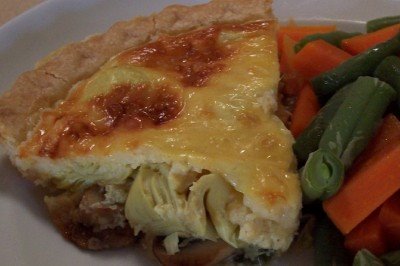
Mary wanted to see what I was having for supper last night. It was a mushroom and artichoke quiche from the Steinbeck House cookbook. The crust is supposed to be made with crushed saltines and sauteed mushrooms and butter (chilled till firm), and then you put lightly cooked green onion and chopped canned (not marinated) artichoke hearts on the base, cover with monterey jack cheese and pour on the filling, made with eggs, cream and cottage cheese, pureed with cayenne and paprika.

Chicken salad and the mysteries of poetic craft

In a weak moment I bought one of those pre-barbecued chickens, basted in salt and lathered with a toxic red substance. Still, it left me with enough cold chicken for a good old chicken salad, a food that – like tuna casserole – was mysteriously absent from my upbringing and which I have embraced in later life. Here’s a perfectly straightforward recipe, based on one from the Fanny Farmer Cookbook:

2 cups cooked chicken, skinned and chopped
1 chopped green onion
1 rib celery, chopped
1/2 cup mayonnaise
2 tbsp plain yogurt
1 tbsp wine vinegar
Salt and ground pepper to taste

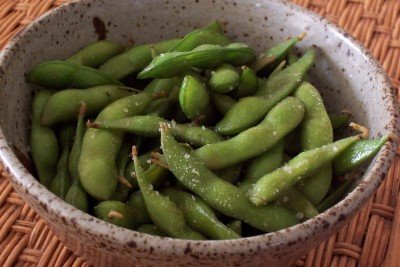
Combine mayonnaise, yogurt and vinegar and blend well; add seasonings. Toss chicken, onion and celery with dressing until well mixed. Serve as a salad, on a bed of greens, or as a sandwich filling, on toasted English muffins. Why mess with simplicity? Have it with a lovely bowl of Edamame, drizzled with sesame oil and dusted with salt.

It hardly needs saying that Mark Strand is not a chicken, or a salad, nor even simple, but interesting to know he is Canadian-born (PEI). I first came across his name as co-editor (with Eavan Boland) of the form poetry anthology, The Making of a Poem. He’s also published a handy little book of essays on poetry called The Weather of Words. I’m finding it heavy going, but there are always moments in any such collection, and so I soldier on. I thought this, from the start of Notes on the Craft of Poetry, was an interesting take on it:

“Each poem demands that I treat it differently from the rest, come to terms with it, seek out its own best beginning and ending. And yet I would be kidding myself if I believed that nothing continuous existed in the transactions between myself and my poems. I suppose this is what we mean by craft: those transactions that become so continuous we not only associate ourselves with them but allow them to represent the means by which we make art… To a large extent these transactions I have chosen to call craft are the sole property of the individual poet and cannot be transferred to or adopted by others. One reason for this is that they are largely unknown at the time of writing and are discovered afterwards, if at all.”

He quotes Orwell’s rules of good writing, and questions whether these or any rules can really be applied to poetry: “For the poems that are of greatest value are those that inevitably, unselfconsciously break rules…”

His argument against craft is that it cannot work as a defining or diagnostic concept, because poetry “cannot be understood so much as absorbed.” He seems to be an advocate for mystery, arguing that we not attempt to impose a structure on the process of creating poems, because to do that is to imply a common purpose for poetry, which it eludes, because a poem’s purpose “…is not disclosure or storytelling or the telling of a daydream; nor is a poem a symptom. A poem is itself and is the act by which it is born. It is self-referential and is not necessarily preceded by any known order, except that of other poems.”