Skip to content

quiches

Mocambo and smoked salmon

Went to Mocambo last night where Tanis MacDonald and Elizabeth Bachinsky were on the bill. She’s touring the east with a pair of poets, Michael V. Smith and Jennica Harper, who also made an appearance, as did local and seldom seen poet/novelist Steve Noyes.

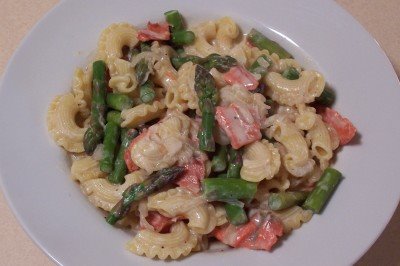
Meanwhile I had been meditating on how to use up some of my smoked salmon, left over from the great smoked salmon cheesecake enterprise of ’06. I settled on smoked salmon quiche, and last night’s Smoked Salmon Penne with Pepper Vodka which I made with cresta di gallo instead of penne, because I think it’s a pasta of much greater character. Right up there with my favourite, the aptly named radiatore. Here’s a low-ish fat version of that quasi-Russian pasta dish:

3 cups penne
1-1/2 tbsp olive oil
1/2 cup shallots, minced
3 tbsp white wine
1 c fish stock
6 tbsp low fat sour cream
6 oz smoked salmon, flaked or chopped
1 c cooked asparagus or sugar snap peas, in 1-2″ pieces
1-2 tbsp pepper vodka
Cook the penne until al dente, about 8 minutes. Drain and rinse and drain again.
Meanwhile, cook the shallots in olive oil until soft but not brown, about two minutes. Add the wine and bring to a boil. Add the broth, sour cream and some ground pepper; bring to the boil and then reduce, stirring constantly, until it has a thick, gravy-like consistency. Add the smoked salmon and simmer a couple of minutes. Add the vegetables and heat through. Remove from the heat, stir in pepper vodka and season to taste. Mix in the penne, heat gently and then serve.

Back to poetry

I’ve been preoccupied with food lately so time to think a bit more about poetry. My cyber scouts have been sending me interesting things to read, so I thought I’d share.

Mary felt I needed to know about the not-quite-yet-born Quarterly Journal of Food and Car Poems, from Washington state, which is seeking form poems for its first issue, and provides a nicely photographed sonnet to a steak for inspiration, as well as a handy list of links to Wikipedia definitions of allowable forms.

And Nancy has been reading the well-endowed (in the most fully figured meaning of that phrase) website of the Poetry Foundation, which is an excellent site and one I hadn’t visited before. She also found an online version of the article on rhyme, meter, stanza and pattern that appeared in a recent issue Poetry Magazine, by George Szirtes.

And as for me tucked up with my million books on poetry, I was reading again a few comforting passages from my heroine Maxine Kumin’s delightfully readable and charming collection of Essays on a Life in Poetry, Always Beginning. In a 1996 interview included in the collection, she was asked about the process of writing a novel on a typewriter, which she began using a very literal cut and paste method, so she had the first page scrolling across the room before she inserted her second page. She was asked if she thought computers had changed the surface or shape of prose, and she replied

“Oh I know it has…It’s dangerous! It corrupts you in midpage because it’s so easy to insert and delete that you take a lot of wrong turns… I’m not really comfortable yet with the computer. I use it for prose, a little warily, and then I print things out and make a lot of changes by hand, and then I go back and put them in.”

Just so. I like to print poems out and write on them (with dates!!) so that I don’t lose those speculative changes. I rarely go back to previous versions, but it can be helpful to have them if I get myself completely messed up. I find the Version Control feature in Word cumbersome and not really workable for me, but on the other hand, just pressing the Save button pretty much obliterates your editing history. Literary researchers of the future should have an interesting time of it.

Have a look at this site if you’re interested in editing history; it shows four manuscript versions of Wilfred Owen’s Dulce Et Decorum Est, and I seem to recall reading we don’t know which was his own finished version, so in anthologies etc. you will find one or some variation on these. To view each draft full-screen, choose right-click a manuscript “button” (A, B, C, D) and choose Open Link in New Window.

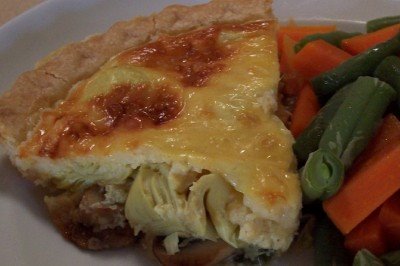
Mary wanted to see what I was having for supper last night. It was a mushroom and artichoke quiche from the Steinbeck House cookbook. The crust is supposed to be made with crushed saltines and sauteed mushrooms and butter (chilled till firm), and then you put lightly cooked green onion and chopped canned (not marinated) artichoke hearts on the base, cover with monterey jack cheese and pour on the filling, made with eggs, cream and cottage cheese, pureed with cayenne and paprika.

Meter mania

The lovely Saskatchewan-born neo-formalist Elizabeth Bachinsky shared her passion for sonnets with Kate Braid’s form class in Nanaimo last night. She is very fond of palindromes and Sapphic stanzas as well, and her first book, Curio, included a translation into anagrams of part of The Wasteland. She has done some wild things with Google search results too.

There was a preliminary discussion of meter, and while reading the chapter on Iambic meter from the excellent text, An Exaltation of Forms, we ran into diverging opinions on how to scan the line, which I now learn is “oft-debated” in scansion: “When to the sessions of sweet silent thought” (–Shakespeare, Sonnet 30).

Kate said that Keith Maillard had once told her that it was important not to confuse rhythm with meter and that this had made sense of the metrical world for her. If I’m paraphrasing her correctly, she said that rhythm has more to do with the emphasis we might put on a line when we read it, and meter is the more abstract “unreal” template we put over that line to measure it, within the context of the rest of the poem.

I’m still puzzling on that, but I found something that supports Maillard’s view, if music and poetry are this strongly connected, on a page about music theory. It says:

Many modern conceptions of rhythm and meter place them in opposition. Rhythm is often defined to consist of the actually sounding durations of music, while meter is the alternation of strong and weak beats, or the interaction of pulse strata, that are inferred from the rhythm. Rhythm is thus conceived as emerging and active— a “concrete” patterning that is measured by, and heard to work with or against the “abstract,” deterministic, rigid metrical grid.

Does that make sense to anyone? A couple of us thought the line (see second paragraph above) could be scanned as more or less straight dactylic tetrameter (quibbles over whether “silent” could be read without an initial stress, in context), but others wanted to put it into iambic pentameter with a double ionic (unstressed/unstressed/stressed/stressed) foot in the middle and a trochaic substitution in the first foot.

Ok, any [other] prosody geeks out there? For the rest of us, I like this page for a nice basic summary of meter. And I was having a little fun today with this one that has some online quizzes and tutorials on prosody.

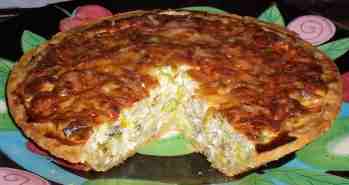
And for those of you who prefer food, here’s what I had for supper last night (Rich Leek Tart, it’s called). Obviously I have a long way to go as both a cook and a food photographer, but it was pretty tasty. The leeks were sweated for about half an hour, with minced shallots and a couple of sliced mushrooms, before being mixed with strained yogurt, swiss cheese and eggs, and the result was sweet and dense; it almost tasted like I’d added sugar.