Skip to content

poetic meter

Purdy, Pinsent, prosody and apostles

Al Purdy’s very topical just now. Not only is his Rooms for Rent in the Outer Planets: Selected Poems, 1962-1996 up for Canada Reads , the CBC is airing a documentary about him called “Yours, Al” this coming Thursday, April 13, on CBC Television’s Opening Night. The show stars Gordon Pinsent as Al Purdy and is on at 8 pm local time across Canada.

Meanwhile, I’ve wantonly picked up yet another book to browse. The house is pretty well carpeted with half-read books on prosody and form these days. Annie Finch, in her new collection of essays, The Body of Poetry: Essays on Women, Form and the Poetic Self , kicks off and out with a chapter on metric diversity, arguing against the championing of iambic pentameter as the premier English meter. “The use of the single label ‘iambic’ to include lines in other meters, she says, “…may prove to erase what it assumes to include, just as the generic use of the pronoun ‘he’ – said to include females – arguably erases female presence.”

With Easter coming, English cooks are busy making Simnel Cake, pretty much just a fruit cake with marzipan topping, but something virtually unknown on this side of the Atlantic. Apparently its roots lie in another English holiday, Mothering Sunday, which takes place in March. Serving girls were permitted to visit their mothers on this day and the practice was to bring a simnel cake to prove how clever they were (if they made a good one, it would stay moist and tasty till Easter). Its presence at the Easter meal has to do with the 11 marzipan balls that decorate the top, representing all the Apostles except Judas. Perhaps with the new evidence that surfaced last week we can bring the numbers back to an even 12…

Next year in West Chester

I have been looking with longing at the program for the 12th Annual West Chester University Poetry Conference: Exploring Form and Narrative. Among the offerings are workshops on rhyme with Dick Davis, meter with Timothy Steele, a master class with Mark Jarman, and a keynote address by James Fenton, who is also interviewed by Dana Gioia. Alas I can’t fit it in this year, but perhaps I can make the thirteenth edition next year. Never been to Pennsylvania…

Back here on the Coast, I was minding my own business on Tuesday afternoon… well, to be truthful I was engaged in some anguished last minute edits of my poems for the final Form in Poetry class, when the phone rang and Peg said: so, we’ve just got some fresh crab, want to come over and help us eat it? I dithered for a number of seconds, remembering several ill-starred occasions under the sign of the crab back in my Edmonton days. Then I thought, well, maybe it was a passing thing. Maybe it was bad frozen crab crossed with too many libations. Maybe it was just time to give it another try. So I brought along a quiche lorraine for a back-up, but the crab was fresh and simple, boiled in salt water, needing nothing but a nice bit of french bread and salad. And it went well with gin! The best news was that I suffered no ill-effects at all, so that strikes off the only food I’ve ever believed I was allergic, or at least intolerant to. I am grateful.

Meter mania

The lovely Saskatchewan-born neo-formalist Elizabeth Bachinsky shared her passion for sonnets with Kate Braid’s form class in Nanaimo last night. She is very fond of palindromes and Sapphic stanzas as well, and her first book, Curio, included a translation into anagrams of part of The Wasteland. She has done some wild things with Google search results too.

There was a preliminary discussion of meter, and while reading the chapter on Iambic meter from the excellent text, An Exaltation of Forms, we ran into diverging opinions on how to scan the line, which I now learn is “oft-debated” in scansion: “When to the sessions of sweet silent thought” (–Shakespeare, Sonnet 30).

Kate said that Keith Maillard had once told her that it was important not to confuse rhythm with meter and that this had made sense of the metrical world for her. If I’m paraphrasing her correctly, she said that rhythm has more to do with the emphasis we might put on a line when we read it, and meter is the more abstract “unreal” template we put over that line to measure it, within the context of the rest of the poem.

I’m still puzzling on that, but I found something that supports Maillard’s view, if music and poetry are this strongly connected, on a page about music theory. It says:

Many modern conceptions of rhythm and meter place them in opposition. Rhythm is often defined to consist of the actually sounding durations of music, while meter is the alternation of strong and weak beats, or the interaction of pulse strata, that are inferred from the rhythm. Rhythm is thus conceived as emerging and active— a “concrete” patterning that is measured by, and heard to work with or against the “abstract,” deterministic, rigid metrical grid.

Does that make sense to anyone? A couple of us thought the line (see second paragraph above) could be scanned as more or less straight dactylic tetrameter (quibbles over whether “silent” could be read without an initial stress, in context), but others wanted to put it into iambic pentameter with a double ionic (unstressed/unstressed/stressed/stressed) foot in the middle and a trochaic substitution in the first foot.

Ok, any [other] prosody geeks out there? For the rest of us, I like this page for a nice basic summary of meter. And I was having a little fun today with this one that has some online quizzes and tutorials on prosody.

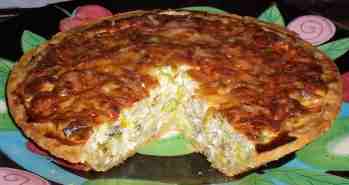
And for those of you who prefer food, here’s what I had for supper last night (Rich Leek Tart, it’s called). Obviously I have a long way to go as both a cook and a food photographer, but it was pretty tasty. The leeks were sweated for about half an hour, with minced shallots and a couple of sliced mushrooms, before being mixed with strained yogurt, swiss cheese and eggs, and the result was sweet and dense; it almost tasted like I’d added sugar.