Skip to content

editing

Some words from literary editors

One of my co-colloquiists brought along the latest issue of Poets & Writers, in which is a topical article for all of us here, called Putting Your Poetry into Order. And an even more irresistible (to me) feature: Through the Eyes of the Editors, in which three literary magazine editors speak to us.

Stephanie Fiorelli discusses a fairly new magazine she co-founded, Avery, going for three years; unusually for a literary journal, it’s independent, non-profit and publishing nothing but short stories. She and her fellow editors also maintain a blog to open up some of what goes on to produce such a publication.

Essayist and poet David Hamilton, who’s been editing the Iowa Review for thirty years, talks about general changes and the impact of university-isation of literary journals over the years: escalating numbers of submissions (10,000 poems received each year of which 120-150 can be published); ‘go-team’ competitive sensibilities between academic-run journals.

Most interesting to me was the piece by poet Stephen Corey, who edits the Georgia Review (and who co-edited an anthology I highly recommend, Spreading the Word: Editors on Poetry) who said a number of thoughtful things. He estimates having received something like 200,000 poems, 50,000 short stories and 15-20,000 essays during his 25 year involvement with the magazine. He goes on to say

“that these statistics are misleading and unnecessarily intimidating, because the bulk of what we receive is not very good at all. The competitive pool is very small, and across the past 25 years I have not seen any appreciable increase in its relative size, despite burgeoning creative writing programs, spell-check and rudimentary grammar-check software, summertime writers conferences, private writing mentors, and online writing workshops.”

He says the number of non-fiction submissions has massively increased,

“except that most of the pieces we receive are not essays anymore, but autobiographical narratives and reminiscences that read more like sentimental journal entries than thoughtful and rigorous considerations of experiences”

And that although the number of poems submitted hasn’t changed much, the number of short stories has dropped, but perhaps this is because

“I think the publishing industry has worked over-time of late to eradicate the short story form, and I think some of the writing programs may have been helping too. Story cycles, linked stories, novels-in-stories – all these au courant designations are attempted end-arounds in the pro-novel, anti-short story game of book marketing.”

His advice to writers is in tune with the overall tone of our time: to slow down.

“Any person who writes one great poem or story or essay per year for twenty years will take his or her place on the short list of the finest writers of all time. Slow down. Read voluminously, year after year, both for pleasure and to be reminded of all that you must not do, and all that you must exceed, in order to make your own special, indelible mark… Never to be forgotten once read – isn’t that what we must seek?”

Back to poetry

I’ve been preoccupied with food lately so time to think a bit more about poetry. My cyber scouts have been sending me interesting things to read, so I thought I’d share.

Mary felt I needed to know about the not-quite-yet-born Quarterly Journal of Food and Car Poems, from Washington state, which is seeking form poems for its first issue, and provides a nicely photographed sonnet to a steak for inspiration, as well as a handy list of links to Wikipedia definitions of allowable forms.

And Nancy has been reading the well-endowed (in the most fully figured meaning of that phrase) website of the Poetry Foundation, which is an excellent site and one I hadn’t visited before. She also found an online version of the article on rhyme, meter, stanza and pattern that appeared in a recent issue Poetry Magazine, by George Szirtes.

And as for me tucked up with my million books on poetry, I was reading again a few comforting passages from my heroine Maxine Kumin’s delightfully readable and charming collection of Essays on a Life in Poetry, Always Beginning. In a 1996 interview included in the collection, she was asked about the process of writing a novel on a typewriter, which she began using a very literal cut and paste method, so she had the first page scrolling across the room before she inserted her second page. She was asked if she thought computers had changed the surface or shape of prose, and she replied

“Oh I know it has…It’s dangerous! It corrupts you in midpage because it’s so easy to insert and delete that you take a lot of wrong turns… I’m not really comfortable yet with the computer. I use it for prose, a little warily, and then I print things out and make a lot of changes by hand, and then I go back and put them in.”

Just so. I like to print poems out and write on them (with dates!!) so that I don’t lose those speculative changes. I rarely go back to previous versions, but it can be helpful to have them if I get myself completely messed up. I find the Version Control feature in Word cumbersome and not really workable for me, but on the other hand, just pressing the Save button pretty much obliterates your editing history. Literary researchers of the future should have an interesting time of it.

Have a look at this site if you’re interested in editing history; it shows four manuscript versions of Wilfred Owen’s Dulce Et Decorum Est, and I seem to recall reading we don’t know which was his own finished version, so in anthologies etc. you will find one or some variation on these. To view each draft full-screen, choose right-click a manuscript “button” (A, B, C, D) and choose Open Link in New Window.

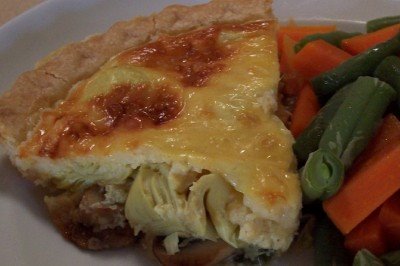
Mary wanted to see what I was having for supper last night. It was a mushroom and artichoke quiche from the Steinbeck House cookbook. The crust is supposed to be made with crushed saltines and sauteed mushrooms and butter (chilled till firm), and then you put lightly cooked green onion and chopped canned (not marinated) artichoke hearts on the base, cover with monterey jack cheese and pour on the filling, made with eggs, cream and cottage cheese, pureed with cayenne and paprika.