Skip to content

literary journals

Litmag report cards & BC animal health regulations

Duotrope’s Digest is just about the coolest thing (aside from Marcel the Shell of course) that I’ve come upon in this virtual world. It’s a report card for literary mags: you can search for information about poetry or fiction submissions at almost every journal in the English-speaking world, and find out what their speed of response is, whether they accept electronic submissions, their acceptance rate, whether they pay, and many other useful details.

The information provided comes from writers who submit work to the journals, rather than their editors and publishers, and the file on each magazine shows how many reports the information is based upon. Writers register, enter the title and submission details for each piece of work, and then report back when the piece has been accepted or rejected.

This is doubly useful, because writers can use it to track their own submissions while performing a public service to others. And because it tracks individual pieces, a writer can see – on the record for each magazine – where else contributors have submitted the same work. Which is helpful if you’re trying to figure out your plan B for a rejected piece, or tap new markets for similar writing.

Meanwhile, the BC government is reviewing its animal health regulations and seeking public input, which I’d say is a *very* good thing, particularly if you look at the way the underlying principles are presented:

A sound BC animal health policy framework (including legislation, regulation and policy) should:

  • Protect human health.
  • Minimize the negative economic impact of animal disease outbreaks.
  • Support the continued productivity and competiveness of livestock operations.
  • Strengthen the confidence of interprovincial and international trading partners.

You will look in vain here for any mention of animal welfare. Our health and financial gain seem to be the only reasons for keeping animals healthy.

Given that the government wishes to extend its definition of “animal” to include pets, wildlife, fish and other aquatic animals, for purposes of “managing health” I’d think the wider public would find it in their personal interests – and those of their non-humanoid friends and family members – to elbow in on the consultation.

It’s unclear to me, having read through the consultation document only once, whether a revised policy would be able to make crucial distinctions between the concerns created by factory farming vs small-scale farming vs pet ownership, for example. And whether they would protect farmers from excessive zeal by regulators, such as the needless slaughter of a water buffalo herd in 2002 (all the animals killed tested negative for BSE, as had been predicted).

Skate update, and more on poetry reviewing

Since my first triumphant experience with skate wings in black butter, back in April, I tried cooking it again and was appalled by a penetrating ammonia odour coming from the fish. What was going on? Had I added too much vinegar, causing some toxic reaction? Delia mentioned nothing about this possibility in the book I was using for my recipe.

So I did a little further research and here’s what I found. Apparently skate, like shark, can become contaminated by the urea both species carry in their skin. Not all pieces of skate will have this: the ammonia odour comes from poor handling when it’s first caught and processed, and you should be able to smell it in the raw fish. Ideally you should sniff the fish before you buy it – impossible to do through a grocery store’s shrink-wrapped packaging of course. Better to make your purchase through a fishmonger if you can find one; and of course they’ll be least likely to sell you improperly prepared fish, so safer all round. (I guess this would be more of our self-inflicted damage from allowing mass-procurement supermarkets to take over food handling from knowledgeable specialists.) However, if you do find yourself with an ammonia-scented morsel, you can rescue the day by soaking it in lemon-infused water for 30 minutes to remove the smell (and taste). I guess that’s one more reason skate is a sadly neglected fish… but try it anyway.

After discussion about the tone of poetry reviewing in Canada, I came across some interesting reading from the archives of Chicago’s venerable Poetry Magazine where they once had a major fisticuffs over poetry reviewing. Plus ca change..

Flax, linseed and poetry in Chicago

When did linseed become flax? I often get startled looks when I call those little beggars in the Red River Cereal linseed, but I sure wouldn’t dare call the oil version by that name, because we know linseed oil as a furniture polish, traditional oil for cricket bats, and paint solvent, not as the trendy and expensive wonder-supplement we call flax seed oil.

The source of all this is a plant whose full and proper name is Linum usitatissimum, as we might have guessed by the names of other of its products, linoleum and linen for example. It is also grown as an ornamental plant in gardens, its sky blue flowers opening only in the morning. Other uses include dye, paper, medicines, poultices, fishing nets and soap, as well as a handy plug for drains (wrap it up first though eh?). If you’re not keen on sardines or cold water/oily fish, ground flax seed or flax seed oil are particularly good sources of Omega-3. It’s not something I’ve seen used as a central ingredient in cooking – its flavour is pretty nondescript – but you can add it for nutritional and/or decorative reasons to a number of baked goods, soups, grains etc.

I was leafing through my new copy of PN Review which includes a review of the University of Chicago’s recent exhibition The Making of Modern Poetry. The show’s over now, and on the wrong side of this continent, but I liked the reported response by John Ashbery to an acceptance by a literary magazine of his poem Europe, exclaining it was “the best news since the Treaty of Utrecht“.

In my wanderings on the U of Chicago site looking for information on the exhibition, I encountered Poem Present, where you can, if you have QuickTime or an MP3 player, hear and view past readings, including a reading and lecture by Robert Creeley who visited the university the year before he died. What a wonderful world.

Back to poetry

I’ve been preoccupied with food lately so time to think a bit more about poetry. My cyber scouts have been sending me interesting things to read, so I thought I’d share.

Mary felt I needed to know about the not-quite-yet-born Quarterly Journal of Food and Car Poems, from Washington state, which is seeking form poems for its first issue, and provides a nicely photographed sonnet to a steak for inspiration, as well as a handy list of links to Wikipedia definitions of allowable forms.

And Nancy has been reading the well-endowed (in the most fully figured meaning of that phrase) website of the Poetry Foundation, which is an excellent site and one I hadn’t visited before. She also found an online version of the article on rhyme, meter, stanza and pattern that appeared in a recent issue Poetry Magazine, by George Szirtes.

And as for me tucked up with my million books on poetry, I was reading again a few comforting passages from my heroine Maxine Kumin’s delightfully readable and charming collection of Essays on a Life in Poetry, Always Beginning. In a 1996 interview included in the collection, she was asked about the process of writing a novel on a typewriter, which she began using a very literal cut and paste method, so she had the first page scrolling across the room before she inserted her second page. She was asked if she thought computers had changed the surface or shape of prose, and she replied

“Oh I know it has…It’s dangerous! It corrupts you in midpage because it’s so easy to insert and delete that you take a lot of wrong turns… I’m not really comfortable yet with the computer. I use it for prose, a little warily, and then I print things out and make a lot of changes by hand, and then I go back and put them in.”

Just so. I like to print poems out and write on them (with dates!!) so that I don’t lose those speculative changes. I rarely go back to previous versions, but it can be helpful to have them if I get myself completely messed up. I find the Version Control feature in Word cumbersome and not really workable for me, but on the other hand, just pressing the Save button pretty much obliterates your editing history. Literary researchers of the future should have an interesting time of it.

Have a look at this site if you’re interested in editing history; it shows four manuscript versions of Wilfred Owen’s Dulce Et Decorum Est, and I seem to recall reading we don’t know which was his own finished version, so in anthologies etc. you will find one or some variation on these. To view each draft full-screen, choose right-click a manuscript “button” (A, B, C, D) and choose Open Link in New Window.

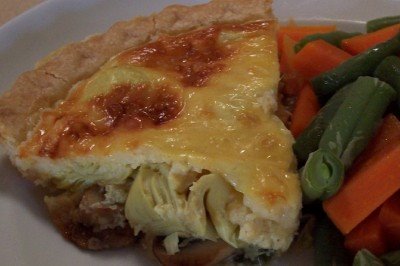
Mary wanted to see what I was having for supper last night. It was a mushroom and artichoke quiche from the Steinbeck House cookbook. The crust is supposed to be made with crushed saltines and sauteed mushrooms and butter (chilled till firm), and then you put lightly cooked green onion and chopped canned (not marinated) artichoke hearts on the base, cover with monterey jack cheese and pour on the filling, made with eggs, cream and cottage cheese, pureed with cayenne and paprika.

Mslexia, Kathleen Jamie and the University of Gastronomic Sciences

Just got my copy of the Apr/May/Jun issue of Mslexia. The annual poetry competition closes April 28, so you might squeeze in if you hurry. The theme for the next issue is Travellers’ Tales, and the one after that I’m sure will speak to a lot of us here on the Wet Coast this year: Rain. The Making a Poem column this issue features the Scottish poet Kathleen Jamie:

“I don’t believe in writer’s block. I think you write the things that are given to you to write and then you wait for the next thing that is given to you to write. In between are what we must call fallow periods. That’s the only word for it. I hate the idea of flogging yourself in production, producing stuff for the sake of it.”

Meanwhile, I’ve been thinking about going back to school and getting another master’s degree. The University of Gastronomic Sciences offers one in Food Culture: Communicating Quality Products. Based in Italy, the program includes rigorous field seminars to learn about the production of the best foods and wines of Italy, France, Spain and Northern Europe. Sounds like a worthy academic goal, no? The price tag, room, lunches and travel abroad included, is a trifling 21,000 Euros, or just a sliver of prosciutto under $30,000 Canadian. Well, we have till July to stew on it.

Knedliky, muffins and poetry from Manchester to Newcastle

Susan tells me that Rick was preparing a giant Czech dumpling (knedliky) for supper last night. Lucky them! I remember it well: thick, fragrant and delightfully absorbent slices accompanied some of the lovely meat specialties I had on a couple of trips to Prague, and many more were lurking in the kitchens of the Czech and Slovak Club that was so conveniently situated at the end of my street in London.

What is it about soft doughy substances… I’ve had a week of struggles with muffins. Made my third batch today after failures with apple muffins from the Steinbeck House cookbook a week ago (dry and hard), lemon poppyseed muffins from an internet recipe yesterday (flopped hideously over the rims of the muffin cups). This morning we returned to old faithful, blueberry muffins from the good old New Recipes from Moosewood, and – at last – success. Not perfection, but sweet, warm, edible success.

I came across Michael Schmidt’s Stanza lecture yesterday. His Lives of the Poets is not so much littering as landscaping my personal wasteland of unread works: it is one book that you can honestly say, before you’ve even opened it, has real stature. Apparently last year’s Neil Astley lecture was believed to be at least partially directed at Schmidt, the Mexican-born founder and publisher of Manchester-based literary journal PN Review, and of Carcanet, which is certainly a very different press than Newcastle’s Bloodaxe. Two worlds of opinion in two northern cities.

While enjoying both sides of the argument, I do have a lot more Carcanet on my shelves than Bloodaxe, and the reasons include Gillian Clarke, Eavan Boland, Sujata Bhatt, Les Murray and Elizabeth Jennings.

But I also cherish a number of titles from Bloodaxe: Ken Smith’s Wild Root, collections by Carol Rumens, Stephen Knight, Helen Dunmore. Not to forget Peter Sansom’s Writing Poems and Astley’s own Staying Alive.