Skip to content

poetic form

Skating into form

I spent some time excavating my magazine basket, and came across a copy of The Writer’s Chronicle from December 2004. I must have picked it up at the Vancouver AWP conference. There was an interview in it with Annie Finch, talking about her shift from free verse to form, a transition she says took her 20 years to make.

“I wanted to be challenged more deeply as a poet, by a more profound kind of anguage resistance, and in the end I found only form could offer me that. I got tired of feeling that the content was overpowering the words themselves; I wanted more ‘opacity,’ to use Charles Bertstein’s term.”

She began using form while doing her MFA in Creative Writing, in spite of rather than because of the guidance she found there:

“…people kept saying, ‘this poem would be a lot better if you wrote it in free verse.’ But I was set on training myself to use form well, so I just kept on with it.”

She has several different strategies for choosing a form for a particular poem:

“When a line drifts into my head, I often recognize it as a certain meter or sense that it would be a good refrain line for a certain form, or a good chant line or part of a final couplet, that sense of where it might fit can be part of the sense it gives me. So, often the poem brings the structure with it… But sometimes it’s the opposite, especially with a form I am not very familiar with yet: a poem will bug me for years, and it just won’t be finished, until finally I hammer or coerce it, or let myself be coerced by it, into its right shape… And there’s a third way too. I am not one of those poets who turn up their noses at the idea of using a particular structure on purpose; the shape of some of my favorite poems came first. For example, when I wrote A Carol for Carolyn for Carolyn Kizer… I wanted to write a carol for obvious reason, and I wanted it to be in amphibrachs before I even started, because that was the hardest meter I knew and I wanted to write her something special.”

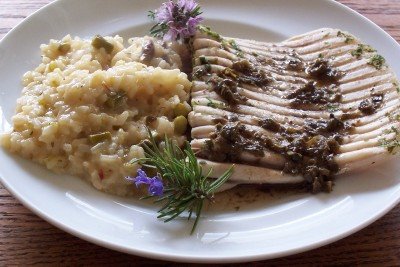
A pressing engagement to hunt Easter eggs yesterday, followed by a beautiful lamb dinner, meant I only had lunch to cope with, having been wallowing in blueberry muffins since breakfast. I was startled to find a fresh skate wing in my local grocery store, which got me thinking about the last time I’d had skate in black butter, which must have been about six years ago, at my only visit to Sheekey’s: a memorable meal — and not cheap. (We even got to do a little celebrity spotting, because Janet Street-Porter was dining there that night.) Skate is the perfect fish: delicate, easy to cook, and, for all intents, boneless. Even the recipe was easy to find. So to complicate life a little bit, and because my rosemary bushes are in full bloom and begging to be used, I also made a lemon risotto which I spiked with a handful of asparagus, just because it’s spring.
Villanelle

Blues-oriented form fiends may like to check out the latest Paul Reddick cd, Villanelle. I heard him interviewed a while back, but wasn’t paying full attention at the time; it seems to me he said that many (all?) of the songs on the album incorporated formal elements from poetry, but I haven’t been able to find that interview or any corroborating evidence.

And that somewhat predictably brings me to Dylan Thomas, whose Do Not Go Gentle Into That Good Night, for his dying father, remains the most stunning villanelle I’ve ever heard.

Two years ago today – it was the morning of Easter Monday – my own dad passed away. Here he is, sailing for London.

Purdy, Pinsent, prosody and apostles

Al Purdy’s very topical just now. Not only is his Rooms for Rent in the Outer Planets: Selected Poems, 1962-1996 up for Canada Reads , the CBC is airing a documentary about him called “Yours, Al” this coming Thursday, April 13, on CBC Television’s Opening Night. The show stars Gordon Pinsent as Al Purdy and is on at 8 pm local time across Canada.

Meanwhile, I’ve wantonly picked up yet another book to browse. The house is pretty well carpeted with half-read books on prosody and form these days. Annie Finch, in her new collection of essays, The Body of Poetry: Essays on Women, Form and the Poetic Self , kicks off and out with a chapter on metric diversity, arguing against the championing of iambic pentameter as the premier English meter. “The use of the single label ‘iambic’ to include lines in other meters, she says, “…may prove to erase what it assumes to include, just as the generic use of the pronoun ‘he’ – said to include females – arguably erases female presence.”

With Easter coming, English cooks are busy making Simnel Cake, pretty much just a fruit cake with marzipan topping, but something virtually unknown on this side of the Atlantic. Apparently its roots lie in another English holiday, Mothering Sunday, which takes place in March. Serving girls were permitted to visit their mothers on this day and the practice was to bring a simnel cake to prove how clever they were (if they made a good one, it would stay moist and tasty till Easter). Its presence at the Easter meal has to do with the 11 marzipan balls that decorate the top, representing all the Apostles except Judas. Perhaps with the new evidence that surfaced last week we can bring the numbers back to an even 12…

Next year in West Chester

I have been looking with longing at the program for the 12th Annual West Chester University Poetry Conference: Exploring Form and Narrative. Among the offerings are workshops on rhyme with Dick Davis, meter with Timothy Steele, a master class with Mark Jarman, and a keynote address by James Fenton, who is also interviewed by Dana Gioia. Alas I can’t fit it in this year, but perhaps I can make the thirteenth edition next year. Never been to Pennsylvania…

Back here on the Coast, I was minding my own business on Tuesday afternoon… well, to be truthful I was engaged in some anguished last minute edits of my poems for the final Form in Poetry class, when the phone rang and Peg said: so, we’ve just got some fresh crab, want to come over and help us eat it? I dithered for a number of seconds, remembering several ill-starred occasions under the sign of the crab back in my Edmonton days. Then I thought, well, maybe it was a passing thing. Maybe it was bad frozen crab crossed with too many libations. Maybe it was just time to give it another try. So I brought along a quiche lorraine for a back-up, but the crab was fresh and simple, boiled in salt water, needing nothing but a nice bit of french bread and salad. And it went well with gin! The best news was that I suffered no ill-effects at all, so that strikes off the only food I’ve ever believed I was allergic, or at least intolerant to. I am grateful.

Glosas & a few words about rejection

I’ve been working on a glosa arising from a quatrain by our late lamented high priestess of Canadian poetry, Gwendolyn MacEwen. An interesting thing, the glosa. Aside from Marilyn Hacker, who seems to have tried every form invented, you don’t really see them much by any but Canadian poets. That PK Page has a lot to answer for! In her inspiring collection, Hologram, she defines it as a stanza form, based on a quatrain by another poet, consisting of four 10-line stanzas where the 6th and 9th lines rhyme with the 10th. (Pah, child’s play, sez I after wrestling through 9 stanzas of terza rima..)

But my research tells me that it is also considered pretty much a nonce (love that word) form, also known as a glose (that seems to be how the Americans spell it) and that you can use any number or kind of lines as your starting point: they need not even be poetry. Neither is there any law that says the stanzas must be ten lines or follow any particular rhyme scheme.

The art of it is, I think, firstly to find a way to make the source lines your own, so that they have – fully – two lives; and secondly to walk a fine balance between bringing your poem to its own life and paying appropriate tribute to the source poet’s words. Choosing those source lines is difficult enough, and it’s good to know we can look beyond quatrains for them.

Rejection. Ouch: it never stops hurting, but I guess in this world so overcrowded with words we can’t write without it. One of the AWP sessions in Austin that I wasn’t able to make centred on The Resilient Writer, a collection of interviews with writers who survived to talk about rejection. Meanwhile, I found a blog about rejection by an editor who helpfully and comprehensively explains the nature and context of rejection letters… in a way that doesn’t hurt… TOO much.

So up here in Fanny Bay we might not have escaped another day of rain, but we did get a bucket of oysters for supper last night, and this morning a real live rainbow!

Leonard on form

At the beginning of February, CBC presenter Shelagh Rogers – the best voice in the west? – interviewed our national icon Leonard Cohen about his induction into the Canadian Songwriters Hall of Fame. She talked to him about poetry as well, and he had some interesting things to say about the benefits he’d had from working within the “obligation of rhyme”. “Lift your heart in gratitude,” he says, because it lets you discover congruencies you’d never otherwise encounter. He likes form too:

“Form imposes a certain opportunity to get deeper than your first thought… I don’t have any ideas and I don’t trust my opinions… but when you submit yourself to a form then… you’re invited to dig deeper into the language and to discard the slogans by which you live, the easy alibis of language and of opinion… If you look in the Spenserian stanza for instance, which is a very, very intricate verse form where you have to come up with many rhymes of the same sound, you’re invited to explore realms you usually don’t get to with your ordinary easy thought… I consider my thought stream extremely uninteresting and it’s only when I can discard it that I can say something that I can get behind.”

While you’re hanging around the CBC site, try searching ‘Leonard Cohen’: I stumbled upon a CBC Archives clip of him reciting poems back in 1958…