Skip to content

pesticides

Nourishing Indiana

StairwellHere in the curious world of the conference hotel, if you can find the stairs, they won’t necessarily take you where you want to go. And they are bleak enough to discourage the faint-hearted. I enjoyed a good fifteen minute cardio workout yesterday, travelling with a well-intentioned Marriott employee who tried in vain to help me find the elusive “up-stairs” to get one floor above.

Never mind, there are plenty of long hallways to cover finding my way from FridayDinnerroom to meal to conference at the 51st instance of the Weston A Price annual conference in Indianapolis, where we “Focus on Food”. Which is invariably excellent and plentiful at these conferences. Here’s the happy queue at last night’s turkey dinner – birds donated by Fields of Athenry Farm (the farmers and producers are always credited in the menus found in our programs) and replete with several ferments (sauerkraut, fermented cranberry relish, sourdough bread, fermented herbal tea) and grass-fed butter.

Yesterday’s sessions were mostly all-day affairs. I spent most of mine fiercely concentrating on the rapid-fire thoughts and slides of Stephanie Seneff, whose talk covered Pesticides, Antibiotics, Vaccines & Pharmaceuticals at dizzying speed (see her web page to download her slides, as well as find links to  her research).

She walked us through research papers a-plenty to illustrate her points. She is a strong advocate of sulfur – it’s one of the least discussed yet most common mineral in the body after calcium and phosphorus and plays a huge role in amino acid development (essential, in short, for protein in the body). The American population tends to be deficient in it (esp. vegetarians and those on low protein diets), and chronic acetaminophen (Tylenol) use further depletes sulfate.

Glyphosate (Roundup) is implicated in many conditions, contrary to studies which claim it to be harmless. For licensing purposes, glyphosate is only tested in isolation, but Roundup contains many other ingredients designed to enhance its effects (up to 1000x); and of course it’s only studied for 90 days, whereas its health effects are cumulative. Seneff had tracked some interesting correlations: glyphosate use tracks closely with autism rates, anemia, sleep disorders, breast cancer rates, kidney disease and more.

Glyphosate has been found in breast milk, urine and water. That it hasn’t been found sooner is probably a product of the few labs willing to test for it.

Seneff explained that the reason glyphosate affects human health is its effect on beneficial gut bacteria, which serve a protective role in the body. Glyphosate blocks the production of tyrosine, tryptophan, and phenylalanine – three essential amino acids formed on the shikimate pathway. This pathway, the argument goes, “is only found in plants and microorganisms, never in humans” – however, it is found in our gut bacteria, which help to synthesize amino acids. Glyphosate also inhibits cytochrome P450 (CYP) enzymes which in humans help to break down toxins.

The best way to avoid glyphosate is to eat certified organic foods, including many sulfur-containing foods (and have epsom salt baths – which allows you to absorb sulfur and magnesium through your skin).

She had a lot to say about statins as well – I strongly recommend anyone taking these have a look at her slides and do their own research. The gist was that they may protect you from heart attacks, but they will cause heart failure – a long and limiting way to go – as well as weakening many other body systems.

I ended yesterday with a talk by naturopath Louisa Williams, who spoke about antibiotic-resistant bacteria. She believes these to be causing many chronic disorders (pain, anxiety, depression, fatigue, movement disorders, memory loss, constipation/diarrhea) and contributing to others (cancer, Crohn’s meningitis, multiple sclerosis, Parkinson’s, Pertussis, Sarcoidosis, Lyme’s…) . The gist is that antibiotic over-use has created resistant bacteria, which then mutate into cell wall defective (CWD) bacteria. These lack the structure that allows antibiotics and our own immune systems to recognize and deal with them.

Diagnosis is difficult. Treatment includes the usual detox protocols (removing environmental and dietary toxins); stop ‘feeding the fire’ by taking antibiotics except for acute conditions (even over-using microbial oils such as oregano will lead to problems); seek constitutional homeopathy remedies; and heal the gut with plant polysaccharides (mannose – though she felt the amounts needed exceeded what could be obtained through diet) and special probiotics.

Genetically-modified October

There has been a fair amount of GMO action, good and bad, this month.

On October 10, the Healthy Saanich Advisory Committee bravely invited public input into their deliberations on the question of whether to allow Genetically-Modified (GM) seed crops into the municipal district. [For those who don’t live here, Saanich is one of the largest of our 13 municipal districts and 3 electoral areas that make up what is commonly known as Victoria (plus the Gulf Islands), but more accurately named the Capital Regional District. It is also a daunting mixture of urban, suburban and rural (peri-urban really, on this increasingly crowded tip of Vancouver Island) areas.] The Healthy Saanich Committee took the public input into their own deliberations, and will be making a recommendation against allowing GM crops to Saanich Council in November. One of the presenters requested that the meeting where the recommendation would be made should be one where the public could be present.

At least fifteen residents made written presentations to the committee, and another fourteen each made five-minute verbal presentations to the committee, who will have left the meeting groaning under the weight of much additional reading. Local farmers, gardeners, citizens, doctors, scientists and church groups were represented, and thirteen of the fourteen presenters spoke emphatically against allowing GMOs into the community.

In my five minutes I spoke as one of the millions of people in North America who have, for the past 18 years, been obliged to consume GM foods without our knowledge or consent, because our federal government has twice blocked the introduction of mandatory GM food labelling, thereby removing our choice over whether or not to eat it. And GM ingredients are present in, so the estimates go, some 70% of the foods in Canadian grocery stores (if you eat a lot of processed foods, your consumption is probably higher than that). Other presenters pointed out the failure of governments to require adequate long-term studies of GM products on animal and human health and on the environment. Still others argued that GM crops would increase the amount of pesticides used on our soil, and therefore the quantity of pesticides introduced into our diets and water supply.

In a timely reminder that the pesticide threat was no idle supposition, we’ve just had news that Canada is on the brink of approving GM corn and soybeans – destined for human and livestock consumption – designed for use with the pesticide 2,4-D (an ingredient in Agent Orange), which is needed because Roundup-Ready GM crops have created glyphosate-resistant weeds, creating what had been predicted from the outset: an increase in pesticide use, not the decrease originally promised by the biotech industry.

In Ontario, farmers gathered to protest the planned introduction of GM alfalfa into Canadian fields. The prospect is more than worrying, because alfalfa is a hugely important crop, which forms the bottom of our own food chain. Organic growers are heavily dependent on it both as a livestock feed, an export crop and a cover crop. Since the only alternative Canadians have if they don’t want to eat unlabelled GM foods is to buy certified organic (no GM ingredients or agricultural inputs are allowed in Canada’s certified organic production), this puts our whole organic food system at risk. Given the rates of contamination of non-GM corn, soy and canola by their GM counterparts in North America, and the sorry tale of the “Triffid” flax that killed Canada’s European flax export trade, it is a certainty that GM alfalfa will cross with non GM.

And finally, Michael Pollan has written a thoughtful analysis of California’s pending vote on mandatory labelling of food containing GMOs, coming up November 6, and the need in today’s damaged food system, for a more vigorous and less one-sided blending of food with politics.

Spring on the wing

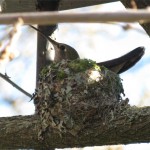
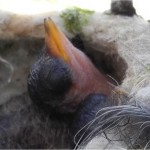
Spring is erupting in all directions. The Anna’s Hummingbird (Calypte anna) nest that graces my fence has very recently produced three newborns and I’m looking forward to watching their progress (and seeing how they all squeeze into a space that’s probably two inches across at most). It’s still damp and chilly here so the mother is spending a good deal of time warming their hairless, featherless bodies. I knew they were big on nectar – hence their value as pollinators – but hadn’t realized they also chow on insects. I’ve hung a feeder nearby that should (for now) be safe from the ants who overran it last time I hung it out. I’ll have to make an ant moat if they become a problem again.

Speaking of moats, I’m intrigued by the idea of a chicken moat. Not a chicken keeper myself, but I’m working on a group project around chickens for the Permaculture Design course I’m taking.

Other airborne creatures have been in the news lately. Meli sent me notice of the headline item that bees are being adversely affected by pesticides. I am not quite certain why it has suddenly become headline news that if pesticides kill insects, and bees are insects, then bees are going to be harmed by pesticide use, but I suppose it does not hurt to belabour this important point. To which should be added the related point that pesticides will also harm beneficial insects besides bees, as well as the higher life forms (hummingbirds, for example?) that feed on those – whether by poisoning them or by removing a food source.

Let us all (who are within geographical reach) celebrate our wisdom in these matters by heading off this Saturday to enjoy a pesticide-free work party at Haliburton Community Organic Farm.

Vancouver’s urban farms

Time, food and agriculture never sleep, at least not where interesting stories are concerned.

There’s a link here to a rather beautiful brochure  shows that shows you who’s growing what and where in twenty-six urban farms in Vancouver.

And a nice story about the loneliness of the the farming life which I suppose applies to urban farmers as well; it offers a reminder that we are often in too much of a hurry, and too accustomed to shopping anonymously for food, to thank those who provide it.

And some good news for Victoria food shoppers, with a new whole/local foods store opening, conveniently situated near the wondrous Capital Iron.

A wrist-slapping lesson in public consultation for Stephen Harper whose decision to bring to fruition his longtime plan to dismantle the Canadian Wheat Board was declared illegal by a federal court.

And an opportunity for British Columbians to participate in a public consultation on a province-wide ban on cosmetic pesticides is open until December 15. Anyone who cares about the continuing health of honeybees and other wild pollinators, other species in the food chain/eco system, as well as pet-owners and parents should take a moment to speak in favour of this ban.

The soil is the thing: the EU Soil Report warns about what the soil Soil: Worth standing your ground for from The European Environmental Bureau

Food – sight and sound

B is for Bananas (if you didn’t know why it was important to buy these organic and Fairtrade, here’s your briefing)


BANANAS!* trailer.
 

B is also for Bees


Queen of the Sun trailer from Youtube.


And R is for radio, specifically NPR (I’m close enough to the border to be able to listen in) where you can hear

Yotam Ottolenghi talking vegetables – promo for his excellent cookbook Plenty (recipes born in YO’s wonderful Guardian column, The New Vegetarian); Barry Estabrook speaking in depth to NPR’s Fresh Air about his new book Tomatoland, which blows the lid off many aspects of the Florida tomato industry – labour standards, soil depletion, pesticide use – and explains why big ag’s focus on high yield tomatoes does not put good tasting food on your plate (which is exactly why Slow Food exists); and then a brief look at sustainable fish (tilapia) production: urban fish agriculture (but not the kind that involves feeding them corn and, like other farmed protein sources, causes more of the same old problems to those who eat them)