Prawns & other fishy business
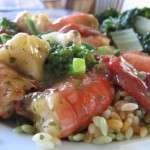 I often share tables and menus with people who have not spent the past half dozen years or so obsessing about food to the same degree as I, and who therefore do not have as much trouble finding something edible in restaurants and other food outlets. Most of them do not register my shudder at the sight of prawns on the menu; nor do I act on first instincts to seize the menu and tear it into tiny pieces and then arms flailing eyes wild to scream at them “don’t touch them they’re poison!!!!” It’s become one of those things I simply won’t comment on unless invited.
One of the reasons I eat very little fish anymore, and particularly avoid prawns, as well as farmed catfish, basa, tilapia etc from China, Thailand, Indonesia, Vietnam and elsewhere – and of course farmed salmon from Canada – is because of the use of antibiotics, which are used to combat potential infection in overcrowded tanks and cages. This is prophylactic use, not treatment of illness, and is as worrying as the use of low dosages of antibiotics as a growth enhancer in land-based meat farming. The most troubling of these antibiotics is a series called fluoroquinolones.
So I’m inviting myself to comment here, because I have just read an article about these very chemicals (showing up in fish illegally imported to the US from China, Thailand, Canada, Indonesia, Vietnam and Ecuador) and simultaneously noticed that the Canadian Food Inspection Agency has relaxed by .04 ng/g the fluoroquinolone residues in aquaculture products action level from 0.6 ng/g (ppb) to >1.0 ng/g. This is because
The revised action level continues to provide adequate human health safety to consumers and is considered stringent enough to detect deliberate use of fluoroquinolone therapeutants in aquaculture.
Well all right then. It’s tiny, and the CFIA continues to assure us that there is no change in Health Canada’s policy of
zero tolerance for deliberate use of fluoroquinolone therapeutants (ciprofloxacin, danofloxacin, enrofloxacin and sarafloxacin) during fish production life cycle.
But if you also read
Resistance to quinolones has been reported in a variety of important bacterial pathogens, including Escherichia coli, Klebsiella pneumoniae, and other enteric organisms; Pseudomonas aeruginosa; Chlamydia trachomatis and Mycoplasma pneumoniae; Campylobacter jejuni; Burkholderia cepacia; Stenotrophomonas maltophilia; Neisseria gonorrhoeae; Staphylococcus aureus (especially oxacillin-resistant strains); Enterococcus faecium; and Streptococcus pneumoniae.
Don’t you just not want to go there at all? Particularly on a week when there’s news of a new antibiotic-resistant strain of gonorrhea and a spike in the incidence of syphilus — as well as general increases in STD’s in the elderly as well as youth. Not to forget the ever-increasing rates of food-borne illnesses like campylobacter jejuni, salmonella, and E. coli O157:H7 (and the new one that surfaced in Germany this year, E. coli O104:H4). And of course the hospital superbugs. It’s all enough to put you off your dinner.
A couple of months ago Barry Estabrook laid out the issues, and praised the one prawn I will still eat and am thankfully positioned to find – the Spot Prawn.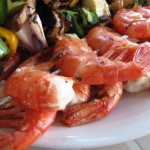
I have no doubt that things have improved since 2003 when Felicity Lawrence documented problems with the industry; but I am still suspicious of foods like prawns whose cost has so cheapened on the menu. And I know that most restauranteurs are watching their price points too carefully to ask too many questions about the full story on everything they buy. And will mislead you whether by accident or not, as I learned in Newfoundland a few years ago where a waitress informed me that the tiger prawns on the menu were local, which I doubted enough to double check; and yes, they were local – to Thailand I think it was.
