Skip to content

sustainability

Food Security in Bloom
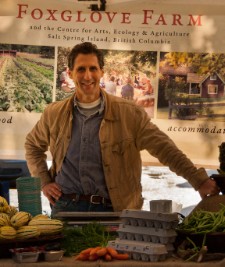
I blossomed along last night to catch Michael Ableman speak on Thinking Like an Island: Food Security and Sustainability, as part of the art gallery’s Art in Bloom series. The promo promised we’d hear about how “thinking like an island means minimizing reliance on “off-island” resources.”

And indeed it was so. It was a lively, passionate and articulate talk, presenting alternatives for a sustainable future, “where communities develop their own full cycle food systems and city planners integrate food production into new developments.” Ableman speaks with authority, from the foundations of a lifetime spent farming and driving urban agriculture programs (like SOLEfood in East Vancouver), which he now does from Foxglove Farm on Salt Spring Island.

On Salt Spring, he said, there are the problems we all share today: utter dependence on fossil fuel and the automobile and imported food; and like many other urban centres, even this island has its share of poverty and food insecurity, well hidden from public view.

Think of Earth as an island floating in a sea of space, he suggested; perhaps if we thought of it that way we might take better care of it.But it all starts with food: nothing is more basic to our needs, and yet we’ve handed over that responsibility to others, and we’re seeing the results in soil loss, water contamination, obesity, health problems of many kinds.

But islands of farming – for every farm should be as self-contained, self-sufficient and self-renewing as an island – nowadays have ecological and educational roles as well as to feed a predominantly urban world.

His deepest message for the future of food security has to do with education. We can learn to build food security by growing our own gardens: people need the knowledge as well as the means and land to produce some part of the food supply. We can secure it for the future by cultivating those skills in our children, who will after all reap the fruits of our time, so they might as well learn to grow vegetables while they’re at it.

While you can’t impose changes on those who don’t understand the value of food, you can teach children in schools – where the curriculum needs to cover all aspects of food production with the same importance currently given to math and history. Moreover, every school should restructure its approach to food procurement, and make use of its off-duty kitchens for neighbourhood food processing and preservation.

On land tenure, a much discussed obstacle to new farmers, he proposes different models of ownership. It’s wrong, he said, that the only qualification you need for this at present is capital, when stewardship is the more important quality for custodians of this essential resource.

If we are all just passing through, all that remains is the land: we owe it to the future to leave it more fertile than we found it. Land ownership, particularly of parcels of 5 acres or more, should be tied to requirements to learn how to rebuild the soil for growing. But for any new development, building permits should include food production component in proportion to population they support; industrial buildings should be required to have rooftop growing spaces.

He suggests that the armed forces should be put to work restoring growing land and our railway system. Because a local diet is not necessarily an inclusive or varied one, particularly in northern areas, we need to make use of regional foodsheds and transportation is central to providing the population. Rail is the most cost and energy-efficient way to do that.

He paused to throw a few cautions in about phosphorus, one of the three essential components in plant nutrition (along with nitrogen and potassium). Commercial farming uses about 90% of mined phosphorus in agricultural production: this includes, of course, biofuels. Phosphorus is another nonrenewable resource which is due to become scarce, and Ableman feels it’s the elephant in the room, and it’s going to be the next thing worth fighting for. He suggested we check out which countries hold reserves of it. The answer is: China (which has just upped the price so as to conserve supplies for its own use); the US (will run out in 25 years); and, sadly for Africa, Africa.

He mentioned some lectures he’d given on the Hawaiian Islands for the Center for Ecoliteracy. Hawaii used to be a model of self sufficiency, where the population’s role in relation to the environment that supplied its food supply was fully understood; where it was appreciated that the survival of each of us is inextricably tied to one another and the world around us: and that what we do in the way of harvesting seafoods, for example, affects the survival of our community in the long term. But that knowledge has been lost and Hawaii now imports 80% of its food and suffers the same associated problems as everywhere else.

He spoke as well of time he spent as a teenager in Jamaica, and how that island too now relies upon imported food; and in its altered agriculture, geared to supply global markets, has lost what he calls its “national wealth” – the flavour of its fruits.

He quipped that it’s time farmers received the same rock star status that chefs do; but then again, farming is not a spectator sport. People who don’t want to farm should make friends with a farmer: you will need them. And speaking of rocks, he has a fine idea for soil replenishment, which is that every community should have a rock grinder, to enable us to replenish soil minerals by creating our own rock dust.

The bottom line: though it’s encouraging to see how many people want to eat well and locally today, there simply aren’t enough of us doing the hands-on work of growing food. We have a couple of generations of people now who know no more than how to push keys on a keyboard. We need to consider what we’ll depend on when we can’t depend on technology, for the skills we’ll require to survive on this earth include growing food and restoring the soil.

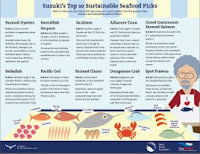
Farm/city overlap and Suzuki’s Top 10 seafood

Yesterday’s episode of CBC’s The Current included a segment called Farmland Disputes, a discussion of what happens to farms that are swallowed by cities. It’s uncomfortable territory.

There is no doubt we need to protect growing land for food, but those lands, particularly when they are overtaken by the city limits, are too expensive for farmers to buy, particularly when farmers are paid so badly – and in careers that lack pension plans. When retirement comes, many of our aging farmers hope to sell their land, or rezone it for development, in order to make up a retirement fund. But that takes more land out of the food production picture. The program reported that

  • Only 6% of Canada’s land is suitable for farming
  • Class 1 farmland, on which you can grow almost any crop, makes up about .5% of the total
  • Between 1971 and 2001, Canada permanently lost 14,000 square kilometres of its best farmland to urban growth
  • Almost half of Canada’s urban land is sitting on dependable farmland
  • The population of all our cities is growing beyond the limits of existing housing

Where land is being protected – and developers do tend to be winning the battles – much of the land sits idle, because there are not enough new farmers. And aspiring farmers often cite the cost of land as one of their chief obstacles. Until we have governments that back farming and promote a national food policy, we’ll go on losing land. Meanwhile, we must sit watching it slip away until the crisis point is passed.

Turning one’s worried face to the sea, here’s another handy fridge guide for sustainable seafood, courtesy David Suzuki:

Green marketing, and get it off your chest: complaints central

It’s hard being green, and don’t we all know it? Everything’s so complicated. Local or organic? Paper or biodegradable plastic? On and on.. For some perceptive insights into the advertising angles, catch while you can the Green Marketing podcast on one of CBC‘s very best radio shows: The Art of Persuasion. From Rachel Carson, to BP’s rebranding errors – well in advance of the Deepwater Horizon fiasco, to green pizza, to Marks & Spencer’s Plan A, it’s a good, pithy story well told.

And the website now offers visual content, like this fabulous ad:

Well. Once you’ve mastered your green strategy you still have to cope with the rest of life’s irritations. It seems sometimes that things go well beyond annoying. For those still looking for a new year’s resolution, might I suggest direct consumer action? It has the double benefit of being a stress reliever for the complainant, and a public education service for the industry in question.

The Consumers Association of Canada provides a most helpful list of agencies to complain to, arranged by industry, as well as tips on complaining effectively.

Those of you not happy to be test dummies for Canadian airport security geeks wanting to play with their new body scanners can vent your spleen at the Canadian Air Transport Security Authority.

The Advertising Complaints Authority is the place to go to complain about advertising by email, mail or fax.

Wendell Berry’s rules for healthy functioning of sustainable local communities

I happened upon a web page that listed farmer-poet-essayist-novelist Wendell Berry‘s 17 rules for the healthy functioning of sustainable local communities (and here’s a place you can read some of his poems):

1. Always ask of any proposed change or innovation: What will this do to our community? How will this affect our common wealth?

2. Always include local nature – the land, the water, the air, the native creatures – within the membership of the community.

3. Always ask how local needs might be supplied from local sources, including the mutual help of neighbours.

4. Always supply local needs first (and only then think of exporting products – first to nearby cities, then to others).

5. Understand the ultimate unsoundness of the industrial doctrine of ‘labour saving’ if that implies poor work, unemployment, or any kind of pollution or contamination.

6. Develop properly scaled value-adding industries for local products to ensure that the community does not become merely a colony of national or global economy.

7. Develop small-scale industries and businesses to support the local farm and/or forest economy.

8. Strive to supply as much of the community’s own energy as possible.

9. Strive to increase earnings (in whatever form) within the community for as long as possible before they are paid out.

10. Make sure that money paid into the local economy circulates within the community and decrease expenditures outside the community.

11. Make the community able to invest in itself by maintaining its properties, keeping itself clean (without dirtying some other place), caring for its old people, and teaching its children.

12. See that the old and young take care of one another. The young must learn from the old, not necessarily, and not always in school. There must be no institutionalised childcare and no homes for the aged. The community knows and remembers itself by the association of old and young.

13. Account for costs now conventionally hidden or externalised. Whenever possible, these must be debited against monetary income.

14. Look into the possible uses of local currency, community-funded loan programmes, systems of barter, and the like.

15. Always be aware of the economic value of neighbourly acts. In our time, the costs of living are greatly increased by the loss of neighbourhood, which leaves people to face their calamities alone.

16. A rural community should always be acquainted and interconnected with community-minded people in nearby towns and cities.

17. A sustainable rural economy will depend on urban consumers loyal to local products. Therefore, we are talking about an economy that will always be more cooperative than competitive.

Sustainable resolution

Looking for a new year’s resolution? How about aiming for sustainable consumption?

A handy guide to sustainable food has been published on Sustain‘s website. It’s a term that gets bandied around a lot, so it’s good to have a working (and workable) definition, which goes something like this:

  1. Buy local, seasonally available ingredients as standard.
  2. Buy food from farming systems that minimise harm to the environment, such as certified organic.
  3. Reduce the amount of foods of animal origin (meat, dairy products and eggs) eaten and eat meals rich in fruit, vegetables, pulses, wholegrains and nuts.
  4. Stop buying fish species identified as most ‘at risk’ and buy fish only from sustainable sources.
  5. Choose Fairtrade-certified products for foods and drinks imported from poorer countries
  6. Avoid bottled water and instead drink plain or filtered tap water.
  7. Protect your and your family’s health and well-being by making sure your meals are made up of generous portions of vegetables, fruit and starchy staples.