Poetry poetry poetry

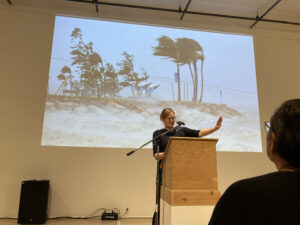
Sunday was another one of those floor-to-ceiling poetry readings, with 10 on the menu. Luckily two were unable to attend (a third likewise but she’d enlisted her sister to read in her place) so it was a little shorter than it would have been otherwise.

I’m sure I’ve moaned about this style of reading before; it is, I feel, far too common in today’s poetry programming to attempt to squeeze as many poets as possible into a single event. The reading turns into a marathon, and the one or two you came to hear are lost in the numbing volume of the whole. You don’t get enough of the ones you want to hear, and perhaps you hear too much of those you don’t. And everyone else just doesn’t register.

Magazine launches – where 5 or 10 people come and read a poem they’ve had published in that issue, with perhaps one other – are one thing, and I’m ok with them as long as someone keeps the readers moving along (when faced with a long list of readers, the eye of the audience turns naturally to the clock).

But on Sunday, we were at this particular two hour event to hear a few minutes each of 10 first collections by 10 different readers. Another problem I have with these events is that the readers are introduced in volume, and if you aren’t familiar with them, as I mostly wasn’t, by the time you’ve heard the list of credentials and the readers take the stage you lose track of who of the five poets this half you’re hearing and what their background is. None of them thinks to say their name, or give the bridge into their work as a well composed introduction is meant to do. I’d rather each poet were treated with singular dignity – introduced one at a time, giving the audience a moment to change gears – instead of being bulk processed. There, that’s my rant done for today.

We did have an impressive list of readers, and – my grievances aside – I can totally understand why these 10 readers were chosen to celebrate the Poetry School’s 10 years; the numbers have a nice symmetry and you don’t have to narrow what must be an enormous list of achievers down quite so much to a more manageable number.

Here’s the list: Chris Beckett, Melanie Challenger (represented by her very able sister), Claire Crowther, Helen Farish (not present), Martha Kapos, Sharon Morris, Roger Moulson, Daljit Nagra, Anne Ryland, Greta Stoddart (not present). A new poem of Stoddart’s, called Drawing Breath, did take my breath away, but with my increasingly taxed powers of concentration I confess that was the only poem I heard that stays with me. And it’s not the fault of the readers or the poetry. I guess I needed to pace myself better. Live and learn.

Next up was a more manageable one-man show, by CK Williams, who led us through umpteen drafts of one of his poems. Fortunately he didn’t bring all 255 versions of this single poem (actually I don’t think 255 was the final count, more of a midpoint) which changed title several times, shape certainly, and whose themes shifted in and out of focus while he tried out different images, many of which he was so fond of he got new poems out of them. There followed a good substantial Q&A; session hosted by Fiona Sampson. One of the last questioners asked for advice about how to – as he’d put it (quoting others) – create the poet who was to create the poem. His answer was simple: read poetry. But not everyday stuff, he added: read great poets.

Well. That was good. Then Monday I wandered over to the Troubadour which has changed so much since my day. Today’s Troub is a young noisy place. Well groomed couples were canoodling over their two-for-one happy hour cocktails (cocktails??) to the sounds of Bob Marley. The dark wood twosome booths are mostly gone. The place is twice as big now they’ve knocked it through and put in a deli next door. There are semi-integrated toilets where the genders meet around a big round sink and take turns watching the skin on their hands flap in the high power wind of the hand dryer. Nothing so new here, really. It’s been like this for a few years, but I sat and really looked at it for a while on Monday.

The most shocking change is the basement, where the poetry happens, and which I reflected I’ve now seen in three incarnations. The first, which I remember from circa 1988, was a dark, smoky room with a blanket hung over the door at the bottom of some steep steps; on poetry nights it seemed to be always dim and full of random crazies. The second was a cleaned-up version with a small stage, but a door down from the kitchen that sometimes opened inopportunely, and a guaranteed interruption by emergency siren on the road above at least once in every reading. Now we have a big L-shaped space with odd little private rooms out of sight of the stage that are – in poetry readings at least – never used. And a bar, so you don’t have to rush upstairs at the break for replenishment. And quite a few benches or chairs with backs nowadays, not just back-breaking stools.

The poetry programming has put on a little heft here too: no more one- or two-poet nights; four readers shared the stage on Monday. The star turn and concluding reader was CK Williams, whose Collected Poems is a serious doorstop not realistically in the purchasing (or more accurately carrying) range of a migrant like myself. Roz Goddard, Birmingham’s Poet Laureate, read first; then a southern voice, Janice Moore Fuller; then Brightonian Jackie Wills.

Tagged , , | Comments Off on Poetry poetry poetry


Biodynamite

Saturday I overcame the weekend handicaps imposed by what are generously described as “improvements” on the Underground, and managed to arrive at Victoria coach station in time to welcome my classmate Jenn to London. Off we sped on the trusty number 11 bus, alighting beneath the shadow of St. Paul’s and walked unswayingly across the Millennium Bridge, and along the waterfront until we reached Borough Market,


in good time for the launch of Biodynamic Food Fortnight. We managed to source some fantastic snacks before events began: a toasted Montgomery cheddar cheese sandwich

(watching the cheddar raclette being assembled

made me so faint I was forced to take a native oyster or two from a seventh generation oyster seller.

Revived, we ascended many stairs into the massively crowded Borough Market boardroom. The celebration was all around biodynamic farming methods, which we’d heard about on our trip to Crete. Basically it is to do with sustainable agricultural practices – including respecting the natural seasons of what you grow; organic – chemical free – farming; humane animal husbandry; and some extras that have to do with moon cycles and spirituality which believers say puts the farming back into the earth’s natural cycles. It arises from the work of Rudolf Steiner.

With listeners spilling out the door we had a couple of lively welcomes from guest chefs Michel Roux (Jr.) and Cyrus Todiwala. Roux extolled at some length the beauty of the biodynamic produce and meat he uses, concluding that it was for him a science of respect for the living things we consume. And then Todiwala gave an endearingly sprawling talk which tied together biodynamic farming, Zoroastrianism, poisoned vultures and the omnivores of India. (The poisoned vultures theme was interesting: he was speaking about the use of the anti-inflammatory drug Diclofenac, which is administered to farm animals and which poisons the kidneys of vultures, whose ecological role includes consuming carrion so that wild dogs – who can spread rabies – don’t. He didn’t mention the fact that farmers also deliberately poison vultures, believing them to spread disease among their livestock; and they can be accidentally poisoned by hunters using poisoned bait for other purposes)

We were by this time perishing from heat and overcrowding and too long standing, so we plunged back into the market, which – holy overcrowding! – by now looked like this:

And pushed our way along, glimpsing wistfully a Comté cheese stand…

until we reached the oysters,

where we knocked a couple more back.

Then on to a whirlwind tour of Covent Garden, including of course Neals Yard Dairy, and a bite to eat at Food For Thought. And then through Chinatown and off into the wilds of Kensington to have a browse through Whole Foods, which – after the high street outside, and Borough Market, and just about everywhere else in London – really wasn’t that crowded. Lots and lots of everything there, but we left relatively unscathed.

Tagged , , | Comments Off on Biodynamite


Culture, culture, culture and a little bee bim bap

It’s been a pretty poetic week all in all. Monday evening I went to the South Bank to see Sean O’Brien and Ian Duhig read. I’d been admiring O’Brien’s latest, The Drowned Book, for the past couple of weeks, so was happy to hear him in person, and it turned out to be an auspicious week for him, winning his third Forward Prize a couple of days later. Ian Duhig won me over a couple of years ago with his wonderful ode to string vests, from The Lammas Hireling, and he gave an entertaining and eccentric reading from his new collection, The Speed of Dark.

Tuesday we went out to Troika, which I hadn’t visited for years, and ate too much (thanks for the cheesecake, Howard).

Wednesday I had a day off while I shifted myself to the next charitable bed, in lovely leafy Turnham Green.

And Friday was a start-to-finish day of culture, with some bee bim bap in the middle. I got to the British Museum, despite a painfully slow District Line, in time to collect my ticket and timed entry to the Terracotta Army exhibition. It was a great show; someone had told me the soldier count was only 17 figures (of a possible 7000) but the selling point – getting nose to nose with those present – was convincing, and it was a good thing to see as it’s been widely promoted and will be much talked about.

It was called The First Emperor, and was intended more as a briefing on the life (rather short – died at 49) and times of China’s first emperor, Qin Shihuangdi, and what had led him to have the army – plus civil servants, acrobats and musicians (perhaps they haven’t found the chefs yet) – and his still-buried tomb created on such a scale. Protection, company and entertainment in the afterlife, apparently. Not a nice man, I suppose, but one of awesome ambition. Probably not much liked by the conscripts (over over 700,000) who lived and died making his afterlife a happy one. I wonder where they ended up: let’s hope they are in a kind of eternal beach resort with the likes of those who built the pyramids.

The space chosen for this show was the grand old British Library Reading Room, which had had to be reinforced and rearranged for the occasion. I’d watched a television documentary about the show which gave some useful context for it, so I felt I got as much as I needed and made my way through in about an hour to meet Nancy for some coffee followed by aforementioned bee bim bap, which was good but, really, could not surpass the Bul Go Gi House‘s version, back in Edmonton.

At one of the Poetry School‘s 10th anniversary celebration events on Friday afternoon, there was a good showing for Eavan Boland (introduced by Michael Schmidt) who spoke delightfully and occasionally controversially about the place of the simile in modern poetry. Her first metaphor was a surprising one: she talked about how much she had enjoyed building computers, and how in about 1992 Unix lost its dominance to the appeal of GUI. Unix, she said, had been described to her as a language that spoke to the core of the machine, while GUI spoke to both machine and user. How right, she remarked, to lose a language that was facing inwards.

And went on to argue that the simile was the tool of epic poets, and was no longer relevant; poems and images should be an integrated whole where logic is suppressed and the reader engages to discover meaning instead of being handed it. Though there were some lovely similes in one of the poems she discussed (Sylvia Plath’s “Words“). Her own beautiful example was “The Black Lace Fan My Mother Gave Me“. She provided but didn’t speak to an old favourite of mine: “A Disused Shed in County Wexford” by Derek Mahon. (Which, as I had been talking with Nancy about ekphrasis earlier in the day, I decided could be identified as such, due to the presence of flashbulbs. So there.)

After a break, many of us and some more as well, reconvened to hear Boland in tandem with Robert Potts and Germaine Greer, with Schmidt again hosting events. The topic was Poetry Makes Nothing Happen and the response was, well, pretty much but that doesn’t make it a bad thing. Boland had some sharply phrased things to say about the death of pastoral poetry – gone forever, she observed, in a world where there can be no moral engagement with a nature we have destroyed. And when talk turned to the role of the poet in grappling with the harsh realities of our world, she invoked Seamus Heaney‘s Nobel speech, and the anecdote that speaks of being “caught between dread and witness”. Greer made some good points about the value of poetry that might make nothing happen in a world where too damn much is going on too fast to allow us to make sense of it (shades of Serge Latouche!).

Tagged , , | Comments Off on Culture, culture, culture and a little bee bim bap


Been such a long, long time…

…since I had a minute to blog, it really has. Which reminds me of one of my favourite songs:
[youtube=http://www.youtube.com/watch?v=yFq5YhvhzuI]

But back to reality, whoever has time for that.

Tracking backwards, I was so so so so very lucky to join in a collective event to belatedly celebrate Nancy’s birthday on Saturday afternoon: she had the great wisdom to suggest that those of us who wished could come to the Barbican and watch a play in her esteemed company, and the play she chose was, honestly, one of the best I’ve seen. The company was the inescapably and reliably brilliant Theatre Complicite, and their new production, A Disappearing Number, featuring the wonderful Saskia Reeves, was intricate and funny and incredibly moving. It is odd, isn’t it, that when you see something moving, you can’t actually move for a while, and so in a way we enjoyed sitting stunned in our seats long after the last hurrah.

We eventually did get up and wandered outside for fortifying cups of tea in the rain, watching the London rats race by with their rucksacks and flapping maps, and then went for a very nice meal at Fish Central (pour moi, grilled squid, brill and sticky toffee pudding).

Friday I went back to my old (work) stomping grounds and was whisked away by one of the head hunters in a taxi and a train and a car all the way to darkest Henley where I met the lovely Belinda, who runs Stirring Stuff. We had an informal demonstration by two members of her Big Boys’ Cookery Club, who prepared a substantial and delicious meal of veal kidneys with peas, broad beans, roasted shallots and fried bread (it sounds nicer in French but I don’t recall all the words) and talked Slow Food until bedtime, the distant sounds of one of the resident teens and her thousand friends somewhere above our heads, and returned to London in the morning.

Thursday I reached farther back into the past and met up for a drink and catch-up in a pub near Victoria Station with Graham, another former Spencerian; Wednesday I had a most delicious supper with Tina, a return visit to The Fish Hook in Turnham Green for some spicy fish soup and a bowl of mussels in cream.

Tuesday was a poetry reading – a big one – at Oxfam Marylebone, a quarterly event organised and hosted by expat Canadian poet Todd Swift. It was an impressive lineup (though missing one – most unfortunately, David Morley couldn’t make it) and the readings moved at a cracking pace, so was not as wearing as the length of the list might have suggested. We heard Fleur Adcock, Chris Beckett, Julia Bird, Giles Goodland, Chris McCabe & Mario Petrucci, a good and invigorating mix for a rainy night.

Before the reading, Tammy and I enjoyed a terrific late in the day dim sum from what we think is (another) chain restaurant, Ping Pong. Everything was good. Very good.

And before that, I flew back from Parma. Only last Monday.

Tagged , , , | Comments Off on Been such a long, long time…


Plastic world

I got a monster killer migraine yesterday afternoon, which went some way to explaining why fate didn’t want me travelling this weekend.

Before it hit, I did a bit of reading on the subject of plastic, which I wandered into through a story on the banning of plastic shopping bags. It made a nice change from the latest grim news for English farmers who are already struggling with the latest round of foot and mouth.

But it’s not a much more uplifting story, although the banning of plastic bags – something not unknown in Canada – is a good thing. Spending, as I have been lately, quite a bit of time Thameside in London, I’ve often noticed them floating in the water. The Thames is a tidal river, draining into the English Channel, so as my recent reading has been telling me, those plastic bags will ultimately end up as plastic fragments perhaps even flowing past my house on the Gorge in Victoria.

The interesting – if tiny – preview of a longer film called Synthetic Sea, produced by the Long Beach CA Algalita Marine Research Foundation, explains that plastic, as we should all know by now, is non biodegradable: which means that although it breaks down in time, it doesn’t disappear, it simply disassembles under sunlight – a process called photodegradation – into tiny plastic fragments which then wash around in the ocean, for centuries. Algalita believes that every piece of plastic ever created still exists.

In the the centre of the Pacific, Algalita took a random sample of sea water which showed there were six times as many plastic particles as there was plankton in the water. This means, of course, that plastic is competing with plankton as a food source for filter-feeding sea life (at the bottom of the food chain). The plastic becomes embedded in cell tissue of lower life forms like salps and is then ingested by larger sea life – on and on up to the fish on our dinner plate: I wonder if there is any way to find out how much plastic ends up in a salmon steak?

Not only does it threaten our food sources, plastic is also killing wildlife. Sea birds like albatross will eat larger plastic items like bottle caps and disposable lighters that fill and block their digestive system and kill them through starvation; others confuse tan coloured plastic fragments with krill or may eat nurdles – the pellets used by manufacturers to ship plastic for manufacture – thinking they are fish eggs. The problem here is that birds regurgitate their food for their young, many of whom die through malnutrition and the poisoning from the toxins that plastics carry. Whales and other sea animals are often found to have massive quantities of plastic – including balloons – in their digestive systems, and may also sustain injury or die when becoming trapped or tangled in discarded plastic.

So banning plastic bags is a good first step, but it’s not the end of the story. Plastic is lurking in all parts of our lives. I found a 2004 article in Science magazine that adds a caution about where else it’s hiding:

Many “biodegradable” plastics are composites with materials such as starch that biodegrade, leaving behind numerous, nondegradable, plastic fragments. Some cleaning agents also contain abrasive plastic fragments.

Like Algalita, the researchers found lots and lots of plastic fragments of all sizes; they found theirs in estuarine and subtidal sediments around Plymouth, and to check whether it was really something that all kinds of animal life would ingest, they kept “amphipods (detritivores), lugworms (deposit feeders), and barnacles (filter feeders) in aquaria with small quantities of microscopic plastics. All three species ingested plastics within a few days.” They couldn’t say what the long term effects of eating plastics might be on these or larger animals, but they do warn that “There is the potential for plastics to adsorb, release, and transport chemicals.”

A few statistics that are circulating on the web:

  • The world uses over 1.2 trillion plastic bags a year. That averages about 300 bags for each adult on the planet. That comes out to over one million bags being used per minute.
  • On average we use each plastic bag for approximately 12 minutes before disposing. It then lasts in the environment for decades.
  • Not all litter is deliberate. 47% of wind borne litter escaping from landfills is plastic. Much of this is plastic bags. In the marine environment plastic bag litter is lethal, killing at least 100,000 birds, whales, seals and turtles every year. After an animal is killed by plastic bags, its body decomposes and the plastic is released back into the environment where it can kill again.
  • In June 2006 United Nations Environmental Program report estimated that there are an average of 46,000 pieces of plastic debris floating on or near the surface of every square mile of ocean.
Tagged , | 2 Comments