Not all Zoom & gloom

… though I was not happy to learn the airline on which I was booked to fly next Friday had gone the way of the fairies. Still, I’m rebooked now and looking forward to kissing the English ground once more in a week or so.

It’s been busy busy here – blackberries to jam, tomatoes racing against time to ripen for me before I leave, potatoes growing… berries! I know I am berry-obsessed but even I was a little startled to see these peeking out of the tater patch

but a little swift research told me potato berries are nothing to be alarmed about and are part of the natural cycle of spuds, but the plants are usually dug up before they fruit. The fruits can be saved for seed much like a tomato plant, apparently.

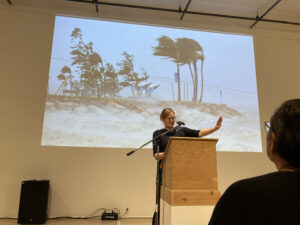
Other entertainments include a town hall meeting last week in Victoria, at the invitation of Victoria’s one and only NDP member of parliament, Denise Savoie

with NDP agriculture critic Alex Atamanenko, where a room packed to the ceiling with farmers and foodies

rocked and rolled and got excited about food security issues that affect an island like ours. There was a lot of talk about the potential effects of a food crisis on an island that imports 95% of its food, and about the very interesting observation that here, where 90% of the population say they garden, only 10% of those gardeners grow any food. I had also heard earlier that there are only 5 or 6 full time farmers on the Saanich Peninsula’s dozens of farms. One organic farmer, David Chambers

spoke forcefully on the desperate need to inspire and reward young aspiring farmers so that there is someone to carry the growing and farming knowledge into the next generation.

Writer/editor/farmer Tom Henry

was representing small farmers and talked about the difficulties small producers have in meeting the stringent requirements of national grocery chains: they are not growing in sufficient volume to be able to produce only those perfect fruits and vegetables picky shoppers have been encouraged to demand. Which is only one reason you don’t find more local food in your local supermarket.

Other speakers talked about community gardens and the need to introduce bylaws to allow the growing of food on every available piece of common land. As Carolyn Herriot said, if there’s a food crisis on the mainland, do you really think anyone’s going to stop and put food on a boat for us? A model of self-sufficiency (she achieved it in five years), her proposals include planting edible ornamentals, saving seeds, and acquiring the skills to grow food all year round.

Doing my small part this special year, here are my first ever spuds, and I think they’re beautiful:

Sunday saw a lot of rain, and a lunchtime visit to Merridale Cidery

where the wood fired oven was making its presence a little too obvious

right into the dining room. We didn’t pause for a tasting

as we’d done that a couple of years ago, but we did settle down for a lovely lamb burger

before the drive back over a more than misty Malahat.

Yesterday was dry and fine and perfect for driving to Duncan to visit the dentist. After which, a little lunch with Shirley in Maple Bay where her potentially prize-winning succulents were blooming

safely out of reach of the chief garden pest, looking a little thin we thought, as it trimmed the clover.

1 Comment


The pit

Spent last Sunday learning about pit cooking – and many other things – from the wondrously encyclopaedic Nancy Turner. It was a Slow Food Vancouver Island event, and about 20 of us made the schlep out to Sooke Harbour House where the sun shone while we shivered on the shore, grateful in the end for fire.

Although the pit had been dug for us (phew) by some Wwoofers, it was apparently too big, so had to be filled in a bit.

The next point of business was to find some smaller rocks for cooking: the large rocks were deemed suitable for lining the pit, but the food itself had to sit on smaller rocks, preferably lava, and without any cracks.

We lined the pit

and started the fire with some of Nancy’s fuzz sticks which made light work of kindling.

While the fire gathered heat and warmed up the rocks to cooking temperature, Nancy entertained us with some interesting foods. She brewed us a nice pot of Labrador tea, which also included other local delicacies like nootka rose, stinging nettle, yerba buena, subalpine fir, liquorice fern root (a powerful sweetener), dried saskatoons and dried yarrow.


Onto the fire it went.

And it simmered away while we had a nice snack of bannock, molded onto green sticks

and toasted over what was now getting to be a very hot fire.

Tea time.

Then there was a nice snack of porphyra, a near relative of nori, which had been harvested in the Broughton Archipelago and then dried

and was particularly tasty toasted on the bannock sticks.

Eventually all was ready,

the fire was hot enough,

and Nancy gave us a thorough briefing, as the pit and food have to be assembled quickly and in sequence.

With a pole to guide the laying of food, the rocks are covered with ferns and salal branches…

the salmon goes on…

add some shellfish, veg

and a bowl of water (the cooking method has more to do with steam than fire)


cover it all up with more ferns, more salal branches, and top with soaked burlap

then shovel dirt over all

until it’s completely covered.

At the end of the cooking time (in our case a somewhat excessive 4 hours or so, but in large traditional pits as much as 24 hours), uncover — carefully


and decant the food onto platters

and lay it out

to enjoy in a gorgeous al fresco dining area

and finish with some of Sooke Harbour House’s excellent desserts.

2 Comments


Honey extracting

Last Monday a group of us went to Larry and Marilyn’s for an extracting party. So absorbed was I in my task of finding cool comfortable clothes to last me a day in a warm garage I forgot to remember who else might be there…

but luckily was able to adapt my wardrobe to suit the conditions and escaped without a sting, although not everyone was so lucky. The bees were a bit dopey and curious and kept a close eye on us and the honey supers, and did a bit of the fine cleaning.

First task was to cut the cappings on the honey. There were several tools at our disposal. Top of the line was the capping knife,

which melts the tops off in one fell swoop, with relative speed (depending on who was operating it)…

and then there’s this more modest version…

and finally the capping comb, which is useful and necessary for finishing work as well. They must all be used carefully as you don’t want to damage the comb and make more work for the bees when you return the frames to the hive.

Then the frames, dripping honey, are positioned in the extractor, either a larger-capacity mechanical one

or a hand-cranked model that can do two frames at a time.

After a while it starts to flow…

and flow.

And then, when you have uncapped as many frames as you can,

you can down tools (the cappings are melted down for the beeswax)

and go for lunch. If you are not too full from sampling fingerfuls of honey.

Comments Off on Honey extracting


Food price issues for low incomes; BC Day, blackberries and zucchini

In Our Food, our Future last week, the topic was the impact of high food prices on those with less disposable income, where the proportion of monthly income spent on food is escalating with possibly dangerous results. Some interesting issues raised. The rise in obesity among poor people, because fatty, sugary foods are cheaper than better quality ones. The lack of practical food skills (selection, preparation) among those who need them most: young, pregnant or breastfeeding women, single parents, students. The difficulty of feeding ever-hungry teens on a small budget. And the economic risk of experimenting with cooking or dietary change: if you are on a very tight food budget, with children to feed, monotony is a big problem, because you must stick to foods with a long shelf life (fatty, sugary, highly-processed) that you know how to portion and prepare, and that your family will eat.

It’s been party time in Victoria. Last weekend was BC Day, and the crowds were out in the inner harbour,

the Snowbirds did an impressive flyby.

I didn’t stay for the evening’s open-air entertainment which included Burton Cummings, Feist and Sarah McLachlan, because I had food to think about.

The Himalayan blackberries are in season now, though I suspect people are not picking them because there’s a rumour about (repeated to me with my berry pail at every turning) that they aren’t ripe until the end of August. Ok, so believe that if you wish. I believe with mine eyes and mine palate and mine berry bucket.

During an irresponsible visit to some farm markets, I bought loganberries and giant boysenberries, which for scientific purposes I compared in my berry line-up, in order of size, with a Himalayan and a native blackberry.

Then, because my apples are ripe and my berry pail full, I made pie. Rather good with Udder Guy’s strawberry ice cream.

And for those who say to me “but don’t you get tired of zucchini?” I can only laugh sadly and smugly. There’s soup to be made, chocolate-zucchini cake of course, but also zucchini parmigiana as earlier mentioned, and this wonderful thing which I sampled last April (paired with smoked provolone) at the wonderful La Croce di Malta in Parma. I thought the proprietor was calling it zucchini escabeche, but in fact she was saying Zucchini alla Scapece,

which is a superb Italian cousin; by her account from Sicily. It’s a wonderful substance, featuring fresh mint, garlic and vinegar and – best of all for dinner party purposes – a good long sit on the kitchen counter. I read that its combination of sour and sweet flavour signals its origins in Spanish cuisine, and its roots in Spanish-ruled parts of the country.

1 Comment


Organic weeds

I spent some time reflecting on the back-breaking nature of organic farming last week.

Wednesday’s tasks at Haliburton were to liberate the squash patch from smartweed, which was something more than abundant.

Four of us made a good dent

and were rewarded with lemonade and some rejected potatoes, which I took home and roasted with thyme, lemon and mushrooms, as instructed by Nigel Slater.

Saturday I paid a visit to Local Yokels, where with my growing weed-naming skills I can with some certainty say that we pulled smartweed, sorrel, morning glory, plantain, mustard and lots of other stuff from the squash,

the broccoli

the cabbage

and the corn (boo!)

Couldn’t say hello to the chickens as they had been taken away for a holiday to get over the trauma of witnessing whatever was killing their kin – a weasel, it was thought, rather than raccoons, as the corpses were left in the chicken tractor. Whatever it was, security’s going to be ramped up considerably before they return to the field.

But the berry trail was looking good, with lots of berries ready for the picking.

And the bees are very happy in the borage

though it’s nearing the end of honey season, and I’m looking forward to a visit to Larry & Marilyn’s to help out with some extraction on Monday.

Comments Off on Organic weeds