Skip to content
Home » Archives for 2012 » Page 3

2012

Eat there then

Eat Here Now signI’m a week behind in my entries, so here goes the catch-up. Last Sunday’s Eat Here Now festival looked to me to have been enormously popular, with lots of food being eaten and bought and talked about in Market Square.

The square had been divided into an eating and entertainment side, and a vendors’ side. Crowds seemed to be milling evenly between the two by the time I left, but as I arrived at lunchtime, I headed with sooo many others to the taste for a toony buffet provided by locally-oriented restaurants. Cosmo Meens, as always, drew a crowd, this time offering a curried tofu soup with focaccia, an offering from his new Hot and cold Cafe. Relish was there with a “Vietnamese sub” of house-smoked pork terrine and asian vegetables; Sooke Harbour House’s lovely little quinoa salad with salmon, seaweed and other local delicacies, came with an all-too tasty edible scoop, but I’d be surprised if many of them lasted long enough to do their job. All in all it was a hard day for vegetarians: aside from those mentioned, and some mushroom ravioli from Cowichan Pasta, almost every stand offered meat; of which Kulu’s spicy sausage got my vote, if only because it came laden with kimchi! (Luckily for the non-carnivores, Green Cuisine was open for business on the fringes of the festival.)

Relish Vietnamese SubSooke Harbour House Salad


Canoe Brewpub's Pulled PorkKulu's Spicy SausageSmoken Bones Meaty Sandwiches


And then it was time to browse the vendors’ stalls, which of course included Haliburton Farm, where Farmers Nate & Mike were holding the fort; Libby Seabrook was doing a brisk trade in InfuseTea (her blueberry & rosemary blend is to die for, just for the record); Fry’s Bakery was selling mini-pizzas, blueberry scones and rather beautiful baguettes – can’t wait for them to open their shop on Craigflower Rd, which is rumoured to be happening later this month. City Harvest was there with urban abundance, Wildfire had some tempting shortbreads (lavender and local wheat were my picks) and Sun Trio’s tomatoes were as beautiful as the day was long and sunny.

Haliburton - Farmers Nate & MikeInfuseTea - Libby Seabrook

Frys BakeryFrys BaguettesFrys Blueberry SconesCity HarvestWildfire Bakery


Sun Trio Tomatoes

Slow Food Lamb Roast

Cory Pelan loves lamb, and he likes it best in a farmer’s field with lots of people bringing lots of lovely food to go with it. So yesterday afternoon he and the Slow Island convivium put on a summer party to raise funds for sending Vancouver Islanders to Terra Madre this October.

We sat on hay bales (invited to bring blankets to cover them) and watched the lamb turn on its spit until it was time to dine. Some idled away the time visiting the pig pens to see the heritage breed pigs that farmer Tom Henry raises there. Cory did the carving, assisted by Peter Zambri and watched by a host of hungry foodies.


By this time platter after platter of side dishes had arrived (I think it best to let the food speak for itself):


…and there was a groaning board of desserts as well.

Seediness & worminess

Artichoke with TreefrogA group of Gorge Tillicum Urban Farmers visited the Garden Path last week, to have a look around at a garden going (deliberately) to seed.

Carolyn Herriot walked us round the garden she carved out of broom and bracken about 12 years ago, and which over the years has been an organic plant nursery, a source of local organic seed, and now a fruitful training centre for interns. Carolyn has increasingly turned her hand to writing and is awaiting release of her new cookbook, The Zero-Mile Diet Cookbook, which follows her last book, The Zero Mile Diet: A Year Round Guide to Growing Organic Food.

Here she checks artichokes, which are ready for seed collection when the flower turns to fluff. Her leeks are in bloom, to the delight of the many bees who visit the garden. And she showed us a box of peas that had been collected and put into a container for freezing. Although they’d been carefully checked for pea weevil, freezing the peas for several days would make sure that anything missed would not hatch.


Pea weevil is a problem in summer peas; any planted after June should be resistant varieties, as the weevils bore through the pods and into the peas to lay eggs, which hatch out and can stunt or destroy seedlings as well as ruining the peas for eating.


Below, Carolyn shows off her Jerusalem artichokes. Every year, she said, she digs them up and leaves none behind, and every year they gallop back larger than life: I am grateful I had only planted mine in containers, and even there they happily go on self-propagating. Another reliable returnee is oca (oxalis tuberosa), a hardy little tuber from Peru via New Zealand, which sports lush, four-leafed foliage and produces lemony morsels ideal for roasting. Carolyn has introduced it to our area, selling tubers at Seedy Saturdays for several years now, and they volunteer back each year. New this year is the asparagus pea (Tetragonolobus purpurea) which looked a lot like one of the wild greens we picked when I was in Crete – probably was the same, since this hails from the Mediterranean. Pretty and tasty.


One other novelty item Carolyn’s been selling through Seeds of Victoria is the strawberry spinach (Chenopodium capitatum), which was rather beautiful.

After that it was time for a sip of juice – which Carolyn makes with a steam extractor – and a look at some of her seed-saving. We also got a pep talk about the gut flora which have become a great topic of interest to her through her research for her cookbook, as have recipes involving fermentation which feed those beneficial organisms.


Last weekend marked the 20th anniversary party and plant sale at the Greater Victoria Compost Education Centre, where a life-sized red wiggler was handing out gummi-worms and birthday cake, while outside were a number of vendors, including foodista turned tea-wallah, Libby Seabrook, offering some delicious herbal concoctions. Also spotted was Farmer Tina from Corner Farm in North Saanich, digging a nearly released local book.


Bee-gone cruel world

Bombus vosnesenskiiAs mentioned previously I returned home to find my Bombus box deserted and only a couple of sickly bees still staggering about under the bedding.

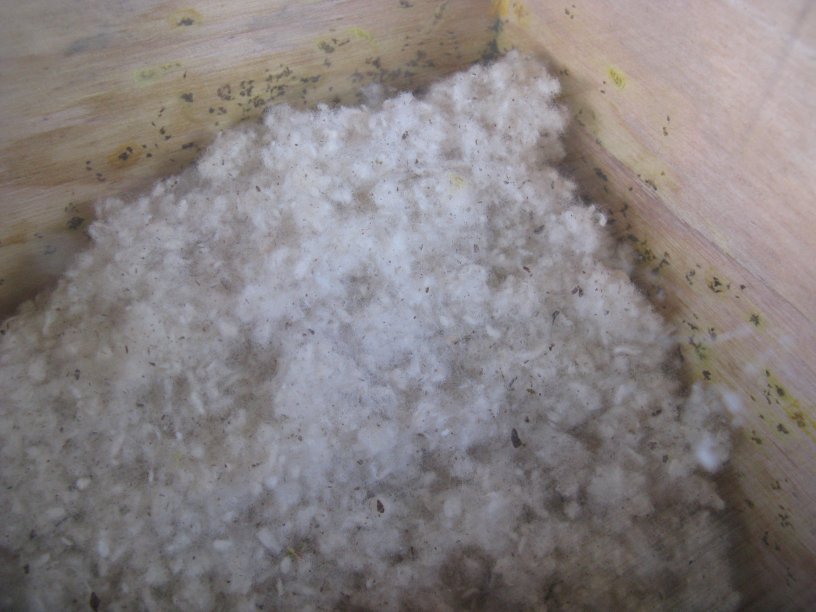
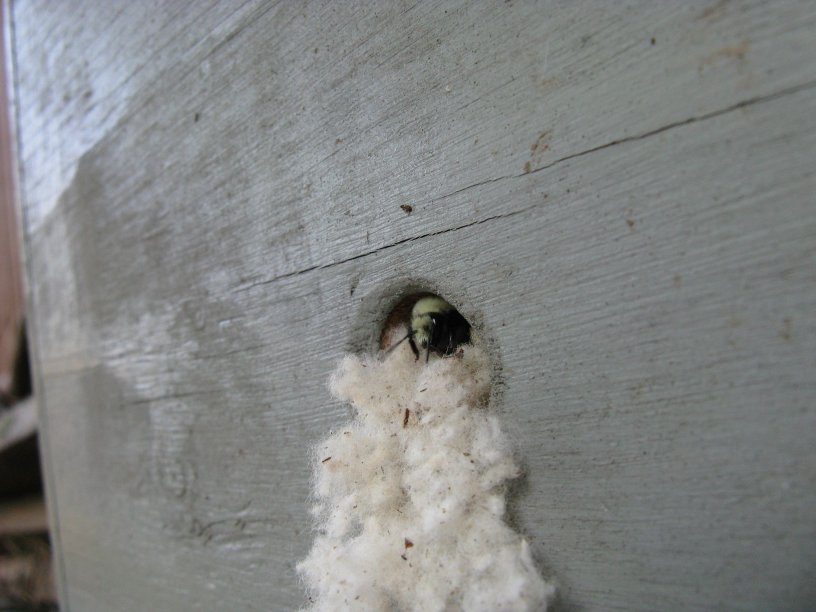
Mine were Bombus vosnesenskii or yellow-faced bumblebees, and I’d lured them into the box in the spring by placing it their path after I’d noticed the queen bumbling around my wood pile with the determined air of a house hunter. The box came pre-bedded with cotton mattress stuffing, and the first sign that the box was occupied was a spill of bedding out the entry hole. When I lifted the lid to look, the bedding seemed mounded up, and there was, well, bee dung on the walls. As soon as the lid was open, a bee shot out the front to ask what my business was, and after a while I noticed there was always at least one bee stationed at the entrance, with workers coming and going around her.

Bombus box entranceOccupied Bombus nestBombus vosnesenski


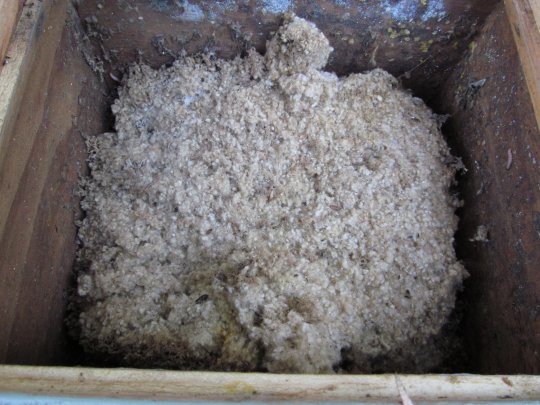
The hive was thriving up until the time I left, in late July. When I returned last weekend I noticed there was no bee in the doorway, and when I poked around inside, there was no more activity, and the bedding was grey, the walls were grey, and there were moths and maggots crawling around.Abandoned Bombus nest

I asked my friendly neighbourhood entomologist (every neighbourhood should certainly have one!) for advice. He said it had happened to him as well sometimes, and put me onto a bumblebee specialist, who swiftly replied with the following comforting words:

That’s a pretty standard finding towards the end of the colony.  There are many parasites that take over once the queen is done laying her eggs and the males and new queens leave the nest.

Well, comforting for me anyway. I had seen a yellow-face bopping around in my tomato flowers just the other day, so I knew they were still about, and I hoped that the tomato-lover had been one of the hearty offspring of “my” hive.

In truth I was a tiny bit relieved they had gone as they were quite frisky, if not downright aggressive: for some reason one would always emerge to dive bomb me when I went into my compost bin for any length of time, and then zoom around in the bin while I was trying to dig it over. I finally had to resort to wearing a headscarf if I wanted to dig things into the pile to keep them from tangling in my hair.

But then yesterday as I was starting to clean the box out – all maggoty and grey and sticky – I paused at the compost bin and darned if I wasn’t bopped in the head by a bombus. A big one, a queen I guess, as she was about three times the size of the workers who’d been hanging out the door in days gone by. She flew around and around the space where the box had been until I ran and fetched it. She entered and quickly backed out, then wandered around the front as if checking to be sure it was her own front door. Put her head in the door again, backed out, and so on for five or ten minutes,  until she finally gave up and flew away.

Wrecked comb+Bombus corpsesBombus vosnesenski QueenBombus vosnesenski queen


I emptied the box, washed it and set it out on the grass to dry. I’ll bleach it later. But as I was climbing the ladder to the apple tree nearby, darned if she didn’t buzz me again. Clearly she has assigned blame for the whole sorry state of affairs, and I am the villain. But how do you apologize to a bee?

Here’s a good video showing the amazing things that happened in bombus world, under all that cotton fluff.. for a few months anyway.

A lesson in not waiting for permission

The Transition Network (and Transition Towns)  exist because governments are too slow to respond to the need for urgent change. Community action can fill the void, and the town of Todmorden in West Yorkshire proves the case in point. All you need is a group of people with passion and vision and the will to plant in every scrap of land and teach one another the how and why of growing food. Check out the Incredible Edible Todmorden website, but first watch this inspiring TED talk.

ALECC 2012 – Space + Memory = Place (days 4&5)

Saturday morning we repaired (by schoolbus) to the beautiful spaces at Okanagan College, where the luckiest presenters spoke in the curvy pod at the top of the stairs, but really everything was lovely there, including a fine breakfast of fresh muffins (featuring Okanagan apricots) and lots of fruit.

Okanagan College PodBreakfast fruitFruit+muffin


The best overall session of the conference for me was one called Looking Away, Looking In, Looking Under: Perspectives on the Okanagan on Saturday morning, which featured a lively talk by Kelowna’s own George Grinnell on Patrick Lane’s novel Red Dog, Red Dog which is set in the Okanagan; followed by an entertaining if depressing look at development by another local speaker, Daniel Keyes (White + Green Space Invader: The Rhetoric of Development in the Okanagan) – check out the toe-curling promotional video. Poet, blogger and essayist Harold Rhenisch finished things off with Caraway & Pippins, a luscious essay that circled around the Newtown Apple (each “a tiny earth, a green planet”) as an emblem of the cultural and agrarian changes wrought by commerce and industrialization on the Okanagan.

The Saturday junket to the farmers market was a brilliant idea, but much too short a visit. No sooner had I downed my black bean-chickpea quesadilla than I was sprinting up and down the aisles, power-shopping for produce – a giant fennel bulb, a jar of local salsa, a box of sweet yellow cherry tomatoes – the latter from Curtis Stone, who had mentored another SPIN farmer at the market, Janice Elliott – and trying to find an organic peach grower.

Kelowna Farmers MarketKelownaFarmersMarketKelowna Farmers Market


I had come to the Okanagan with a mission: organic peaches were on my mind. As you may know, dear reader, peaches are right near the top of the Dirty Dozen, a couple of fruits below apples, and so one of the best places to put your money when buying organic produce. I’d been warned that I might have to make a side trip to Cawston or Keremeos to find organic growers, as most of the Okanagan fruit in the Kelowna area is chemically produced. At the 11th hour (12:58 in fact, since the stallholders start packing up at 1pm) I was pointed to the Fruit Guy, Michael Welsh, who grows without pesticides and sold me a 20lb case of beauties (he also writes very fine poetry, according to Nancy Holmes, but I didn’t know that at the time.) The catch was I had to drag it back on the bus and get it back to our residence so I could pack it into the car for the morrow’s trip back to Victoria.

Mission accomplished, fruit in hand, grateful to be back in the cool of the building, I settled into an easy chair in the pod for the last Saturday session, Unmemoried Heights? Thinking In/With the Rockies, starring Gyorgyi Voros who took us on an excellent adventure: Wallace Stevens‘ hunting trip to BC; Tempest Emery who talked about landscape and memory in Sid Marty‘s work; and Benedict Fullalove who invoked a host of odd characters, from Rupert Brooke to Viscount Milton & WB Cheadle and Howard O’Hagan before the clock ran out on his Unmemoried Heights: Historicizing the Rockies.

Sunday morning began with probably the best yoga session I’ve ever attended, at 7am on a sunny, dewy lawn overlooking the valley. After that, temperatures already starting to climb, came a blur of packing and vacating and hanging about waiting for the most welcome coffee, fruit and pastries which arrived mid-session: our saintly panel chair released us to seek refreshment mid-panel, while being entertained on the subject of Generation A by Richard Pickard, Cate Sandilands and Jenny Kerber.

I had to depart after that session in order to get to the ferry with reasonable confidence of getting home before midnight; the traffic was horrendous, stop and go for an hour or two on the baking highway beyonFerry, sunsetd Hope, until I got nearer Tsawwassen and those welcome sea breezes. Ironically, given the last session of the conference, the saddest news awaiting me when I returned to my garden later that night was the death of my bumblebee colony. My local entomologist can’t be sure what the cause was, just disease of some kind he thinks.