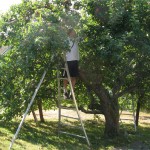
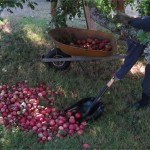
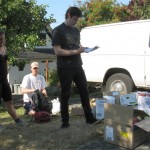
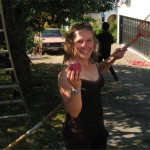
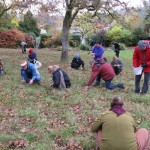
 I attended a workshop yesterday organized by the Victoria Transition Capital Nut Project in Playfair Park, a restored Garry Oak Meadow in Victoria. It attracted a couple of dozen brave souls willing to stand in the November chill and learn how to make Garry Oak acorns edible. Being the proud custodian of a very large
 tree myself, and being overshadowed by a number of others, I thought it would be a worthwhile skill. We were led through the process by ethnoecologist and wild food forager Abe Lloyd.
We learned about defects to watch for. Sprouted acorns (Garry Oaks are white oaks, a class of tree whose seed germinates in the autumn) are not necessarily a problem, although they are often cracked, which may allow insects or mould into the nut. Acorns with caps still in place when they fall are no good because the cap usually covers some mould. A small hold indicates that a worm has eaten the contents and left the premises. Spotting – especially dark discolouration – can indicate damage. The best way to find out is to open the nut (they are soft enough to crack with your teeth) and check. This time of year – October or November – is the best for hunting acorns. Early falls (August, September) are usually unripe or damaged nuts so should be avoided.
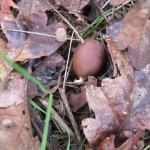
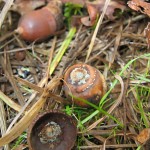
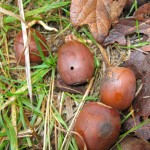
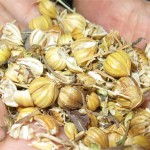
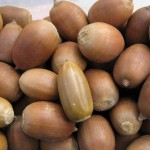
He showed us some samples – with a couple of English Oak acorns for comparison (there are a few of these trees in Victoria, though Garry Oaks are the native species). The ones that were still in their shells had been dried; his guideline for readiness was when the shell could be cracked easily by hand or nutcracker (or hammer). The shelled samples included some black ones which he said were still fine, but he’d hastened the drying process and discoloured them (they can be dried on racks, with fans or with a dehydrator). After drying, he ground them to flour in a blender. Because they have an oil content of about 10% they’re not well-suited to grain mills that use stone grinders, as they might gum them up (there is less oil in flour grains like wheat).
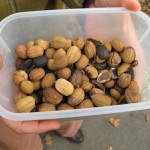
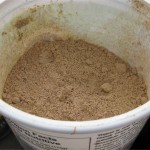
As it circulated, Abe invited us to have a sniff and a taste of the flour. We could smell the sugars in the flour, but it tasted bitter, because of the high tannin content in these acorns. The next step was to leech out these tannins, by soaking the flour in water for four or five days, pouring the liquids off morning and night, and then tasting the final product to check for bitterness. The colour of the liquid changes, growing lighter as the tannins are removed. The final sludge can be used straight away as a batter for flatbread, or dried and used with flour for flavour (bearing in mind it is low in glutens so wouldn’t make great yeast bread on its own).
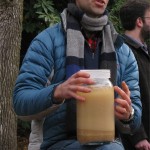
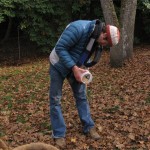
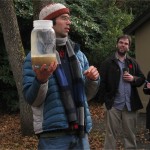
Abe demonstrated his flatbread technique. He usually adds maple syrup to sweeten the bread a little, but it worked well without.
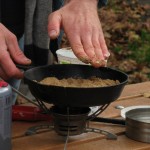
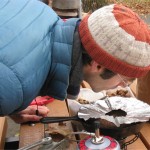
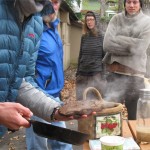
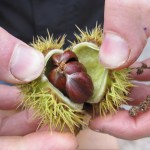
A morsel of hot acorn flatbread: just the ticket. Someone had brought some Spanish chestnuts – the edible variety which unfortunately don’t have quite enough time to ripen in our temperate climate. And local agrologist Kendell Neilsen was on hand with a sample of hazelnuts she’d gathered in the area.

 The Transition Network (and Transition Towns) exist because governments are too slow to respond to the need for urgent change. Community action can fill the void, and the town of Todmorden in West Yorkshire proves the case in point. All you need is a group of people with passion and vision and the will to plant in every scrap of land and teach one another the how and why of growing food. Check out the Incredible Edible Todmorden website, but first watch this inspiring TED talk.