Skip to content

farm tours

A poetry survey – for readers & writers; LifeCycles local food fun-raiser and Sooke farm & garden tour

Marketing has come to poesie! If you want to make your views known about what you read, where you buy it and what moves you to do so, help yourself to the Literary Press Group’s survey of the poetry market.

A few short days remain for those wishing to RSVP on a mouthwatering invitation from LifeCycles: RSVP by July 30th! It’s holding a summer soiree – the Local Food Fun-raiser – featuring “local food, drinks, music, a silent auction and great fun.” All happens Thursday August 11th, 2011 from 6-9pm @ Sleeping Dog Farm, 1506 Burnside Road West, Victoria BC, with catering by Nourish and Real Food Made Easy. The price is $60 with local alcoholic beverages for sale (charitable tax receipt given for a portion of the ticket). All proceeds will go to support LifeCycles core programs. For tickets (available via Paypal) head to LifeCycles website, or visit The Good Planet Co. located at 764 Fort St. in Victoria.

And if you’re out Sooke way, or would like to be, you can support Sooke Region Food CHI Society by attending its second annual Farm and Food Garden Tour on Sunday, August 14, from 10am-5 pm. This self guided tour will feature 11 unique local farms and gardens in and around the Otter Point area.

If you want to get more involved, you can contact Keeley Nixon if you’d like to volunteer at one of the venues to work with a grower, meet and greet people, and help with any set up/take down. This is a great chance to connect with more people in the community and show you support for our farmers.

Tickets are $10 (free for ages 15 and under) and are on sale now in Sooke at Shoppers Drug Mart, Peoples Drug Mart, Double D Gardens, Westburn Garden Centre, and Sooke Country Market (Saturdays). In Victoria, tickets are available at all Dig This locations and Moss St Market (Saturdays). Free for ages 15 and under. Tickets are also available in Sooke on the tour day at Shoppers Drug Mart and Peoples Drug Mart. Contact the Sooke Food CHI for more information.

A pair of farms and an old dog

Spent some time at Haliburton Farm this week, collecting my latest CSA basket and seeing what was up with the farmstand and the farmers. “What a beautiful farmstand!” said one woman, visiting for the first time. And she was right: it’s in its glory just now.

2011 Haliburton Farmstand Carrots2011 Haliburton Farmstand Kohlrabi2011 Haliburton Farmstand Broad Beans


And the veg box bounty reflects that too:

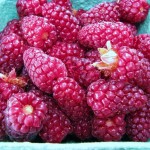
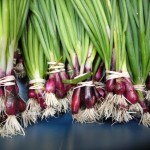
2011 Haliburton CSA Blackboard July202011 Haliburton CSA Tayberries July202011 Haliburton CSA Purple Green Onions July20


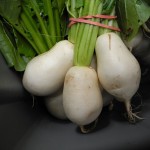
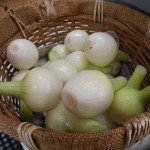
2011 Haliburton CSA Salad Turnips 20 July2011 Haliburton CSA Salad Mix July202011 Haliburton CSA Onions July20


While elsewhere on the farm, the bees are buzzing, the weeds are growing, and the potatoes need hilling with a nice bit of straw.

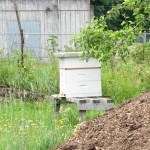
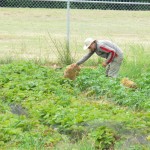
2011 Haliburton Bees Orchard July202011 Haliburton Farmer Emily Weeding July202011 Haliburton Farmer Nate Putting Straw on Potatoes July20


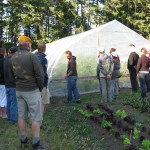
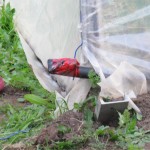
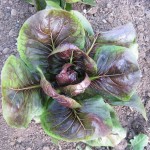
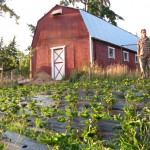
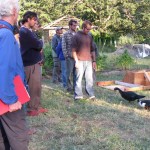
Last night’s COG-VI farm tour was in Metchosin, at Sweet Earth Farms, where farmer Ian King explained how his mobile greenhouses can be pulled on their metal runners to help extend his seasons. We all admired his radicchio which was fortunately too bitter to interest the deer that had just broken into the field, obliging the purchase and installation of new deer fencing.

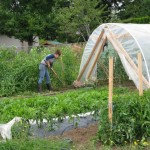
Sweet Earth Farms GreenhouseSweet Earth Farms Greenhouse RunnerSweet Earth Farms Radicchio


Then we got a look at the raspberries (thriving) and the strawberries (likewise) and were inspected by a couple of bold and curious ducks

Sweet Earth Farms RaspberriesSweet Earth Farms Strawberries+MikeSweet Earth Farms welcome ducks


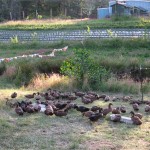
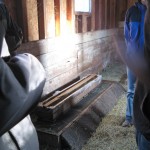
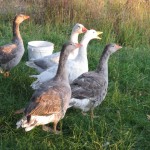
unlike the rest of the flock which were young and skittish. Their duck barn boasts a custom designed water trough which sits on a mesh-covered drainage box so that their wild drinking doesn’t end up soaking the nice thick straw floor. The geese were interested and vocal; they are Pilgrim geese, an endangered species, so Ian is planning to raise goslings to try to safeguard some numbers locally.

Sweet Earth Farms ducksSweet Earth Farms water trough duck barnSweet Earth Farms Pilgrim Geese


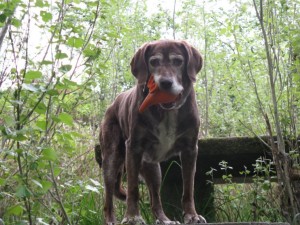
And the final farewell goes to old Anton, who passed away today after an extremely long and joyful life, aged 15 and 3/4.

Anton Colquitz Park

Beef and chicken à la française

So here we are in France. We arrived on Sunday morning, in Lyon, and I for one am rejoicing in the cooler temperatures – Parma was a steamy 35 degrees when we left. We’ve had our customary stage weather – chilly and drizzly with a bit of sun thrown in.

We had a free night in Lyon and headed for Le Nord, one of the Bocuse brasseries, on the expert recommendation of a local (thanks Jeremy). An excellent salad of green beans, artichoke hearts and a silky slab of foie gras de canard, followed by a wholesome waffle with sides of applesauce, warm chocolate and cream. Pas mal, and a good entree to France.

Monday we were up with the birds and off to Bourg-en-Bresse where we met our new friends Philippe Marchenay and Laurence Bérard, researchers in food and bio-ethnology, who talked to us about geographical designations and biodiversity in French food products.

Our first example was Charolais beef, plodding towards AOC/PDO designtion and so widely known already that they have their own museum at la Maison du Charolais, where we had a talk and a tasting.

Then onto the bus and off at a Charolais farm.

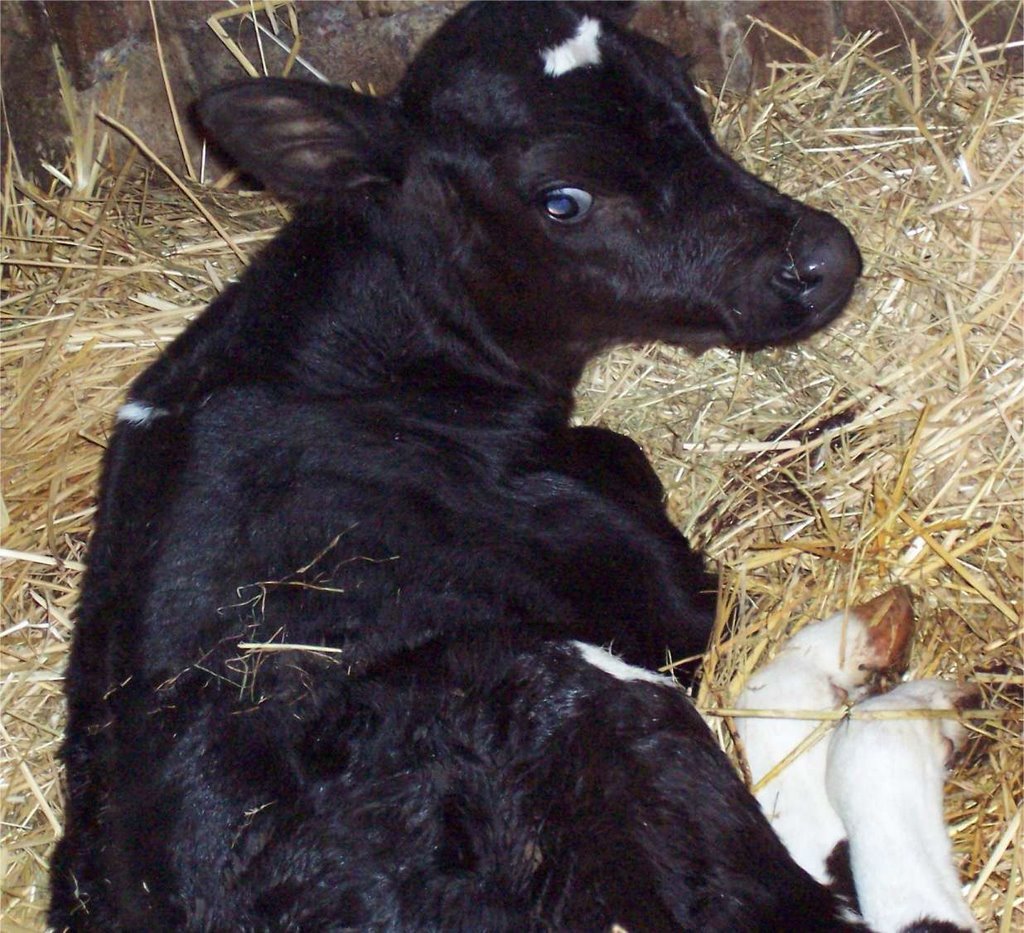
Dominique Gateau, the owner, talked to us about his breeding practices, which involve 24 hour video surveillance during calving, which lasts from January till June. We met a few of the newcomers and were shown some of the qualities that make good beef cattle.

Afterwards, he set up a little wine and cheese party on some hay bales, featuring of his own goat and cow cheese.

And then back to le Maison du Charolais where they also have a restaurant, and we had a Charolais steak before heading off into the night.

Tuesday morning we ambled across the street to Lyon’s excellent food market, les Halles de Lyon, where Philippe and Laurence guided us through the stalls.

We fetched up at a great cheese stand and bought plenty for lunch which we enjoyed in Philippe and Laurence’s comfortable house in the country.

Lots of cheese, wonderful bread, salumi, apple juice, Philippe’s cornichons, a bowl of fresh strawberries, and their neighbour’s wine.

Then to the Bresse Chicken farm owned by Christophe Vuillot, who, at 37, thanks to skills at poultry farming learned from his grandfathers, has a happy life raising his happy chickens who fill the fields around his house, with a small flock of guinea fowl and a grey border collie keeping an eye on them. The birds are long maturing, fed on a mixture of special poultry feed and what they forage in the grasses, and they are given a helping of whey in their feed which works as a natural preventative against worms and parasites. They are also, of course, healthy enough that they don’t need the chronic antibiotics that battery farmed chickens do.

We were given a demonstration of the dressing of these very special and very expensive chickens, which are slaughtered on the farm, their head and neck feathers left on (for aesthetic purposes, the farmer explained) and then sewn into a linen casing that expels air and acts as a secure protection for up to a week. The chickens are prepared this way for competitions and feast day – 150 of them are hand sewn each Christmas at this farm alone.


And for supper, we had… chicken.

Tuesday: the pig breeder and then lunch at La Nonna Bianca

Phew. I have been in more than one barn in my time but never one that smelled like Tuesday’s. This was a day to sober the hardiest meat eater: when we parted ways at the end of it I was reminded of people leaving a funeral.

Our guide through this version of hell was Francesco Sciarrone, the veterinarian and meat inspector who had previously talked to us about animal welfare and slaughterhouses. He and the pig breeder answered questions afterward, and at one point someone asked him how he felt about eating pork, witnessing as he does the entire grim saga from industrial pig production through slaughter every day.

Traditionally, he observed, people ate meat once a week, or maybe every couple of weeks; nowadays we expect meat every day, even several times a day. So, his implicit reply was: if you want meat every day, this is the market economy’s way of fulfilling that request.

He told us he himself doesn’t eat meat every day; he has it maybe once a week, and for that he goes to the butcher in his town, so he knows how the meat was raised and who is slaughtering and processing it. So he pays four, five or maybe six times what we’d pay for the meat of the animals in those hellish sheds, but that’s what it costs to raise it humanely. And he’s fortunate to be in a part of the world where small scale butchers have not yet been entirely driven out of business by supermarkets. (I recently saw some figures for England: The number of butchers in Britain has declined from 22,900 in 1980 to 6,600 in 2005.)

I guess that makes it vote with your feet time. Here’s the Italian version of where that pork chop on your plate comes from:

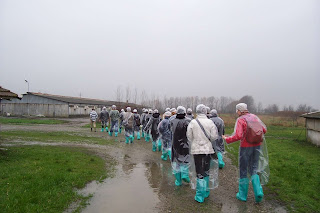
We kitted up in some protective plastic for the occasion and that kept the muck off us (but was more for the protection of the pigs from infection). The smell when we walked in to the sow shed was overpowering, overwhelming, persistent.
According to the EU, “Sow stalls are the most widely used housing system within the EU because they allow individual rationing, prevent aggression, are easy to manage and occupy little space. However, in some member states, the use of individual stalls for pregnant sows has been made illegal or is currently being phased out.” Signatory states have until 2013 to change their systems, but the stalls (aka gestation crates) can still be used to confine the sows for up to four weeks after gestation, according to the US Humane Society’s report on the subject (they also have a short video clip about sow stalls on their website). I was grateful to learn that the UK has banned these since 1999. I don’t know if there’s legislation governing this in Canada, but the largest pork producer in the US has just announced its intention to do away with them.

Anyway, here – from the point of insemination (usually artificial), for at least the next three weeks – they stand, sit or lie down, because that’s all they can do.

When after 21 days they are seen to be definitely pregnant, they are moved to another barn – which we didn’t see – to finish the gestation period, about three more months. (My reading tells me that at least 60 to 70% of US sows are housed in stalls throughout the entire gestation.) Presumably the ones who didn’t get pregnant the first time get to stand there for another round. If they’re lucky.

Then when they are ready to give birth, it’s into the farrowing crates; these too are designed so that the sow cannot turn or move other than to stand, sit and lie down, with what is called a “creep” area for the piglets to move around her. She is barricaded from them so that she does not lie on them (and damage the product). Even when they are safe from crushing, the farmer said there would be around a 10 percent mortality among the piglets, mainly from issues to do with development and feeding.
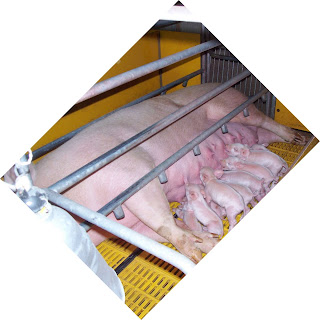
Once the piglets are weaned (by law when they are at least 4 weeks old), the sows are returned to what the EU coyly calls “service accommodation,” namely, in most cases, sow stalls. They can expect to live like this, moving back and forth from one crate to another, for their entire lives, which for good breeders last 6-7 litters (around 3 years). Longer lives than the pigs we eat, which are slaughtered when they reach prosciutto weight – about 9 months and 140kg.

When they’re weaned, the piglets move into teen (weaner) housing, kept in family groups. Not because we love them so, but because it keeps them from fighting for hierarchy and damaging the product. The promising ones – from a size point of view – are branded on the hips with PP – Per Prosciutto. We noticed this on some of the hams we saw at the prosciuttificio the day before.

This is all the fresh air these pigs get in their lifetimes.

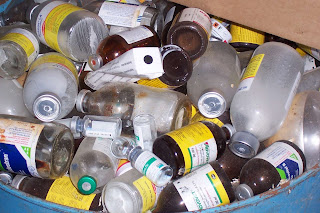
When you live in conditions like this, you get sick. This was the top of the nearly overflowing bin we passed on the way into the barn. Before slaughter, there’s a resting period for animals who’ve been on medication, to try to get the drugs out of their system – to minimise harm to the people who eat the product.
The illumination beyond the door, which looks like daylight, comes from the windowed or skylit outer areas of these barns; it’s not an outdoor run.
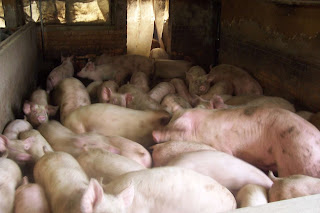
Again, kept in family or familiar groups to keep them from fighting. I guess this is where they stay either until they reach slaughter weight or until they are transferred to another farm to be “finished”. One thing I am guiltily grateful for: that our tour did not take place in the heat of summer, which I’m told is hot and humid – temperatures in the thirties and forties (celcius). I cannot imagine what those sheds must be like then.

The smell hung around for hours as we debriefed soberly afterwards at La Nonna Bianca, the very trattoria that waylayed Carlo Petrini on his way to talk to us. Even without the salumi, which we declined, the meal was pork-heavy: this is after all pork country. We each said, I’m sure, our private apologies to the pigs on our plates. I mulled over what Petrini had said when asked about animal welfare, something poetic about how you eat the violence you wreak on other living beings.

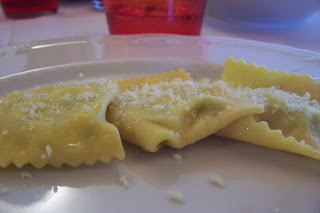
So, the food began its march across our tables. Petrini’s favourite: tortelli verdi (what we’d call ravioli, though by definition, it seems that here, ravioli are meal-filled pasta; these vegetable ones are filled with ricotta and chard, or was it spinach), followed by equally sublime tortelli di zucca (sweet pumpkin filling) (–they disappeared too quickly to photograph), both served with butter and parmigianoreggiano.

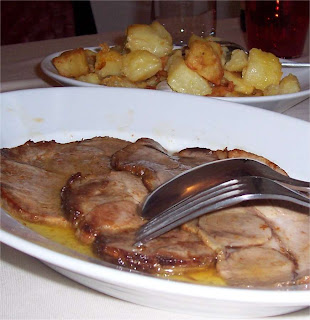
Coppa di maiale arrosto con patate all antico – rich, soft pork with fabulous pan-roasted potatoes, golden and tasty and speckled with crispy bits of rosemary.
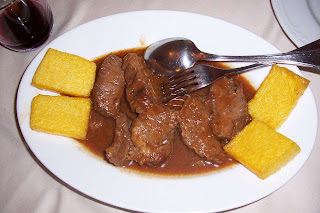
Guanciale brasato con crostoni di polenta (braised pork cheeks) with fried polenta (getting a little full by this point..)
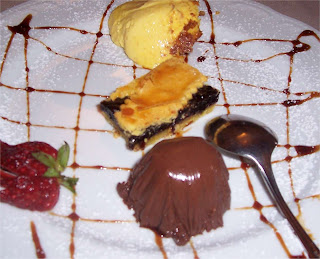
Gorgeous desserts – a kind of standalone creme brulee, a fruit tart and chocolate pudding.
Where the milk comes from

So today’s trip was to the dairy farm:
we got in the bus
to go to the farm
to meet the man
who owns the cows
who give the milk
that makes the cheese…


But before the farm, there was the Christmas market, and a stall selling small round edibles of a Sicilian persuasion.

Then there was the farm. More round things.


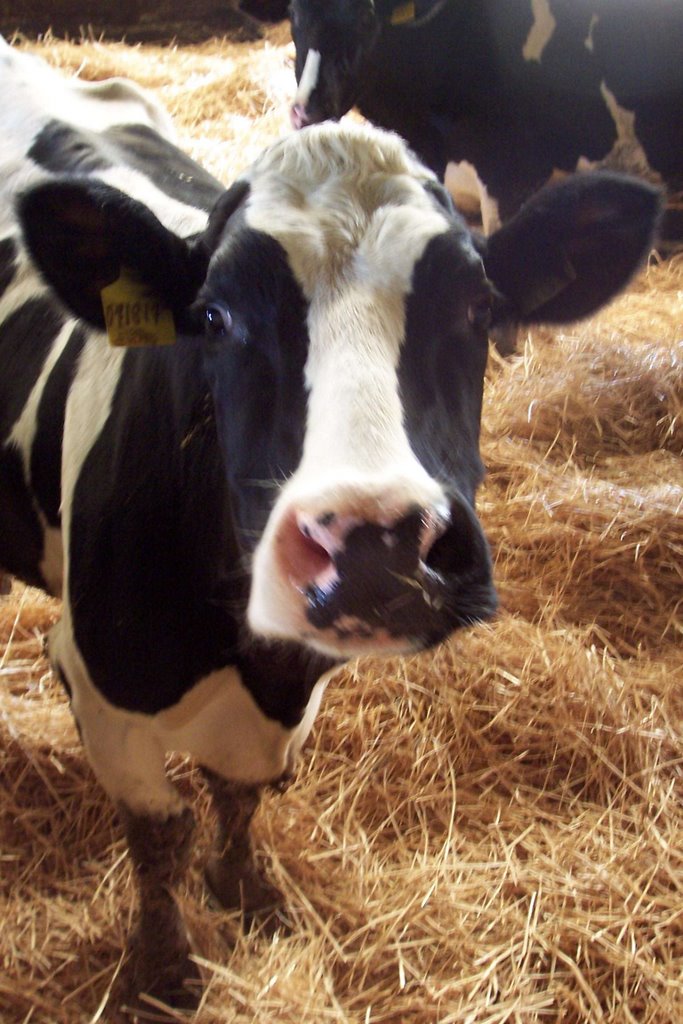
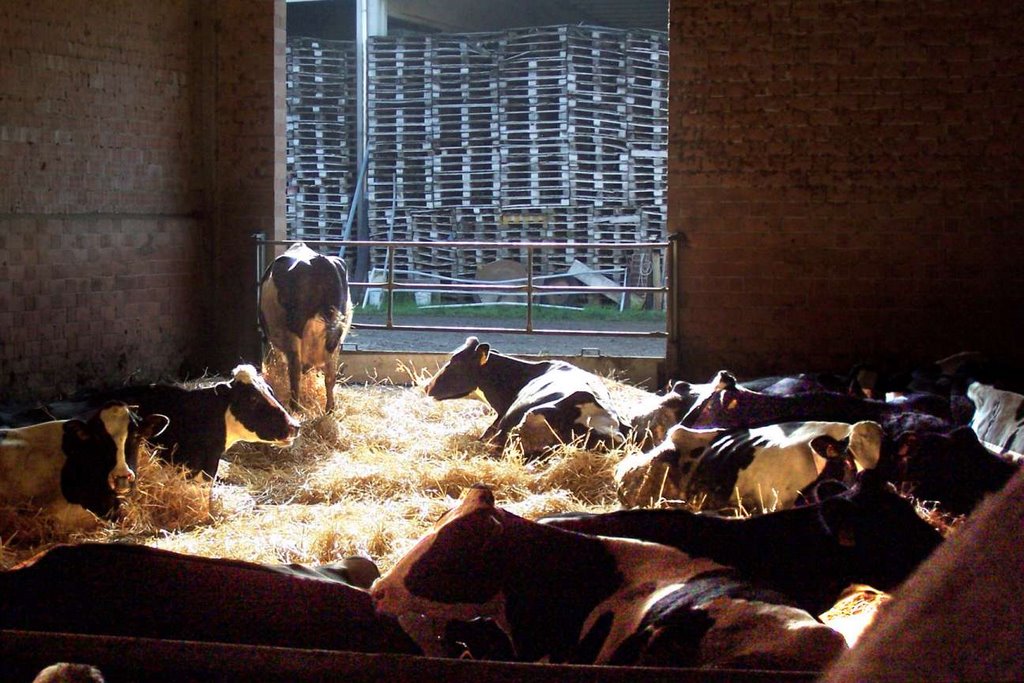
In addition to a persimmon tree, they had 200 cows, about half of which are giving milk at any time while the others are either growing up or getting ready to give birth. This farm had only Friesians, which came from Canada and the U.S. The farmer belonged to a dairy co-op of 11 farms and was very near his cheese factory, convenient for making that 2 hour deadline to deliver the milk. The other restriction on milking for Parmigiano-Reggiano is that the actual milking must be completed within four hours, start to finish (this farm managed it in one and a half hours, twice a day).


Hmm… these remind me of something I’ve seen lately… cylindrical, straw-coloured, stacked to the ceiling… The Parmigiano-Reggiano consortium obliges its dairy farms to produce – on-site – at least 50% of the feed for their cattle; this farm produces 90% of its feed. No animal products can be included in the diet of the dairy cattle, and no silage or wet grass, all to preserve the safety of the cheese, the reliability of the ripening process, and the purity of the flavour.


My fellow Canadian?


We observed the bedroom of the cows.


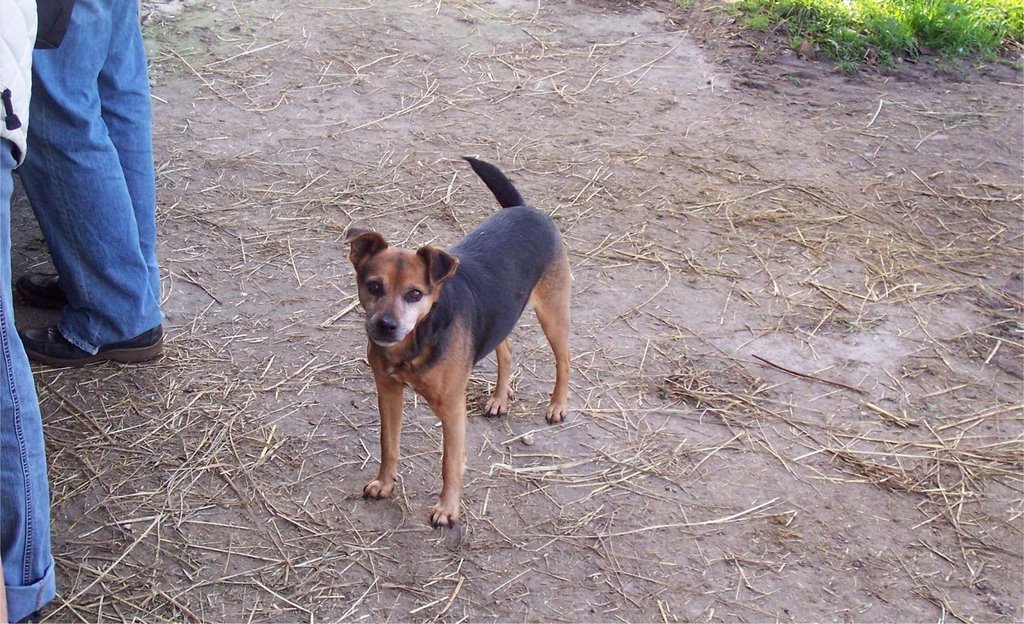
Scary farm dog.


And on that farm there was a cow…


Why yes, as a matter of fact, I was born yesterday.

Is nothing safe?

Appalled to see that a salmonella outbreak in the UK was traced to Cadbury’s chocolate bars! But relieved to see that the source was not the chocolate but the crumb base. So purists can rest easy and carry on with that therapeutic intake.

Yesterday I found the perfect activity for the first gentle day of our heat wave: a visit to Merridale Cidery. We did the self-guided tour to see where and how the cider was made, admired the acres of apple trees and then enjoyed a small tasting of half a dozen of their products. Apple juice was thoughtfully provided for our under-age companion, who was at an age to enjoy the faerie fixtures that were strategically placed to help her endure the tour.

Scrumpy and Traditional Cider were my favourites. In West Country dialect, “scrump” meant to steal apples, and so Scrumpy was the name for pilfered apple cider. At 11% alcohol it was described as a “sit down” cider, and mercifully Merridale has departed from the traditional recipe which calls for raw pork as one of the ingredients.

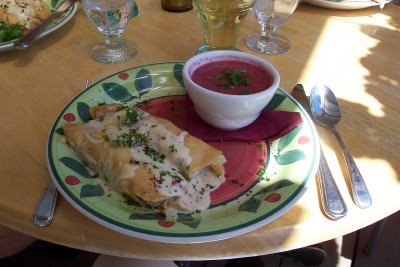
Merridale puts on a mean spread in La Pommeraie Bistro, where we sat outside on the covered veranda and admired the orchard. I had some very nice pulled pork and apple crepes and the soup of the day, a cold honeydew-raspberry concoction which the waitress accurately described as “a smoothie without all the sugar”. It was garnished with chopped mint and gently flavoured with dill and was just the thing for a warm summer day.

The perfect surprise for this melting heat we’re facing was the arrival of my copy of Loutro Poems, an anthology of poetry by writers who attended World Spirit poetry courses 200-2005, lavishly illustrated with colour photos. As if I could forget…