Skip to content

conferences

Windiana

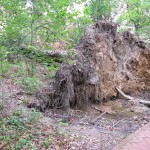
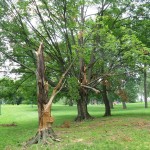
There are several sub-themes to the ASLE conference this year, but I don’t believe wind is one of them. The epic thunderstorm that ranted around Indiana on Monday blew over or damaged a couple of hundred trees on Bloomington’s Indiana U campus, I hear, though so far it’s been relatively calm since delegates started arriving Tuesday.

But let me start in Indianapolis, because that’s what I did. Aside from dear friends reunited, an early major thrill was spending Monday afternoon (after the storm had passed) in the State Library, which is a wonderful place, and wonderfully popular with all kinds of folks. How’s this for a reading room in a public library?

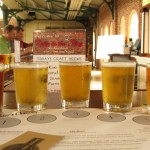
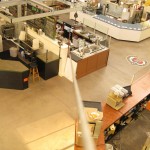
As if that was not enough excitement for one day, I was then hustled into the grand old City Market building where we attended a beer tasting event, a fundraiser for IKE which works for better environmental (air, water etc.) quality for kids in Indiana, at the Tomlinson Tap Room, where there were five mystery beers awaiting thirsty minds, with taste profiles that hinted at their identities. I can modestly report that I guessed all five right, which was about five times the number of questions I could answer on the Indiana / environment quiz that followed. Fortunately my team-mates were much better informed. In fact one extremly interesting question they answered for me was the purpose of the wire that runs from the Taproom directly to the Three Days in Paris creperie below. This I know, thanks to them, is a zipline linking hungry Tappers to a source of fresh crepes. Civilized? I think so.

After a much too short visit to the Indianapolis Art Museum, it ws time for my final Indy treat: visiting the excellent food and winerie Goose the Market, which has lots of fine things including coffee toffee chocolates, house-cured meats, amazing cheeses from near and far, beautiful wines, amusing beers, and a dazzling array of local and not local condiments and essentials, like smoked salt, bourbon-casked vanilla and shagbark hickory syrup.

What could I do but pick up some cheese for the next leg of my journey? From the store’s Virginia collection I chose a herbed Piedmont: a raw sheep’s milk cheese from Everona Cheeses. Nice one. Very nice.

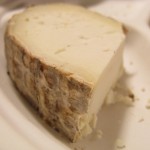
But the ravest of reviews were saved for this Monte Enebro, a gorgeous goat’s milk cheese from northern Spain, its rind blooming with blue mold and vegetable ash. I’m afraid it has already entirely disappeared, but with rapture all round.

And there I will leave you, for the moment as I think that is enough for one day. More on ASLE next installment…

Wychwood & more TWUC

Managed to fit a flying visit to the Wychwood BarnsFarmers Market in before the Writers Union meeting plenary on Saturday. It opens at 8 for the summer season. Another misty morning

but enough vendors and a steady stream of custom that showed it to be a healthy neighbourhood market. Lots of variety: local honey, wool, assorted wild foods from around the country – including maple syrup, dried wild mushrooms (from BC), saskatoons (from Saskatchewan), wild rice, ocal fresh ramps (wild leeks)

and exotic pickles (like spruce tips and cattail hearts). And produce of course, including some spectacular Ontario apples,

sweet potatoes (I think he said the variety was Bordeaux, not the Georgia Jet I’m growing in 5 gallon pails this year),

asparagus,

and some fine vegetables

including a couple of beautiful winter roots, both of which I’ll be planting again this year myself:

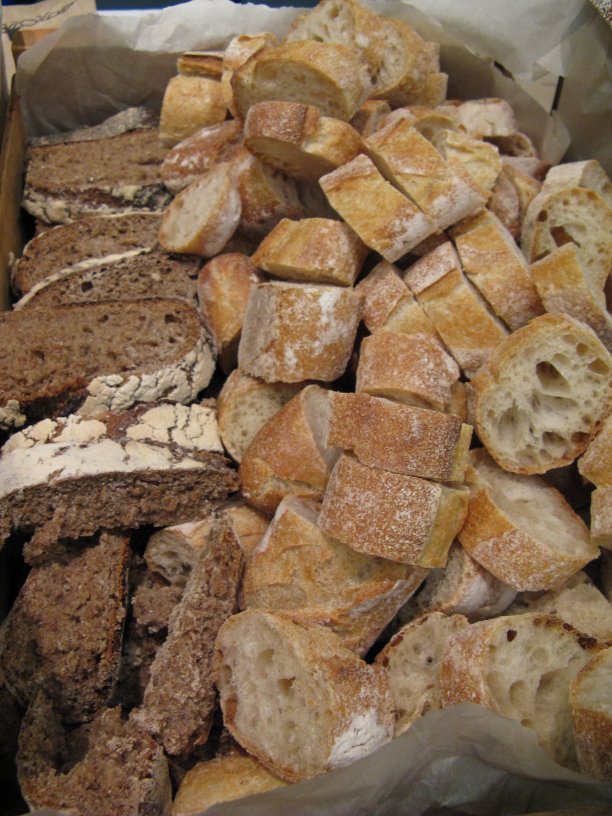
It’s a well organized market, which operates year round thanks to the shelter of the barns. There’s a sensible scheme for the bakers, which keeps them well under cover while the other vendors are under tents:

Then I sprinted off to catch a streetcar and a subway and settle in to a good day’s politicking with the writers. Copyright was the most active topic. Passion on both sides of the discussion, which had to do with the manner in which copyright fees are distributed to creative artists. It could have been a long-winded and ugly discussion, but chair Alan Cumyn managed to guide the concise and respectful speakers through to the vote with a firm and friendly hand. It was a great meeting, after which the writers passed a couple of free hours gearing up for the banquet and short readings and presentation of the Danuta Gleed award (to Billie Livingston for Greedy Little Eyes). And then it was time for 3 Chord Johnny

to bring it on home: great stuff, not least because the musicians are all writers. We danced our feets off and then were regaled for an hour or so by a rogue fire alarm which attracted a swarm of fire engines and slowed the ascent to the after party.

Today’s meeting, in which the gavel was handed over to incoming chair Greg Hollingshead,

was a peaceable wrap-up with elections and farewells.. until next year in Vancouver.

TWUC 2011

Like anyone with that ominous birthday on the horizon, I’d say the Writers Union of Canada approaches its fortieth (2012) with a year-before do in Toronto that combines about the right mix of congeniality, information overload, anxiety and a drop or a bite too much to drink or eat.

Today was the day of workshops, also known of the day of impossible choices. The sessions were recorded, so it should be possible to catch up later with what I missed. We had the relative novelty of a book table this year

for the first time in several years. It seems to be going well.

The Public Lending Right session offered some ominous rumblings about the fate of this 25 year old institution that’s put a few bucks in the pockets of Canadian writers whose books are in the holdings of Canadian libraries. It’s at risk now because of digital publishing – which could drain the system dry if it tries to compensate authors of with new or repurposed electronic titles (not currently included) at a time when PLR funds have already ebbed away to half the per capita amounts enjoyed 25 years ago, due to lack of new moneys to meet the influx of new print titles to the funding pool. Though its cheques are shrinking, they’re incredibly valuable to writers living on marginal incomes; but its future, like other federal spending initiatives, could well be at risk with promised funding cuts coming from a government whose commitment to culture is, shall we say, unclear. And the whole digital rights question is, in the words of panelist Michael Elcock, the “kind of thing that turns your brain to porridge”.

We replenished ours with a break and then returned to porridge country in the New Gatekeepers session, which was more about epublishing and emarketing. Much of the discussion batted around the relevance of publishers (which pay about 10% in conventional royalties, or if you’re lucky some 25% in erights) versus self-publishing or self-representation through the likes of Kobo or Smashwords (where you’d get as much as 70% – but potentially then have to shell out for the kinds of services publishers usually handle: editorial and marketing and administrative). Mention was made of interesting innovations like Cellstories, which publishes short fiction, or Kickstarter, which allows artists to pitch ideas and raise money to carry their projects out; and publisher ECW was there talking about its digital arm, Joyland, which takes only erights, leaving writers free to seek out print publishers separately (or not at all) and is looking into subscription publishing which would allow it to publish up to three such titles a year.

Thus boggled, we briefly emerged to lunch on bi-bim-bap and returned to hear about The New Realities of Book Publishing, which were – you guessed it – largely about epublishing and emarketing. One independent bookseller held out against the flow of chat about blogging and tweeting and social networking to argue that there was still a place for a good bookstore owned and staffed by people who read and love books and can serve customers who do likewise. In support of this, one of the few under-forties writers at the meeting -a teacher – described bibliomania days where her grade 5 and 6 students wore pyjamas to school and lay around reading books all day – a wildly popular program!

Some seriously calorific treats helped us leap the mid-afternoon slump and make it through The Writer as Promoter (Or, Who Has Time to Write) (or, as a panelist quipped, Shouldn’t My Publisher Be Doing This). Wherein there was more chat about blogging and tweeting and social networks. Cassandra Sadek, the director of online marketing for Random House, said that publishers should be guiding authors in building their online presence, and using that to allow readers to be their “brand ambassadors”. Author Cathy Marie Buchanan features a little tutorial about skyping on her website so that she can use it to speak virtually to book club meetings, and also gives live chats on GoodReads (a good place for fiction writers, apparently). Resident curmudgeon Russell Smith was left to object to the idea of thinking like a marketer which he said would mean commoditizing one’s own writing and aiming it to please a target audience rather than writing for writing’s sake: “I also don’t like the idea of “brand”” he said: “I don’t want ‘brand ambassadors for a product’ I want ‘readers for my novel’.”

Then after a swift round of regional meetings it was time to forage for supper. The Pilot pub

may have literary cred, but it was full and noisy on a Friday night so we opted for the quieter confines of the Coffee Mill, which Myrna says is a long-lived Hungarian restaurant, which offered a fair spinach pie

that fueled me for the Margaret Laurence Lecture, introduced by outgoing union chair Alan Cumyn

in which Graeme Gibson

spoke on A Writer’s Life. It was an entertaining tour through his travels in Europe and his beginnings as a novelist, which were as bumbling as any, but distinguished by dedication that still sees him writing some 40 years after his first novel was published. He was also one of the founders of the union, so a description of its humble beginnings rounded out his talk.

And more there will be tomorrow.

Farmer2Farmer in Saanich

Wednesday I joined – at a guess – around 70 farmers from Vancouver Island and Gulf Islands for a Farmer 2 Farmer information exchange. Bob Maxwell, Linda Geggie and Barbara Brennan

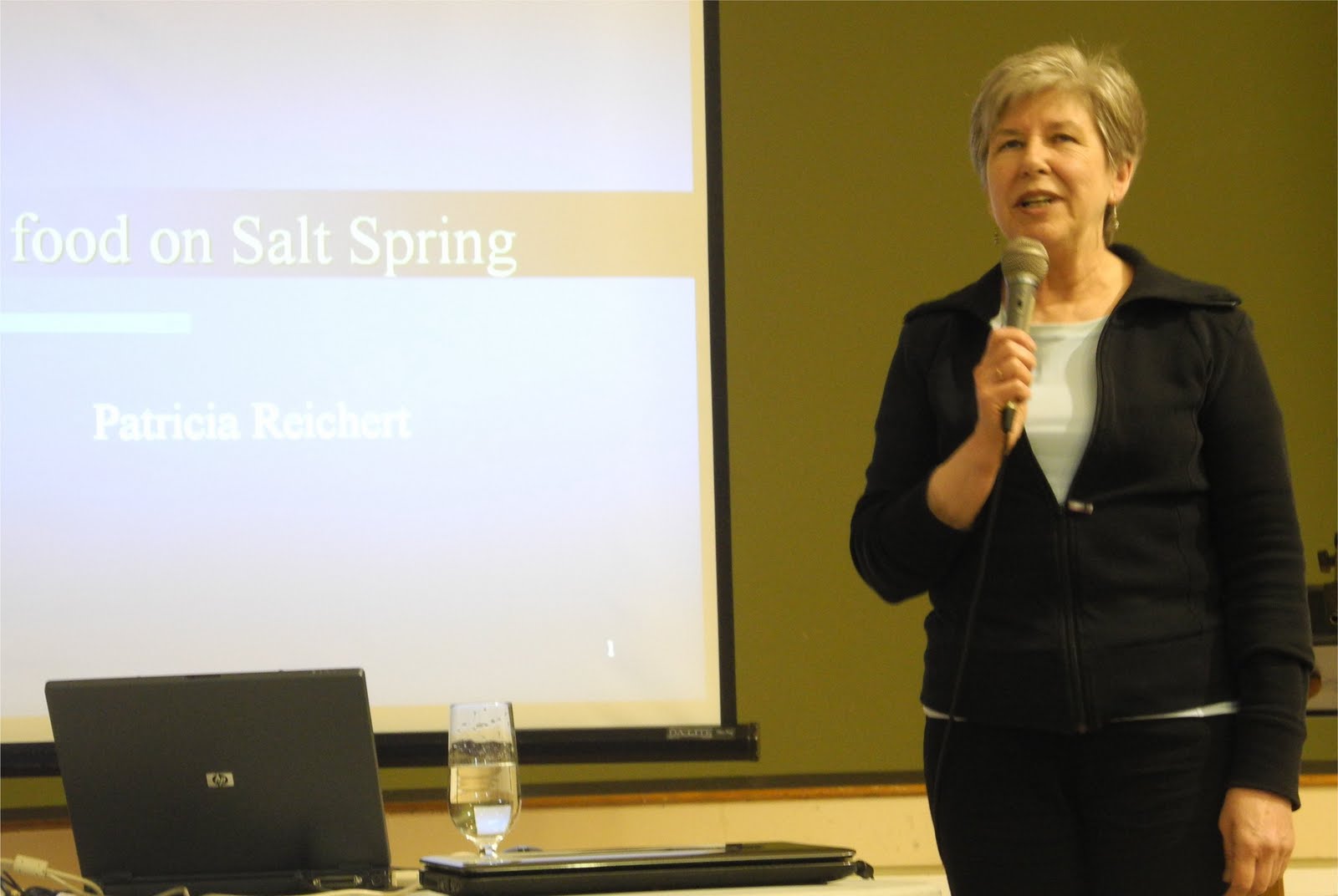
introduced the day, and then Pat Reichert

of Island Natural Growers on Salt Spring Island kicked off with a keynote address. She talked about her research into food production on Salt Spring, a task she describes as “not for the faint of heart, or those with short attention spans”. She found that around 96% of the produce consumed there is imported; and that the change to BC’s meat regulations had a devastating effect on Salt Spring meat production which dropped 50% in the face of requirements to ship all animals off the island for slaughter and butchery.

Island Natural Growers created a demo project – Farm Food Link – to help local organic growers distribute their products to local businesses and institutional buyers on Salt Spring. It’s now a going concern called Growing Up Organic. ING has also partnered with the local Farmers Institute and the Chamber of Commerce, Salt Springers for Safe Food and the Earth Festival Society to form the Salt Spring Food Alliance. They’ve achieved much in a short time through an over-arching Infrastructure Project. There’s a packing and distribution centre in the works, which would provide a central point for small farms to ready their goods for market; an abattoir project, which will provide a mobile abattoir offering both slaughtering and butchery services for Salt Spring (to be shared with Pender Island); and a community compost project. There’s a land lease project in the works as well to improve access to affordable farming land on the island.

Thus inspired, we were invited to join a couple of sessions on topics ranging from Increasing Profitability through specialization? Diversification? Both? to Emerging Food and Ag Business Opportunities in the Region to Integrated Pest Management: What’s bugging you?.

I was at the Pollination Power talk, where we heard from pollinator activist Nathalie Chambers and beekeeper Ed Banas.

Nathalie Chambers’ monumental fundraising efforts to save Madrona Farm have been followed by work with The Land Conservancy where she leads the Pollinator Enhancement Program. Wild bees, she said, are under some of the same threats that are decimating honeybees: loss of habitat and nectar sources, diseases and pesticide use.

She proposes three simple steps that everyone can take to improve the lot of pollinators:

  1. To feed all types of pollinators, ensure there is adequate pollen and nectar available from February to November: native plants are very helpful for this, because native bees are 4 times more attracted to native species than to introduced plant varieties. Native species are also timed to flower in succession: which is something farmers should aim for when planning cover crops as well.
  2. Provide habitat: 70% of bees are solitary ground nesters: the dirt “volcanoes” you may see in the ground indicate their presence. Keep an area of exposed soil undisturbed for them (they like south facing sandy slopes too). Another 30% of bees live in trees, stumps and snags – so leave some of those.
  3. There’s a knowledge gap between scientists and the wider community: but the simple fact is that most pesticides are lethal to invertebrates. She urged us to check out Xerces.org to learn more about organic pest management techniques. She recommended looking into this Wikileaks article which explains the deliberate approval of a pesticide known to be toxic to bees.

Ed Banas talked about pollination from a honey bee keeper’s perspective; about the hazards we create by a fondness for pristine lawns (dandelions and white clover are excellent food sources for bees). And it’s not just the immediate deaths from pesticide spraying that are problematic, he noted, but the generational deaths that follow, when contaminated nectar and pollen are taken back to the hive and fed to the more vulnerable young. He also talked about the crippling effects of using coated seeds, which are treated with fungicides and/or insecticides; when they germinate, they exude a kind of sugar that bees take back to the hive together with its hidden load of pesticides. Corn is particularly often treated, but so are many other seeds: he strongly advises people check seed packs to make sure they’re uncoated.

There was a break and time for another couple of sessions. I dropped into Marketing-it’s about relationships? where there was much talk about the ins and outs of blogs, websites and social media; and Random Acts of Agriculture – which was a forum to share ideas and innovations. The latter group had some interesting ideas to float: Nathalie Chambers told us of her “Random acts of cooking” – a dream of travelling from farm to farm on a truck with a coleman stove and picnic table, ready to cook up produce right on the farm, to show people how good and easy fresh food can be (she did this to enthusiastic response at Madrona’s farm stand until VIHA caught a whiff and shut it down).

Other suggestions included telling consumers that eating good, local, organic food is within reach of almost everyone: you don’t need to commit all your resources, or blow your whole income on food, but buying just a little – a flat of organic blueberries here, a few heads of lettuce there, a pound of local garlic – from a lot of farmers would help them enormously. There was some puzzlement by the farmers present over the misperception that supporting businesses like the Red Barn and the Root Cellar was equated with supporting local growers, when both of these outlets import most of their stock. They were also peeved by the latter’s marketing slogan (“Farm Fresh, Dirt Cheap”) which is simply untrue as people should know by now: good food costs more, and cheap food really isn’t. Don’t worry, said someone, the global economy will take care of that: once cheap oil is taken out of the equation, the profit margin won’t be so attractive for imported food.

A couple of the farmers talked about grain growing on Vancouver Island. One, a hay producer, explained that the market for hay has tanked and that the Island’s hay fields could easily be converted to grain growing, but there’s a lack of infrastructure for other aspects of the process, like milling and grain storage.

Unfortunately taking all that in meant missing Mary Alice Johnson’s talk about Land Leasing and LLAFF (Linking Land and Future Farmers): a regional land registry and database to link up those looking for land with those who have land they wish to share or lease.

After lunch there were roundtable sessions, giving a bit more time for questions and answers about growing new farmers, marketing, government funding, agricultural infrastructure and more. A lively and useful day… may there be more!

Organics ABC

I spent much of this past weekend at the COABC (Certified Organic Associations of British Columbia) annual conference which was conveniently held in Sidney and attracted some great speakers and lots of friendly farm folk, with tasty organic fare to fuel the conversation (“When was the last time you saw organic milk at a conference?” we marvelled in the coffee queue; “This would be a first” we agreed.)

The two headliners for my interests were Chris Thoreau, an urban farmer from Vancouver, speaking about how to make money from farming in cities, and Todd Kabaluk, a researcher from Agriculture Canada, speaking on current research into wireworm.

Thoreau’s talk on Friday night promised to go beyond community gardens to explore some of the economic aspects of urban farming. An entrepreneurial bent is needed to make money from farming in the city, and Thoreau’s aim is to prove it’s a viable economic model for some, both by farming himself and by creating an urban farming network in Vancouver (where there are 19 urban farms – comparing poorly with the 700+ that now exist in Detroit .. but on the other hand, there is – let us be grateful – not the same degree of vacant lots in Vancouver)

City FarmBoy is believed to be the longest standing urban farmer in Vancouver, farming 14 backyards and one rooftop. Farmers on 57th work with residents of the George Pearson Centre providing food and involvment to people living in the facility. Thoreau’s own business, My Urban Farm: small scale sunflower sprouts delivered by bicycle. SOLEfood has literally taken over a parking lot on East Hastings, with the help of a grant from the city to set up. They use raised beds to grow food to sell at high end restaurants, farmers market, recreation centres and so on, using the proceeds to hire people and train farmers.

And then there was a reception, featuring Crannog Ales and Summerhill wines.

Friday night nibbles included…

On Saturday, we had opening addresses from Dag Falck,

of Nature’s Path, explaining the negative effect that “natural” food branding is having on certified organic food sales. He pointed out that only half a percent of all farmland in North America is under organic cultivation, which means that shortages of organic ingredients are imminent if the sector continues to grow. There is a widespread misunderstanding of the meaning of the term – led by marketing – that leads the public to pay a premium for goods made from agricultural products that are – and cost- exactly the same as conventional products. There is a white paper on the subject, from COTA (Canadian Organic Trade Association).

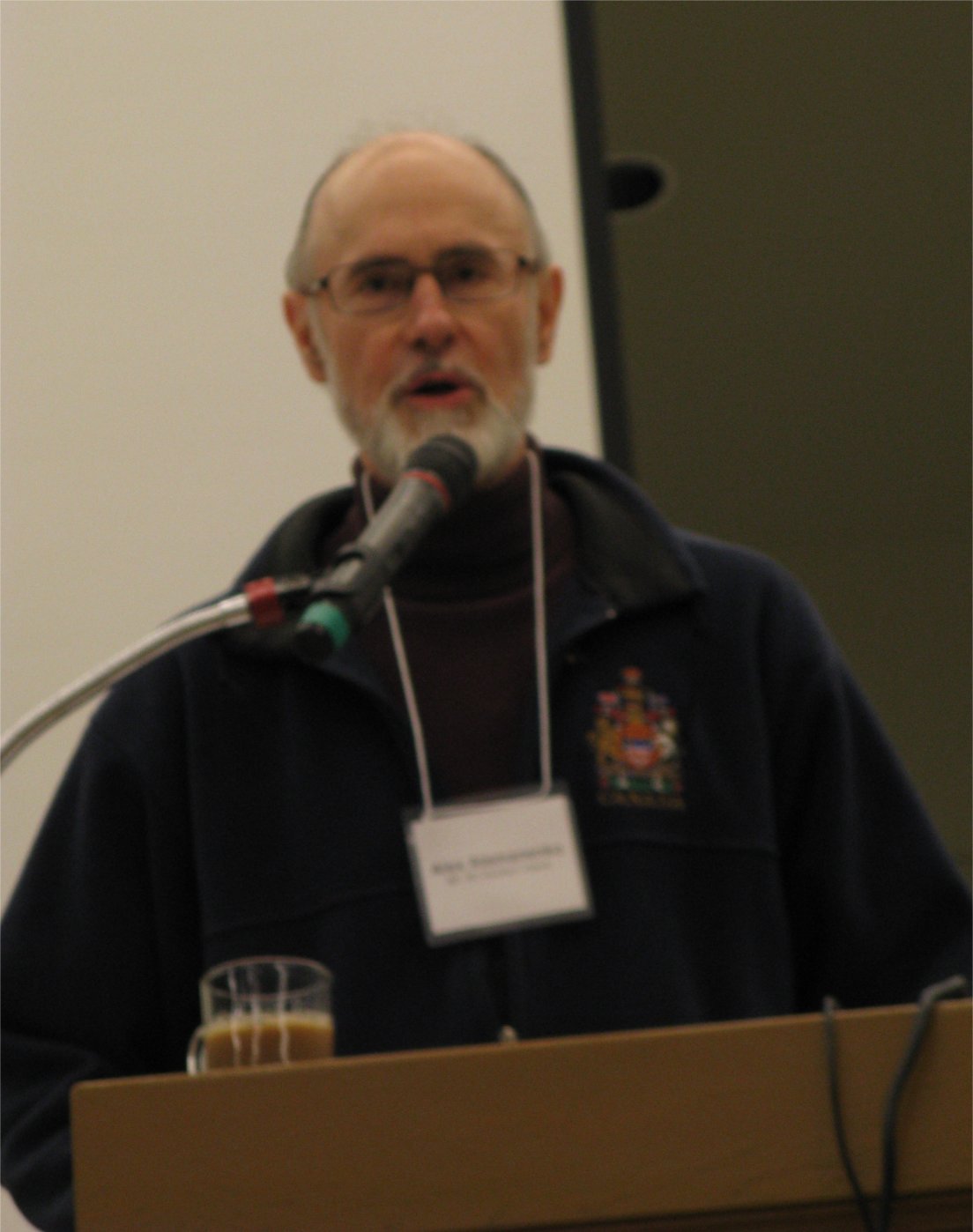
Alex Atamanenko

spoke about organic items topical in Ottawa, including Bill C-474. There is still a shred of hope around the topic, with a new campaign to support a moratorium on GM alfalfa in Canada. He addressed the worrying elements in CETA (Canada–European Union) trade negotiations that threaten seed-saving, and later confirmed what I’d heard about the first-time inclusion of municipal level obligations that could end institutional support for local foods (the proposed changes would “prohibit municipalities from using procurement for sustainable development purposes such as promoting food security by adopting “buy local” food practices”). So lobbying is suggested at the municipal as well as federal level.

I went on to a talk abou soil ecology and alternative mulches for organic blueberry production; basically a discussion about traditional use of sawdust vs composts. One of the reasons was to reduce the loss or injury of plants through plant-parasitic nematodes, which can more easily be kept in check by natural predators such as those found in soil enriched with organic matter.

Then there was a coffee break

and I skipped out to do some errands. After a vibrant lunch

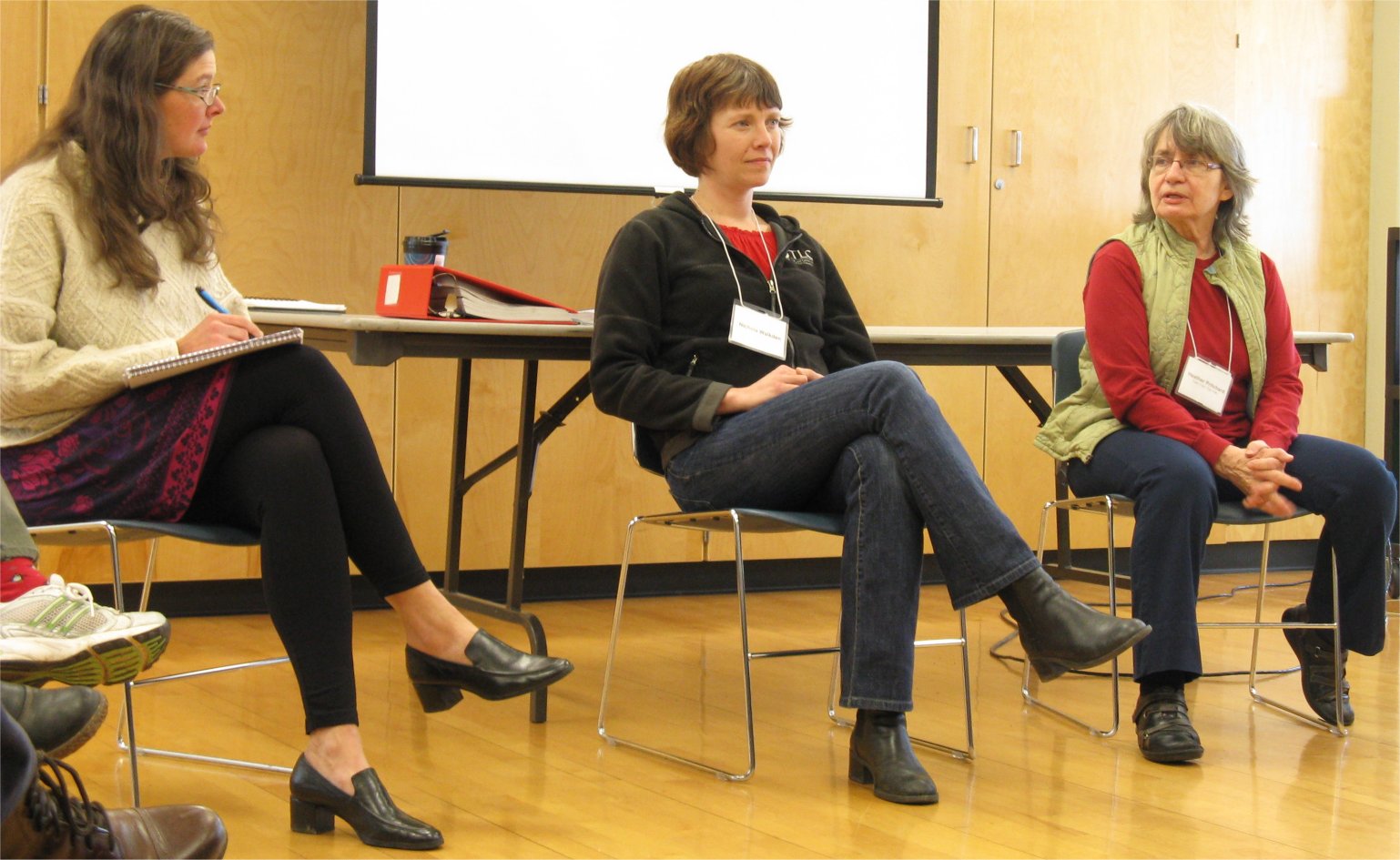
there was a panel on Community Farms, land leasing and other ownership models with Jen Cody of Growing Opportunities; Nichola Walkden of The Land Conservancy; and Heather Pritchard of Farm Folk City Folk. There was a lot of discussion about the ins and outs of land tenure when working with a collective or community model; issues to do with zoning, neighbours and conditions of tenancy.

Then it was time to turn to the most evil insect of them all. Todd Kabaluk gave a thorough consideration to the life and times of the wireworm, mortal enemy to all potato growers and many others besides. As has been previously discussed here, it’s a long-lived pest with a big hunger and an undiscriminating palate; laying waste to seedlings and rendering root vegetables unsaleable. There are no known enemies, though research is looking for these; and it’s hard to kill since its whiskers allow it to whisk up and down in the soil, so you can’t be sure exactly where it is. As Kabaluk wryly observed, “Wireworms are where you find them”.

One place you will certainly find them is in forage crops/ set-aside/ any longer-term grass (like lawns and turf) where moisture levels are steady and there’s lots of food in the roots of grasses. Till that under and you move the grass and the wireworm beneath the soil; when the grass decomposes, and the wireworm loses its food source, you have created a situation where the wireworm must seek a new food source. If you’ve planted a crop, expect visitors, as they’re attracted to the CO2 emitted by the roots.

Although some useful research has been done – involving brown mustard as a rotation crop; use of aromatic oils like citronella; and use of a fungal biological control – there is no quick fix available yet. Kabaluk is focusing on better methods of monitoring their numbers (to reduce the need, e.g., for corn farmers to automatically treat seed with clothianidin even where wireworm numbers are not known). The best summary he could recommend of non-chemical treatments is this article from 2008.

Supper was good and featured lots of salmon from Sointula, as well as local cheese and charcuterie. And a very nice apple and berry crumble to finish.

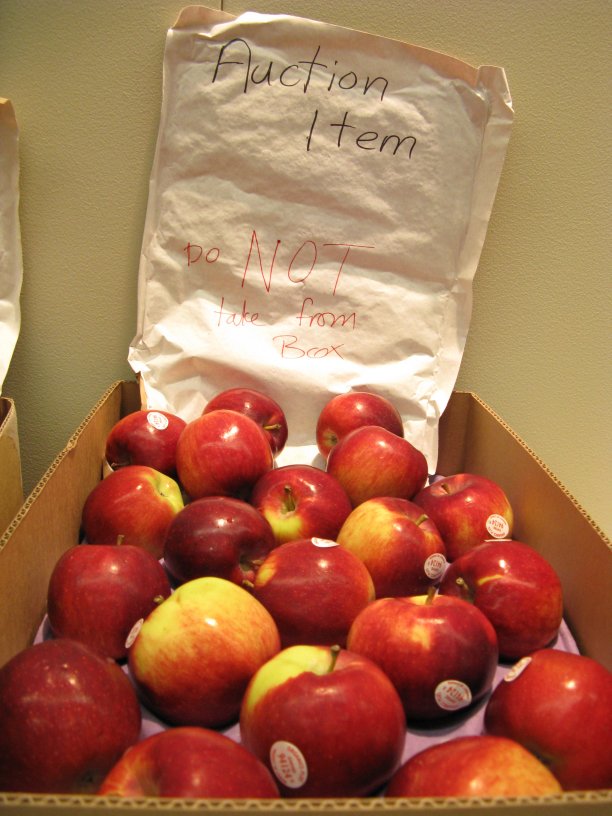
A last look at the silent auction items

– I was outbid on everything (luckily) – and some jolly tunes from the Jugbandits, and that was it for me. I couldn’t make it to the Sunday sessions as I had a bee talk to attend.

Farmland fun

Thursday’s excitement was participation in the Focus on Farmlands conference, where about 180 interested parties, younger and older, got together to talk about farming, food, agricultural land trusts and ownership and where to go from here. Presented by the tireless souls of LifeCycles, including Linda Geggie,
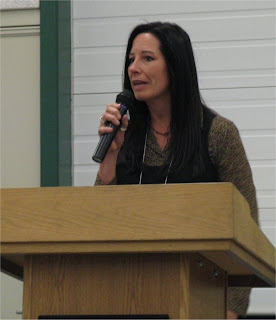
it was a stimulating day of discussion with participants from many different areas: lots of farmers, a good selection of elected officials at several levels of government, and some fringe-dwellers like myself, there to find out more and connect with the like-minded. The topics ranged from farmland trusts, community farms and other models of land access, to farm status and assessment, to political strategies, to urban and traditional methods of growing food. There was too much for any one soul to take in, so LifeCycles plans to post information from the sessions as soon as they can get it onto their website. Video footage from sessions and interviews is being posted on www.farmlands.blip.tv

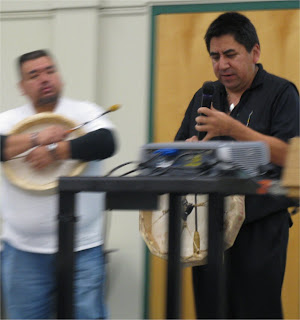
We began with some prayer and drumming from Scott Sam, of the Tsartlip Nation
and then had a briefing from agrologist, farmer and BC Agriculture Council member Niels Holbek who had many interesting statistics to share, including some on farmland loss from the American Farmland Trust and the Farmland Preservation Research Project at the University of Guelph; and a local stat that came up several times through the day: 3% of the province’s land has both 80% of the population and 80% of the province’s gross farm receipts; not a good formula, observed someone, should there be a food security crisis, and the reason why there is so much competition for the same land for farming and housing.
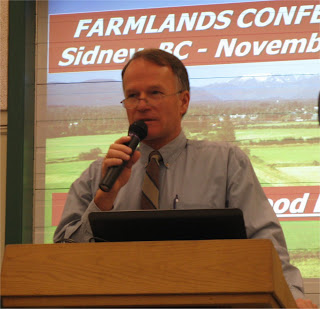
We then broke into workshop sessions. I went to the one called The “Regional Food Basket” – Looking Beyond Farmlands, where we heard from two members of the Tsawout Nation, JB Williams and Earl Claxton Jr, who are working to restore first nation ties to traditional food sources and culture; observing that their populations had been devastated by the introduction of some foods and the loss of others. Lee Fuge of Food Roots talked about pocket markets and the distributors’ warehouse space they share with Share Organics and LifeCycles – but she then had to dash back to the kitchen to make sure our lunch wouldn’t be delayed. Melanie Sommerville of LifeCycles threw a few more numbers into the statistics pool: about 80% of Canadians now live in urban centres; 84.5% do so in BC, with just over 50% of the province’s population in the Victoria and Vancouver regions combined. There is a lot of interest in growing food nowadays – local seed selling has tripled this year – and there are many great examples of local urban agriculture projects – the Fruit Tree program, the Sharing Back Yards program, HomeGrown Gardens, Growing Schools and Spring Ridge Commons. Deb Heighway talked about SPIN farming in Victoria, and recommended the online resources which helped her join the 2000 others worldwide who are farming in other people’s under-used back yards.

In the afternoon I attended the From Ideas to Action: Farmers and Eaters Taking Action on Farmland Issues workshop led by David Mincey,
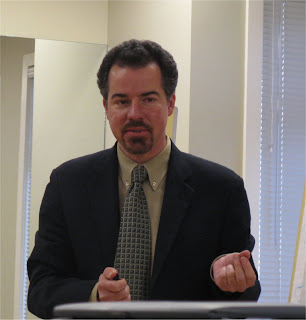
whose Camille‘s restaurant has long been known for its use of local products.

He was joined by fellow restauranteur and Island Chefs Cooperative member Ken Hueston, whose Smoken Bones Cookshack sounds worth a visit. He talked a bit about ‘food trending’ – which is a bit of a vicious cycle, where flavour-of-the-month foods get over-promoted at the expense of variety and honest experimentation by restaurants. A veteran protester (he’s only recently been allowed back into Safeway where 10 years ago he kicked over a display of Mexican corn when there was a local farm visible out the window) he made another good point to do with consumer demand: if we simply go on accepting only 5% local produce in our supermarkets, there’s no motivation on the part of supermarket buyers to change their sourcing. Next to him was David Chambers from Madrona Farm,
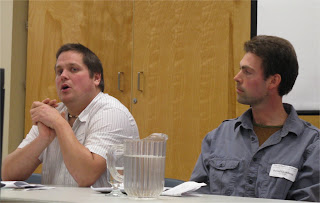
who spoke persuasively and from personal experience on the idea of channelling what farmland we have left through The Land Conservancy, so that it’s preserved for agricultural land in perpetuity, and not loosed to the whims of marketplace when farmers retire. His family farm is in the process of being bought by TLC who – if the needed funds are raised by July 2010 – can assure its future better than the Agricultural Land Reserve, which has proven itself unequal to the forces brought to bear by speculators and developers, and which protects relatively little of the most fertile land in the province, down here in the southern third where all the people want to live. In fact, as Niels Holbeck had told us at the start of the day, 90% of the land included now in the ALR is in the north of the province, and 70% of the lands excluded from the ALR are in the south.

Elmarie Roberts gave a primer on what community support for agricultural land can do, from her experience at Haliburton Farm, which is one chunk of land rescued from subdivision and property development by the local council, and protected by its nonprofit status. She’s one of six farmers who’ll be bringing in the veggies for thirty lucky supporters of their Community Supported Agriculture program. She said that in its purest form, a CSA helps to fund the farm’s operation by small scale investment by members of its community, and its members also work the land alongside the farmers. Here, though, it’s a pick-up scheme that provides a selection of seasonal fruits and vegetables to members, with volunteer work parties picking up the slack in weeding and field work. To her right is Lana Popham,
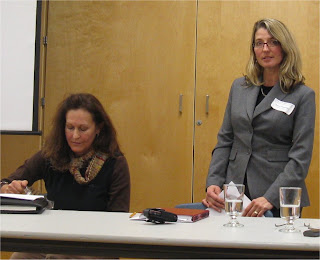
whose family runs the Barking Dog organic vineyard (and makes a rather special local gin!) and who is running for a seat in the next provincial election. David Cubberley
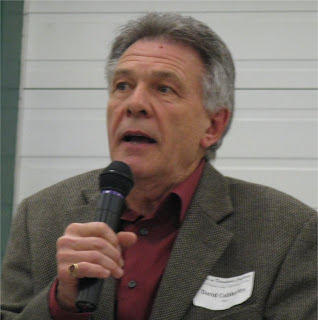
is already there (and put his money where his mouth was by laying down a significant donation to the Madrona Farm purchase fund). He talked about a few of the ALR properties that were topical at present: Panama Flats and Beckwith Farm, both owned by developers claiming to want to grow organic blueberries – I guess they’ve really turned a page in their career books – and he ran us through the political history of Haliburton’s acquisition; it had been owned by the water board who had been sorely tempted by developers who were only stopped by a group of active and well organised community members.

Corky Evans
gave the closing address.
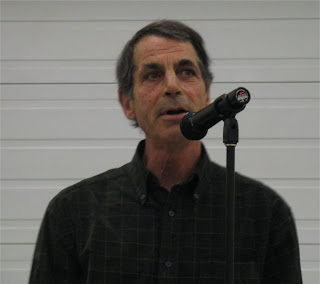
He’s retiring after 25 years in politics, including stints as provincial Agriculture minister and most recently Agriculture critic, and he wanted to share some insights into motivating politicians. He urged people to start showing up at council meetings, to organise into large enough audiences that politicians would have to come and answer to us: “We don’t listen to small groups of people who don’t all live in the same constituency.”

Food, he said, has never appeared on the agenda of any party meeting, any poll, any election in this province; there are no farmers elected to the legislature: and that is why there is no food policy in this province. Someone has to educate the politicians, he said, and a crisis point such as the one we’re in is the best time we’ll ever have to keep them focused on food as an issue; without focus, no action.

Words dear to my heart: “The drug of our time that dissipates focus is television. If you want to keep focused through the next election, don’t watch television, don’t get distracted by what the television stations tell you are the issues.”

He pointed out that BC pays less to support its farmers than Newfoundland; that it would cost $143 million to bring the province to an average rating, compared to other provinces; which amount is .4 of 1% of the annual budget, or $1 million less than tax breaks currently awarded by the government. He wasn’t talking subsidies, which he feels promote bad farmers and bad food, but there are all kinds of ways to support farming other than subsidies.

He said if we were looking for something to ask for in the next election, how about voting for the party that votes to end exclusions (from the ALR): but only if that party also supports farmers: “You can’t protect the land and abandon the people.”

And of course we ended with food: provided all day by the resourceful crew from Food Roots, including apples
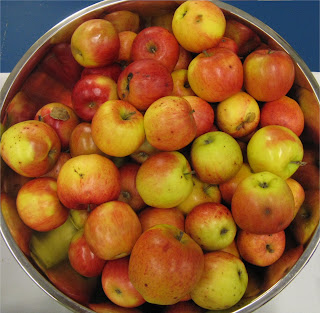
from the Fruit Tree Project. I had to skip out smartly so missed the wine and cheese which featured beverages from local brewers and vintners and Natural Pastures cheeses.