Skip to content

climate change

ASLE 5: Mesocosm, animals and environmental law

ASLE plenary speakers were wide-ranging and various, and I didn’t always have my notebook handy. Una Chaudhuri and Helen Tiffin were the first I heard, on Wednesday. During Chaudhuri’s talk we watched Mesocosm playing out in the background (and heard that the figure in it is modelled on Leigh Bowery, which brought a few random things together for me: having arrived in England in the decade after his glory days, I’d only known of him because of Lucien Freud’s paintings)

Thursday’s plenary speaker Marc Bekoff was stranded because of airport disruptions, so he joined us from his wilderness hideaway by skype, which worked remarkably well, all things considered. He spoke generally about his work which has led to such publications as The Animal Manifesto and Animals at Play: Rules of the Game (which he said brought together his 30 years of research into play behaviour). But his theme, animal compassion, he summarized by saying “Anyone who says that life matters less to animal than our life means to us has never held in their hands an animal fighting for its life.”

He observed that humans have a confusing relationship with animals: claim to love them and yet hunt them or rear them in factory farms, and generally treat them in ways we wouldn’t treat a family pet. They’re very much like us, he said, but also different. Speciesism doesn’t work as a way of establishing a natural hierarchy, where we assign higher and lower designations to animal life using ourselves as a template, because in fact they do a lot of things better than us.

In the Q&A he was asked his opinion of Temple Grandin, which he answered carefully, saying they had met, and that they’d agreed to disagree. He acknowledged her work by saying she’s improved the lives of a minute fraction of the animals who go to slaughter, and acknowledged her “amazing effect,” with which she reaches a very wide audience, informs people about animal sentience. But in Bekoff’s view, she’s not improving the well-being of animals, and it is worth remembering she’s paid by the meat industry.

Next up was environmental lawyer Robert L. Fischman, who teaches at Indiana University Bloomington, and is known among environmentalists for his writings on animal migrations, spoke on themes that affect environmental law at present.

Climate change, he said, currently dominates scholarship and rule making. And observed that in environmental law there is a stark division between people studying pollution control, viewing the environment as a sink; and those studying conservation on other hand , viewing the environment as a treasure trove for goods (natural resources). Pollution control law grew out of public health concerns, while resource management is more rooted in judgements made law, and undergoes conservative incremental change, with changes in ideas of ownership and property.

Which led to discussion of land trusts, the big environmental issue in the US today. In 1980 there were about a tenth of a million acres in trust; tax laws changed around then and so did the interest in land trusts. By 2003 there were 5 million acres, and in 2005 some 12 million acres; and it’s probably doubled since then. Land trusts are a relatively new species of property right, placing values on land and water rather than on the monetary value of land for transformative development use.

Initially, land trusts were isolated zoo-like reserves, but they became stepping stones, and then lines on a map. By the 1980s, biology had taught us that webs of conservation are importan, so reserves must be nodes in a network. The realities of what we’ve already observed in climate change on land and what changes we anticipate mean that connecting our landscape will be very important in allowing both animals and ecological services to adapt and be resilient to climate change.

Bringing it home to the audience, he pointed out that in environmental law and policy, interdisciplinary work means working with social and natural scientists, not scholars from the arts and humanities. Yet what passes for research in this field really is related to the humanities: you search sources and make arguments based on your findings. Storytelling and rhetoric became uniquely important tools in this particular area of law.

Finally, he said, we need to think through to resilience issues rather than stopping with conservation of the present: for example, we have halted the species elimination of buffalo, but eliminated the migration aspects of their lives. We need to safeguard migration corridors as well as habitat. This “connectivity” is too broad a concept to capture public support, but migration conservation is a concept that might be possible to use to promote a more holistic cause.

In the Q&A, the topic of mountaintop removal in the coal industry came up; timely subject for this Vancouver Islander. Is this, the questioner wondered, as corrupt an industry as it seemed? Stepping lightly through his answer, Fischman chose instead to observe that this area rather demonstrates what a clumsy tool the clean water act is to use on mining and mountaintops.He noted that the Obama administration had at least revoked nationwide permits allowing free mountaintop removal. But the clean water act saved as much of the High Sierra as has been saved; negotiated solutions are still needed.
ASLE 4: farmers market and Banerjee on global warming

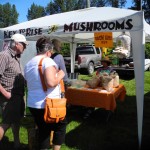
The Bloomington Farmers Market played an unusual role in ASLE 2011. Not part of the official program, it was located near enough to the campus to lure a number of Saturday morning wanderers away from the last day’s sessions for an hour or two. By happy coincidence, I was one of those wanderers, having run into  a like-minded traveller in the elevator.

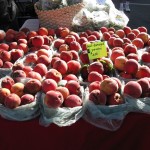
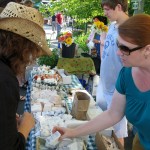
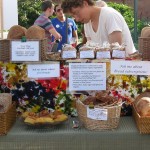
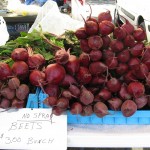
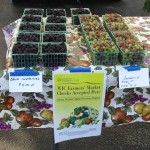
We learned later from the evening’s banquet speaker – an academic whose husband grows flowers and garlic to sell there – that it had been a fairly average day with some 75 vendors and about 8,000 visitors. The sun shone on our visit (but not too much) and we had a happy forage through the wares. Cheese there was, including the Wabash Cannonball, which I believe I’d noticed at Goose the Market earlier on my visit, but like so much on offer, I did not dare try to take home with me except in pictures. A bakery with a bread subscription program. Flowers, scapes, honey, maple syrup, lovely beets and salad greens. Some fine coffee sellers. And even a pipe (micro-) band from the local fire department, there to see off a team of local youngsters on a cycling tour to New England and New York. And some Jazzercizers (not the first I saw on this trip, in fact, as a much smaller group had been toiling away outside the market in in Indianapolis while we lolled about indoors tasting beer).

We returned with our spoils and hot-footed it over to hear the day’s plenary speaker, environmentalist photographer-writer Subhankar Banerjee, who walked us through some of the issues he’s been documenting. The Arctic, with its burden of interlocking catastrophes, was one. It was evident from Banerjee’s photos (some of which have had enough impact to be banned) that global warming is very real in the melting north, and is making wildlife migration and the subsistence hunting/fishing lives of aboriginal northerners precarious; it seems certain the impact of development and energy exploration will destroy this way of life.

His talk about the lives of his images and the verbal/visual battle he’s had with Shell Oil on his Huffington Post column was fascinating. His 2001 polar bear image has had, he thinks, some 40,000 reproductions, becoming one of the most well-known visual arguments against Arctic oil exploration; but Obama’s government was prepared to let it happen, until the Gulf of Mexico spill called a temporary halt to the plan. His Climatestorytellers.org website offers a forum for these and other stories of our times.

Banerjee lives in New Mexico and next showed us some images he’s been working on with desert flora, the cholla cactus in particular, in a series called Where I Live I Hope to Know. He’s trying to understand his surroundings by focusing on what’s unremarkable in his everyday landscape. But most interesting to me was his mention of the devastation of the piñon–juniper woodland. The piñon, New Mexico’s state tree, which gives us pine nuts, is (to put it mildly) a slow-growing tree; it reaches reproductive maturity at about 300 years, and can live as long as 1000 years. He says that about 90% of the mature piñons died between 2001-2005, because of development, erosion, fire and – where my ears pricked up – because of bark beetle infestation. Like the mountain pine beetle in BC (and elsewhere), global warming has meant that the beetle can survive the increasingly mild winters.

In the question and answer that followed, Banerjee remarked that in terms of fossil fuels,  we have exhausted “easy energy” sources; hereafter we’re calling on “extreme energy” where any extraction is dangerous and involves a magnitude of devastation, and being caught up doing or responding to that simply delays the debate on how to solve climate change. Our appetite for energy, he observed, from three countries alone – China, India and the US – has the ability to destroy the planet through extraction and consumption.

High security meals & some curious uses for oregano

The Clink is an interesting restaurant in Britain which is run by inmates of HM Prison High Down (this article about it by an expert in prison food is worth reading too). Envisioned by its Michelin-starred chef-founder as a way to train chefs and restaurant staff, it took seven years to get off the ground, but now produces both good food and employable inmates. It’s not open to all diners – you have to have a good reason for going there and/or be employed by a government or prison office, or with a nonprofit (presumably one with compatible aims to the program which is also a registered charity). I suspect the project may have taken some inspiration from another such ristorante in Italia: the maximum security prison at Volterra in Tuscany.

Another odd and slightly Italian-flavoured item that has crossed my inbox is news of this study that’s found another use for oregano: when cows eat it, it keeps them from burping methane (apparently it is burps rather than farts which emit the greenhouse gas) and ups their milk yields. The study doesn’t say whether the milk picks up any flavour from the herb – but if it does, it might make for some interesting cheeses. And perhaps offer some other health benefits for humans. I have been plied with oregano oil at various points in recent years, by persons neither belching nor lactating, who swear by its curative powers, particularly for preventing colds. Definitely something to plant in my garden this year.

How it went in Parliament: C-311 & C-474 passed!

Well. The outcome of yesterday’s votes on bill C-474: proposed Seeds Regulation Act and bill C-311: Climate Change Accountability Act were both excellent, from a citizen’s point of view: for C-474 the vote passed 153 to 134, and C-311 passed 155-137.

Discussion and voting records for both are in the Hansard, which I encourage all interested souls to read: there is so much said and so little reported on matters which affect all of us.

For bill C-474, here’s another place to look to see how your MP voted, so you can drop them a line of thanks or supply them with more improving reading, as the case may warrant. As you will note, a great many (but not all!!) of the Conservatives do not really seem to have a clear grasp of the ramifications of GMO products on international trade, and I hope you will all make sure you explain it to them, loudly. Because you can be very certain the biotech companies will be whispering in their other ear.

Passing this motion means the bill is going to committee for further study and amendments. The Standing Committee Members on Agriculture and Agri-Food will be deliberating the matter further. If your MP is on this committee and voted against the bill, they would benefit from an extra helping of information from you, as there will be strong lobbying coming from the opponents of this bill: they have a lot of money riding on it (we have only our health and future).

Likewise, your MP will benefit from knowing more about your opionions on the Climate Change Accountability Act, and what more you would like to see done in the way of a plan for Canada to meet its climate change obligations. C-311 sets and enforces national emission targets, but it leaves the preparation of plans to meet those targets to the Minister of the Environment. If Mr Harper’s government does not hear from us, they can go on saying that they are acting in all our interests. Which just isn’t so…

News in the news, and devilish fun with translation

In the self-serving-don’t-mess-with-my-lifestyle department, a recent Pew poll says that over half of Americans surveyed don’t feel humans are responsible for global warming.

In the interesting angle department, Raj Patel draws some interesting conclusions from a recent Lancet article and the ensuing media headlining.

And in the bee-keeping department, here’s a cool manual on bee-keeping produced by the Slow Food Foundation for Biodiversity.

Such fun with words we’re having. We started off doing translation exercises, similar to this “Homophonic Translation” routine, which we did using a latin text. Last night it occurred to me that I might be able to find a way into revision work by using an online translation tool, so I’ve been blasting a few pieces apart by translating them into Japanese, Greek, Portuguese, Korean, Russian, French, Italian and Spanish — and back again, sometimes more than once. It’s been a fun way to take apart a dull line or sentence and see what might enliven it. Or perhaps start me off in a new poem or image.

Here are the opening lines of an old poem of mine I chose at random:

The path of disaster is so often
just beyond the window we’ve turned
away from for that critical
moment

and the translated version (via Japanese and Greek)(with a few tweaks to make the syntax work, more or less):

Such a certain street of destruction
a precise and often window
that exceeds our regard
with empty importance
turns because this

So, a different world and a different meaning, and a lot of nonsense, but maybe something in there presents an opening for new directions and energy.

Spain 6: wine and Bulli

We arrived at Viticultors Espelt, a winery in Girona that opened in 2000, and decanted the able-bodied for tour and tasting, while a pair of sufferers and their translators headed to hospital in search of antibiotics for respiratory tract infections.

We were presented with jolly orange sun-hats in which we set off in hot windy sunshine for a look at the vineyards.

It’s a new estate, only aquired three years ago, and the winemakers are busy learning about their terroir, by experimenting with different harvests, agings and blendings. In this baking climate, the plantings are done strategically, matching the varietal to sun exposure, and using stronger vines like grenache to protect more fragile ones like syrah from the wind that blows in from the sea, visible from the hilltop we were standing on. The terraces along the hillside are being restored by dry stone walling, three km achieved in two years, by two people working full time. Global warming is playing its part here, and the harvests are coming earlier each year: traditionally done in mid September, they are now taking place in mid to late August. Such is the heat, the harvest takes place between 4am and 11am, otherwise the grapes would start fermenting in their skins as soon as they were picked.

As we walked back for our tasting, we passed a charming but unremarkable farmhouse, which the winemaker told us was by night a very exclusive and popular disco, Ranch Frank, started by Salvador Dali and his American girlfriend.

We dashed through the tasting – Mareny 2006 (Sauvignon Blanc and Muscat), Quinze Roures 2006 (Grenaches gris and blanc); some nice full-bodied reds, Saulo 2006 (Grenache and Carinyena) and Terres Negres 2004 (Carinyena and Cabernet); and finished off with Airam 1998, a sweet wine made in very limited quantities from Grenache grapes, using the Solera (“fractional blending”) method, which is also used for sherry. It’s aged in half full barriques using a complicated method of adding partially aged wines to the new (in a process I’d be reminded of when we learned about balsamico tradizionale) all of which allows controlled oxidation to leave its mark.

The bus with its slowly reviving occupants arrived and whisked us off to a lively seafront town called Roses,

where we had an excellent tapas lunch – sweet shots of gazpacho; mussels both in a cold vinaigrette and hot stuffed; a gorgeous but too-small school of anchovies in garlic oil; quail eggs;

calimari; octopus; patatas bravas;

and then some noodle-style paella with, of course, allioli, and strawberries and ice cream to finish, all washed down with lots of sangria.

A lucky thing we’d eaten well as we weren’t offered so much as a speck of foam at El Bulli where all hands were busy preparing for supper.

A spectacular and slightly terrifying cliff-side drive from Roses, the much revered restaurant is only open six months a year, and they begin taking reservations from October.

The numbers involved are revealing… of something. In order to assure newcomers a place in the experience (which is around 30-35 small and ever-changing dishes for 185 euros per head plus wine and taxes) they have a policy of booking half the total 8,000 seasonal seats in repeat business and half new diners. There are 1,700 items on the book-like wine list, representing some 19,000 bottles in their cellars, and so the sommelier recommends you consult online before they start pouring into one of the 60 different wine glasses and 5 types of decanters. They have an electronic menu which you can use to filter your wine selections through your 30 food items if you want to complicate your life further; and of course there is a water list to choose from too.

The staff (67) outnumber the diners (50) but are not all paid employees, since there are 45 trainees (4 this year will be selected from 4000 applicants).

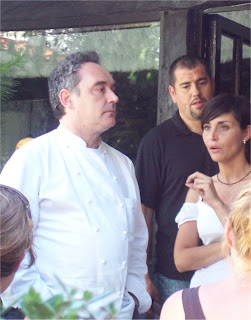
Ferran Adria stepped out of the kitchen long enough to engage in a bit of verbal ping pong about what is art (El Bulli is officially known this year as Pavilion G in the German art festival Documenta) and revealed he spends about 30 percent of his time talking to media and conferences.

After one last look at the dandy view from El Bulli’s courtyard, we hopped back on our bus and arrived at Mataro, which Carlo explained was another word for Mourvedre, very appropriate. It was a nice hotel in a bad location – across the road from what I heard was not a great beach, and a couple of kms from town, so taxis were needed for any expeditions. After we tried the first night’s hotel restaurant fare, we concluded these would henceforth have to include supper. Gazpacho in a wine glass? Phooey.