Skip to content

Skating into form

I spent some time excavating my magazine basket, and came across a copy of The Writer’s Chronicle from December 2004. I must have picked it up at the Vancouver AWP conference. There was an interview in it with Annie Finch, talking about her shift from free verse to form, a transition she says took her 20 years to make.

“I wanted to be challenged more deeply as a poet, by a more profound kind of anguage resistance, and in the end I found only form could offer me that. I got tired of feeling that the content was overpowering the words themselves; I wanted more ‘opacity,’ to use Charles Bertstein’s term.”

She began using form while doing her MFA in Creative Writing, in spite of rather than because of the guidance she found there:

“…people kept saying, ‘this poem would be a lot better if you wrote it in free verse.’ But I was set on training myself to use form well, so I just kept on with it.”

She has several different strategies for choosing a form for a particular poem:

“When a line drifts into my head, I often recognize it as a certain meter or sense that it would be a good refrain line for a certain form, or a good chant line or part of a final couplet, that sense of where it might fit can be part of the sense it gives me. So, often the poem brings the structure with it… But sometimes it’s the opposite, especially with a form I am not very familiar with yet: a poem will bug me for years, and it just won’t be finished, until finally I hammer or coerce it, or let myself be coerced by it, into its right shape… And there’s a third way too. I am not one of those poets who turn up their noses at the idea of using a particular structure on purpose; the shape of some of my favorite poems came first. For example, when I wrote A Carol for Carolyn for Carolyn Kizer… I wanted to write a carol for obvious reason, and I wanted it to be in amphibrachs before I even started, because that was the hardest meter I knew and I wanted to write her something special.”

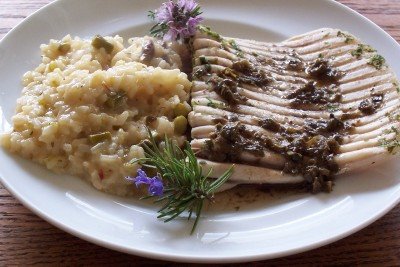
A pressing engagement to hunt Easter eggs yesterday, followed by a beautiful lamb dinner, meant I only had lunch to cope with, having been wallowing in blueberry muffins since breakfast. I was startled to find a fresh skate wing in my local grocery store, which got me thinking about the last time I’d had skate in black butter, which must have been about six years ago, at my only visit to Sheekey’s: a memorable meal — and not cheap. (We even got to do a little celebrity spotting, because Janet Street-Porter was dining there that night.) Skate is the perfect fish: delicate, easy to cook, and, for all intents, boneless. Even the recipe was easy to find. So to complicate life a little bit, and because my rosemary bushes are in full bloom and begging to be used, I also made a lemon risotto which I spiked with a handful of asparagus, just because it’s spring.

Knedliky, muffins and poetry from Manchester to Newcastle

Susan tells me that Rick was preparing a giant Czech dumpling (knedliky) for supper last night. Lucky them! I remember it well: thick, fragrant and delightfully absorbent slices accompanied some of the lovely meat specialties I had on a couple of trips to Prague, and many more were lurking in the kitchens of the Czech and Slovak Club that was so conveniently situated at the end of my street in London.

What is it about soft doughy substances… I’ve had a week of struggles with muffins. Made my third batch today after failures with apple muffins from the Steinbeck House cookbook a week ago (dry and hard), lemon poppyseed muffins from an internet recipe yesterday (flopped hideously over the rims of the muffin cups). This morning we returned to old faithful, blueberry muffins from the good old New Recipes from Moosewood, and – at last – success. Not perfection, but sweet, warm, edible success.

I came across Michael Schmidt’s Stanza lecture yesterday. His Lives of the Poets is not so much littering as landscaping my personal wasteland of unread works: it is one book that you can honestly say, before you’ve even opened it, has real stature. Apparently last year’s Neil Astley lecture was believed to be at least partially directed at Schmidt, the Mexican-born founder and publisher of Manchester-based literary journal PN Review, and of Carcanet, which is certainly a very different press than Newcastle’s Bloodaxe. Two worlds of opinion in two northern cities.

While enjoying both sides of the argument, I do have a lot more Carcanet on my shelves than Bloodaxe, and the reasons include Gillian Clarke, Eavan Boland, Sujata Bhatt, Les Murray and Elizabeth Jennings.

But I also cherish a number of titles from Bloodaxe: Ken Smith’s Wild Root, collections by Carol Rumens, Stephen Knight, Helen Dunmore. Not to forget Peter Sansom’s Writing Poems and Astley’s own Staying Alive.

A different kind of Easter egg

I found a recipe of a different kind for a different kind of appetite. Poor old Anton was scratching away after he returned from a perhaps too cozy weekend with some other dogs when I was away in Campbell River. So I thought, maybe fleas, and looked up some home remedies (the flea collar wasn’t cutting it, although he’s keeping it on as I do NOT like pulling ticks out of dogs’ faces, no I do not) . (Be careful when using remedies with borax, by the way, as you don’t want dogs or children rolling in or ingesting that.)

My absolute favourite was the cure where you place a dish of water in the flea-ridden room, switch off the lights, and place a candle in the dish, the idea being that the fleas will jump towards the light, fall in the water and drown. There was something heroic and tragic in the idea that really appealed to me, but I don’t think it works. Maybe I wasn’t playing the right music?

My, has it only been a decade? The Heather Robinson copyright case is coming up for re-hearing by the Supreme Court of Canada. It feels like it’s been going on all my life. The case seeks to help freelance writers retain copyright on their works, and to obtain payment if their works are sold again by the publisher. It began when Heather Robertson sold first serial rights to a story, and the newspaper without further payment or permission included the story on its digital (online database) services, which re-sell published pieces.

On Sunday April 16, 8 am, CBC North by Northwest host Sheryl McKay will interview Kate Braid and Sandy Shreve, editors of In Fine Form.

Toasting poetry

Just sitting around adding a layer of cookbooks to the layer of poetry books on my desk. A gift from the gods — well, from Susan in Calgary really — arrived in my mailbox yesterday: the gastro-biography Toast, by that most laid back of the British celebrity chefs Nigel Slater. Pretentious is certainly not a word you could use about someone who describes his mother’s chronically burnt toast thus:

“It is impossible not to love someone who makes toast for you. People’s failings, even major ones such as when they make you wear short trousers to school, fall into insignificance as your teeth break through the rough, toasted crust and sink into the doughy cushion of white bread underneath. Once the warm, salty butter has hit your tongue, you are smitten.”

Meanwhile I peruse recipes of a non-toasty nature as I have been smitten myself by an insane plan to cater my own book launch. Will I never learn? I think it was finding a caterer who charged $69 for a smoked salmon cheesecake that unhinged me. So I and my crispy assistant Miss Vicky will take care of things.

I’ve picked up another half-read book. This time it’s the always unpredictable and hugely successful anthology Staying Alive, edited by Bloodaxe’s own Neil Astley (check out his controversial lecture, Guile, Bile and Dangerous to Poetry). I was surprised – favourably – to discover Gwendolyn MacEwan among the contributors; and Anne Michaels, P.K. Page, and lots (7 poems!) of Alden Nowlan. One or two of the section introductions are more confusing than the poems — I have long been baffled by Astley’s assertion that Elizabeth Bishop’s Chemin de Fer could “be read as a ‘coded’ account of female masturbation.” Huh?!? Still, the poems themselves are ones to be grateful for and it is a wonderfully broad selection.

Villanelle

Blues-oriented form fiends may like to check out the latest Paul Reddick cd, Villanelle. I heard him interviewed a while back, but wasn’t paying full attention at the time; it seems to me he said that many (all?) of the songs on the album incorporated formal elements from poetry, but I haven’t been able to find that interview or any corroborating evidence.

And that somewhat predictably brings me to Dylan Thomas, whose Do Not Go Gentle Into That Good Night, for his dying father, remains the most stunning villanelle I’ve ever heard.

Two years ago today – it was the morning of Easter Monday – my own dad passed away. Here he is, sailing for London.

Purdy, Pinsent, prosody and apostles

Al Purdy’s very topical just now. Not only is his Rooms for Rent in the Outer Planets: Selected Poems, 1962-1996 up for Canada Reads , the CBC is airing a documentary about him called “Yours, Al” this coming Thursday, April 13, on CBC Television’s Opening Night. The show stars Gordon Pinsent as Al Purdy and is on at 8 pm local time across Canada.

Meanwhile, I’ve wantonly picked up yet another book to browse. The house is pretty well carpeted with half-read books on prosody and form these days. Annie Finch, in her new collection of essays, The Body of Poetry: Essays on Women, Form and the Poetic Self , kicks off and out with a chapter on metric diversity, arguing against the championing of iambic pentameter as the premier English meter. “The use of the single label ‘iambic’ to include lines in other meters, she says, “…may prove to erase what it assumes to include, just as the generic use of the pronoun ‘he’ – said to include females – arguably erases female presence.”

With Easter coming, English cooks are busy making Simnel Cake, pretty much just a fruit cake with marzipan topping, but something virtually unknown on this side of the Atlantic. Apparently its roots lie in another English holiday, Mothering Sunday, which takes place in March. Serving girls were permitted to visit their mothers on this day and the practice was to bring a simnel cake to prove how clever they were (if they made a good one, it would stay moist and tasty till Easter). Its presence at the Easter meal has to do with the 11 marzipan balls that decorate the top, representing all the Apostles except Judas. Perhaps with the new evidence that surfaced last week we can bring the numbers back to an even 12…