Skip to content

Back to poetry

I’ve been preoccupied with food lately so time to think a bit more about poetry. My cyber scouts have been sending me interesting things to read, so I thought I’d share.

Mary felt I needed to know about the not-quite-yet-born Quarterly Journal of Food and Car Poems, from Washington state, which is seeking form poems for its first issue, and provides a nicely photographed sonnet to a steak for inspiration, as well as a handy list of links to Wikipedia definitions of allowable forms.

And Nancy has been reading the well-endowed (in the most fully figured meaning of that phrase) website of the Poetry Foundation, which is an excellent site and one I hadn’t visited before. She also found an online version of the article on rhyme, meter, stanza and pattern that appeared in a recent issue Poetry Magazine, by George Szirtes.

And as for me tucked up with my million books on poetry, I was reading again a few comforting passages from my heroine Maxine Kumin’s delightfully readable and charming collection of Essays on a Life in Poetry, Always Beginning. In a 1996 interview included in the collection, she was asked about the process of writing a novel on a typewriter, which she began using a very literal cut and paste method, so she had the first page scrolling across the room before she inserted her second page. She was asked if she thought computers had changed the surface or shape of prose, and she replied

“Oh I know it has…It’s dangerous! It corrupts you in midpage because it’s so easy to insert and delete that you take a lot of wrong turns… I’m not really comfortable yet with the computer. I use it for prose, a little warily, and then I print things out and make a lot of changes by hand, and then I go back and put them in.”

Just so. I like to print poems out and write on them (with dates!!) so that I don’t lose those speculative changes. I rarely go back to previous versions, but it can be helpful to have them if I get myself completely messed up. I find the Version Control feature in Word cumbersome and not really workable for me, but on the other hand, just pressing the Save button pretty much obliterates your editing history. Literary researchers of the future should have an interesting time of it.

Have a look at this site if you’re interested in editing history; it shows four manuscript versions of Wilfred Owen’s Dulce Et Decorum Est, and I seem to recall reading we don’t know which was his own finished version, so in anthologies etc. you will find one or some variation on these. To view each draft full-screen, choose right-click a manuscript “button” (A, B, C, D) and choose Open Link in New Window.

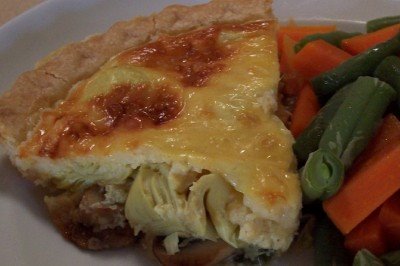
Mary wanted to see what I was having for supper last night. It was a mushroom and artichoke quiche from the Steinbeck House cookbook. The crust is supposed to be made with crushed saltines and sauteed mushrooms and butter (chilled till firm), and then you put lightly cooked green onion and chopped canned (not marinated) artichoke hearts on the base, cover with monterey jack cheese and pour on the filling, made with eggs, cream and cottage cheese, pureed with cayenne and paprika.

Yogurt of the gods

While living in England I once said, only half in jest, that I would not return to Canada until they started selling Greek yogurt. Circumstances beyond my control made me break my vow, but I still think it was a good one to aim for. There is nothing like Greek yogurt. It is smooth and luscious and may be partly cream; the ewe’s milk version is far milder and creamier than anything made of goat’s milk. Traditionally it was made in porous ceramic pots which allowed the whey to leak out, leaving a thick yogurt, something between other yogurt and cream cheese. Greek varieties made with ewe’s milk contain about 5% milkfat, and cow’s milk yogurts contain 9% (as opposed to whole-milk yogurts in this country which have around 3.5%). You can try to make your own with this recipe. Fage Total Greek yogurt is my gold standard.

There is a legendary restaurant in London called Moro, serving Spanish and North African cuisine, and which has produced a couple of excellent cookbooks, first Moro: The Cookbook and then Casa Moro, which is mostly Spanish food. I have the first one, and in it I found a fabulous recipe for Leek and yogurt soup with dried mint. Lacking the Greek yogurt the recipe calls for, I used Jersey Farms 5% yogurt. Whatever you do, don’t use skim milk yogurt if you’re making this as it won’t have the right silky texture. The egg and flour mixed with the yogurt stabilise it and keep it from curdling, but it will separate if you over-heat it. The caramelised butter (a lot like the black butter in my skate recipe) is important too, as it really adds something to the flavour, which is mild and elusive. Don’t use fresh mint as it would be too.. minty. Here’s a slightly modified version of the Moro recipe (to serve four):

1-1/2 tbsp butter
3 tbsp olive oil
2 large or 4 medium leeks, trimmed, washed and sliced thinly
1 tsp paprika
1 tsp dried mint
1 egg
1 tsp flour
1-1/2 cups (350g) good thick full-fat yogurt
2 cups vegetable or chicken stock
caramelised butter (2 tbsp butter heated slowly just until the white bits turn golden)
Salt and pepper to taste

Over medium heat, melt butter in olive oil. Stir in the leeks and cook for 10 minutes. Add the paprika and dried mint and continue cooking gently, stirring occasionally, until the leeks are soft and sweet. Meanwhile, whisk the egg with the flour until a smooth paste is formed. Add the yogurt and thin with the water or stock. Pour over the leeks and heat gently until nearly bubbling. When hot, remove from heat and drizzle with caramelised butter.

Better than a sandwich

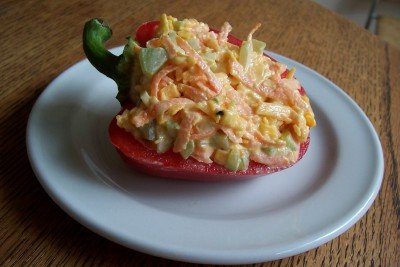
Stuffed peppers are usually cooked, but a long time ago I had a relative of this excellent raw lunch/snack and here is my version, which will stuff two small/medium bell peppers. I recommend red or orange as I prefer the sweetness. Gets a bit gooey if it has to travel, but will survive reasonably well till lunchtime if you refrigerate it. Or you can pack the stuffing separately from the pepper and stuff it when you are ready to eat. It makes a good sandwich filling or spread for toasted English muffins too.

1 medium carrot (about 3/4 cup) grated
3-4 oz cheddar cheese (about 1 cup) grated
1 small green onion, minced (optional)
1/2 rib of celery (about 1/3 cup) diced
1/3 cup mayonnaise, or to taste: just enough to glue everything together
Salt and pepper to taste

An interesting side note about peppers. Bell peppers contain a recessive gene which eliminates capsaisin, the compound responsible for the ‘hotness’ found in other peppers. Capsaisin is the active ingredient in some topical analgesics used for arthritis treatment, such as Capzasin-P.

Caryl Churchill’s play, A Number, is playing at the Belfry in Victoria at the moment. Her most famous play, Top Girls, is being broadcast on Saturday as the BBC Saturday Play. Worth a listen, and available for a week after broadcast.

Mslexia, Kathleen Jamie and the University of Gastronomic Sciences

Just got my copy of the Apr/May/Jun issue of Mslexia. The annual poetry competition closes April 28, so you might squeeze in if you hurry. The theme for the next issue is Travellers’ Tales, and the one after that I’m sure will speak to a lot of us here on the Wet Coast this year: Rain. The Making a Poem column this issue features the Scottish poet Kathleen Jamie:

“I don’t believe in writer’s block. I think you write the things that are given to you to write and then you wait for the next thing that is given to you to write. In between are what we must call fallow periods. That’s the only word for it. I hate the idea of flogging yourself in production, producing stuff for the sake of it.”

Meanwhile, I’ve been thinking about going back to school and getting another master’s degree. The University of Gastronomic Sciences offers one in Food Culture: Communicating Quality Products. Based in Italy, the program includes rigorous field seminars to learn about the production of the best foods and wines of Italy, France, Spain and Northern Europe. Sounds like a worthy academic goal, no? The price tag, room, lunches and travel abroad included, is a trifling 21,000 Euros, or just a sliver of prosciutto under $30,000 Canadian. Well, we have till July to stew on it.

Suet, treacle and some other things

Canadians who have acquired British cookbooks may sometimes need to know equivalent ingredients or measurements. Here’s a site that offers quite a bit of information, although not an answer to the question that still stumps me: what in a Canadian grocery store can equate to shredded suet for making mincemeats, dumplings, pastries and puddings? The suet offered by grocers in Victoria when I asked included bird suet (studded with birdseed!) and chunks of fat pared from beef cuts.

The official word on suet as sold in England is that it is made by grating the hard white fat which surrounds the kidneys, although there is also a vegetarian version, which according to the label is made of hydrogenated vegetable oil, wheat flour, sunflower oil, pectin and sugar. Lard and shortening are the wrong consistency: too soft and greasy. I haven’t experimented to see if they actually work in the finished product, though. I did find mention that hard coconut fat might be the answer. Further experimentation clearly needed in this area. Stay tuned.

Or apparently I can order vegetable suet through A Bit of Home, which happily is based in Toronto so no issues with customs, GST and duty. Everything from self-raising flour to jelly cubes to PG Tips pyramid teabags. Disappointing not to see Cornish Wafers, or Mackerel in brine which are – besides the cheese, the yogurt, the stunning produce selection, the extravagant selections of cream, of marmalade and of sugar – among the things I miss most about living in London.

I must make a return visit to the lonely little UK shelf in Market on Yates, which stocks a similar selection to A Bit of Home. I scored a 500g jar of Marmite there last year for around $18 – which is still cheaper and easier than flying over and slogging back with it in the overwrought luggage.

In The Boy from the Chemist is Here to See You, Paul Farley painted a memorable portrait of black treacle, loosely equivalent to molasses in North America (I’m happy to see that Treacle also appears in New British Poetry):

Funny to think you can still buy it now,
a throwback, like shoe polish or the sardine key.
When you lever the lid it opens with a sigh
and you’re face-to-face with history.
By that I mean the unstable pitch black
you’re careful not to spill, like mercury

that doesn’t give any reflection back,
that gets between the cracks of everything
and holds together the sandstone and bricks
of our museums and art galleries…

Chicken salad and the mysteries of poetic craft

In a weak moment I bought one of those pre-barbecued chickens, basted in salt and lathered with a toxic red substance. Still, it left me with enough cold chicken for a good old chicken salad, a food that – like tuna casserole – was mysteriously absent from my upbringing and which I have embraced in later life. Here’s a perfectly straightforward recipe, based on one from the Fanny Farmer Cookbook:

2 cups cooked chicken, skinned and chopped
1 chopped green onion
1 rib celery, chopped
1/2 cup mayonnaise
2 tbsp plain yogurt
1 tbsp wine vinegar
Salt and ground pepper to taste

Combine mayonnaise, yogurt and vinegar and blend well; add seasonings. Toss chicken, onion and celery with dressing until well mixed. Serve as a salad, on a bed of greens, or as a sandwich filling, on toasted English muffins. Why mess with simplicity? Have it with a lovely bowl of Edamame, drizzled with sesame oil and dusted with salt.

It hardly needs saying that Mark Strand is not a chicken, or a salad, nor even simple, but interesting to know he is Canadian-born (PEI). I first came across his name as co-editor (with Eavan Boland) of the form poetry anthology, The Making of a Poem. He’s also published a handy little book of essays on poetry called The Weather of Words. I’m finding it heavy going, but there are always moments in any such collection, and so I soldier on. I thought this, from the start of Notes on the Craft of Poetry, was an interesting take on it:

“Each poem demands that I treat it differently from the rest, come to terms with it, seek out its own best beginning and ending. And yet I would be kidding myself if I believed that nothing continuous existed in the transactions between myself and my poems. I suppose this is what we mean by craft: those transactions that become so continuous we not only associate ourselves with them but allow them to represent the means by which we make art… To a large extent these transactions I have chosen to call craft are the sole property of the individual poet and cannot be transferred to or adopted by others. One reason for this is that they are largely unknown at the time of writing and are discovered afterwards, if at all.”

He quotes Orwell’s rules of good writing, and questions whether these or any rules can really be applied to poetry: “For the poems that are of greatest value are those that inevitably, unselfconsciously break rules…”

His argument against craft is that it cannot work as a defining or diagnostic concept, because poetry “cannot be understood so much as absorbed.” He seems to be an advocate for mystery, arguing that we not attempt to impose a structure on the process of creating poems, because to do that is to imply a common purpose for poetry, which it eludes, because a poem’s purpose “…is not disclosure or storytelling or the telling of a daydream; nor is a poem a symptom. A poem is itself and is the act by which it is born. It is self-referential and is not necessarily preceded by any known order, except that of other poems.”