
Scary times

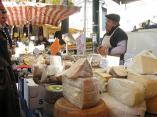
I visited Moss Street Market for its end of season finale, which happened to be on October 31, so there were some oddities around. Flash in the Pan was providing the music; sounded better than they looked!

Poor farmer had to wear a potato sack…

Some flies buzzing round the Haliburton stand

like beekeepers to the honey

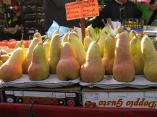
The last thing I thought I needed was more apples, but this selection

was too interesting, and I weakened upon tasting the surprising Grenadine, the perfect Halloween apple?

Other items of interest to cross my path of late include the Spanish Nun video, in which Benedictine nun Teresa Forcades i Vila discusses the H1N1 business in terms that don’t make one particularly eager to rush out and get the vaccine. (Assuming one could even do that!)

She makes mention of a largely unreported incident last February when Baxter released a flu vaccine to Austria, Czech Republic, Slovenia and Germany that was contaminated with live avian flu virus, offering the potential to spread a lethal virus very widely; Baxter is one of the companies now making the H1N1 vaccine.

And she has a number of concerns about unique aspects of this vaccine: the lack of legal redress for any people suffering side effects that has been built in by pharmaceuticals and governments; the different way it works from regular flu vaccines; and the effects of making H1N1 vaccination mandatory rather than voluntary.

She also explains that the WHO’s removal of the term “mortalities” from its definition of “pandemic” is why we are chasing our tails now over an infectious but not overly lethal flu instead of saving our international efforts for a pandemic that actually endangers the lives of high numbers of people.

It’s kind of long (about an hour) but worth watching just to hear some things you might not get elsewhere.

http://vimeo.com/moogaloop.swf?clip_id=7298827&server=vimeo.com&show_title=1&show_byline=1&show_portrait=0&color=&fullscreen=1

BELL TOLLING for the Swine Flu (CAMPANAS por la gripe A) subtitled from ALISH on Vimeo.

It is perhaps worth pointing out that Sr. Teresa is the author of Crimes & Abuses of the Pharmaceutical Industry, which I’d say is a booklet worth looking at, as it addresses issues to do with abuses of power by pharmaceutical companies on the lives of impoverished and vulnerable people.

1 Comment


The Cove and other animals

Went to see The Cove last night. Billed very accurately as an eco-thriller, it took on the Japanese dolphin trade in a clever and compelling way. It starred the director, Louie Psihoyos, and dolphin activist Ric O’Brien, better known as the trainer of Flipper, both appealing and articulate men, accompanied by an equally appealing handful of idealists and adrenaline junkies (including a couple of divers from Vancouver).

Well and imaginatively shot and scored, its aims were simple: to take viewers along as the team planted cameras and recorders in order to document the dolphin slaughter in the whaling village of Taiji, Japan which has seemingly been targeted by whale activists for some years, to judge by this statement dated 1994. Its annual kill as reported by the film is 23,000 dolphins, which are harpooned by local fishermen between September and March, after a number have first been selected to sell to aquariums, where the real money is.

The questionably less fortunate dolphins who are slaughtered for meat are sold for a pittance, despite the film’s assertion of breathtakingly high levels of mercury in their flesh (2000 ppm in dolphin vs the recommended Japanese limit of .4 ppm). Big carnivorous (piscivorous?) fish, at the top of the food chain, absorb all the mercury of the smaller ones they eat, so they are expected to be more toxic. Cheaper dolphin has for some time been fraudulently sold as whale meat (whale is less prone to mercury toxicity than dolphin due to the difference in diet between larger cetaceans and dolphins).

The film’s sharpest anger is reserved for the International Whaling Commission, which cannot seem to decide if it is interested in the smaller cetaceans (i.e. dolphins) or only the larger whales. The Cove paints the IWC as a lumbering, toothless body, which the Japanese have made a mockery of by vote-rigging: building useless seafood plants in impoverished countries and paying their representatives to come and vote with Japan.

It is difficult to have much sympathy for the fishermen of Taiji, when you see that to them a dolphin is just another fish to be speared, but then I am of a culture raised on affection for dolphins, and as squeamish as most urban eaters about the realities of killing my food.

The other side of the story – what happens to a whaling town if it’s not allowed to kill whales (of any size) – is one that will resonate with the other economic outcasts of our time, including forestry, cod, sealing and manufacturing communities, down the road and around the world. Not to mention the town centres and family farms and businesses that are being ruined and bankrupted by large scale retailers and industries.

Even those communities that choose to prostitute or lampoon themselves by taking up tourism are not winners in this; tourism is a fickle and usurious source of income with a short attention span and a great hunger for unsustainable practices.

As we use up our natural resources, or force ourselves out of the economic picture by voting for “efficiencies” and low prices rather than jobs, the ghost towns of our time will have many different faces, all left with that same big question: so what do we do now to make a living?

Comments Off on The Cove and other animals


Monday morning musicals

A couple of barmy musicals to get your week off on the right foot. The agents of Improv.com have been staging such antics at various places for ages, and I have to say that the Grocery Store Musical

[youtube=http://www.youtube.com/watch?v=WnY59mDJ1gg]

is an improvement in quality over last year’s Food Court Musical,

[youtube=http://www.youtube.com/watch?v=dkYZ6rbPU2M]

although, frankly, I would be delighted to witness either one of them in an establishment near me. Being the single minded creature that I am, though, I would have preferred some kind of clever statement about the toxic environments in which these two musicals are staged over the actual and frankly inane lyrics, however amusing. A wasted learning opportunity, the adult educator in me might whisper.

Comments Off on Monday morning musicals


Climate Action, transgenic aubergines, chickens, food policy and CBC awards

Today is the International Day of Climate Action! To… er… celebrate it I’ll be attending a screening of A Sea Change, about the acidification of the earth’s oceans.

In Sweden, consumers are being offered new climate change food labelling in order to help them make climactically healthier decisions about what to eat.

Other interesting items to cross my vision include a story published in Nature about the Indian government’s having said no (for now) to transgenic aubergines (eggplants; aka Bt brinjal) on the grounds they can’t evaluate how likely (or not) the transgenic varieties are to cross with non-GM varieties, a well-worn concern that somehow keeps getting overlooked by biotechnology firms.

An article in the New York Times paints a cautionary picture about kind of issues that can result from overenthusiastic backyard chicken-rearing by people who haven’t quite thought the issues through carefully. It’s very much the sort of thing the SPCA argued would happen before bylaws were relaxed to allow it in Vancouver.

And if you want to put your oar in about Canadian food policy, the People’s Food Policy Project website is the place to go. Because Canada hasn’t got a food policy: although one was researched, discussed and proposed a few years ago, it fell into the cracks between elections and died, unknown and unloved on the mean streets of Ottawa. The people’s project is inviting stories and policy suggestions by December 1.

Other deadlines looming include the CBC Literary Awards, which I hadn’t – until last night – realized had tightened their terms to exclude any work that’s had a public reading. Which made me despair, for I have read a lot of my poems aloud and I really couldn’t tell you which ones. It also made me foresee ugly scenarios of literary whistle-blowing by disenfranchised contestant audience members. (Surely there’s a novel in that?)

2 Comments


Bye Bye Banff and WordFest

I left Banff on Monday morning, having spent much of the weekend dodging in and out of literary and visual arts events.

Saturday afternoon I slipped into and then fled screaming from the most bizarre and numbingly dull curatorial talk I’ve ever experienced. We heard scarcely a shred of information about the Laid Over to Cover: Photography and Weaving in the Salishan Landscape exhibition that we were all interested enough in to show up, and after an hour I couldn’t take it any more.

When I went to see the show on Sunday, its very point was a bit difficult to grasp (but then I had no curatorial context for it!) given the dearth of labelling – which was, according the one point I recall from the talk, a curatorial decision, though the reasoning for this eludes me, if the point of the show was to right an historical wrong of omission.

We were presented with some interesting archival photographs of the building of transportation infrastructure through BC and Alberta; and some rather lovely woven baskets dating from about 1900 through 2009. The baskets were numbered, with no contextual information, placed in apparently random order, and interspersed with modern ceremonial blankets. We ran into a textile artist who’d visited the show and who was galled and mystified as to why these blankets were there – as they were woven not from traditional materials (goat wool and cedar) nor using traditional plant dyes, nor even using traditional weaving methods (one weft she recognized from a loom in New Brunswick). Oh well.

On to literature, and another massively disappointing presentation, this time from Douglas Coupland who read in a manner that struck me as that of someone who had never before encountered the text in front of him.

In a many-signed theatre that reminded me of Italy in its enthusiasm for public instruction,

a poetry cabaret followed, of which I would say Gregory Scofield gave the best reading, but which irritated me in the way that poetry cabarets always irritate me. Luckily I was able to vent my irritation on a hapless festival survey-monger who crossed my path the next day: why, I asked, can Canadian literary festivals not treat poets as writers? Why must the only way to include them in a litfest be to herd them in nines or twelves onto a single stage at a single event instead of including them in literary panels with the prose writers? The other irritant to that event had me asking why spoken word artists must be lumped in with page poets? It would be like pairing water-colourists with metal sculptors on the grounds that they are both visual artists.

Anyway. A talk and mini-readings by fiction writers on Sunday – Debra Adelaide, Jeanette Lynes, Thomas Trofimuk and Tom Wayman – was slightly better. Although to me the supposed theme of the event, “making the most of the hand you are dealt,” was somewhat mystifying in light of the very different themes of the four books. It is a difficult and sometimes impossible task to corral every writer into thematically coherent panels; too many square pegs in the creative realm.

The winning finale to the weekend though was a visit to the Maple Leaf restaurant in Banff, where we dined happily and well on bison stroganoff.

And a parting view, first thing Monday morning, of a trio of antlered elk who posed heroically at the edge of town, seeing us off. Given the damage sustained by one writer’s vehicle during this, the rutting season, we deemed it unwise to linger for photographs, so I’m afraid you’ll just have to imagine them.

Comments Off on Bye Bye Banff and WordFest