

Terra Miele

Beekeepers were out in force at Terra Madre. Coming from Italy, Mexico, France, Brazil, New Zealand, India, the UK, Ethiopia, Kenya, the US, Morocco, Canada, Germany and just about anywhere else you could imagine, they were there to talk about concerns they had in common. One topical story was that of the German ban on GM honey: a Bavarian court ruled at the end of May this year that not only was honey made from nectar of GM crops not saleable, it was not fit for human consumption and had to be destroyed. Other concerns had to do with selective breeding of bees, which was reducing their resilience to disease and contributing to the loss of bee populations that had evolved to suit their native environments. There was discussion of the harm monocultures and commodity crops were doing to the bee populations; and of course there was a great deal of concern over pesticide use and urbanisation of native habitats.

There was lots of honey around. One thing I noticed in the Terra Madre market area was that every country had brought its jar or two of honey;

something that everyone had in common. The Honey Bar was hugely popular: volunteers manned it all day every day and patiently walked bystanders through free tastings of dozens of different honeys from around the world.

I confess I missed the opening ceremony of Terra Madre – just too hard to figure out where it was and how to get there and besides I had booked myself on a honey tasting,

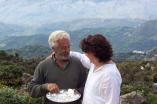
led by honey producer Andrea Paternoster, whose generous selection of MieliThun honeys were hot items in the Salone de Gusto marketplace.

Comments Off on Terra Miele


Terra Madre

So much to say about Terra Madre, I’ll have to break it into bits.

A food meeting with a difference: Terra Madre included a large open space to allow delegates to throw a blanket on the floor and sell – or just show – their wares.


Biodiversity is a big thing in Slow Food’s mission. So much of today’s food has been bred into narrow, profit-oriented channels and lacks the flavour, seasonality and suitability to its terrain that traditional foods had evolved around. Here, a selection of local rice varieties from Thailand…

..and here, a selection of almond varieties from Afghanistan.

Green eggs from Temuco chickens, at the Chilean stand.

One of the many remarkable things about this event was the presence of simultaneous translation — into the 8 official languages of Terra Madre. It wasn’t always perfect or easy to hear, but it was an amazing achievement to do as much as they did. Some of the translators worked between two or three languages.

Some listeners demonstrate what could be described as the house style for positioning the translation receivers for maximum effect…

And someone offering henna services…

Comments Off on Terra Madre


Naples and Rome Oct 20-21

After Pompeii and Herculaneum we went to Naples – using our Arte cards which had given us three days of sightseeing and travel – to get to the National Archaeological Museum of Naples, which held all the ‘good stuff’ from the excavations.

First, though, we were in Naples, so…

The museum. Big and pink!

Head of a poet.

Dear little pig of Herculaneum.

Demeter.

A recent treasure from Herculaneum, Testa di Amazzone, found in 2006. Showing that redheads ruled even then.

Absolutely stunning mosaics and wall paintings from Pompeii and Herculaneum:


The famous Sappho painting from Pompeii.

Then it was time to go to Rome. After a spell of wandering in the graffiti-heavy neighbourhood

we found – with some difficulty – the door to our guest house. Happily much nicer on the inside than the outside.

We asked for restaurant recommendations and ended up at a pleasant local restaurant where I had some buffalo mozzarella with zucchini alla scapece, an excellent combination.

Did not touch the hotel breakfast as it all looked too toxic to be released from plastic:

Went on a tour of the city and eventually found our way to the Trevi Fountain, which was being serviced. But it still drew a sizeable crowd, some watching a man who’d jumped the barricade and was busy picking up the coins that didn’t make it into the fountain, chucking in the smallest ones and pocketing the rest, until he was escorted out by the security guards.

Near this street…

we found a good lunching spot with interesting lighting

and excellent fragoli con gelato.

Next to the Spanish Steps where our first stop was Keats’ House, the lodgings where he died

And of course, being a Slow Foodie, I had to note the McDonalds, just around the corner on the Piazza di Spagna, which was the final outrage that caused the founding of the Slow Food movement in 1986.

Chestnut seller.

And that was more or less it for me for Rome this time. One final meal – excellent and local and recommended by the hotel – and I left for Turin the following morning. Giving another wide berth to the scary breakfast buffet.

Comments Off on Naples and Rome Oct 20-21


Herculaneum & Vesuvius Oct 19

It seemed to us that modern Herculaneum is covered, like most of what we saw of urban southern Italy, by a lot of graffiti.


Kind of liked this street name:

And then we found it…

And it was amazing that anyone found anything here. The town was well buried, beneath another town. This is the depth of lava they had to dig through to find what was buried.

The streets of Herculaneum, unlike those of Pompeii, did not run with odure. They were straight and clean

because householders could empty waste into the drains. The drains are in such good shape here there’s a whole field of study around them.

A 2000 year old bed

and the corner of another one:

And some 2000 year old rope. For some things, surprisingly little has changed.

The baths, in good condition: benches still in place…

and a beautiful floor.

More amazing wall paintings…


and mosaics

Had time to notice the interesting labels on the recycling bins near the mini-bus service to Vesuvius.

We had a swift and occasionally alarming ascent up to the summit of Vesuvius. It’s about a 20 minute drive followed by a 20 minute or so walk up the trail to the top.

Helpful signpost.

Hard to know whether the inside or the outside of the path felt safer!

Rewards are many and heavy if you make it to the top. Or even nearly to the top. There were at least two souvenir stands up there. The local wine, Lacryma Christi del Vesuvio, is made, so they say, from the many vines growing on the slopes of Vesuvius and is named for the emotion Christ felt upon noticing the beauty of the Bay of Naples while he was ascending to heaven… or else for the tears Christ shed when Lucifer grabbed a chunk of heaven and threw it into the Bay of Naples. Or something. Anyway, we tried the red one night and found it a nice southern Italian wine, dark and mineral.

Big, big hole.

Still smoking. Quick visit.

We zoomed down the hill again in our mini-van. Front seat passengers later revealed that the vehicle had no working speedometer (pah, who needs that??) and we’d already figured out there were only four working seatbelts… lucky for us there were only four passengers. Nobody was brave enough to point out to the driver what that ‘no passing’ sign meant as he had clearly decided it was not relevant to drivers in a hurry. However, we were under the protection of the caped crusader, so no harm befell us.

Comments Off on Herculaneum & Vesuvius Oct 19


Pompeii – Oct 17-18

Pompeii is a many-faced city. There is tat

and moonlight;

and a fine basilica…

We started off our weekend with an excellent meal at La Madia, where the degustazione menu was too much but too good to stop. Melanzane Parmigiana

followed by pasta, with cream, veal and potatoes

– wonderful but so filling it was all I could do to enjoy the tagliata that followed – could be the best steak I’ve ever had.

Our dessert – a regional specialty – was a layered excess of chocolate, custard and marzipan…

Thus fortified we were equipped to spend the following day in the ruins of Pompeii.

It would have taken several days to see them properly, but we did what we could. The wall paintings were wonderful:


The baths were impressive…


Many fountains in town, most still giving drinkable water:


This one sweetly decorated with shells:

The mosaic floors were stunning:


Pompeiians obviously enjoyed their bread; there was more than one bakery with its own flour mills:


and ovens, of course:


They ate out a lot too, at thermopolii, where amphorae were propped in holes in the counter; the food stayed hot without flame, because of the heat-preserving properties of terra cotta.


And the colosseum is in pretty good shape, at least on the outside:

Back in town, the preparations for the papal visit were well underway, which included taping up the mail slots and garbage bins and installing some rather fetching porta-loos.


We decided to splash out on a meal at the town’s finest dining establishment, Il Principe, and what a disappointment that was. We were ushered into a near-empty restaurant, sat next to a giant arrangment of fake flowers. The appetisers were good and interesting, souffles of cheese with various vegetables:

Things went really wrong when it was time for our second courses. The sea bass was ok, but like the meals of all four of us, was nearly stone cold when it was served.

And the quality was just not worth the price tag. The proprietor appeared to be too busy catering to the only other table in the restaurant – clearly peopled by old friends and/or local dignitaries – to trouble his head with a quartet of stranieri. We were so disheartened by the experience we fled immediately for a little cafe near the hotel, where we were served nicely decorated and not over-priced caffe macchiato by friendly proprietors.

1 Comment