Skip to content

food security

Tansey on food, wealth gaps and the Canadian Wheat Board

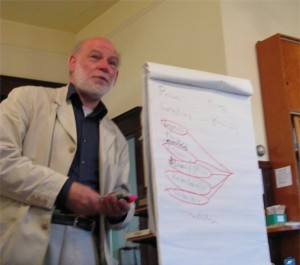
I was at a small and far too short evening with British food activist Geoff Tansey the other night. He was on holiday but kindly agreed to stop in at the Victoria Quakers meeting house to give up a couple of hours talking to local people interested in food issues, and we were treated to a mini-version of the presentations he’s been give at conferences in Nova Scotia and Montana this month.

About 20 of us gathered on a quiet evening when much of the population was tucked up in front of its televisions watching hockey. We started off with a short review of our various breakfasts: the cereals, eggs, breads and fruits were all, noted Tansey, the historical residue of European colonial trade, not local (aside from the salmon that one person had had) – relics, really, of the food systems created by colonial powers that are all on the wane today. And a reminder that food lays its historical tracks down our lives whether we notice or not.

Next it was on to the pillars of food politics. There are always four elements that affect contemporary food systems: power, control, risk and benefit. Power and control contain risks and benefits; understanding who benefits and whose interests are put at risk by the current system is one way of revealing flaws in the structure. Food security definitions, Tansey remarked, do tend to omit mention of power, control and biosphere issues.

He spoke about the economic concentration of power in our food systems which works against broader human interests: there’s a widening gap between the 10% of the world population which holds 80% of global wealth. The wealthy minority will carry on practising what he calls Liddism (keeping a lid on) where the fundamental truths are that we’re living in a bitterly divided adn finite world.

It’s important to acknowledge how greatly technology affects our food system as well, from genetic engineering of food products to customer profiling cards that drive the control of the food products we’re offered.

If we carry on as we are today, Tansey sees three options for global food in the future.

1. The system simply collapses.
2. There’s a technological fix, leading to what he calls an era of corporate feudalism: the rich minority doing all in their power to hold their position at the expense of everyone else.
3. Diversity/equity systems bring a more universal food system into play. There’s a lot of work being done now, but it’s often not very connected.

The tech fix might have a role to play, he added, but only if it aims to meet the goal of diversity/equity. Unfortunately what it’s aiming for right now is economic power and control which simply widens the gap between rich and poor.

There was more discussion after that during which he talked about his recent book, The Future Control of Food: A Guide to International Negotiations and Rules on Intellectual Property, Biodiversity and Food Security. Also about the Food Justice Report of the Food Ethics Council which provides tools for decision makers and is available as a pdf download on the web. And he recommended Thinking in Systems by Donella Meadows.

He mentioned Manitoba film-maker Katharina Stieffenhofer (whose film …And This is My Garden “is about the power of education to foster healthier lifestyles and to reconnect youth to the earth”) in the context of concerns over the future of the Canadian Wheat Board, the farmer-controlled marketing agency that sells Canadian wheat, durum and barley on world markets, and which Stephen Harper has sworn to dismantle.

Harper thinks he has a mandate to take away the power over wheat marketing from its farmers, so please read all about it in Maclean’s. Then consider the pillar of control, and who his “free trade” solution will really benefit. And if you don’t think it’s going to help make food available more fairly and widely, write to him and to the agriculture minister and tell them  what you think.

Food Security in Bloom

I blossomed along last night to catch Michael Ableman speak on Thinking Like an Island: Food Security and Sustainability, as part of the art gallery’s Art in Bloom series. The promo promised we’d hear about how “thinking like an island means minimizing reliance on “off-island” resources.”

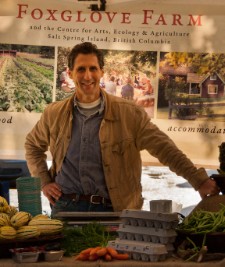
And indeed it was so. It was a lively, passionate and articulate talk, presenting alternatives for a sustainable future, “where communities develop their own full cycle food systems and city planners integrate food production into new developments.” Ableman speaks with authority, from the foundations of a lifetime spent farming and driving urban agriculture programs (like SOLEfood in East Vancouver), which he now does from Foxglove Farm on Salt Spring Island.

On Salt Spring, he said, there are the problems we all share today: utter dependence on fossil fuel and the automobile and imported food; and like many other urban centres, even this island has its share of poverty and food insecurity, well hidden from public view.

Think of Earth as an island floating in a sea of space, he suggested; perhaps if we thought of it that way we might take better care of it.But it all starts with food: nothing is more basic to our needs, and yet we’ve handed over that responsibility to others, and we’re seeing the results in soil loss, water contamination, obesity, health problems of many kinds.

But islands of farming – for every farm should be as self-contained, self-sufficient and self-renewing as an island – nowadays have ecological and educational roles as well as to feed a predominantly urban world.

His deepest message for the future of food security has to do with education. We can learn to build food security by growing our own gardens: people need the knowledge as well as the means and land to produce some part of the food supply. We can secure it for the future by cultivating those skills in our children, who will after all reap the fruits of our time, so they might as well learn to grow vegetables while they’re at it.

While you can’t impose changes on those who don’t understand the value of food, you can teach children in schools – where the curriculum needs to cover all aspects of food production with the same importance currently given to math and history. Moreover, every school should restructure its approach to food procurement, and make use of its off-duty kitchens for neighbourhood food processing and preservation.

On land tenure, a much discussed obstacle to new farmers, he proposes different models of ownership. It’s wrong, he said, that the only qualification you need for this at present is capital, when stewardship is the more important quality for custodians of this essential resource.

If we are all just passing through, all that remains is the land: we owe it to the future to leave it more fertile than we found it. Land ownership, particularly of parcels of 5 acres or more, should be tied to requirements to learn how to rebuild the soil for growing. But for any new development, building permits should include food production component in proportion to population they support; industrial buildings should be required to have rooftop growing spaces.

He suggests that the armed forces should be put to work restoring growing land and our railway system. Because a local diet is not necessarily an inclusive or varied one, particularly in northern areas, we need to make use of regional foodsheds and transportation is central to providing the population. Rail is the most cost and energy-efficient way to do that.

He paused to throw a few cautions in about phosphorus, one of the three essential components in plant nutrition (along with nitrogen and potassium). Commercial farming uses about 90% of mined phosphorus in agricultural production: this includes, of course, biofuels. Phosphorus is another nonrenewable resource which is due to become scarce, and Ableman feels it’s the elephant in the room, and it’s going to be the next thing worth fighting for. He suggested we check out which countries hold reserves of it. The answer is: China (which has just upped the price so as to conserve supplies for its own use); the US (will run out in 25 years); and, sadly for Africa, Africa.

He mentioned some lectures he’d given on the Hawaiian Islands for the Center for Ecoliteracy. Hawaii used to be a model of self sufficiency, where the population’s role in relation to the environment that supplied its food supply was fully understood; where it was appreciated that the survival of each of us is inextricably tied to one another and the world around us: and that what we do in the way of harvesting seafoods, for example, affects the survival of our community in the long term. But that knowledge has been lost and Hawaii now imports 80% of its food and suffers the same associated problems as everywhere else.

He spoke as well of time he spent as a teenager in Jamaica, and how that island too now relies upon imported food; and in its altered agriculture, geared to supply global markets, has lost what he calls its “national wealth” – the flavour of its fruits.

He quipped that it’s time farmers received the same rock star status that chefs do; but then again, farming is not a spectator sport. People who don’t want to farm should make friends with a farmer: you will need them. And speaking of rocks, he has a fine idea for soil replenishment, which is that every community should have a rock grinder, to enable us to replenish soil minerals by creating our own rock dust.

The bottom line: though it’s encouraging to see how many people want to eat well and locally today, there simply aren’t enough of us doing the hands-on work of growing food. We have a couple of generations of people now who know no more than how to push keys on a keyboard. We need to consider what we’ll depend on when we can’t depend on technology, for the skills we’ll require to survive on this earth include growing food and restoring the soil.

Farmer2Farmer in Saanich

Wednesday I joined – at a guess – around 70 farmers from Vancouver Island and Gulf Islands for a Farmer 2 Farmer information exchange. Bob Maxwell, Linda Geggie and Barbara Brennan

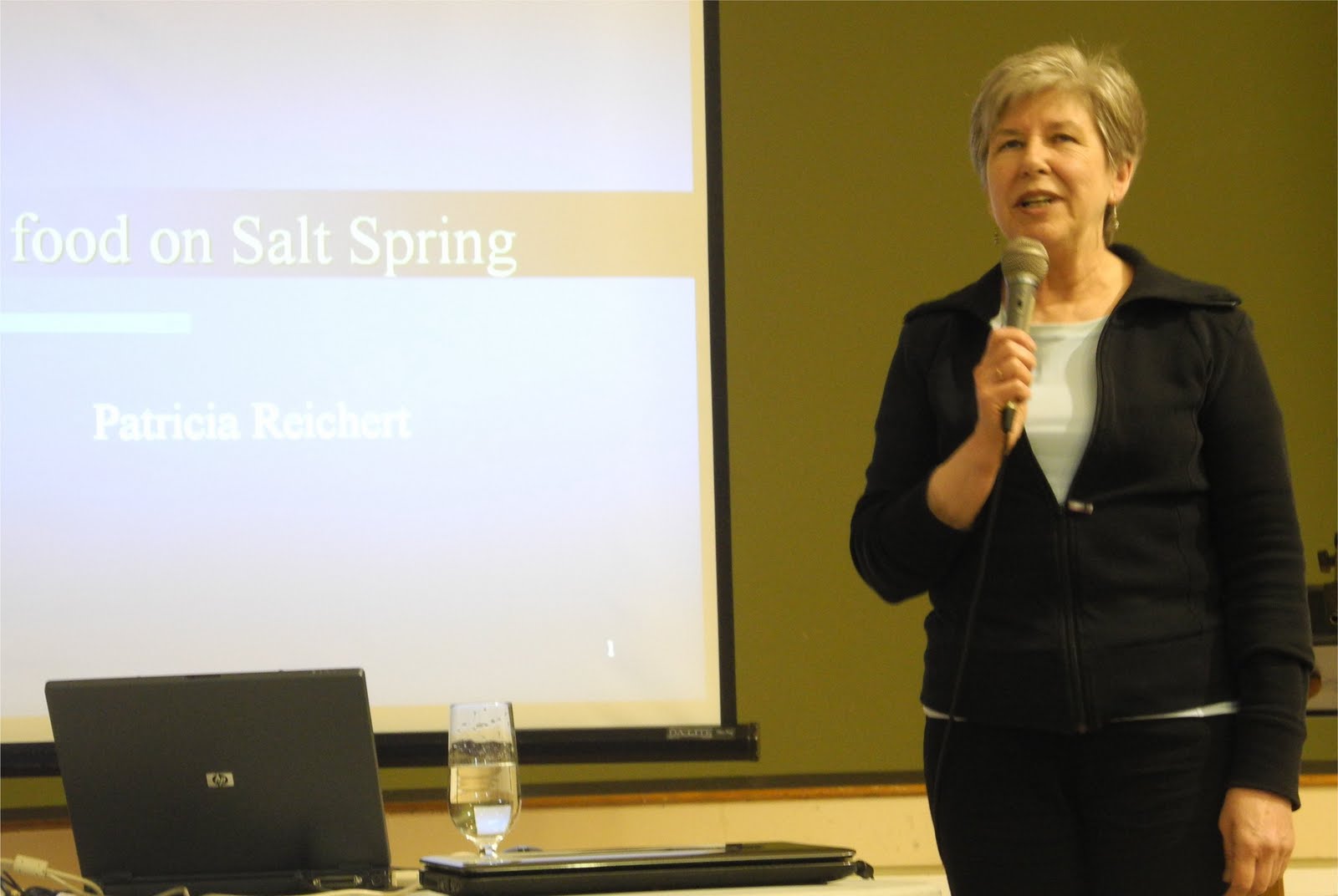
introduced the day, and then Pat Reichert

of Island Natural Growers on Salt Spring Island kicked off with a keynote address. She talked about her research into food production on Salt Spring, a task she describes as “not for the faint of heart, or those with short attention spans”. She found that around 96% of the produce consumed there is imported; and that the change to BC’s meat regulations had a devastating effect on Salt Spring meat production which dropped 50% in the face of requirements to ship all animals off the island for slaughter and butchery.

Island Natural Growers created a demo project – Farm Food Link – to help local organic growers distribute their products to local businesses and institutional buyers on Salt Spring. It’s now a going concern called Growing Up Organic. ING has also partnered with the local Farmers Institute and the Chamber of Commerce, Salt Springers for Safe Food and the Earth Festival Society to form the Salt Spring Food Alliance. They’ve achieved much in a short time through an over-arching Infrastructure Project. There’s a packing and distribution centre in the works, which would provide a central point for small farms to ready their goods for market; an abattoir project, which will provide a mobile abattoir offering both slaughtering and butchery services for Salt Spring (to be shared with Pender Island); and a community compost project. There’s a land lease project in the works as well to improve access to affordable farming land on the island.

Thus inspired, we were invited to join a couple of sessions on topics ranging from Increasing Profitability through specialization? Diversification? Both? to Emerging Food and Ag Business Opportunities in the Region to Integrated Pest Management: What’s bugging you?.

I was at the Pollination Power talk, where we heard from pollinator activist Nathalie Chambers and beekeeper Ed Banas.

Nathalie Chambers’ monumental fundraising efforts to save Madrona Farm have been followed by work with The Land Conservancy where she leads the Pollinator Enhancement Program. Wild bees, she said, are under some of the same threats that are decimating honeybees: loss of habitat and nectar sources, diseases and pesticide use.

She proposes three simple steps that everyone can take to improve the lot of pollinators:

  1. To feed all types of pollinators, ensure there is adequate pollen and nectar available from February to November: native plants are very helpful for this, because native bees are 4 times more attracted to native species than to introduced plant varieties. Native species are also timed to flower in succession: which is something farmers should aim for when planning cover crops as well.
  2. Provide habitat: 70% of bees are solitary ground nesters: the dirt “volcanoes” you may see in the ground indicate their presence. Keep an area of exposed soil undisturbed for them (they like south facing sandy slopes too). Another 30% of bees live in trees, stumps and snags – so leave some of those.
  3. There’s a knowledge gap between scientists and the wider community: but the simple fact is that most pesticides are lethal to invertebrates. She urged us to check out Xerces.org to learn more about organic pest management techniques. She recommended looking into this Wikileaks article which explains the deliberate approval of a pesticide known to be toxic to bees.

Ed Banas talked about pollination from a honey bee keeper’s perspective; about the hazards we create by a fondness for pristine lawns (dandelions and white clover are excellent food sources for bees). And it’s not just the immediate deaths from pesticide spraying that are problematic, he noted, but the generational deaths that follow, when contaminated nectar and pollen are taken back to the hive and fed to the more vulnerable young. He also talked about the crippling effects of using coated seeds, which are treated with fungicides and/or insecticides; when they germinate, they exude a kind of sugar that bees take back to the hive together with its hidden load of pesticides. Corn is particularly often treated, but so are many other seeds: he strongly advises people check seed packs to make sure they’re uncoated.

There was a break and time for another couple of sessions. I dropped into Marketing-it’s about relationships? where there was much talk about the ins and outs of blogs, websites and social media; and Random Acts of Agriculture – which was a forum to share ideas and innovations. The latter group had some interesting ideas to float: Nathalie Chambers told us of her “Random acts of cooking” – a dream of travelling from farm to farm on a truck with a coleman stove and picnic table, ready to cook up produce right on the farm, to show people how good and easy fresh food can be (she did this to enthusiastic response at Madrona’s farm stand until VIHA caught a whiff and shut it down).

Other suggestions included telling consumers that eating good, local, organic food is within reach of almost everyone: you don’t need to commit all your resources, or blow your whole income on food, but buying just a little – a flat of organic blueberries here, a few heads of lettuce there, a pound of local garlic – from a lot of farmers would help them enormously. There was some puzzlement by the farmers present over the misperception that supporting businesses like the Red Barn and the Root Cellar was equated with supporting local growers, when both of these outlets import most of their stock. They were also peeved by the latter’s marketing slogan (“Farm Fresh, Dirt Cheap”) which is simply untrue as people should know by now: good food costs more, and cheap food really isn’t. Don’t worry, said someone, the global economy will take care of that: once cheap oil is taken out of the equation, the profit margin won’t be so attractive for imported food.

A couple of the farmers talked about grain growing on Vancouver Island. One, a hay producer, explained that the market for hay has tanked and that the Island’s hay fields could easily be converted to grain growing, but there’s a lack of infrastructure for other aspects of the process, like milling and grain storage.

Unfortunately taking all that in meant missing Mary Alice Johnson’s talk about Land Leasing and LLAFF (Linking Land and Future Farmers): a regional land registry and database to link up those looking for land with those who have land they wish to share or lease.

After lunch there were roundtable sessions, giving a bit more time for questions and answers about growing new farmers, marketing, government funding, agricultural infrastructure and more. A lively and useful day… may there be more!

More on farmland/cityland

Following on the heels of the Farmlands Dispute program, here’s a video about a long-running local battle for farmland south of Vancouver. The current owner is a developer..

“Saving the Southlands” tells the story of the 30-year battle to protect a 500-acre parcel of prime farmland in Tsawwassen from proposed housing development – set against the backdrop of an emerging food security crisis in BC. The film features a number of Tsawwassen residents, Richmond City Councillor and ALR co-founder Harold Steves, agrologist Arzeena Hamir, and also profiles several local community farming success stories. Funded entirely by local citizens, a number of whom were also involved in the production, its release comes in the midst of a landmark public hearing after which council will vote on whether to apply to the Agricultural Land Commission to return the Southlands to the ALR. The property was removed 30 years ago under questionable evidence, but has remained protected by its municipal agricultural zoning thus far. Owner Century Group has been ramping up its efforts over the past year to get that changed. Now inclusion in the ALR could finally bring this saga to a close, opening the door to other potential models, such as a land trust with urban farming and nature conservancy components, favoured by many in the community.
Common Sense Canadian

Farmland fun

Thursday’s excitement was participation in the Focus on Farmlands conference, where about 180 interested parties, younger and older, got together to talk about farming, food, agricultural land trusts and ownership and where to go from here. Presented by the tireless souls of LifeCycles, including Linda Geggie,
it was a stimulating day of discussion with participants from many different areas: lots of farmers, a good selection of elected officials at several levels of government, and some fringe-dwellers like myself, there to find out more and connect with the like-minded. The topics ranged from farmland trusts, community farms and other models of land access, to farm status and assessment, to political strategies, to urban and traditional methods of growing food. There was too much for any one soul to take in, so LifeCycles plans to post information from the sessions as soon as they can get it onto their website. Video footage from sessions and interviews is being posted on www.farmlands.blip.tv

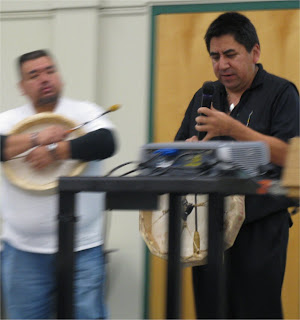
We began with some prayer and drumming from Scott Sam, of the Tsartlip Nation
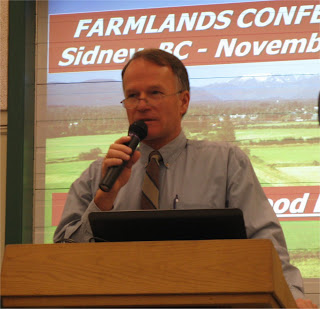
and then had a briefing from agrologist, farmer and BC Agriculture Council member Niels Holbek who had many interesting statistics to share, including some on farmland loss from the American Farmland Trust and the Farmland Preservation Research Project at the University of Guelph; and a local stat that came up several times through the day: 3% of the province’s land has both 80% of the population and 80% of the province’s gross farm receipts; not a good formula, observed someone, should there be a food security crisis, and the reason why there is so much competition for the same land for farming and housing.
We then broke into workshop sessions. I went to the one called The “Regional Food Basket” – Looking Beyond Farmlands, where we heard from two members of the Tsawout Nation, JB Williams and Earl Claxton Jr, who are working to restore first nation ties to traditional food sources and culture; observing that their populations had been devastated by the introduction of some foods and the loss of others. Lee Fuge of Food Roots talked about pocket markets and the distributors’ warehouse space they share with Share Organics and LifeCycles – but she then had to dash back to the kitchen to make sure our lunch wouldn’t be delayed. Melanie Sommerville of LifeCycles threw a few more numbers into the statistics pool: about 80% of Canadians now live in urban centres; 84.5% do so in BC, with just over 50% of the province’s population in the Victoria and Vancouver regions combined. There is a lot of interest in growing food nowadays – local seed selling has tripled this year – and there are many great examples of local urban agriculture projects – the Fruit Tree program, the Sharing Back Yards program, HomeGrown Gardens, Growing Schools and Spring Ridge Commons. Deb Heighway talked about SPIN farming in Victoria, and recommended the online resources which helped her join the 2000 others worldwide who are farming in other people’s under-used back yards.

In the afternoon I attended the From Ideas to Action: Farmers and Eaters Taking Action on Farmland Issues workshop led by David Mincey,
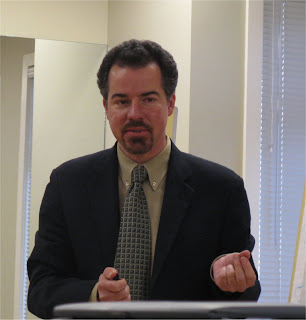
whose Camille‘s restaurant has long been known for its use of local products.

He was joined by fellow restauranteur and Island Chefs Cooperative member Ken Hueston, whose Smoken Bones Cookshack sounds worth a visit. He talked a bit about ‘food trending’ – which is a bit of a vicious cycle, where flavour-of-the-month foods get over-promoted at the expense of variety and honest experimentation by restaurants. A veteran protester (he’s only recently been allowed back into Safeway where 10 years ago he kicked over a display of Mexican corn when there was a local farm visible out the window) he made another good point to do with consumer demand: if we simply go on accepting only 5% local produce in our supermarkets, there’s no motivation on the part of supermarket buyers to change their sourcing. Next to him was David Chambers from Madrona Farm,
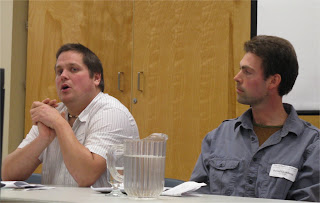
who spoke persuasively and from personal experience on the idea of channelling what farmland we have left through The Land Conservancy, so that it’s preserved for agricultural land in perpetuity, and not loosed to the whims of marketplace when farmers retire. His family farm is in the process of being bought by TLC who – if the needed funds are raised by July 2010 – can assure its future better than the Agricultural Land Reserve, which has proven itself unequal to the forces brought to bear by speculators and developers, and which protects relatively little of the most fertile land in the province, down here in the southern third where all the people want to live. In fact, as Niels Holbeck had told us at the start of the day, 90% of the land included now in the ALR is in the north of the province, and 70% of the lands excluded from the ALR are in the south.

Elmarie Roberts gave a primer on what community support for agricultural land can do, from her experience at Haliburton Farm, which is one chunk of land rescued from subdivision and property development by the local council, and protected by its nonprofit status. She’s one of six farmers who’ll be bringing in the veggies for thirty lucky supporters of their Community Supported Agriculture program. She said that in its purest form, a CSA helps to fund the farm’s operation by small scale investment by members of its community, and its members also work the land alongside the farmers. Here, though, it’s a pick-up scheme that provides a selection of seasonal fruits and vegetables to members, with volunteer work parties picking up the slack in weeding and field work. To her right is Lana Popham,
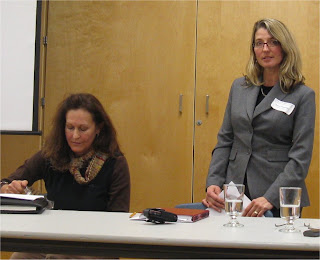
whose family runs the Barking Dog organic vineyard (and makes a rather special local gin!) and who is running for a seat in the next provincial election. David Cubberley
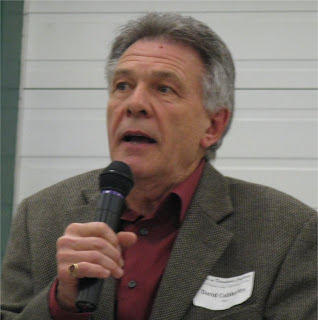
is already there (and put his money where his mouth was by laying down a significant donation to the Madrona Farm purchase fund). He talked about a few of the ALR properties that were topical at present: Panama Flats and Beckwith Farm, both owned by developers claiming to want to grow organic blueberries – I guess they’ve really turned a page in their career books – and he ran us through the political history of Haliburton’s acquisition; it had been owned by the water board who had been sorely tempted by developers who were only stopped by a group of active and well organised community members.

Corky Evans
gave the closing address.
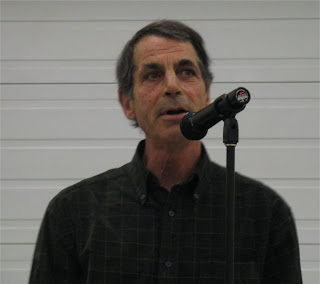
He’s retiring after 25 years in politics, including stints as provincial Agriculture minister and most recently Agriculture critic, and he wanted to share some insights into motivating politicians. He urged people to start showing up at council meetings, to organise into large enough audiences that politicians would have to come and answer to us: “We don’t listen to small groups of people who don’t all live in the same constituency.”

Food, he said, has never appeared on the agenda of any party meeting, any poll, any election in this province; there are no farmers elected to the legislature: and that is why there is no food policy in this province. Someone has to educate the politicians, he said, and a crisis point such as the one we’re in is the best time we’ll ever have to keep them focused on food as an issue; without focus, no action.

Words dear to my heart: “The drug of our time that dissipates focus is television. If you want to keep focused through the next election, don’t watch television, don’t get distracted by what the television stations tell you are the issues.”

He pointed out that BC pays less to support its farmers than Newfoundland; that it would cost $143 million to bring the province to an average rating, compared to other provinces; which amount is .4 of 1% of the annual budget, or $1 million less than tax breaks currently awarded by the government. He wasn’t talking subsidies, which he feels promote bad farmers and bad food, but there are all kinds of ways to support farming other than subsidies.

He said if we were looking for something to ask for in the next election, how about voting for the party that votes to end exclusions (from the ALR): but only if that party also supports farmers: “You can’t protect the land and abandon the people.”

And of course we ended with food: provided all day by the resourceful crew from Food Roots, including apples
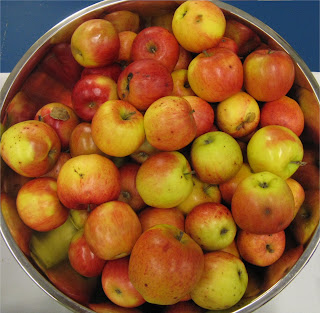
from the Fruit Tree Project. I had to skip out smartly so missed the wine and cheese which featured beverages from local brewers and vintners and Natural Pastures cheeses.
Not all Zoom & gloom

… though I was not happy to learn the airline on which I was booked to fly next Friday had gone the way of the fairies. Still, I’m rebooked now and looking forward to kissing the English ground once more in a week or so.

It’s been busy busy here – blackberries to jam, tomatoes racing against time to ripen for me before I leave, potatoes growing… berries! I know I am berry-obsessed but even I was a little startled to see these peeking out of the tater patch

but a little swift research told me potato berries are nothing to be alarmed about and are part of the natural cycle of spuds, but the plants are usually dug up before they fruit. The fruits can be saved for seed much like a tomato plant, apparently.

Other entertainments include a town hall meeting last week in Victoria, at the invitation of Victoria’s one and only NDP member of parliament, Denise Savoie

with NDP agriculture critic Alex Atamanenko, where a room packed to the ceiling with farmers and foodies

rocked and rolled and got excited about food security issues that affect an island like ours. There was a lot of talk about the potential effects of a food crisis on an island that imports 95% of its food, and about the very interesting observation that here, where 90% of the population say they garden, only 10% of those gardeners grow any food. I had also heard earlier that there are only 5 or 6 full time farmers on the Saanich Peninsula’s dozens of farms. One organic farmer, David Chambers

spoke forcefully on the desperate need to inspire and reward young aspiring farmers so that there is someone to carry the growing and farming knowledge into the next generation.

Writer/editor/farmer Tom Henry

was representing small farmers and talked about the difficulties small producers have in meeting the stringent requirements of national grocery chains: they are not growing in sufficient volume to be able to produce only those perfect fruits and vegetables picky shoppers have been encouraged to demand. Which is only one reason you don’t find more local food in your local supermarket.

Other speakers talked about community gardens and the need to introduce bylaws to allow the growing of food on every available piece of common land. As Carolyn Herriot said, if there’s a food crisis on the mainland, do you really think anyone’s going to stop and put food on a boat for us? A model of self-sufficiency (she achieved it in five years), her proposals include planting edible ornamentals, saving seeds, and acquiring the skills to grow food all year round.

Doing my small part this special year, here are my first ever spuds, and I think they’re beautiful:

Sunday saw a lot of rain, and a lunchtime visit to Merridale Cidery

where the wood fired oven was making its presence a little too obvious

right into the dining room. We didn’t pause for a tasting

as we’d done that a couple of years ago, but we did settle down for a lovely lamb burger

before the drive back over a more than misty Malahat.

Yesterday was dry and fine and perfect for driving to Duncan to visit the dentist. After which, a little lunch with Shirley in Maple Bay where her potentially prize-winning succulents were blooming

safely out of reach of the chief garden pest, looking a little thin we thought, as it trimmed the clover.