Kneading Conference West: day 1
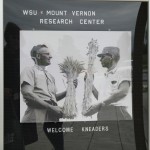 Drove to Mount Vernon, WA yesterday: a long day, but a gorgeous drive through lush northwest Washington. Headed to the first Kneading Conference West, which is modelled on Maine’s long established and hugely popular Kneading Conference. The idea is to bring together bakers, millers, farmers and interested bystanders like myself – writers, home bakers and researchers.
Arrived in time to take a stroll through the orchard and the many lovely gardens at the conference venue, the Mount Vernon Research & Education Centre – herb, vegetable, “water-wise”, Japanese and others. The land is owned by the university but orchard and gardens are managed by volunteers from the Master Gardener program. It was grey and spitty weather and the tables beneath tents in the field looked less than inviting, but we were cheered to learn these were for meals, and most of the workshops are indoors.
As was the first I attended: A Realistic Approach to Making Grain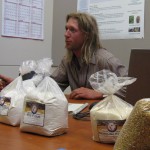 Work – An On-Farm Example. David Mostue turned out to be a riveting speaker: after graduating from architectural studies he returned to a 230 acre family farm and set to repairing and upgrading the century-old infrastructure and rethinking its purpose. It had been started as a pear orchard, but pears are one of the many crops that have become, as he put it, a casualty of international trade and scale: labour is cheaper elsewhere, and they’re a labour-intensive crop.
He spoke well enough to fix a couple of dozen of us to our seats in a very small room for about three hours. He covered the practical issues around making it as a grain farmer, whether large or small scale. He pointed out that grain is a great crop for poor soil and challenging conditions – his farm is in the Rogue Valley in southern Oregon, where temperatures average 95-100 degrees fahrenheit in the summer, and there’s a lot of heavy clay: this means that a crop like winter wheat (so named because it grows through the winter, but is harvested in summer) which can be planted in the fall is a better choice, since clay is sodden all winter and rock hard in summer, so has a small window for planting in spring.
He spoke about the qualities of different wheats – of particular interest to the bakers, and to farmers like him who need to understand the uses to which bakers put their flour. High gluten (protein) content flour, used in industrial baking, needs high soil fertility (often using artificial fertilizer). Artisanal bakers can cope with a lower protein flour (11-12%), because they use fermentation and long risings instead of the large quantities of dry yeast typical of high-speed industrial methods. Long risings, as Andrew Whitley will tell you, give the gluten time to develop and also make the bread more digestible. Lower protein still are soft white wheats (6-10%) that make pastry flour; or rye or alternative wheats (emmer, spelt et al) that are popular in artisanal baking. The highest gluten levels are in durum wheat (his clocked in at nearly 15% last year), used for semolina flour: Mostue had wanted to make his own whole grain pasta, which he found to have an unbeatable flavour and dense texture that made it more fliling than its commercial counterpart.
But of course nothing is simple, and Mostue explained the many other aspects of grain production – preparing the soil (he uses a five year rotation so that he can build soil fertility naturally, rather than using artificial fertilizer), seeding (we learned a lot about seed drills), weeding and harvesting (who knew combines could be so interesting?). He had progressive ideas about marketing the farm and its products, using social media but also building a market by getting people to understand and be interested in the farm; using innovative variations on standard CSA programs (including use of Survey Monkey for ordering), farm dinners… and plenty of wine (which they happen to produce on farm!)
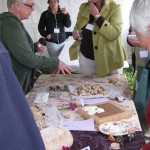 Reluctantly we left for the fruit garden and
 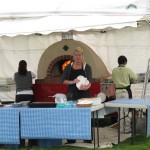 a cider and goat cheese tasting, followed by abundant pizzas fresh from the mobile wood-fired ovens, and salads of wheatberries and donated vegetables – carrots and beets – that were roasted in the ovens, followed in turn by seriously good cookies from the
 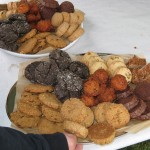 Breadfarm.


