Pumpkin season

For pottage and puddings and custards and pies,
Our pumpkins and parsnips are common supplies,
We have pumpkins at morning and pumpkins at noon,
If it were not for pumpkins we should be undoon.

–Pilgrim verse, circa 1630

Please please please don’t waste your pumpkin by just using it for a candle holder: it is an edible and excellent food! I weep annually in this country for the pumpkins rotting in the fields on November 1st, when, as we must still repeat and repeat, there are people starving elsewhere in the world. Instead of meditating on such bad behaviour, why not reward yourself with a good meal of pumpkins? Such cheap food at this time of year, and easy to freeze as a puree.

Make your own equivalent to canned pumpkin from scratch, by baking it (like most squash it’s watery, so needs to be baked: boiling or steaming it will get you into trouble). Seed and cut the pumpkin in half or big chunks, without peeling, and bake it cut side down on a lightly oiled baking sheet at 350 F for about 30-40 minutes, until the flesh is tender when poked with a fork. Cool until just warm. Scrape the pumpkin flesh from the peel. Either mash, or puree in small batches in a blender. Freeze it in 1 cup containers if you can’t cope with anything more after all that effort.

1 Comment


Edmonton’s Olive

Here I am in the place it all began for me, poetry-wise, reading last night at a series run in part by my first poetry teacher, Doug Barbour. I’ve had a great few days here catching up with old friends and eating well. My ritual visit to the Bul-Go-Gi House took place on my first night, on a table groaning under the weight of excellent bulgalbi (bbq ribs), delightfully garlicky wonton soup with rice cakes, a lavish serving of jap-chae noodles, and more. The second night’s good eating was the Sunday buffet at Maurya Palace: everything was good right down to the kheer. I had a wonderful and very beautiful Mimosa Salad (butter lettuce, shrimp and a few other things) at the Ninth Street Bistro, around the corner from one of my many former homes in this town and next door to Laurie Blakeman’s constituency office. Not to mention sharing a wall with my evening reading venue, Martini’s Bar & Grill.


With Bert Almon, one of my two poetry profs – both great mentors and supporters for many years – at the University of Alberta, who currently teaches a whole new generation of poets at the U of A.


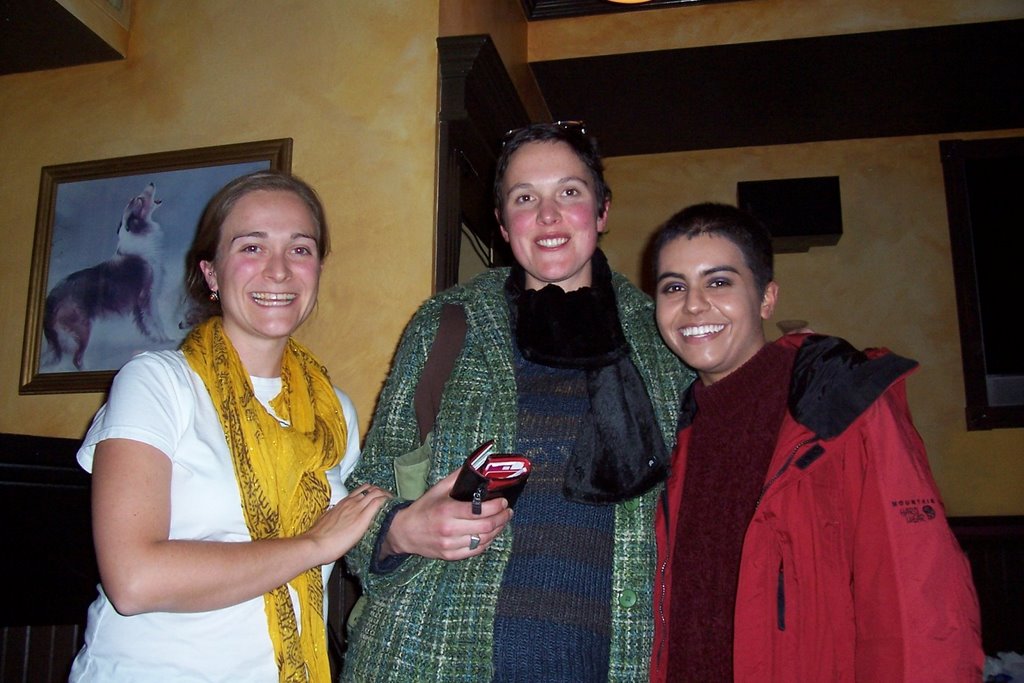
Three of the Olives: K.L. McKay, T.L. Cowan, Jenna Butler.


Edmonton luminaries: Ben, Laurie, Merna and Shirley.


K.L. McKay reads (in front of a picture that looks a lot like my dear old dog Sara) as the Olive wraps up another night at Martini’s Bar & Grill. In addition to working in the Olive Editorial Group, she publishes a broadsheet series, Spire which offers a subscription that will deliver 12 hand-stamped and numbered issues to your door.

Comments Off on Edmonton’s Olive


Sales talk for poets

Dear me, where does the time go. Since my last entry I’ve attended two poetry readings, one of them my own, and had a restful time up-island. Here then a few notes in a quasi-chronological order.

At the Black Stilt last Friday we were treated to Yvonne Blomer reading from her first collection from EkstasisA broken mirror, fallen leaf – telling us she has another two manuscripts up her sleeve already. A nicely done reading of a new poem for two voices with her husband, and a small lesson in Japanese contained in the rest of her reading from the new collection. And swiftly followed by veteran fellow reader Barry Dempster who said something that triggered another thought about That Book I’ve Been Reading, 101 Ways to Make Poems Sell.

Dempster spun one of his many entertaining tales around a recent media interview, in which he was asked “that question all poets dread: what’s your book about?” And indeed we do dread it, and indeed we could stop fearing the question, or being irked by it, and turn it to our advantage, as he did, by having an answer ready to pull from our back pocket. Chris Hamilton-Emery terms this the one-sentence hard sell (as distinct from the longer 30 second sell), and it’s standard sales & marketing stuff.

If you have time to engage your prospective buyer, readings booker, interviewer, you can expand it to the Thirty-Second Sell, about 90 words that will convince others to buy your book, because “people have very low attention spans and, where consumption is concerned, great filters for working out what does gain their interest and, eventually, their money and time.” In other words, figure out what your USP is and come up with a short speech to explain it.

Meanwhile, back on Vancouver Island, on Wednesday we headed north and stopped in Lantzville to collect some books from Oolichan. Up the road and across the street we spotted a sign promising local food at the Black Dog Cafe and headed inside for some sustenance. There was a roasted garlic and tomato soup served with a dollop of pesto: sublime. And some potato and pesto quiche which was less sublime but did the trick. The lemon meringue pie we passed on our way out the door looked wonderful but we had to sprint on up the road to our destination at Fanny Bay. We dined out that night at a place we hadn’t tried before, the Monte Christo in Courtenay. The food was a bit on the unremarkable side – they seemed to specialise in a few too many cuisines to be master of any – but the setting was good and on a sunny day would have been gorgeous.

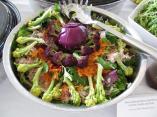
Day two we headed to the Kingfisher spa for necessary repairs to our nerves and everything else. I declined to buy the six or was it nine quality skincare products they specially selected just for my problem skin, and after a steam and a wallow we finished the job with an excellent lunch in the restaurant there. Peg had the foresight to order a bowl of the Indonesian vegetable soup for us to share – we waded into a fantastic lightly spiced pureed vegetable combination that would certainly have been too much for us single-handed with all that followed. My Ahi Tuna Salad was divine – nicely seared and seasoned and served on mushrooms and artichokes, prettily ornamented with fried lotus root rounds and cherry tomatoes. I was so enthused I ordered the chocolate mousse which was perked up with nuggets of chocolate. Wished I’d brought my camera when Judy’s tower of brulee arrived – a bit of a misnomer but impressive, a brulee-like substance larded with ginger and mango and then arranged in bricks with a crunchy mortise of what looked like brandy snaps.

Last night I read with a delightful Newfoundlander poet and film maker, Marian Frances White to a large and largely unknown (to me) crowd. With Mocambopo’s move to the Black Stilt has come a new, young and enthusiastic following, and you have to arrive very early for either a seat or a place at the open mic. As it should be. Wendy Morton officiated, and proclaimed the success of the latest round of Random Acts of Poetry.

Comments Off on Sales talk for poets


Spices of wife, especially cardamom

As I was cleaning out my spice drawer — ok, thinking about cleaning out my spice drawer — I made an ill-advised visit to my computer and happened upon a Blogcrictics posting about the health benefits of spices. Almost shocking to come across an article like this that doesn’t mention turmeric.

Of course the king of spices himself must be Michael Ondaatje for his enduringly fragrant poem, The Cinnamon Peeler, featuring another most healthful spice.

The blogger does go on about cardamom though, which I’m definitely in favour of. I love it in kheer and I have a recipe for Cardamom Lime Cheesecake which was an old favourite (- just think of the comprehensive nutritional benefit you get from that one: vitamin C from the limes, calcium from the dairy, protein from the eggs, and eternal life from the cardamom!)

Cardamom Lime Cheesecake (8-10 servings)
2 tbsp butter, melted
1 tbsp sugar
1-1/4 c graham crumbs
2 envelopes gelatin
1-1/4 c sugar
1 c milk
grated peel of 3 limes
1-8oz pkg cream cheese
2 c large curd cottage cheese
1/3 c lime juice
1 c whipping cream, whipped
3/4 tsp cardamom

  • Press butter, 1 tbsp sugar and graham crumbs into a 9″ springform pan and bake 5 minutes at 350f. Set aside.
  • Combine gelatin and sugar in a double boiler and stir in milk and eggs. Cook over boiling water, stirring until mixture starts to thicken (15 minutes or so). Remove from heat, stir in peel and chill mixture until syrupy.
  • Whirl smooth in a food processor or blender the cream cheese, cottage cheese, lime juice and cardamom. Stir in the gelatin mixture and fold in whipped cream. Pour into springform and chill at least 4 hours.
3 Comments


Hazelnuts and poetry reviews

At the Feast of Fields the other weekend, we noticed a bowl of hazelnuts at the Dunsmuir Lodge stand. We paused, we tasted, we tasted again. They were amazing! We asked about them and were told they had been shelled the day before, then blanched in water, dusted with icing sugar and deep fried. Spectacular. Another (get thee behind me Satan) reason I’m so glad I don’t own a deep fryer…

I have been reading a book mentioned earlier on this blog, 101 Ways to Sell Poems and was struck by the sections (they are several) to do with reviewing. In my experience writers here spend almost as much time uselessly deploring the state of reviewing as dissing our teeny tiny publishers for not being more powerful marketing machines. This book answers both questions with the suggestion we just get off our duffs and wade in there to help.

Reviewing, as Chris Hamilton-Emery points out, needn’t be limited to the already limited space in newspapers. We can be both reviewers and reviewees, and both positions are helpful to our own literary presence. We have the power of the net behind us. Blogs, of course, are good places to air our allegiances to books that impress us (and hey — what am I doing now?); so are online bookseller review spaces (e.g. Amazon.ca); online journals and e-zines, listservs, our own web pages are also good places to do this. And there’s nothing to stop us from starting another online reviewing journal anytime we want. Implicit in his discussion is the suggestion not to waste time and newsprint/webspace trashing other writers’ works: you do more good by promoting your interests through positive action.

Some of the many remarks I found noteworthy came from the publisher side of Hamilton-Emery’s brain, where he addresses that question we get from our publishers: to whom should we send review copies? Hamilton-Emery tells you to stop and think carefully about that one, because it serves nobody’s interests to simply send copies to every newspaper and journal around. Profit margins on poetry are low enough, he observes; the last favour you want to do yourself and your publisher is to “flush their profits down the drain [by sending] too many unsolicited review copies to the benighted leagues of literary editors.” He urges poets to “Think of all the junk mail you have ever received and how delighted you were in opening it all up and reading it.”

He assures us that there is nothing untoward in cultivating reviewers to talk about our books. Other people are already doing this. All you are doing is helping out the journal by focusing their ability to match the right reviewer to the right book, instead of leaving them to wade through the accumulations and randomly assign, let’s say, absolutely the wrong book to the wrong reviewer.

Comments Off on Hazelnuts and poetry reviews